
TL;DR
TL;DR: Replace a forklift hydraulic cylinder in 6 steps: diagnose the leak or drift, decide rebuild-vs-replace (seal kit ~$20-150; new cylinder ~$500-2,000+), lock out the truck and depressurize, remove the cylinder, install the new one with fresh seals and correct torque, then bleed, cycle, and load-test. Most failures are the seal package or a scored chrome rod – the barrel rarely wears out.
Key Takeaways
- The barrel rarely fails – check the rod for scoring and the rod-gland seal for leaks first
- Reseal/rebuild is the economical fix; a new cylinder is warranted for scored/pitted rods or obsolete models
- Lock out the truck and fully relieve hydraulic pressure before touching any fitting – pressurized cylinders are a crushing hazard
- Match the OEM part number and serial to your truck before ordering – lift, tilt, and mast cylinders differ
- Warranty tiers matter: Kingstream OEM genuine 12-month, OEM-equivalent 6-month, aftermarket 3-month
- Always bleed the circuit and cycle the mast through full travel before returning the truck to service
Table of Contents
- Key Takeaways
- Abstract
- Before You Start: Tools, Skill Level, and Safety Rules
- Step 1: Diagnose the Failure – Is It Really the Cylinder?
- Step 2: Decide Rebuild vs Replace – With Real Warranty Tiers
- Step 3: Prepare the Forklift and Lock Out Hydraulic Pressure
- Step 4: Remove the Hydraulic Lift Cylinder
- Step 5: Install the New Cylinder and Seals
- Step 6: Bleed, Cycle, and Test the Cylinder
- Troubleshooting: 5 Problems After a Cylinder Replacement
- When to Call a Professional (and When to Rebuild Instead)
- Frequently Asked Questions
- Conclusion
- References
Abstract
Most forklift hydraulic cylinder replacement jobs turn out to be reseal or rebuild work, not a full swap. The steel barrel rarely fails; the seal package and the chrome piston rod do.
A fleet maintenance manager facing a leaking lift cylinder has one real question: reseal, rebuild, or replace? This guide walks the full path, from diagnosis through the rebuild-versus-replace decision to the six-step remove and install, then bleeding and load-testing the finished assembly. It assumes a mechanic comfortable with mast work, hydraulic fittings, and lockout/tagout, not a complete novice. If you’re deciding whether to skip the shop and do a forklift hydraulic cylinder replacement yourself, this is the sequence to follow.
The numbers favor the rebuild in most cases. A seal kit runs roughly $20 to $150, while a new lift cylinder costs $500 to $2,000 or more. Replacing the seal package first, before condemning the barrel, is the cheaper call.
Before You Start: Tools, Skill Level, and Safety Rules
Get the prep right before any forklift hydraulic cylinder replacement. Plan basic mechanical work with torque-spec discipline, and gather every tool below before you drain a drop of oil.
What you will need
- Wrenches and a torque wrench sized to the barrel and clevis pins
- A non-metallic seal pick, so the rod gland and piston grooves aren’t scored
- A clean drain pan, absorbent mats, and lint-free rags for hydraulic oil
- The correct seal kit, verified against the cylinder part number first
Safety rules that are not optional
Lower the mast and forks to the ground, shut the truck down, and block or crib the carriage before touching a fitting. OSHA 29 CFR 1910.178 covers powered-industrial-truck inspection and safe operation, including hydraulic leaks and mast integrity (OSHA, n.d.). ISO 4413 adds the lockout and depressurization rules you can’t skip (ISO, 2010). A cylinder still holding pressure acts like a loaded spring; bleed it to zero first.
A self-repair is safe only when the truck is locked out and the circuit fully depressurized; skip that and the job isn’t worth the risk. On a typical sit-down counterbalance truck, one lift cylinder remove-and-install runs 2 to 4 hours for a mechanic with basic skills and a torque wrench.
Step 1: Diagnose the Failure – Is It Really the Cylinder?
A leaking rod gland or a mast that drifts under load points to the lift cylinder, not the pump. Before you commit to a forklift hydraulic cylinder replacement, check whether the mast settles under load and whether oil shows on the chrome rod.
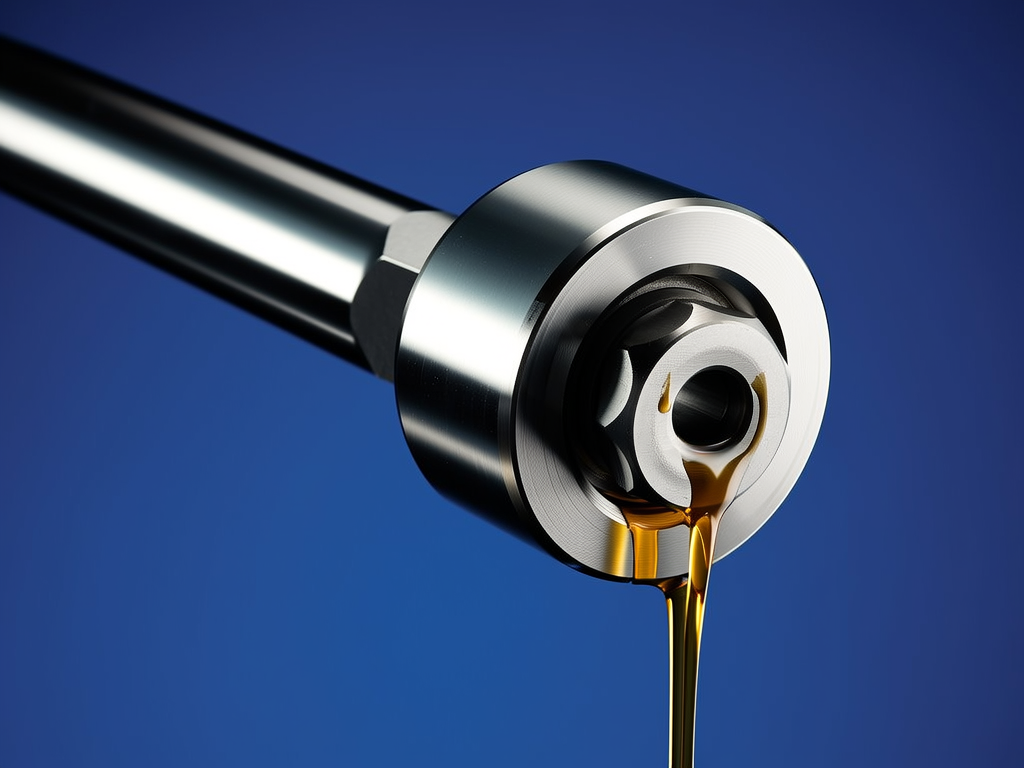
Signs of a failing lift cylinder
Most lift cylinder faults surface in a predictable order. Wet oil on the chrome rod means the rod-gland seal is bypassing. A mast that droops under a raised load signals an internal leak past the piston seal.
- Rod-gland leak. Oil weeping from the rod top, with a wet gland or pooled oil on the carriage.
- Mast drift under load. Forks creep down with a load raised, control valve closed.
- Slow or uneven lift. One side of the carriage rises faster, or lift slows under load.
- Jerky motion. The mast stutters on the way up.
- Audible squeal. A high-pitched whine as oil bypasses a hardened seal.
How to confirm it is the cylinder and not the valve
Run a leakdown check. If drift tracks load position and the rod gland is wet, the cylinder is the suspect. If the mast creeps with a dry gland, the valve, relief, or pump is the culprit, and a forklift hydraulic cylinder replacement won’t fix it.
A common mistake is ordering a cylinder before confirming the leak source; contrary to appearances, a dry rod gland points to the valve, not the cylinder.
Per an IEEE Access state-of-the-art review, seal degradation and rod-condition loss are the dominant failure modes of hydraulic cylinders, and the barrel itself rarely fails (IEEE Access, 2021).
In hydraulic practice, those seal failures trace to 3 root causes: contamination, misalignment, and pressure spikes. Contaminated oil wears the rod and gland, a misaligned mast loads one side of the seal, and a pressure spike forces past a hardened lip. Confirming which one decides the fix: flush, reseal, or replace.
With the cylinder confirmed, Step 2 weighs a forklift hydraulic cylinder replacement against a reseal.
Step 2: Decide Rebuild vs Replace – With Real Warranty Tiers
The barrel of a forklift hydraulic cylinder rarely fails; the seal package and chrome rod do. That asymmetry is why most jobs are a reseal, not a forklift hydraulic cylinder replacement.
When a seal kit is enough
A weeping rod gland, a clean chrome rod, or an internal leak that surfaces as mast drift all point to a reseal. A standard bore and an in-stock kit make reseal the default call.
When the rod forces a new cylinder
A scored, pitted, or bent chrome rod defeats any new seal, and so does heavy corrosion or welded barrel damage. On an obsolete model with no kit listed, forklift hydraulic cylinder replacement is the only path. For a doosan forklift hydraulic cylinder, verify the part number against the Daewoo/Doosan cross-reference first.
Warranty tiers and what they mean
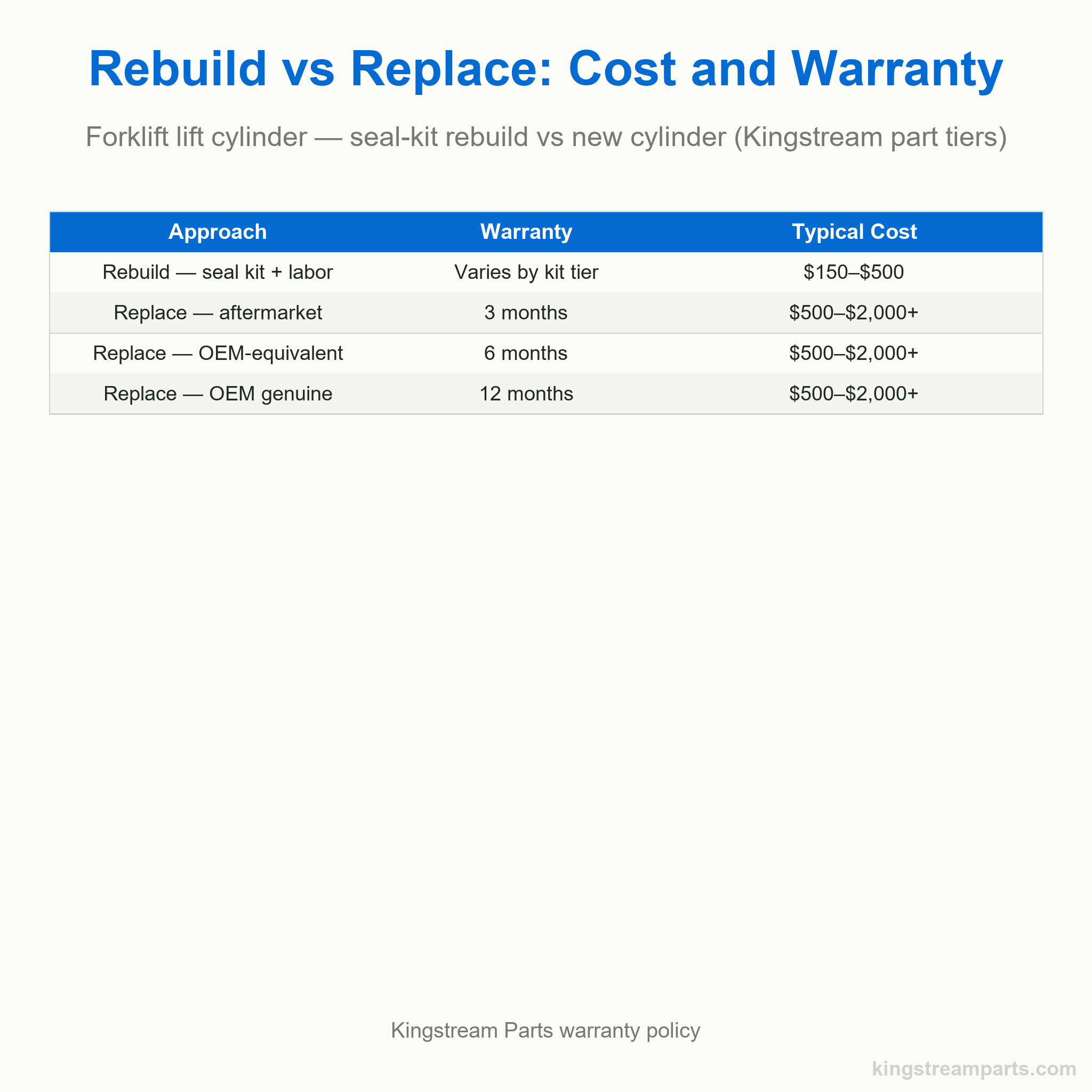
Kingstream tiers warranty by parts quality: OEM genuine carries 12 months, OEM-equivalent 6, aftermarket 3. A rebuild’s warranty follows the seal kit tier you buy; a replacement’s follows the cylinder. We stock the single-acting lift cylinder, seal kits, and 5-ton telescopic cylinders in all three tiers.
| Path | Typical cost | Kingstream warranty |
|---|---|---|
| Rebuild (seal kit + labor) | $20-$150 kit + $150-$500 labor | Seal kit tier: 3, 6, or 12 months |
| Replace, aftermarket cylinder | $500-$2,000+ | 3-month |
| Replace, OEM-equivalent cylinder | $500-$2,000+ | 6-month |
| Replace, OEM genuine cylinder | $500-$2,000+ | 12-month |
We compared the three tiers in the table above, and the trade-off is plain: a longer warranty tracks a higher parts grade, so match the tier to how long the truck will stay in service.
The economics are stark: a seal kit runs $20 to $150, shop labor adds $150 to $500, and a new mast or lift cylinder starts near $500 and climbs past $2,000. Most fleets reseal first and reserve forklift hydraulic cylinder replacement for scored or pitted rods.
Where we can help
The deciding step in this guide is sourcing the part that matches the rod condition you measured, not the cheapest line. Kingstream stocks the seal kits, single-acting lift cylinders, and 5-ton telescopic cylinders used in this repair across all three warranty tiers, so the coverage can match how long the truck stays in service. Check part availability with your truck’s OEM part number and serial.
Step 3: Prepare the Forklift and Lock Out Hydraulic Pressure
Neutralize the hydraulic system
Lower the mast and forks to the ground, then shut the truck down completely. On an electric truck, disconnect the battery or switch it to service mode. On an engine truck, remove the key and chock the wheels. Cycle the lift and tilt valves several times with the power off to bleed stored pressure out of the lines. A cylinder that still holds pressure can spray fluid or shift the mast when you loosen the first fitting, which is why depressurization comes before any wrench work in a forklift hydraulic cylinder replacement.
Physical lockout and blocking
Even with the mast fully lowered, the mast and forks carry real weight. Block or crib under both before you reach for a fitting. Hang a lockout tag on the ignition so no one can operate the truck while you’re underneath it.
Warning: Tag out the truck and block the mast before touching a fitting. Residual pressure and mast weight stay crushing hazards even after the mast is lowered.
OSHA 29 CFR 1910.178 makes lockout/tagout mandatory before servicing powered industrial trucks, and ISO 4413:2010 treats residual hydraulic pressure as a live hazard that must be released and verified before disassembly (OSHA, n.d.; ISO, 2010). A lowered mast removes the visible risk, not the stored energy, and skipping this step is the most common way a forklift hydraulic cylinder replacement turns dangerous.
Step 4: Remove the Hydraulic Lift Cylinder
To remove a lift cylinder, place a catch pan under the fittings, disconnect and cap both hoses, then pull the rod-end clevis pin and the barrel-end pin in that order. Support the cylinder before the last pin clears, and lower it so the chrome rod never touches the mast or carriage.
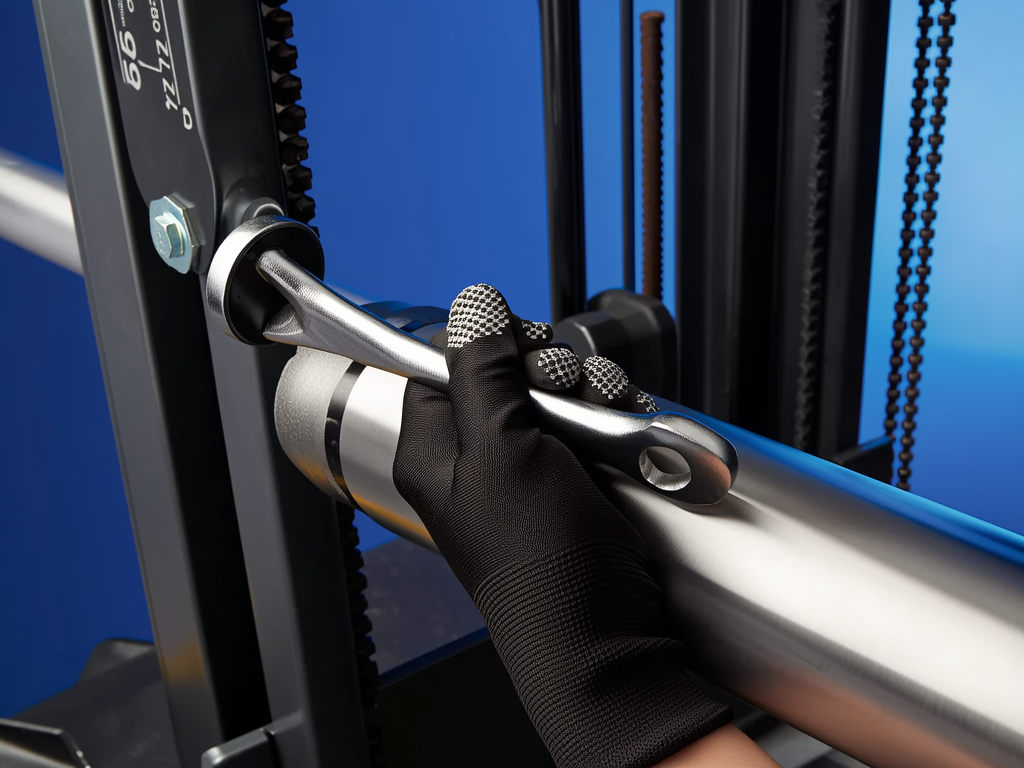
Disconnect hoses and cap the ports
Set a catch container under the fittings. Disconnect the hoses, cap each port the moment it opens, and label every hose to its port. Mismatched reconnection causes post-repair trouble after a forklift hydraulic cylinder replacement, and an uncapped port is an open path for debris that will score the new rod and seals.
Unpin the cylinder from mast and carriage
Pull the rod-end clevis pin from the carriage, then the barrel-end pin at the mast. Before that last pin clears, the full weight of a mast lift cylinder is on you, and it drops the instant it’s freed. Support the barrel, then guide it down so the chrome rod contacts nothing.
The removal order for a forklift hydraulic cylinder replacement:
- Cap and label every port and hose before the pins.
- Pull the rod-end clevis pin, then the barrel-end pin at the mast.
- Support the barrel before the last pin clears.
- Lower it straight down, chrome rod clear of mast and floor.
In a forklift hydraulic cylinder replacement, the two failure points are contamination and rod damage. Uncapped ports let debris into the hydraulic circuit, which scores the new seals on reinstall; an unsupported barrel falls and bends the chrome rod. Capping ports and supporting the weight avoids both.
A mast lift cylinder hangs from 2 pins, the rod-end clevis at the carriage and the barrel-end at the mast. Disconnect and cap both hoses first, pull the clevis pin, then the barrel pin, and support the barrel before the last pin clears. Capping ports and bearing the weight keep the chrome rod clean and straight.
Step 5: Install the New Cylinder and Seals
Installation is where a forklift hydraulic cylinder replacement either seats cleanly or destroys its own seals in the first week.
A cylinder that shares a bore size is not a drop-in fit. Port orientation, mount style, rod diameter, and stroke must match the mast, or the rod binds and the hoses won’t reach. For a Doosan truck, confirm the part against the Daewoo-to-Doosan cross-reference before you lift it in.
Position, pin, and torque
Set the cylinder rod-up and lower it into the mast channels. Install the barrel-end pin first; it carries the weight while you align the rod end. Then insert the rod-end clevis pin and torque both rod-end and barrel-end fasteners to the manufacturer’s spec with a torque wrench. Skip the torque value and the pins walk or egg the bore under load.
Seal and O-ring installation
Fit fresh seals and O-rings, each lubricated with clean hydraulic oil before it goes in. Reconnect the hoses to the labeled ports hand-tight first, then snug them down without cross-threading. Contamination is where these installs quietly fail: a single nick on a new seal, from a dry ring or a dirty rod, leaks on the first mast cycle.
Before you cycle the mast for the first bleed, run this checklist:
- Confirm the OEM part number and rod-up orientation before lifting
- Torque rod-end and barrel-end fasteners to spec
- Lube fresh seals and O-rings with clean hydraulic oil
- Reconnect hoses to the labeled ports without cross-threading
A lift cylinder installs in a 2-pin sequence: barrel-end pin first to carry the weight, then the rod-end clevis pin, both torqued to the manufacturer’s spec. Fresh seals and O-rings go in lubricated with clean hydraulic oil, and a single nick from a dry ring leaks on the first mast cycle.
Step 6: Bleed, Cycle, and Test the Cylinder
After a forklift hydraulic cylinder replacement, top up the fluid to the full mark and run the mast through full travel several times to purge trapped air. Then hold a rated-capacity load and confirm a smooth, even lift with no drift.
Prime and bleed the circuit
Air in the circuit reads as a spongy, jerky lift. Cycle the mast through full travel three to five times with no load; each pass returns trapped air to the reservoir.
Cycle, leak-check, and load-test
Cycle again, then hold a rated-capacity load and verify no drift. A weeping rod gland means the seal did not seat, so return to Step 5.
- Top up fluid to the full mark
- Cycle full travel, no load, three to five times
- Check the rod gland for weeping
- Verify smooth, even lift, no sponginess
- Hold a rated-capacity load and confirm no drift
Skipping the bleed is the top cause of a truck that lifts fine in the shop and jerks on the floor.
A trained mechanic completes a single forklift hydraulic cylinder replacement, including bleed, cycle, and load test, in two to four hours. OSHA 1910.178 inspection practice calls for the rated-capacity load test, and a clean no-drift hold, before the truck returns to service (OSHA, n.d.).
Troubleshooting: 5 Problems After a Cylinder Replacement
A fresh cylinder rarely causes the fault. When a lift misbehaves right after a forklift hydraulic cylinder replacement, look at the install before you blame the part. Work down the table top to bottom.
Five symptoms cover nearly every post-install fault you will encounter.
| Symptom | Likely cause | Fix |
|---|---|---|
| Mast won’t lift | Air trapped, or a pump/relief-valve issue | Bleed the circuit fully, check the relief valve, verify pump flow |
| Leak at the rod gland | Seal installed wrong, nicked, or wrong size | Replace the rod gland seal and inspect the rod surface |
| Jerky or spongy movement | Trapped air in the circuit | Cycle the mast full travel several times, then top up fluid |
| Cylinder drifts under load | Internal leak past the piston seal, or a valve seat | Reseal the cylinder, check the control valve |
| Squeal or whine | Low fluid, air, or a worn pump | Top up, bleed, and inspect the pump |
If a symptom returns after the fix, check the control valve and pump before condemning the barrel.
5 faults after a forklift hydraulic cylinder replacement trace to 2 root causes: a skipped bleed or a nicked seal. The bleed step produces the spongy feel and the drift; rod gland leaks and a whine usually mean a seal went in dry. Lubricate every seal with hydraulic oil before the rod enters the barrel.
If the mast is telescopic or spring-loaded, or a symptom persists after the fixes above, the next section walks through when to call a professional.
When to Call a Professional (and When to Rebuild Instead)
Most mast cylinder jobs are reseal/rebuild work, not full forklift hydraulic cylinder replacement. A few edge cases push the job past a home shop: telescopic and high-capacity mast cylinders use multi-stage assemblies needing fixtures and safe handling; spring-loaded masts store energy even after pressure release, and LPG or diesel trucks add a fuel-system hazard; corroded or seized pins that need cutting are the last stop point.
Warning: Stop and call a pro for a spring-loaded mast, a multi-stage cylinder, an LPG or diesel truck, or a pin that needs cutting. Stored mast energy and fuel lines raise the stakes.
For warranty-sensitive fleet repairs, a documented rebuild protects coverage better than a rushed field swap. The deciding factor is the seal kit, not wrenching skill: a shop rebuild with the correct kit and clean handling can outlast a hurried replacement. Sourcing the right single-acting lift cylinder, seal kit, or telescopic cylinder up front matters most.
4 situations push a cylinder job past a home shop: multi-stage telescopic or high-capacity masts needing fixtures, spring-loaded masts that store energy after pressure release, LPG or diesel fuel systems, and corroded pins that need cutting. Call a professional at any of them before the wrenches come out.
Frequently Asked Questions
How much does it cost to replace a forklift hydraulic cylinder?
A reseal or rebuild runs roughly $170 to $650 (a $20-$150 seal kit plus $150-$500 labor), while a full forklift hydraulic cylinder replacement lands between $500 and $2,000 or more. Kingstream warranty tiers track part quality: OEM genuine carries 12 months, OEM-equivalent 6 months, and aftermarket 3 months.
How do I know if my forklift hydraulic cylinder is bad?
Watch for a rod-gland leak, mast drift under load, slow or uneven lift, jerky motion, or a squeal.
Can you rebuild a forklift hydraulic cylinder instead of replacing it?
Usually, yes. The barrel rarely fails; the seal package and chrome rod do. Reseal a clean rod; replace a scored or obsolete rod.
What causes a forklift hydraulic cylinder to leak?
A worn seal package, contamination, misalignment, or pressure spikes. Contamination is the leading seal-killer.
How long does it take to replace a forklift lift cylinder?
A trained mechanic needs about 2 to 4 hours for a single lift cylinder, including bleed and load test.
Is it safe to replace a forklift hydraulic cylinder yourself?
Yes, with lockout/tagout, full depressurization, and cribbing per OSHA 1910.178. Without those, no.
What is the difference between a lift cylinder and a tilt cylinder?
A lift cylinder raises and lowers the mast. A tilt cylinder tilts the mast and forks forward or back.
Conclusion
Forklift hydraulic cylinder replacement starts with diagnosis, not a parts order. A clean chrome rod usually calls for a reseal or rebuild. A scored, pitted, or obsolete rod calls for replacing the assembly. Lock out and depressurize first, then bleed and load-test before the truck returns to duty.
Kingstream’s warranty tiers track parts grade: 12 months on OEM genuine, 6 on OEM-equivalent, and 3 on aftermarket. The spread is the point. A cylinder the truck will keep for years earns the longer coverage; a short-term replacement does not.
Per the diagnosis-first rule, reseal a clean rod and replace a scored one; the barrel itself rarely fails.
That rule is where sourcing begins. Pick the part to match the rod condition you measured rather than the cheapest line, and keep the truck out of service until it holds rated capacity without drift.
References
- Occupational Safety and Health Administration. (n.d.). 29 CFR 1910.178, Powered industrial trucks. U.S. Department of Labor. https://www.osha.gov/laws-regs/regulations/standardnumber/1910/1910.178
- International Organization for Standardization. (2010). ISO 4413:2010, Hydraulic fluid power – General rules and safety requirements for systems and their components.
- Failure monitoring and predictive maintenance of hydraulic cylinder: A state-of-the-art review. (2021). IEEE Access, 9. https://ieeexplore.ieee.org/document/9329070
Last reviewed and updated: August 2026. Author: Kingstream team. For tailored guidance, contact our team.