
TL;DR
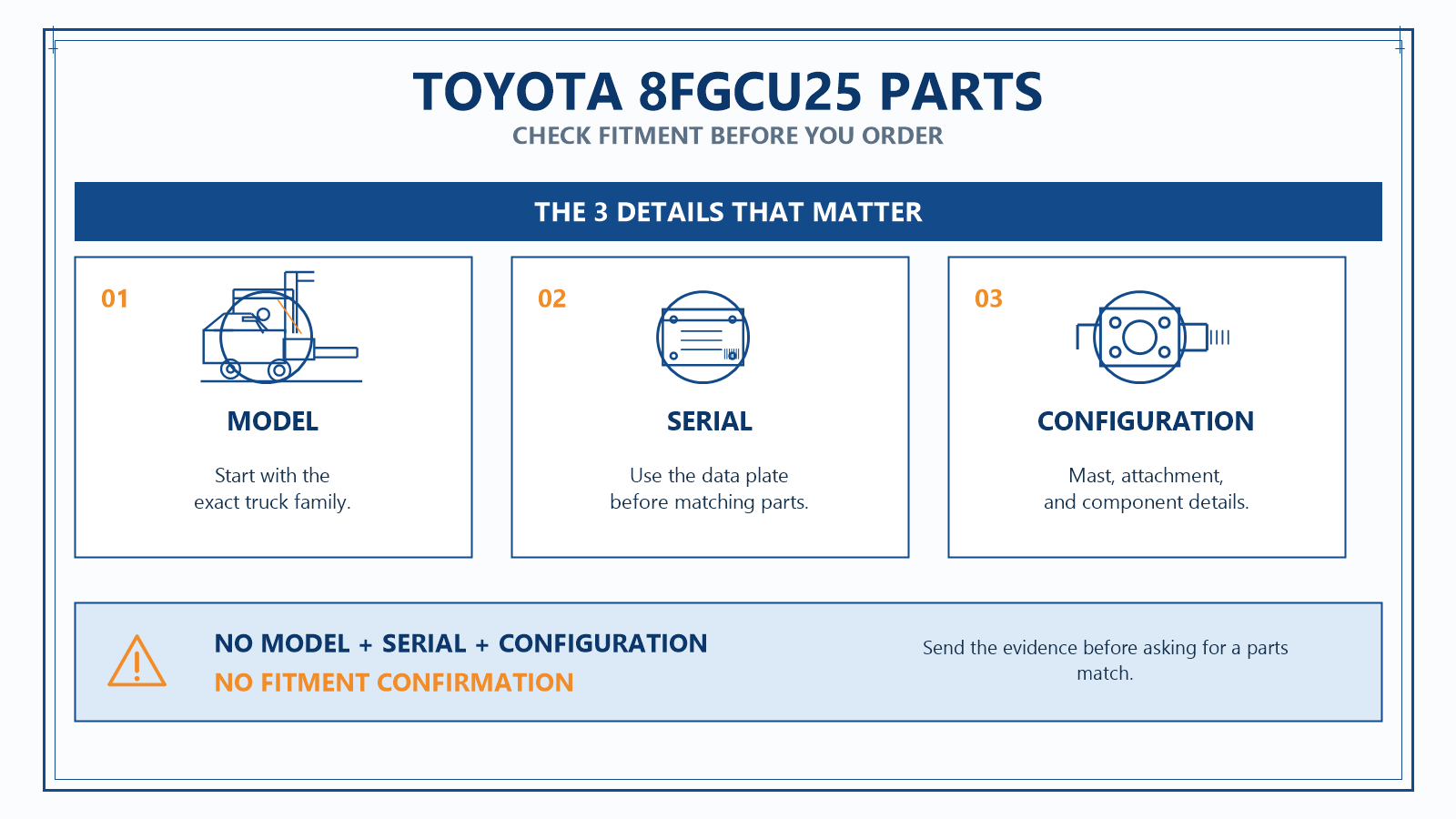
Do not order a Toyota 8FGCU25 part from the model code alone. Record the full data plate, serial number, configuration details, old part number, and photos, then request a fitment check before payment.
Why 8FGCU25 parts fitment starts with identification
No, the Toyota 8FGCU25 model code alone is not enough to confirm that a replacement part fits a particular truck. Use it as the starting point, then add the truck’s serial number, configuration details, and evidence from the removed component before requesting a quote. (Toyota Material Handling, n.d.)
The model code helps narrow the search to the right Toyota forklift family, but it does not by itself settle every production range, market, option, or revision question. Treat “fits 8FGCU25” as a screening statement until the model-and-serial combination and the component details have been checked.
This guide is therefore about preparing a quote-ready Toyota forklift 8FGCU25 parts request. It is not a universal parts catalog, a promise that every listed component fits every 8FGCU25, or a substitute for the final fitment confirmation.
The Toyota 8FGCU25 parts decision framework
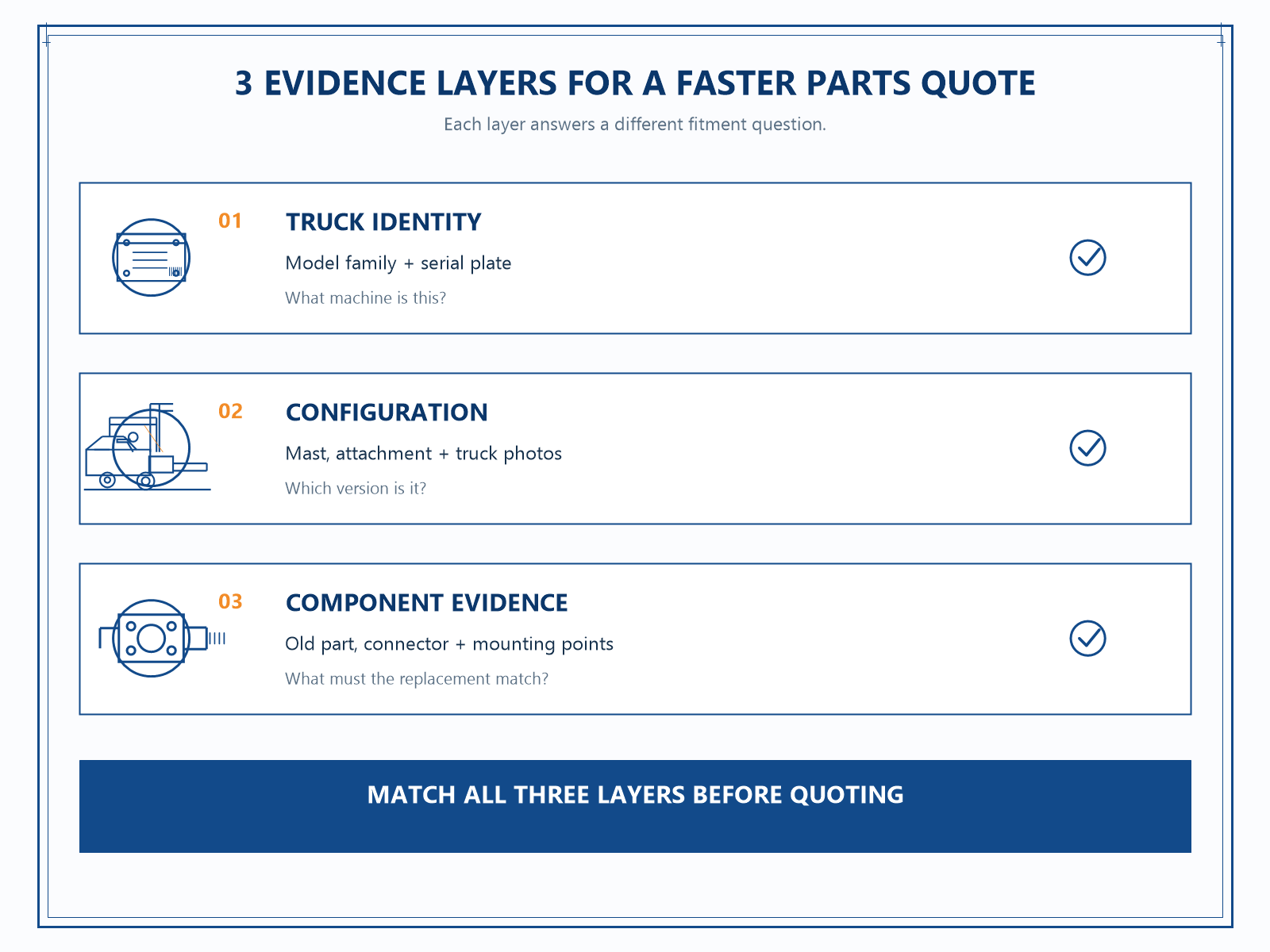
Before searching a Toyota 8FGCU25 parts catalog, build the request in three evidence layers. This makes it easier for a supplier or technician to identify what is known, what still needs to be measured, and what must be confirmed against a parts source.
Model and serial
Start with a clear photo of the data plate and transcribe the model number exactly as shown. Record the serial number separately, including letters, numbers, and any punctuation that may appear. Do not silently correct an unclear character. Mark it as unreadable and request a better photo if necessary. (Toyota Material Handling, n.d.)
Configuration and component
Add the details that can change the part path: mast and attachment arrangement, fuel or voltage information, capacity and tire information, and the system that needs service. For the removed component, include the old part number if visible, photos of labels and mounting points, connector or hose details, and quantity. These are buyer-supplied inputs, not universal specifications for every Toyota 8FGCU25.
Buyer evidence versus supplier confirmation
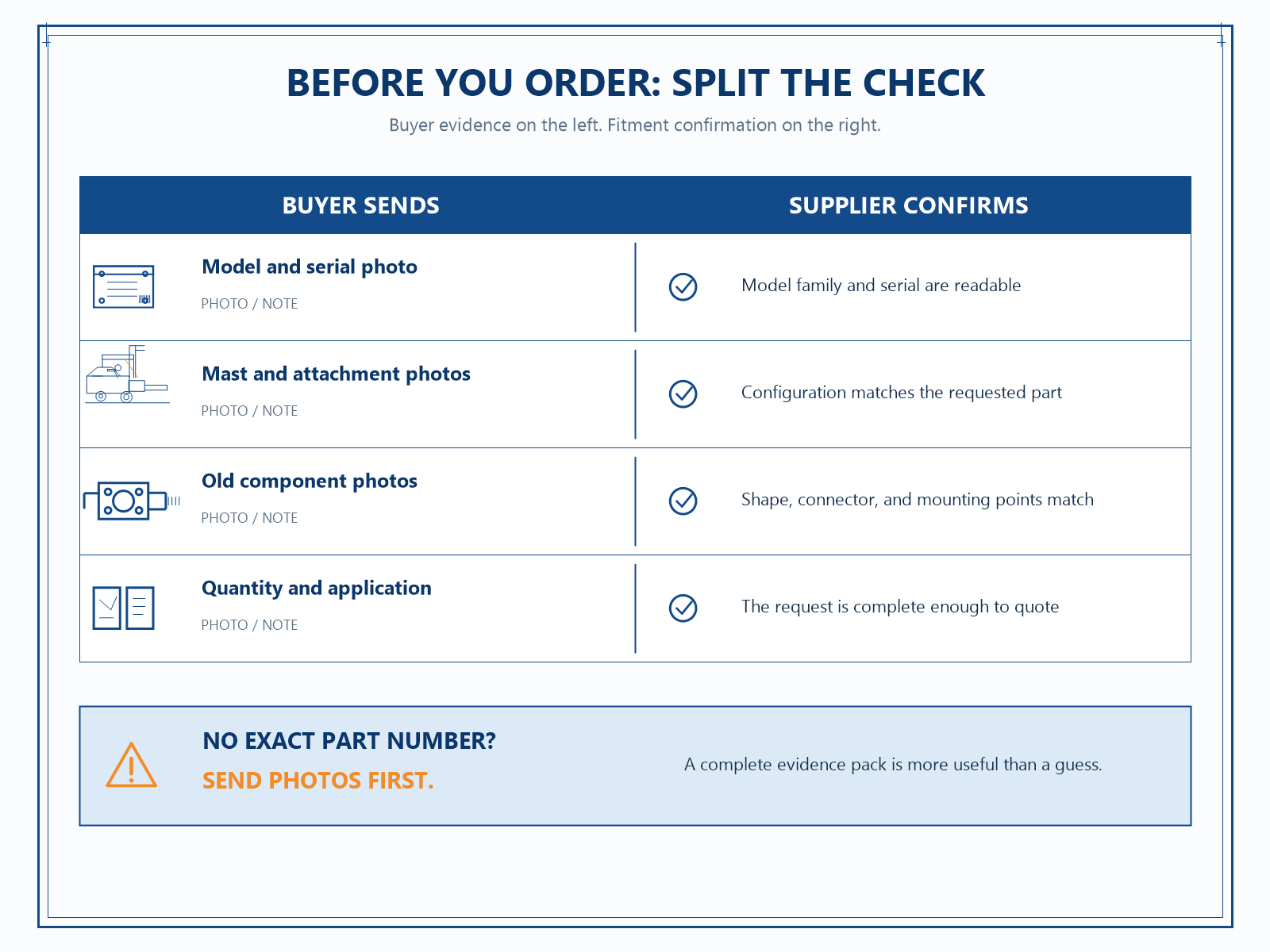
Your responsibility is to identify the truck and describe the part clearly. The supplier’s responsibility at quote stage is to check the supplied information against the applicable catalog, diagram, position, revision, or supersession record and to state what remains uncertain. (Toyota Material Handling, n.d.)
Use case 1: routine Toyota 8FGCU25 service parts
For a routine maintenance request, describe the service system and send the truck identity first. Categories such as filters, belts, cooling items, and other scheduled-service components can help a supplier understand the request, but a category name is not a confirmed part number.
Include:
- Exact model and serial number, preferably from the data plate.
- The old part number or a clear photo of its label, if available.
- The system and component name, requested quantity, and whether the part is for one truck or a small fleet.
- Photos when the item has a visible connector, unusual mounting detail, or multiple possible versions.
Keep symptoms separate from identification. For example, an overheating complaint may justify checking the cooling system, but it does not prove that one particular cooling component is the failed part. Ask for a fitment review before payment, especially when the old number is missing or unreadable.
Talk to a specialist
For a Toyota 8FGCU25 parts request, share the model and serial details from this checklist with a single-source forklift parts supplier covering 14 major brands, so the fitment review starts with the identifiers that narrow the correct application. Share the model and serial details.
Use case 2: option-sensitive 8FGCU25 components
Some Toyota 8FGCU25 parts requests need more than model and serial because the physical configuration affects the selection. This is common when the request involves the mast or attachment, hydraulic fittings, electrical connectors, seat mounting, or tires.
For these requests, add the relevant evidence:
- Mast or attachment type, mounting pattern, and photos of the connection points.
- Hydraulic hose or fitting photos, including routing and connection details, without assuming that a similar-looking hose is interchangeable.
- Electrical connector shape, wire-side and component-side photos, and any readable label.
- Seat base or mounting photos and dimensions when the request concerns a seat or suspension component.
- Tire size and construction details as shown on the truck or existing tire, rather than a guessed size.
The model number remains important, but it is only one input. Do not fill unknown capacity, voltage, dimensions, or option values with a typical 8FGCU25 specification. Mark the field unknown and let the fitment review determine what must be confirmed.
Toyota 8FGCU25 parts verification table
Use this table before sending a quote request. It separates information you can provide from information that should be confirmed against the correct parts source.
Match the field to the owner and confirmation stage
| Field | Supplied by | Why it matters | Confirmed when |
|---|---|---|---|
| Model number | Buyer | Narrows the truck family and search path | Read against the data plate and supplier catalog |
| Serial number | Buyer | Helps identify the relevant production range | Matched to the applicable catalog or manual range |
| Mast and attachment details | Buyer | Identifies option-sensitive mounting and function | Checked against the diagram, position, or configuration record |
| Fuel or voltage | Buyer | Separates configuration-dependent systems | Confirmed against the truck record and part application |
| Capacity and tire information | Buyer | Prevents assumptions about load and rolling components | Matched to the physical truck and catalog requirement |
| Old part number and photos | Buyer | Connects the request to the actual removed component | Compared with interfaces, diagram position, and any supersession |
The table does not replace a fitment decision. It shows whether the request is ready for review and where the supplier must provide confirmation.
Verification step: use the manual and the old part together
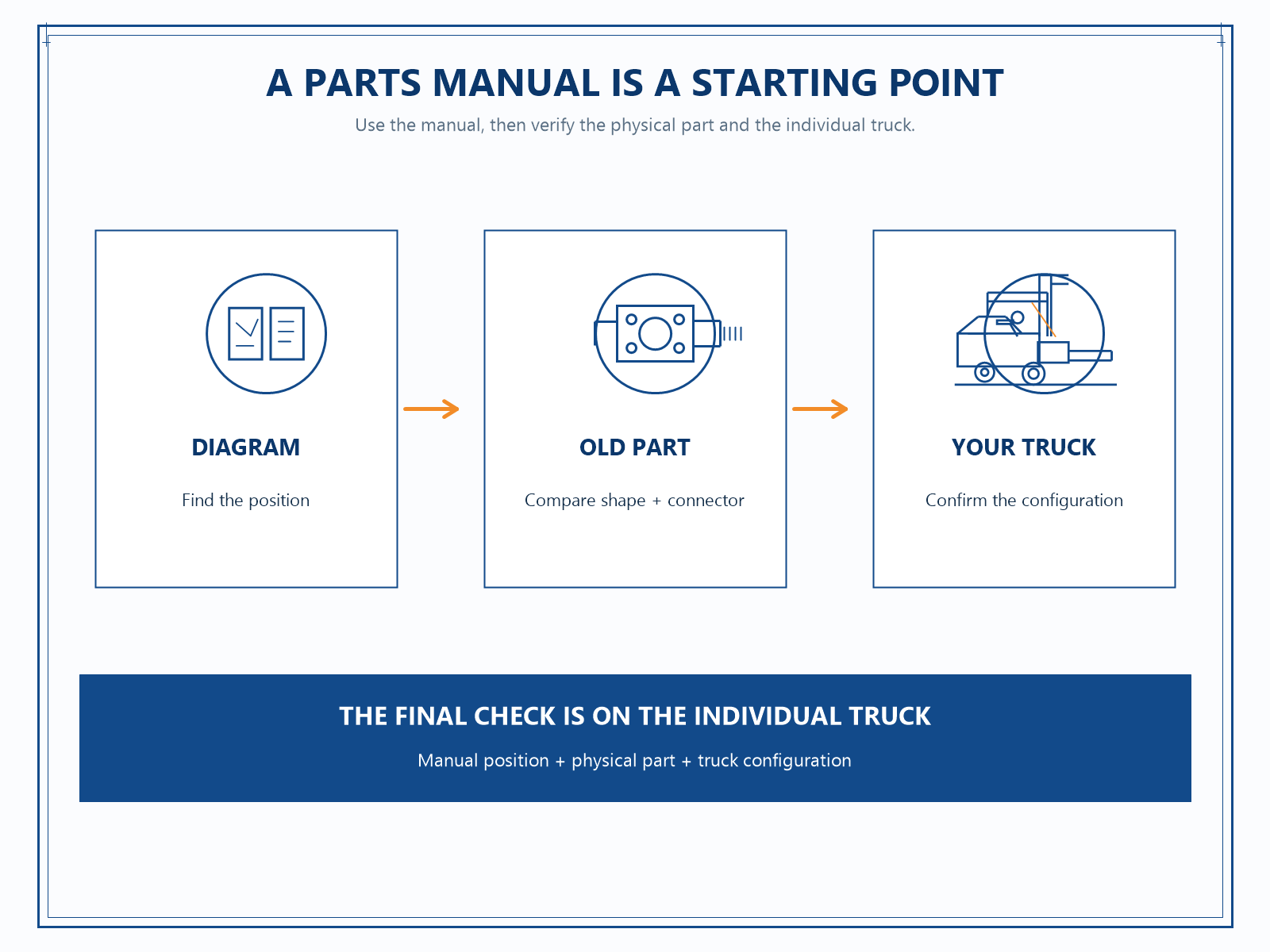
A Toyota 8FGCU25 parts manual or diagram is useful only when it is checked against the individual truck and the component in front of you. Treat a downloaded PDF or a visually similar listing as a lead, not as automatic fitment proof.
- Confirm that the model and serial range match the truck being repaired.
- Open the relevant system group, such as the hydraulic, electrical, cooling, mast, or operator area.
- Locate the diagram position and record the part reference exactly as shown.
- Compare that reference with the old part number, label, connector, hose end, mounting points, or other physical interfaces.
- Ask the supplier to confirm the current number, any supersession, and the remaining fitment uncertainty before ordering.
This sequence prevents a correct-looking diagram from being applied to the wrong range or option. It also gives the supplier a traceable reason for the proposed part instead of relying on a model-only match.
What to ignore when comparing 8FGCU25 parts listings
Do not treat any of these signals as fitment proof by themselves:
- A listing that says only “fits Toyota 8FGCU25” and gives no serial or configuration boundary.
- A photo-only match where connector shape, mounting, dimensions, or revision are not checked.
- Copied marketplace specifications that are presented as if they describe every truck in the model family.
- An interchange claim with another Toyota code that has no supporting catalog reference or supplier confirmation.
- A low price, “in stock” label, or fast reply used to replace identification evidence.
The practical response is to ask for the missing evidence, not to assume that the listing is wrong. If the seller cannot explain how the model, serial, and physical part information were matched, keep the request open and seek a documented fitment review.
When to delay the Toyota 8FGCU25 parts order
Warning: Pause the order when a key identifier is unresolved.
The request is not ready if the serial number is unreadable, the truck configuration is unknown, the physical component has not been checked for an option-sensitive request, or a part-number supersession has not been explained.
At that point, take a clearer data-plate photo, record the missing configuration field, photograph the old component from several sides, or ask for manual and catalog review. A short delay for evidence is usually easier to manage than a wrong-part shipment, return process, or avoidable truck downtime.
Use the status “fitment pending” in your internal request until the model, serial, component evidence, and supplier confirmation agree. Do not convert an unresolved match into an order simply because the model code looks familiar.
FAQ about Toyota 8FGCU25 forklift parts
Where can I get Toyota forklift parts?
Start with a Toyota parts and service channel or a parts supplier that can review the model, serial number, configuration, and component evidence. Ask how fitment will be confirmed before treating a listing as suitable for your truck. (Toyota Material Handling, n.d.)
Where can I find a Toyota forklift parts catalog?
Look for the catalog or parts manual that matches the truck’s model and serial range. A catalog result becomes useful when its system group, diagram position, old number, and physical interfaces agree with the part being replaced. (Toyota Material Handling, n.d.)
What are the specifications of the Toyota 8FGCU25 forklift model?
There is no single set of values that should be assumed for every year, market, and configuration. Use the truck’s data plate and records for the information needed for the part request, then have the applicable source confirm the relevant specification or option.
Is the Toyota 8FGCU25 model number enough to order a part?
Usually not. Add the serial number and, for option-sensitive components, configuration details, the old part number, and photos. The supplier should confirm the exact application and any supersession before the order is placed. (Toyota Material Handling, n.d.)
Conclusion
Toyota 8FGCU25 parts sourcing should start with the data plate and serial number, then move to configuration and the physical component. Send the old part number and photos when available. Routine service requests may need less evidence, while mast, hydraulic, electrical, seat, and tire requests need closer interface checks. If an identifier is unreadable or a supersession is unresolved, keep the request fitment pending until the supplier confirms the application.
References
- Toyota Material Handling. (n.d.). Forklift parts, services, and forklift warranties. https://www.toyotaforklift.com/parts-and-service
- Toyota Material Handling. (n.d.). What is a forklift data plate and how do I read it? https://www.toyotaforklift.com/resource-library/blog/toyota-products/what-is-a-forklift-data-plate-and-how-do-i-read-it
- Toyota Material Handling. (n.d.). Toyota genuine forklift parts and accessories. https://www.toyotaforklift.com/parts-and-service/toyota-genuine-parts
Last reviewed and updated: September 2026. Author: Kingstream team. For tailored guidance, contact our team.