
TL;DR
Run a daily pre-shift inspection (OSHA 1910.178(q)(7)), then follow the hour ladder: 250h oil and filters, 500h hydraulic and brakes, 1,000h axle, mast and tires, 2,000h annual major service. Schedule by operating hours, cut intervals 30-40% in multi-shift work and 20-30% in dusty yards, and log every check.
Abstract
This guide turns the OSHA daily-inspection rule and the 250/500/1,000/2,000-hour service ladder into a one-page forklift preventive maintenance checklist, with an hour-vs-calendar scheduling rule so you never miss a service window.
Key Takeaways
- OSHA requires a documented daily pre-shift inspection under 1910.178(q)(7); forklifts were #6 on OSHA’s 2024 top-10 citations.
- Schedule PM by operating hours: 250h oil/filters, 500h hydraulic/brake, 1,000h axle/mast, 2,000h annual service.
- Electric forklifts: water lead-acid batteries every 5-10 charges, capacity-test per the battery OEM; lithium is near maintenance-free.
- Multi-shift sites: cut service intervals 30-40%; dusty or outdoor yards: 20-30%. Let the hour meter, not the calendar, decide.
- Unplanned breakdowns cost 2-3x preventive maintenance and can shorten lift life 20-40%.
Table of Contents
- Abstract
- Key Takeaways
- Why Preventive Maintenance Beats Reactive Repairs
- Before You Start: Setting Up Your PM Program
- Daily Pre-Shift Inspection Checklist (OSHA 1910.178(q)(7))
- Weekly Checks and the 250-Hour Service
- 500-Hour and 1,000-Hour Services
- The 2,000-Hour Annual Major Service
- Hour- vs Calendar-Based Scheduling (With Environment Multipliers)
- Electric vs. Internal-Combustion Forklifts: Two Different Checklists
- Common Forklift Maintenance Mistakes to Avoid
- What to Do If You Miss a Service Interval
- Download the One-Page Forklift PM Checklist
- Frequently Asked Questions
- Conclusion
- References
Why Preventive Maintenance Beats Reactive Repairs
A single unplanned breakdown averages about $18,400 in lost productivity, overtime, and expedited repairs (Heavy Vehicle Inspection, n.d.). That is the price of waiting until a lift fails. A scheduled service stops the failure before it stops the warehouse. The sections that follow build a forklift preventive maintenance checklist that runs from the daily pre-shift inspection to the 2,000-hour service.
A scheduled preventive maintenance program avoids up to 75% of unexpected breakdowns, which is the strongest single reason fleets run one (Fleet Rabbit, n.d.). The same program generates the daily inspection records OSHA expects when it audits powered industrial trucks, and those records double as proof of due diligence (OSHA, 2024). Prevention is cheaper per hour than the repairs it replaces.
By the Numbers
- $18.4k average cost of one unplanned breakdown, counting lost production and rush parts (Heavy Vehicle Inspection, n.d.)
- 2-3x more a reactive program costs versus scheduled preventive maintenance (Heavy Vehicle Inspection, n.d.)
- 20-40% shorter lift life when you maintain only after failures (Heavy Vehicle Inspection, n.d.)
- 2,248 violations of OSHA’s powered industrial truck standard in 2024, making it the 6th most-cited rule that year (OSHA, 2024)
Before You Start: Setting Up Your PM Program
A forklift preventive maintenance checklist is only as good as the records it runs on, so gather the hour tracking, logs, labor, and parts stock every interval below depends on.
- Confirm the hour meter works. Record the current reading in the log before the first service.
- Wire in telematics where the fleet has it so hours and fault codes feed the log.
- Set up a CMMS or paper log with date, hour stamp, and technician per entry.
- Assign a technician or sign a service contract with a vendor for the interval work.
- Stock the consumables: air and fuel filters, oil, hydraulic seals, hoses, and brake pads.
- Clear an inspection area with power access and enough room to raise the mast.
Fleets that put telematics-based maintenance reporting in place typically see 15 to 20 percent better uptime and 20 to 25 percent lower maintenance costs, per industry research (Verified Market Research, 2025). Automatic hour capture removes the most common failure in a forklift preventive maintenance checklist: a truck that runs past its interval because nobody logged the reading.
Daily Pre-Shift Inspection Checklist (OSHA 1910.178(q)(7))
OSHA requires every powered industrial truck to be inspected before first use each shift, and the result documented in writing (OSHA, n.d.). That daily exam, set by 29 CFR 1910.178(q)(7), is the legal floor under any forklift preventive maintenance checklist.
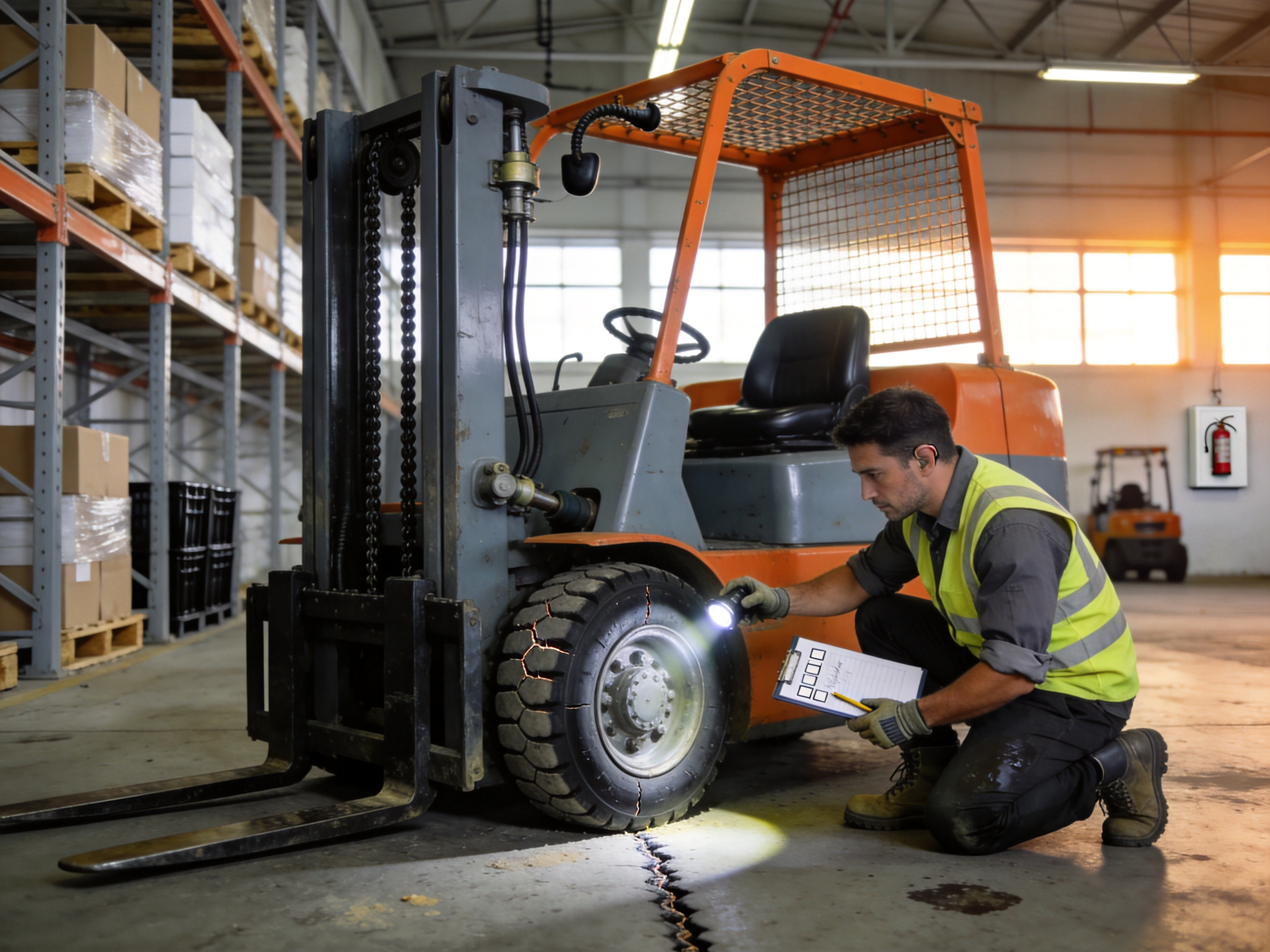
Run it with the key off and the parking brake set. A thorough pass through this forklift preventive maintenance checklist takes 5 to 10 minutes (OSHA, 2026). Any failed item takes the truck out of service before the shift opens.
- Check fluid levels. Engine oil, hydraulic, and coolant read at spec; no fresh leaks under the truck. Done when nothing sits below the low mark.
- Inspect tires. Check pressure, cuts, and punctures. Done when no damage can affect steering or load stability.
- Check forks and mast. Cracks, distortion, and heel wear (CCOHS, n.d.). Done when fork thickness stays above the 10% wear limit and no weld or surface crack is visible.
- Test brakes, horn, and steering. Done when the truck stops under control, the horn sounds, and steering responds without delay.
- Confirm lights and backup alarm. Done when the operator can see and be seen, and the alarm sounds in reverse.
- Log every finding. Record the result and any defect in the shift log, and tag the truck out of service. Done when the entry is signed and dated.
Operator checks catch unsafe conditions before a truck runs; they do not replace technician services at 250, 500, 1,000, and 2,000 hours (OSHA, 2026). A complete forklift preventive maintenance checklist includes both layers: this daily gate and the interval work below.
OSHA 29 CFR 1910.178(q)(7) requires a written pre-use inspection before the first shift use of every powered industrial truck. It is not optional paperwork: the standard ranked sixth on OSHA’s 2024 top-10 most-cited list with roughly 2,248 violations (OSHA, n.d.; OSHA, 2024). Treat the pre-shift log as compliance evidence.
Weekly Checks and the 250-Hour Service
After the daily pre-shift check, the next rung of the forklift preventive maintenance checklist is the weekly pass and the 250-hour service. A single-shift truck logs about 40 hours a week, so the 250-hour service lands roughly every six weeks.
Weekly items stay operator-level: tire pressure and condition, visible leaks under the truck, and battery water for electric units. The 250-hour stop, roughly every six weeks to two months depending on shift duty, is the first true technician service, centered on the fluids and lube points that keep an internal combustion truck running. (Toyota Material Handling, n.d.)
| Task | Check | Interval |
|---|---|---|
| Engine oil and filter | Drain and replace per spec | 250 hours / 2 months (Toyota Material Handling, n.d.) |
| Air filter | Inspect, clean or replace | 250 hours, 100 if dusty (Toyota Material Handling, n.d.; Limble, n.d.) |
| Hydraulic oil | Verify level, no foam | 250 hours (Toyota Material Handling, n.d.) |
| Grease points | Lube mast and carriage | 250 hours (Toyota Material Handling, n.d.) |
| Tire pressure and condition | Check air, cuts, wear | Weekly (Limble, n.d.) |
| Visible fluid leaks | Inspect under truck | Weekly (Limble, n.d.) |
| Battery water | Top off cells, clean terminals | Weekly (Limble, n.d.) |
Use the table as the working copy in the shop and log each completed line with the hour meter reading.
Toyota anchors its internal combustion line on a 250-hour service, the most common OEM baseline for the first technician stop on the forklift preventive maintenance checklist: engine oil and filter, air filter inspection, hydraulic oil level, greased points. (Toyota Material Handling, n.d.) Dusty operations pull air filter checks to about 100 hours; multi-shift sites trim intervals 30 to 40% to stay ahead of wear. (Limble, n.d.)
Here is what we would check first
The checklist is only as good as the parts that go in the bay, and the 250 to 2,000 hour ladder asks for air filters, oil filters, hydraulic seals, hoses, and brake parts at every rung. Talk to the Kingstream sourcing team to match the right replacement grade to your fleet, with OEM-compatible parts from a single source across 14 major brands and fast quotation.
500-Hour and 1,000-Hour Services
The middle rungs of a forklift preventive maintenance checklist split at 500 and 1,000 operating hours. These are the first intervals where fluid changes and component checks take over from the daily inspection.
At 500 operating hours, the service anchors on the hydraulic system: oil and filter change, brake inspection, and a steering and suspension check. Toyota’s published baseline for electric trucks sits near 500 hours (Toyota Material Handling, n.d.).
The 1,000-hour service adds the drivetrain and structure: axle oil, mast rollers and chains, tire rotation, and a coolant flush check (Toyota Material Handling, n.d.). Brake work stays inspection-heavy, with shoes and wheel cylinders checked before they wear thin (Toyota Material Handling, n.d.).
The mast roller and chain work matters most on high-stacking operations, where chain stretch changes lift speed and fork leveling. The table below maps each mid-tier task in a forklift preventive maintenance checklist.
| Service | Key tasks | Typical interval |
|---|---|---|
| Hydraulic oil and filter | Drain old oil, replace filter | 500 hours (Toyota Material Handling, n.d.) |
| Brake inspection | Check shoes, wheel cylinders, lines | 500 hours (Toyota Material Handling, n.d.) |
| Steering and suspension | Inspect linkages, check play | 500 hours (Toyota Material Handling, n.d.) |
| Axle oil | Check level, top up or change | 1,000 hours (Toyota Material Handling, n.d.) |
| Mast rollers and chains | Lubricate, adjust tension | 1,000 hours (Toyota Material Handling, n.d.) |
| Tire rotation | Rotate tires, inspect wear | 1,000 hours (Toyota Material Handling, n.d.) |
| Coolant | Check level and condition | 1,000 hours (Toyota Material Handling, n.d.) |
The 2,000-Hour Annual Major Service
The 2,000-hour service is the top rung of the forklift preventive maintenance checklist, a full annual overhaul (Toyota Material Handling, n.d.).
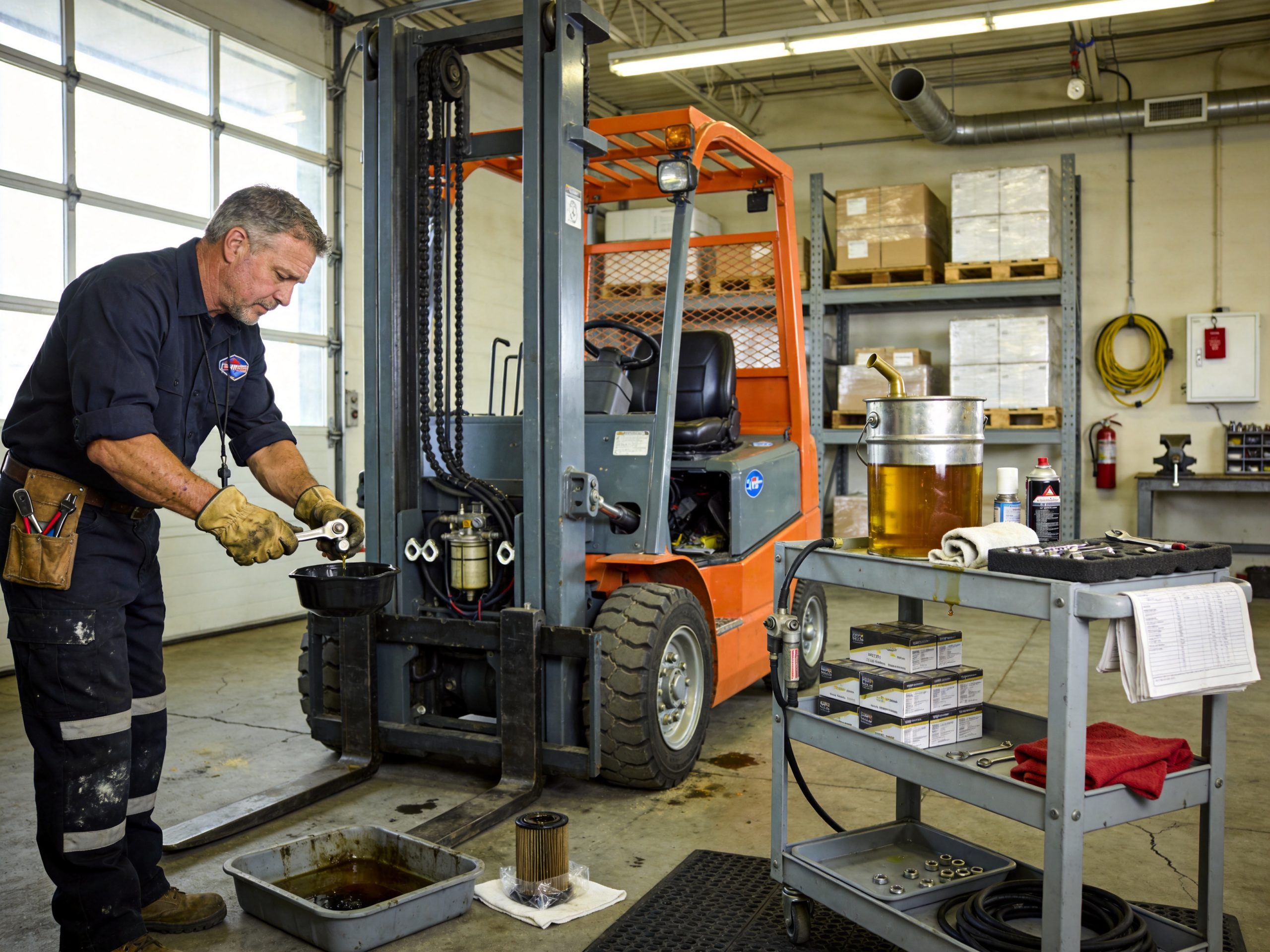
- Inspect the transmission and gearbox. Done when shifts are smooth and drain fluid is clean.
- Replace the full filter set. Air, oil, fuel, hydraulic. Done when all four are new.
- Flush and refill the coolant. Check hoses while the system is open. Done when the level holds.
- Service the brake master cylinder and shoes. Done when the pedal holds and stops are even.
- Replace hydraulic hoses and seals. Done when fittings run dry and no hose is cracked.
- Load test the forks and chains. Measure thickness against the 10% wear limit (CCOHS, n.d.). Done when forks pass and chains hold.
Stock fork pins, hydraulic seals, hoses, brake shoes, and air and fuel filters before you book the bay. OEM genuine parts carry a 12-month warranty, OEM-equivalent 6 months, aftermarket 3 months.
The annual overhaul at 2,000 hours is the deepest pass on the forklift preventive maintenance checklist. It covers the full filter set (air, oil, fuel, hydraulic), transmission, coolant, and brake master cylinder with shoes (Toyota Material Handling, n.d.). Forks leave service once wear reaches 10% of blade thickness (CCOHS, n.d.).
Hour- vs Calendar-Based Scheduling (With Environment Multipliers)
Schedule forklift preventive maintenance by operating hours, not the calendar. A truck that logs 2,000 hours a year is due its annual service at the hour marker, not on January 1.
When telematics or an hour meter exists, it drives the schedule. Calendar dates act only as a floor for low-usage trucks that rarely hit an interval in a year. Some manufacturers build the same logic into the rule itself: an hours-or-days trigger, whichever comes first.
Environment multipliers adjust that baseline: multi-shift operation cuts intervals 30 to 40%, and dusty or outdoor yards cut them 20 to 30% (Limble, n.d.).
| Condition | Interval adjustment | Typical example |
|---|---|---|
| Normal single shift | No change | 500-hour service at 500 hours |
| Multi-shift operation | Cut 30 to 40% | 1,000-hour service pulled to 700 hours |
| Dusty or outdoor yard | Cut 20 to 30% | Air filter checked near 100 hours |
| Air filter in dusty ops | Check every 100 hours | Inspect at each PM |
Fleet managers running two or three shifts typically shorten their forklift preventive maintenance checklist intervals by 30 to 40%, and dusty operations by another 20 to 30%, so air filters in those yards get checked around every 100 hours (Limble, n.d.). The calendar sets the floor; the hour meter sets the date.
Electric vs. Internal-Combustion Forklifts: Two Different Checklists
The powertrain changes your forklift preventive maintenance checklist more than any other variable. An electric truck and a diesel truck move the same pallets, then ask for different care at different intervals. The electric list centers on the battery; the combustion list on the engine and its exhaust.
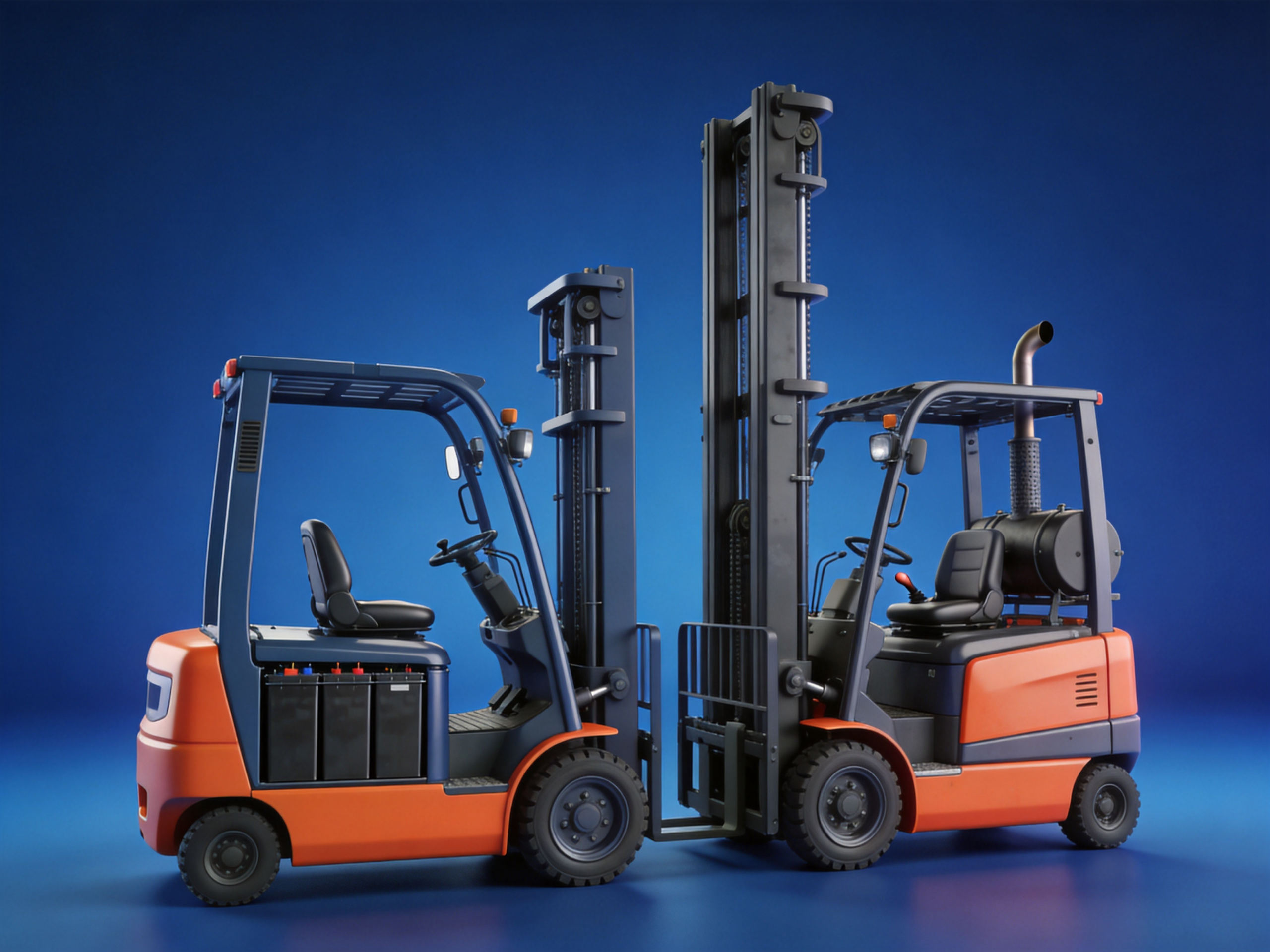
| Maintenance item | Electric | Diesel / LPG |
|---|---|---|
| Power source | Water lead-acid every 5-10 charges (Limble, n.d.) | Engine oil and filter at the 250-hour service (Toyota Material Handling, n.d.) |
| Filters and air | Cooling vents only | Oil, fuel, air at the OEM interval (250-600h) |
| Battery / engine health | Periodic capacity test per the battery OEM | Radiator, belts, coolant checked |
| Emissions | None | Tier-4 DPF/DEF on diesels |
Hydraulics and brakes follow the same intervals on both types. The rows above are where the two checklists actually diverge, and where scheduling errors start.
Electric trucks concentrate maintenance in the battery: lead-acid packs need watering every 5-10 charges (Limble, n.d.), periodic capacity testing per the battery OEM, and replacement as capacity fades, typically across 3 to 5 years of service (Fleet Rabbit, n.d.), while lithium-ion runs near maintenance-free (Limble, n.d.). Combustion trucks shift that load to the engine, with oil changes at the 250-hour service (Toyota Material Handling, n.d.) and filters at the OEM-specified interval, often 250 to 600 hours.
Whichever powertrain you run, a schedule is only as good as the parts it installs. Kingstream has supplied forklift replacement parts for five years, and we tie warranty to part quality: OEM genuine 12 months, OEM-equivalent 6 months, aftermarket 3 months, the same terms guaranteed across our brand pages. Match the replacement grade to the duty before you finalize your forklift preventive maintenance checklist.
Common Forklift Maintenance Mistakes to Avoid
Most breakdowns stem from process errors, not machine faults. Non-standardized in-house repair practices cause more downtime than the trucks themselves, and a program that avoids up to 75% of unexpected breakdowns (Fleet Rabbit, n.d.) is only as strong as its daily habits. These five mistakes appear most often in forklift preventive maintenance checklist audits.
- Calendar-only scheduling. Hours drive service, not dates; a one-shift truck is not a three-shift truck.
- Skipping the daily inspection log. An unlogged check has no audit trail.
- Generic filters and oil. Off-spec parts void warranty coverage.
- Ignoring hydraulic leaks. A slow weep becomes a dropped load.
- Missing the 10% fork wear check. Worn forks fail at the heel under load (CCOHS, n.d.).
Warning: Calendar-only scheduling is the costliest mistake. Light-duty trucks get over-serviced while heavy-shift units run past their intervals. Warning: Skipping the daily inspection log compounds every other error. No record means defects go untracked.
Treating operators as frontline intelligence and encouraging defect reporting without blame gives the shop the cheapest repair window it will ever get: a crew that reports early, in writing, flags the small failure before it becomes a breakdown.
Most breakdowns trace to process errors, not machine faults, and the most common of them is skipping the daily inspection log. Worn forks are the leading structural failure: once wear reaches 10% of blade thickness, forks can fail at the heel under load (CCOHS, n.d.). Log every check; an unlogged check has no audit trail.
What to Do If You Miss a Service Interval
If you miss an item on your forklift preventive maintenance checklist, do not skip the next interval to compensate. Run the missed service plus a full inspection before the next shift, because letting the gap slide drops you into reactive repairs that cost 2 to 3 times as much as scheduled preventive maintenance (Heavy Vehicle Inspection, n.d.).
- Run the missed service first. Perform the overdue PM before the truck returns to work. Done when the service record is current.
- Inspect for cascaded wear. Oil breakdown, filter bypass, and contaminated hydraulics follow a skipped service. Check fluids, filters, and hoses for damage.
- Pull an oil sample if in doubt. An analysis or a filter check confirms whether contamination reached the engine or hydraulics.
- Log the exception. Note what was missed, why, and the corrective action so the pattern shows in your maintenance history.
Falling into reactive maintenance is the real cost of a missed interval. Reactive repairs cost 2 to 3 times as much as scheduled preventive maintenance and shorten lift life by 20 to 40% (Heavy Vehicle Inspection, n.d.). Catching up promptly keeps one oversight from becoming an overhaul.
Download the One-Page Forklift PM Checklist
Most forklift preventive maintenance checklist guides are prose walkthroughs, not sheets you can pin to a wall. This one-page version consolidates the daily pre-shift inspection, the 250 and 500 hour services, the 1,000 hour interval, and the 2,000 hour annual overhaul. The OSHA 29 CFR 1910.178(q)(7) daily pre-use exam anchors the first block (OSHA, n.d.).
Open the print view in your browser to save a copy.
The one-pager contains:
- Daily pre-shift block covering brakes, forks, tires, lights, horn, leaks.
- Weekly and 250-hour services for the operator walkaround and first technician service.
- 500-hour and 1,000-hour intervals with hydraulic, drive train, and engine work.
- 2,000-hour annual service including fork wear measurement against the manufacturer limit (CCOHS, n.d.).
- One blank log row per truck for date, hour meter, sign-off.
The sheet calls for filters, oil, and seals. The forklift maintenance parts category carries air filters, oil filters, hydraulic seals, and brake parts; the air filter category covers intake service.
Frequently Asked Questions
How often does OSHA require forklift inspections?
Every shift, before the truck goes into service. OSHA 1910.178(q)(7) requires a pre-use exam, and the rule ranked #6 among the most-cited standards in 2024 with roughly 2,248 violations, so a missed daily inspection is a fully documentable enforcement risk. (OSHA, n.d.; OSHA, 2024)
How often should a forklift be serviced?
Follow the 250-hour, 500-hour, 1,000-hour, and 2,000-hour ladder, with routine service at 250 to 500 hours and overhauls near 2,000. (Toyota Material Handling, n.d.)
What is the difference between daily, weekly and monthly forklift maintenance?
Daily maintenance is the operator pre-use check of brakes, steering, forks, and leaks. The forklift preventive maintenance checklist adds weekly and monthly technician work covering fluids, battery care, and lubrication. (Limble, n.d.)
Is forklift maintenance based on operating hours or calendar time?
Operating hours, not calendar time. Hour-driven scheduling is standard; multi-shift work should shorten intervals by 30-40% and dusty or outdoor yards by 20-30%. (Toyota Material Handling, n.d.; Limble, n.d.)
Do electric forklifts need less maintenance than diesel forklifts?
Yes. Electric trucks skip engine oil and filter changes, but battery upkeep takes their place. Toyota anchors electric service at 500 hours versus 250 for internal-combustion trucks. (Toyota Material Handling, n.d.)
How often should forklift batteries be watered?
Every 5 to 10 charges for lead-acid batteries. Top up with distilled water at low charge to avoid overflow. (Limble, n.d.)
When should forklift forks be replaced?
When wear passes 10% of original fork thickness, or when cracks, bends, or distortion appear. Fork inspection lands in annual service, near 2,000 hours. (CCOHS, n.d.)
Conclusion
A working forklift preventive maintenance checklist is only as good as the log behind it. Run the daily pre-shift inspection before every shift under OSHA 29 CFR 1910.178(q)(7), then hold each service to the hour meter: oil and filters at 250 hours, hydraulics and brakes at 500, axle, mast and tires at 1,000, and the full annual overhaul at 2,000. Cut intervals 30 to 40% in multi-shift work and 20 to 30% in dusty yards, log every completed check with the hour reading, and retire any fork once wear passes 10% of blade thickness (CCOHS, n.d.). A program that holds this pattern avoids up to 75% of unexpected breakdowns (Fleet Rabbit, n.d.) and turns every service record into the compliance evidence OSHA expects.
References
- Occupational Safety and Health Administration. (n.d.). Powered industrial trucks (29 CFR 1910.178). U.S. Department of Labor. https://www.osha.gov/laws-regs/regulations/standardnumber/1910/1910.178
- Occupational Safety and Health Administration. (2026). eTool: Powered industrial trucks (forklift), operating the forklift: Pre-operation. U.S. Department of Labor. https://www.osha.gov/etools/powered-industrial-trucks/operating-forklift/pre-operation
- Occupational Safety and Health Administration. (2024). Top 10 most frequently cited standards. U.S. Department of Labor. https://www.osha.gov/top10citedstandards
- Canadian Centre for Occupational Health and Safety. (n.d.). Forklift trucks: Fork safety. https://www.ccohs.ca/oshanswers/safety_haz/forklift/fork_saf.html
- Toyota Material Handling. (n.d.). How to set up a forklift maintenance schedule. https://www.toyotamhs.com/how-to-set-up-a-forklift-maintenance-schedule/
- Heavy Vehicle Inspection. (n.d.). Warehouse material handling equipment preventive maintenance guide. https://heavyvehicleinspection.com/blog/post/warehouse-material-handling-equipment-preventive-maintenance-guide
- Fleet Rabbit. (n.d.). Preventive maintenance best practices for forklifts in manufacturing plants. https://fleetrabbit.com/blogs/post/preventive-maintenance-forklifts-manufacturing-plants
- Limble CMMS. (n.d.). Forklift preventive maintenance checklist. https://limble.com/learn/forklift-checklist
- Verified Market Research. (2025). Forklift repair and maintenance service market report: Size, growth, trends and forecast (2025-2033). https://www.verifiedmarketresearch.com/product/forklift-repair-and-maintenance-service-market
Last reviewed and updated: August 2026. Author: Kingstream team. For tailored guidance, contact our team.