
TL;DR
Verdict: Choose cushion (or polyurethane) tires for smooth indoor floors, pneumatic tires for outdoor yards and rough terrain, and non-marking compounds for food and cleanroom sites. Then size every tire to the truck’s OEM spec and load rating, and weigh total cost of ownership rather than sticker price.
Abstract
Buying forklift tires comes down to four variables: where the truck works, what it carries, what floor it runs on, and how much a wrong tire costs in downtime and premature replacement. The sections ahead turn those variables into a step-by-step decision framework.
Key Takeaways
- Cushion tires suit smooth indoor floors; pneumatic suits outdoor and rough terrain
- Solid and polyurethane tires cost more upfront but run longer with no flats
- Size every tire to the truck’s OEM spec and load rating before buying
- Total cost of ownership beats sticker price: downtime dominates cost
- Non-marking compounds are required in food and cleanroom operations
- OSHA/ANSI inspections catch worn tires before they cause accidents
Table of Contents
- Abstract
- Key Takeaways
- How to choose forklift tires: the decision framework
- Cushion vs Pneumatic vs Solid: What Each Tire Is
- What to Ignore When Buying Forklift Tires
- Best Forklift Tire for Each Application
- Forklift Tire Cost and Total Cost of Ownership
- How to Read Forklift Tire Sizes and Fit Your Truck
- How to test forklift tires before buying
- When to Delay Your Forklift Tire Purchase
- FAQ
- Conclusion
- References
Forklift Tire Types at a Glance
Four tire types cover the forklift tire market: cushion (press-on), air pneumatic, solid pneumatic, and polyurethane. Each is designed for a specific operating environment. The wrong tire on the wrong floor accelerates wear, causes downtime, and damages surfaces.
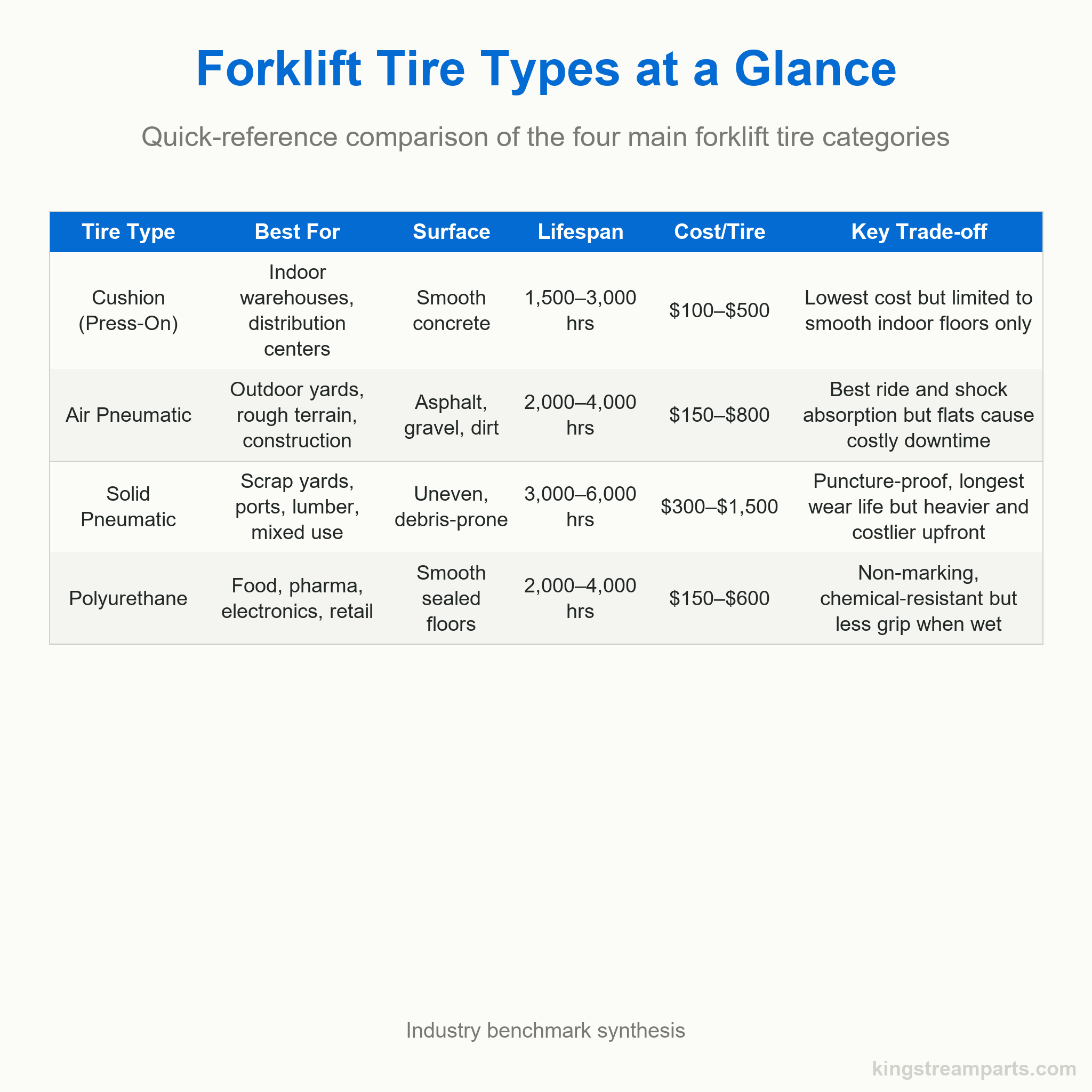
The table below maps each type to its application, surface, cost band, and defining trade-off.
| Tire Type | Best Application | Surface | Lifespan | Cost/Tire | Key Trade-off |
|---|---|---|---|---|---|
| Cushion (press-on) | Indoor warehouse, distribution, manufacturing | Smooth concrete | 1,500-3,000 hrs | $100-$500 | Tight turning radius, no flats; zero outdoor capability |
| Air Pneumatic | Outdoor yards, rough terrain, construction | Asphalt, gravel, dirt | 2,000-4,000 hrs | $150-$800 | Best ride and traction; punctures cause costly downtime |
| Solid Pneumatic | Scrap yards, ports, lumber, mixed-use | Uneven, debris-prone surfaces | 3,000-6,000 hrs | $300-$1,500 | Puncture-proof, longest wear life; heavier, less shock absorption |
| Polyurethane | Food, pharma, electronics, cleanroom | Smooth sealed floors | 2,000-4,000 hrs | $150-$600 | Non-marking, chemical resistant; reduced grip when wet |
Cushion tires
Cushion tires are smooth solid rubber pressed onto a steel band. Built for smooth concrete floors in warehouses and manufacturing lines, they cost $100 to $500 per tire. Their compact profile shortens the turning radius in narrow aisles. The trade-off is zero tolerance for outdoor surfaces and limited shock absorption over a full shift.
Pneumatic tires
Air pneumatic tires are inflated rubber carcasses built like truck tires. They excel on gravel, construction sites, and uneven asphalt where shock absorption and traction count most, at $150 to $800 per tire. The vulnerability is flats: a single puncture can idle a forklift for hours, and underinflation is the leading cause of premature failure.
Solid tires
Solid pneumatic tires are shaped like air pneumatics but are solid rubber through the cross-section. They cannot go flat, making them the default for scrap yards, ports, and lumber operations. Rated for 3,000 to 6,000 hours, they deliver the longest wear life at $300 to $1,500 per tire.
Polyurethane tires
Polyurethane tires are synthetic, non-marking press-on tires for environments where floor hygiene matters most. Food processing, pharmaceutical cleanrooms, and electronics assembly require them because black rubber leaves visible marks. At $150 to $600 per tire, polyurethane resists oils, solvents, and cleaning chemicals that degrade standard rubber. The drawback is grip: it becomes slippery on wet floors and chips on debris-laden surfaces.
Four tire types cover the forklift tire market: cushion press-on for smooth indoor floors, air pneumatic for outdoor yards and rough terrain, solid pneumatic for debris-prone industrial sites, and polyurethane for food and cleanroom facilities. Still, 85% of forklift tires are replaced with roughly 25% of usable life remaining, per an Industrial Distribution fleet study (Industrial Distribution, n.d.).
How to choose forklift tires: the decision framework
Choosing a forklift tire is not a single-variable decision. Four criteria interact (application environment, load requirements, duty cycle, and total cost); getting any one wrong can cut tire life in half. The framework below weights each factor so you can rank options against your actual operating conditions.
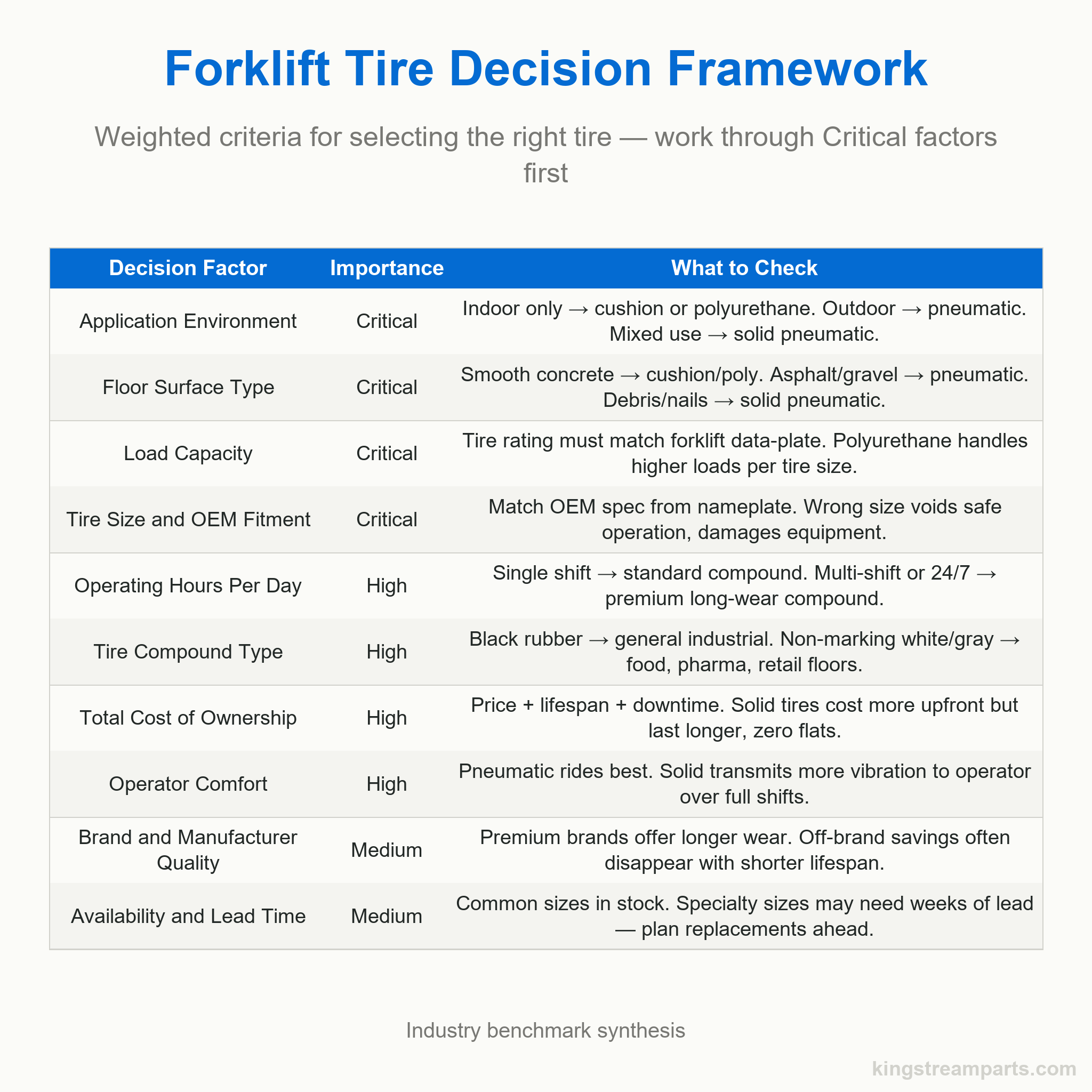
Application: indoor vs outdoor
Where the forklift operates is the first filter. Smooth concrete or epoxy floors call for cushion tires or smooth-tread solids, which maximize contact patch and resist chunking on hard, flat surfaces. Outdoor or mixed-terrain operations on asphalt, gravel, or dirt demand pneumatic or solid pneumatic-profile tires whose deeper tread sheds mud and absorbs surface irregularities.
Floor surface type matters even within a single facility. Polished concrete, rough aggregate, steel decking, and chip-sealed asphalt each impose different wear rates on the same compound. Match the tread to the most abrasive surface the forklift crosses, not the average one.
Load capacity and floor type
Tire capacity must meet or exceed the forklift’s rated load at maximum lift height. Polyurethane and solid rubber compounds carry higher loads per given tire size than pneumatic equivalents, a difference that matters when equipment runs near the upper limit of its nameplate rating.
Tire size and fitment are non-negotiable. An undersized tire shifts the load center, destabilizes the truck, and accelerates drivetrain wear. Measure the existing tire’s sidewall markings (diameter, width, and rim size) and match them exactly.
Operating hours and duty cycle
Single-shift operations can run most tire compounds without excessive heat buildup. Multi-shift and 24/7 operations need compounds engineered for sustained running; heat is the dominant failure mode when a tire never cools between shifts. Solid tires and high-durometer compounds manage heat better in continuous-duty applications than standard pneumatics.
Duty cycle also governs the compound choice. Black tires contain carbon black reinforcement and deliver longer wear life in general industrial settings. Non-marking tires are mandatory in food processing, pharmaceutical, and retail-floor applications where black skid marks on flooring are unacceptable.
Operator comfort rounds out the duty-cycle decision. Pneumatic tires absorb floor vibration and reduce operator fatigue over long shifts. Solid tires transmit more road vibration to the chassis and operator, a factor that compounds across an 8-hour or 12-hour shift.
Total cost of ownership
Purchase price is the smallest line item in a forklift tire’s lifetime cost. An industry study documented that 85% of forklift tires are replaced while 25% of usable life remains. The pattern stems from avoidable damage, improper compound selection, or lack of wear monitoring. Operators lose nearly a quarter of tire value to early replacement, absorbing avoidable downtime and expense. (Industrial Distribution, n.d.)
The TCO equation spans four components: purchase price, installation labor, downtime from flats, and floor damage. A cheaper tire that flats frequently costs more over its service life than a costlier tire bought once. Brand quality is a secondary factor: higher-tier tires cost more upfront but deliver longer wear intervals. Lead time matters for specialty sizes. Less-common dimensions for narrow-aisle or high-capacity trucks can take weeks to arrive.
Here is the five-point decision framework, in priority order:
- Application environment. Indoor smooth-floor, outdoor rough-terrain, or mixed. It determines the tire category.
- Load rating and size. Match OEM specifications exactly. Never undersize.
- Duty cycle. Single shift versus multi-shift dictates compound heat tolerance and wear life.
- Compound type. Black for general industrial; non-marking for food, pharma, or retail floors.
- TCO, not purchase price. Factor in downtime, floor wear, and labor over the expected service interval.
Cushion vs Pneumatic vs Solid: What Each Tire Is
How each type is built
Cushion tires (press-on) are solid rubber pressed onto a steel band or wheel hub, with no rim and no air chamber. The compact build allows a tighter turning radius, but floor irregularities transmit straight to the axle.
Air pneumatic tires use a tube or tubeless chamber of compressed air inside a rubber carcass, like vehicle tires. The air cushion delivers the best shock absorption of any forklift tire. A single puncture disables the tire, and underinflation is the leading cause of premature pneumatic failure.
Solid pneumatic tires fill a pneumatic-shaped profile with solid rubber on standard multi-piece rims. Punctures become irrelevant. The trade is added weight and a stiffer ride.
Where each type belongs
Cushion tires stay on smooth sealed concrete: warehouses, DCs, and manufacturing floors. They trade outdoor capability for stability and turn radius.
Air pneumatics are the pick for unpaved or broken ground, absorbing the jarring that solid tires transmit straight to the operator. Flat-tire downtime and regular pressure checks are the ongoing cost.
Solid pneumatic tires survive scrap yards and port terminals where debris would puncture an air tube in hours. They cross from gravel yard to warehouse floor without tearing up the surface, but weigh more and ride harder than either cushion or air types.
Non-marking and polyurethane variants
Polyurethane is a synthetic press-on tire that carries higher loads than rubber of equivalent size and resists oils, solvents, and chemicals. Naturally non-marking, it is specified for food processing, pharmaceutical, and retail floors. It can be slippery when wet and chips on rough terrain; it stays indoors.
Non-marking rubber replaces carbon black, the standard reinforcing filler, with silica or other pale fillers. The result wears faster and costs more. Facilities that mandate non-marking tires (FDA food plants, pharma cleanrooms) accept the trade because a stained floor is a compliance failure.
Across all four types, 85% of forklift tires are replaced with roughly 25% of their service life remaining, driven more by convenience and budget cycles than by actual wear (Industrial Distribution, n.d.). A tire pulled too early is a cost absorbed silently across every replacement cycle.
Glossary
- Cushion tire (press-on): Solid rubber pressed onto a steel band or hub; no rim, no air.
- Air pneumatic tire: Air-filled tire, tube or tubeless, on a multi-piece rim; highest shock absorption.
- Solid pneumatic tire: Solid rubber in a pneumatic-profile shape on standard rims; puncture-proof.
- Polyurethane tire: Synthetic press-on tire; non-marking, chemical resistant, higher load capacity than rubber.
- Non-marking compound: Rubber formulation with silica fillers instead of carbon black to prevent floor staining.
What to Ignore When Buying Forklift Tires
Marketing claims that don’t matter
Any forklift tire buying guide that leans on lab-derived mileage numbers is selling a test condition, not your operating reality. Those ratings come from smooth laboratory drums under ideal load and temperature, not from your floor with expansion joints and dock plate impacts. A tire rated for 3,000 hours may deliver half that on rougher surfaces, a gap no warranty bridges.
Dismiss the "one tire fits all" pitch. A compound that works on polished warehouse concrete tears up on asphalt. A deep-tread pneumatic that grips loose gravel marks up an epoxy cleanroom floor. No single formulation covers every surface.
Roughly 85 percent of forklift tires are removed from service while a quarter of their usable tread remains, per a widely cited industry study (Industrial Distribution, n.d.). That figure is money left on the table, and it undercuts every mileage claim on a brochure.
Brand halo vs application fit
A brand name on the sidewall buys recognition, not a compound matched to your floor. Camso, Continental, and Yokohama all produce capable tires with strengths in different applications. A Continental press-on built for cold storage adds nothing over a correctly spec’d Camso equivalent on a room-temperature floor. The right question is not which brand is best but which tire in that catalog was engineered for your surface and duty cycle.
Warning: Buying the same brand as the truck manufacturer does not guarantee a better fit. Forklift OEMs do not make tires. The "OEM tire" on a new truck is a volume-sourced commodity from a third-party maker, selected to a price point, not to your floor.
Match the tire to the application first, then choose from brands that offer a compound built for it. That sequence avoids the costliest error in any forklift tire buying guide: an expensive tire on the wrong surface.
Your next step
After you have matched the tire type and size to the data plate, the remaining work is sourcing a replacement that fits and ships quickly. Kingstream covers 14 major brands from a single source, and its OEM-compatible parts come with a fast quotation turnaround. Get a quote and a parts specialist will confirm availability and pricing for your lift truck.
Best Forklift Tire for Each Application
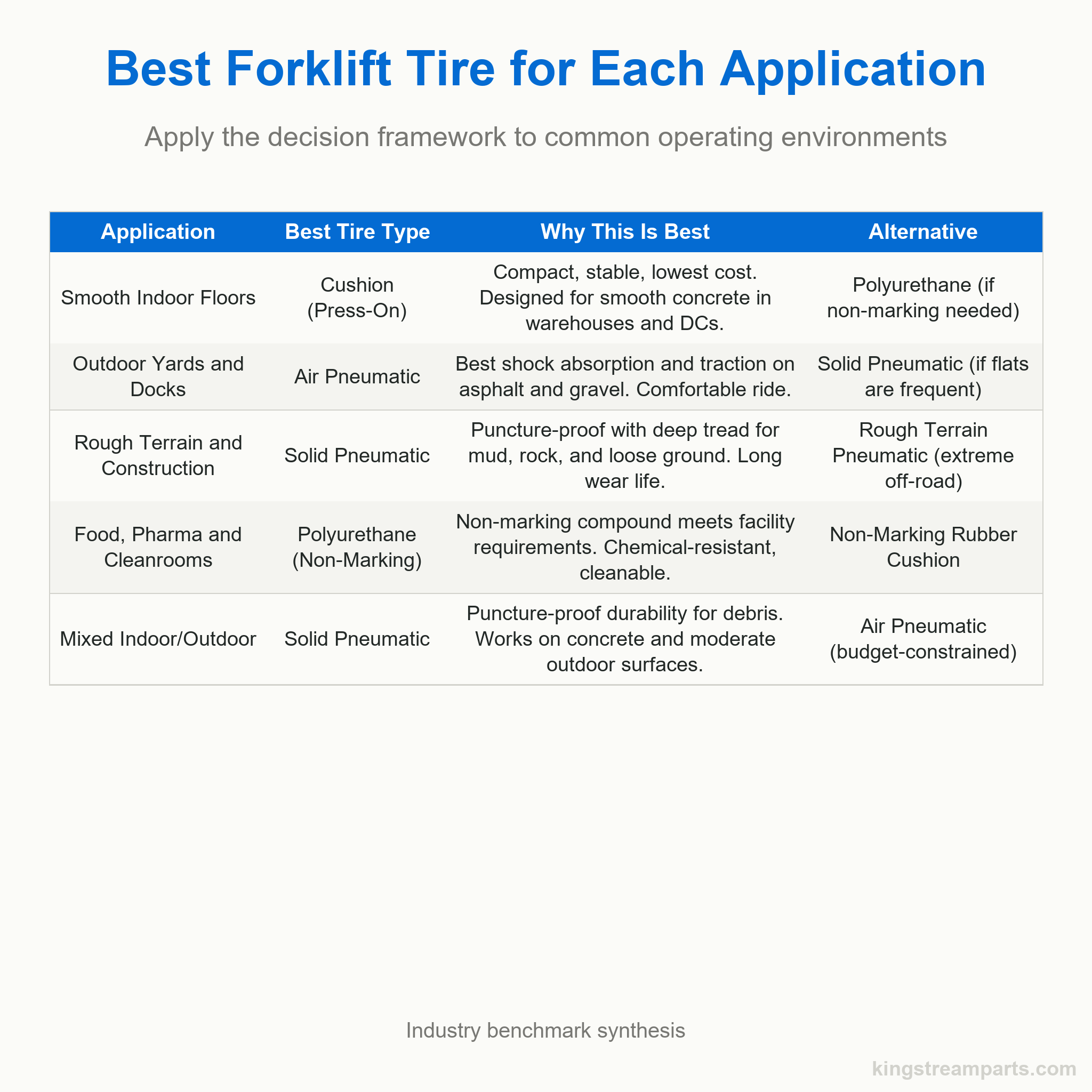
Your operating surface determines your tire type. The four environments below cover the majority of forklift applications, each with a clear best pick and an honest trade-off.
Smooth indoor floors
Press-on cushion tires are the standard for warehouses and distribution centers with level concrete. They are compact, stable, and the lowest-cost option at $100 to $500 per tire. Expect 1,500 to 3,000 operating hours. The trade-off: cushion tires transmit more vibration to the operator than pneumatic alternatives. If non-marking performance is required, polyurethane press-on tires add chemical resistance at a higher unit cost.
Outdoor yards and dock areas
Air pneumatic tires handle asphalt, gravel, and mixed-surface loading docks with the best shock absorption in the category. They last 2,000 to 4,000 hours at $150 to $800 per tire. The risk is flats. A single nail can idle a forklift mid-shift. Operations that lose more than two shifts per quarter to punctures should switch to solid pneumatic tires, which trade some ride quality for zero-flat operation.
Rough terrain and construction sites
Solid pneumatic tires with deep tread are built for mud, rock, and demolition debris. They are puncture-proof and deliver the longest wear life of any type at 3,000 to 6,000 hours. Pricing runs $300 to $1,500 per tire. For extreme off-road conditions, rough-terrain pneumatic tires offer maximum grip at $500 to $3,000 per tire and 2,000 to 5,000 hours. The trade-off: solid pneumatics are heavy and transmit more vibration to the operator.
Food, pharmaceutical and cleanroom sites
Polyurethane press-on tires are the default for sanitation-governed environments. The compound leaves no marks, resists cleaning chemicals, and carries higher loads per tire size than rubber. Expect 2,000 to 4,000 hours at $150 to $600 per tire. Non-marking rubber cushion tires offer a lower-cost fallback where chemical exposure is light. The trade-off: polyurethane loses grip on wet floors, making drainage and housekeeping part of the tire equation.
Before ordering, verify these five application-fit checks:
- Floor surface. Smooth sealed concrete, asphalt, gravel, or dirt? Surface type locks in the tire category.
- Debris risk. Nails, scrap metal, or glass in the operating area? One puncture can erase the cost advantage of air pneumatics.
- Marking sensitivity. Will a black rubber streak trigger a quality-audit finding? Non-marking compound becomes non-negotiable.
Two further checks matter most where operations already run multi-shift or sanitation-heavy duty:
- Shift length. Operators on 10-to-12-hour shifts benefit from the shock absorption of air-filled or foam-filled pneumatics.
- Chemical exposure. Cleaning agents and process chemicals degrade standard rubber compounds. Polyurethane resists them better across the board.
Industry data shows that 85% of forklift tires are replaced with roughly 25% of their usable tread life still remaining (Industrial Distribution, n.d.). Matching tire type to operating environment is the single most important decision in any forklift tire buying guide, because no compound performs well in the wrong setting.
Forklift Tire Cost and Total Cost of Ownership
Purchase price is the number most buyers focus on. It is also the wrong number to optimize against. A total cost of ownership view accounts for three variables the sticker price ignores: operating hours delivered before replacement, downtime cost per flat-tire incident, and whether the compound damages the floor it runs on.
| Tire Type | Purchase Price | Lifespan (Hours) | Flat Risk |
|---|---|---|---|
| Cushion press-on | $100-$500 | 1,500-3,000 | None |
| Air pneumatic | $150-$800 | 2,000-4,000 | High |
| Solid pneumatic | $300-$1,500 | 3,000-6,000 | None |
| Polyurethane | $150-$600 | 2,000-4,000 | None |
Purchase price by tire type
Cushion press-on tires occupy the low end of the price curve, with common sizes at $100 to $500 per tire. Air pneumatics run $150 to $800 depending on size and ply rating. Polyurethane press-ons fall in a similar band at $150 to $600. Solid pneumatic tires command the highest unit price, $300 to $1,500, driven by material volume and the more involved mounting process.
A forklift tire buying guide that stops at unit price misses the costs that show up after installation.
Downtime and premature replacement costs
Industry data shows 85% of forklift tires are replaced with 25% of their service life remaining, per an Industrial Distribution study of fleet maintenance patterns (Industrial Distribution, n.d.). That unused tire life is a direct expense most operations never measure. A peer-reviewed value engineering study on forklift tire replacement, published in the ACM MSIE 2019 proceedings, found systematic wear-based replacement timing to be the most effective cost control for fleet managers (MSIE, 2019).
The downtime cost per flat is the line item most missing from a typical forklift tire buying guide. One flat on a busy dock stops the truck, requires a service call, and can idle downstream operations for an hour or more. A manufacturer case study tracking port operations found solid tires reduced three-year operating costs versus pneumatic equivalents once flat-related downtime was priced in (Apexway, n.d.). For multi-shift indoor-outdoor operations, the case for solid pneumatics almost always closes, even at a higher per-tire price.
How to Read Forklift Tire Sizes and Fit Your Truck
Forklift tire sizing is not guesswork. Every truck leaves the factory with a specific tire specification and load rating, and any forklift tire buying guide that skips fitment is incomplete. The replacement must match those numbers exactly. A tire that looks close but differs by a fraction of an inch will wear unevenly, stress the axle, and shift the truck’s stability triangle.
How to decode tire size numbers
Forklift tire sidewalls carry a size code in a consistent format. For pneumatic tires, the notation reads 8.25-15: section width in inches, then rim diameter. For press-on solids, the code runs outer diameter by width by rim diameter, e.g., 16x6x10.5.
A half-inch mismatch in outer diameter changes ride height and load center. On a sit-down counterbalance truck, that geometry shift alters rated capacity at every lift height, because the stability formula on the data plate assumes the original tire diameter.
Matching OEM specifications and load ratings
The data plate lists the OEM tire size, ply rating, and rated capacity. The replacement tire’s load rating at operating speed must meet or exceed that number. A tire rated for 6,000 pounds on a truck loading to 6,200 pounds is under-spec, even with matching bolt pattern and diameter.
Compound selection matters too. A truck spec’d for hard press-ons running 24/7 on smooth concrete should not get a soft, high-grip compound. The softer tire will chunk within weeks. Matching the OEM compound family, not just the size, rounds out a complete forklift tire buying guide.
Warning: OSHA 1910.178 mandates pre-shift inspection of powered industrial trucks; tires are part of that check. ANSI/ITSDF B56.1 governs tire condition standards. A worn or mismatched tire can draw a citation and stop-work order (OSHA, n.d.; ITSDF, n.d.).
For anyone working through a forklift tire buying guide, the data is sobering: 85% of forklift tires are replaced with roughly 25% of usable tread life still remaining on the casing. That gap between what a tire can deliver and when fleets actually replace it represents avoidable tire spend compounding year after year across multi-truck operations (Industrial Distribution, n.d.).
How to test forklift tires before buying
Most buyers evaluate a tire by catalog price alone, skipping the checks that predict real-world performance. A forklift tire buying guide is incomplete without a testing step before the purchase order.
Sample and inspect
Test the compound on the actual floor. Black rubber works on asphalt but marks sealed concrete; non-marking compound is mandatory for food-grade and pharmaceutical environments. Check the sidewall stamp: load rating must meet or exceed the forklift’s maximum capacity with the heaviest attachment fitted. For press-on tires, confirm rim-to-hub fitment before ordering.
Check wear patterns and load handling
Run a loaded truck across the fleet’s actual floor. Chunking on rough concrete means the compound is too hard for that surface. Tread squirm under full load signals a marginal rating. If no sample is available, request a reference site with similar floor conditions.
An industry study found 85% of forklift tires are replaced with roughly 25% of usable life remaining, a waste margin compound-to-floor matching and load testing reduce (Industrial Distribution, n.d.). Costlier tires cost more upfront but outlast budget alternatives; a sample test avoids locking into the wrong compound.
Before purchasing, work through the following checklist:
- Compound-to-floor match. Test on the actual floor surface.
- Load rating confirmed. Sidewall stamp must meet or exceed capacity.
- Sample under load. Run a loaded truck on the real floor; check for chunking.
- Lead time verified. Specialty sizes can take weeks; confirm availability.
When to Delay Your Forklift Tire Purchase
Buying tires before operating conditions are settled risks paying for the wrong surface and replacing them early.
Per Industrial Distribution, an industry study found that 85% of forklift tires are replaced with 25% of their service life remaining, meaning nearly a quarter of every tire’s potential is discarded before the tread indicator reaches the casing (Industrial Distribution, n.d.). A bad purchase compounds that statistic. Paying twice for the same position is a cost no operation absorbs willingly.
Delay is justified when a forklift will be decommissioned within months. A scheduled floor resurfacing or rack reconfiguration changes traction demands. A seasonal yard transition from dry summer hardpack to winter ice alters the surface requirements. Unresolved load specs mean a tire sized for one weight class cannot serve a heavier one.
Specialty sizes carry weeks of lead time. Delay only when the timeline is known. A considered pause is strategy; a reactive purchase risks the early replacement the data already describe.
FAQ
What are the different types of forklift tires?
The four main forklift tire types are cushion (press-on) tires for smooth indoor concrete floors, air pneumatic tires for outdoor yards and rough terrain, solid pneumatic tires for debris-prone industrial sites like scrap yards and ports, and polyurethane press-on tires for food, pharmaceutical, and cleanroom environments. Cushion tires cost $100 to $500 per tire and deliver 1,500 to 3,000 operating hours. Air pneumatics cost $150 to $800 per tire with 2,000 to 4,000 hours of life but carry high flat risk from punctures. Solid pneumatics are puncture-proof and last 3,000 to 6,000 hours at $300 to $1,500 per tire. Polyurethane tires are non-marking and chemical resistant at $150 to $600 per tire across 2,000 to 4,000 hours of service life.
How do I choose the right forklift tire for my application?
Start by matching the tire type to your operating surface. Smooth indoor concrete or epoxy calls for cushion or polyurethane press-on tires. Outdoor yards, gravel, and rough terrain require pneumatic or solid pneumatic tires. Then verify the tire’s load rating meets or exceeds your truck’s OEM specification on the data plate. Factor in your duty cycle: multi-shift and 24/7 operations need compounds rated for sustained heat buildup, and non-marking compounds are mandatory in food, pharmaceutical, and retail environments where black skid marks are unacceptable. Finally, weigh total cost of ownership rather than purchase price alone, accounting for downtime, installation labor, and floor wear over the expected service interval.
What is the difference between cushion and pneumatic forklift tires?
Cushion tires are solid rubber pressed onto a steel band with no air chamber, built exclusively for smooth indoor concrete floors. Their compact profile enables a tighter turning radius and they cost $100 to $500 per tire. They have zero outdoor capability and transmit more vibration to the operator. Air pneumatic tires use compressed air inside a rubber carcass like a truck tire, delivering the best shock absorption of any forklift tire on asphalt, gravel, and uneven terrain at $150 to $800 per tire. The trade-off is flat risk: a single puncture can idle a forklift mid-shift, and underinflation is the leading cause of premature pneumatic failure. Cushion tires stay indoors; air pneumatics belong outdoors where shock absorption and traction matter most.
Are solid forklift tires better than air-filled tires?
It depends entirely on the operating environment. Solid pneumatic tires are puncture-proof and deliver 3,000 to 6,000 hours of wear life, making them better for scrap yards, ports, lumber operations, and any site where debris would puncture an air tube in hours. They eliminate flat-related downtime at $300 to $1,500 per tire. Air-filled pneumatic tires provide superior shock absorption and operator comfort over long shifts at a lower upfront cost of $150 to $800 per tire. The decision turns on a simple trade-off: if puncture risk is high and a single flat costs more in downtime than the price difference between tire types, solid tires pay for themselves. If your floors are clean and ride quality matters most, air pneumatics cost less upfront.
When should forklift tires be replaced?
Forklift tires should be replaced when tread depth reaches the wear indicator or casing, when visible damage such as chunking, sidewall cracks, or uneven wear develops, or when they no longer pass the OSHA 1910.178 pre-shift inspection standard. ANSI/ITSDF B56.1 governs tire condition requirements; a worn or mismatched tire can draw a citation and stop-work order. Industry data shows 85% of forklift tires are replaced with roughly 25% of usable tread life remaining (Industrial Distribution, n.d.). Switching from calendar-based to wear-based replacement timing, with documented tread-depth measurements, can recover significant tire value across a multi-truck fleet.
What are non-marking forklift tires and where are they required?
Non-marking forklift tires replace carbon black, the standard reinforcing filler in rubber, with silica or other pale fillers to prevent black skid marks on flooring. They are mandatory in FDA-governed food processing facilities, pharmaceutical cleanrooms, electronics assembly, and retail environments where a stained floor constitutes a compliance or quality-audit failure. Non-marking rubber compounds wear faster and cost more than standard black rubber. Polyurethane press-on tires offer a synthetic non-marking alternative with added resistance to oils, solvents, and cleaning chemicals at $150 to $600 per tire, though they can lose grip on wet floors and chip on debris-laden surfaces.
How much do forklift tires cost?
Purchase prices range from $100 to $500 for cushion press-on tires, $150 to $800 for air pneumatic tires, $300 to $1,500 for solid pneumatic tires, and $150 to $600 for polyurethane press-on tires. However, purchase price is only one component of total cost of ownership. A cheaper tire that flats frequently costs more over its service life than a costlier tire bought once, once downtime, installation labor, and premature replacement are priced in. Industry data shows 85% of forklift tires are replaced with roughly 25% of usable tread life remaining (Industrial Distribution, n.d.), meaning early replacement is often a larger cost driver across a fleet than the per-tire sticker price. For multi-shift operations facing regular flat risk, solid pneumatic tires typically recover their higher upfront cost within the first year through avoided downtime alone.
Conclusion
The right forklift tire starts with the operating surface. Smooth indoor concrete calls for cushion or polyurethane press-on tires. Outdoor yards and rough terrain demand pneumatic or solid pneumatic tires. For environments that cross both, solid pneumatic tires offer a compromise that avoids the flat risk of air pneumatics while handling debris that would destroy cushion tires.
Size every replacement to the OEM specification on the truck’s data plate. A half-inch mismatch changes ride height, shifts the load center, and alters rated capacity at every lift height. Match the compound to the most abrasive surface the forklift crosses, not the average one, and weigh total cost of ownership rather than purchase price alone.
Industry data shows 85% of forklift tires are replaced with roughly 25% of usable tread life remaining (Industrial Distribution, n.d.). A disciplined, wear-based replacement schedule recovers that lost value across every truck in the fleet. For operations that lose more than two shifts per quarter to pneumatic flats, solid pneumatic tires close the cost gap within the first year. For food, pharmaceutical, and cleanroom sites, non-marking polyurethane compounds are non-negotiable.
The five-point decision framework described above (application environment, load rating, duty cycle, compound type, and total cost of ownership) provides a repeatable method for matching any forklift to the right tire. If your operating conditions are in flux (a planned floor resurfacing, a seasonal yard change, or an upcoming truck decommissioning), delay the purchase until conditions settle. A considered pause is strategy; a reactive purchase risks the early replacement the data already describe.
References
- Industrial Distribution. (n.d.). Study: 85% of forklift tires are replaced with 25% of tire life remaining. Industrial Distribution. https://www.inddist.com/operations/article/13773353/study-85-of-forklift-tires-are-replaced-with-25-of-tire-life-remaining
- Application of value engineering (VE) technique to reduce cost in case of forklift’s tire replacement. (2019). In Proceedings of the 2019 International Conference on Management Science and Industrial Engineering (MSIE ’19). Association for Computing Machinery. https://doi.org/10.1145/3335550.3335581
- Occupational Safety and Health Administration. (n.d.). 29 CFR 1910.178: Powered industrial trucks. U.S. Department of Labor. https://www.osha.gov/laws-regs/regulations/standardnumber/1910/1910.178
- Industrial Truck Standards Development Foundation. (n.d.). ANSI/ITSDF B56.1: Safety standard for low lift and high lift trucks. https://www.itsdf.org/cue/b56-standards.html
- Apexway. (n.d.). Solid tires vs pneumatic tires in port operations: 3-year cost comparison. https://www.apexway.com.tw/blog-detail/solid_tires_vs_pneumatic_tires_in_port_operations_3-year_cost_comparison/
Last reviewed and updated: August 2026. Author: Kingstream team. For tailored guidance, contact our team.