
TL;DR
Forklift transmissions come in hydraulic, mechanical and hydrostatic types. Failure usually shows up as slipping, no forward or reverse, or a hard shift, and the repair economics depend on rebuild vs replace. Match parts by OEM part number, not brand-generic listings.
Abstract
Forklift transmission failure is one of the most expensive breakdowns on a lift truck, but most failures are predictable and preventable. The guide below covers the three transmission types, the symptoms that precede failure, the parts inside them, and a rebuild-vs-replace cost decision, grounded in ANSI/ITSDF B56.1-2020, OSHA 29 CFR 1910.178 and SAE 2015-01-2830.
Key Takeaways
- Three transmission types: hydraulic, mechanical (manual), and hydrostatic
- Symptoms like no reverse, slipping, or a hard shift point to the torque converter, clutch, or control valve
- Transmission fluid type and change interval prevent most failures
- Rebuild vs replace depends on housing condition, labor hours and parts availability
- Buy by OEM part number, since generic listings fit poorly and void warranty cover
Table of Contents
- Abstract
- Key Takeaways
- What is a forklift transmission and how does it work
- Types of forklift transmissions
- Common forklift transmission problems and symptoms
- Forklift transmission parts: what’s inside
- Forklift transmission repair costs: rebuild vs replace
- Forklift transmission fluid and maintenance
- How to source the right forklift transmission parts
- Frequently Asked Questions
- Conclusion
- References
What is a forklift transmission and how does it work
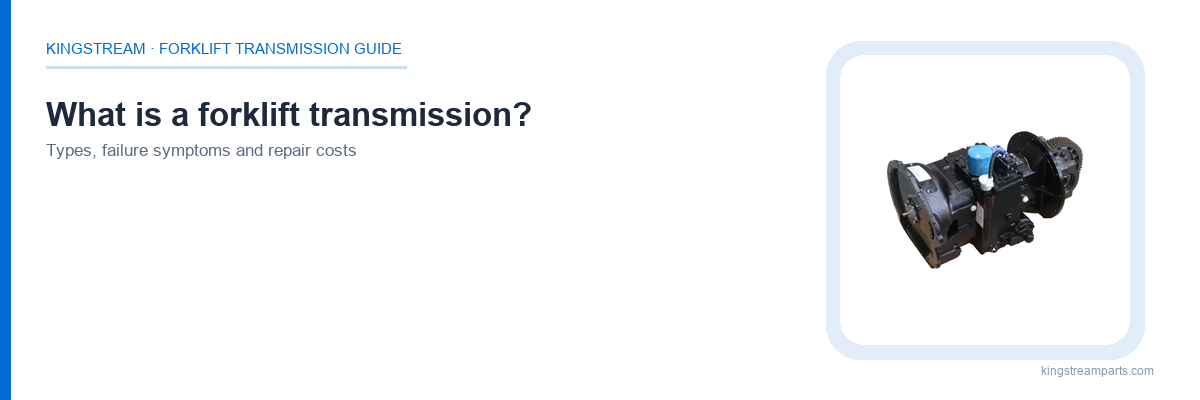
A forklift transmission is the power-transfer unit between the engine or motor and the drive axle. It converts engine rotation into the wheel speed and torque that move the truck. Counterbalance forklifts use one of three designs: hydraulic automatic, mechanical manual, or hydrostatic.
Hydraulic (automatic) torque-converter transmissions
The hydraulic torque-converter is the dominant design for counterbalance forklift transmissions. A torque converter transfers power through hydraulic fluid, so the transmission shifts itself and the operator never touches a clutch. One lever reverses direction, which suits docks where forward-reverse cycling is constant.
Mechanical (manual) gearbox
Older and smaller units use a mechanical gearbox with a foot clutch and gear lever, much like a car. It costs less to build and repair, but demands more operator skill and slows high-cycle loading work.
Hydrostatic drives
Hydrostatic drives pair a hydraulic pump with a motor for infinitely variable speed without gear changes. They appear on compact and warehouse equipment, where precise inching matters more than raw cost, but component prices run higher.
By the Numbers
- 3 transmission designs cover counterbalance forklifts: hydraulic, mechanical, hydrostatic
- 1910.178 OSHA regulation governing powered industrial truck operation (OSHA, n.d.)
- 2020 revision of the ANSI/ITSDF B56.1 safety standard for industrial trucks (ITSDF, 2020)
- 2015 SAE technical paper, no. 2015-01-2830, on torque-converter driveline analysis (Agarwal et al., 2015)
Glossary
- Torque converter – a fluid coupling that transfers engine power to the transmission hydraulically, enabling automatic shifting
- Counterbalance forklift – the standard forklift configuration, with forks in front and a heavy counterweight at the rear
- Hydrostatic drive – a pump-and-motor drive that varies speed continuously without a mechanical gearbox
Forklift transmissions move power from the engine or motor to the drive axle through one of three designs: hydraulic torque-converter, mechanical gearbox, or hydrostatic. Because a worn or mismatched unit creates a hazard on busy docks, the equipment is regulated. OSHA 29 CFR 1910.178 sets the operating requirements for powered industrial trucks, and ANSI/ITSDF B56.1-2020 is the current design and maintenance standard for them (OSHA, n.d.).
Types of forklift transmissions
Three types of forklift transmission (N = 3) dominate the market: hydraulic (automatic torque converter), mechanical (manual), and hydrostatic (Agarwal et al., 2015). That one-line answer settles most buyer questions. The right pick depends on duty cycle, operator comfort, and total cost of ownership.
Hydraulic transmission: components and use case
The hydraulic transmission is the standard on counterbalance forklifts. A torque converter couples the engine to the gearbox through fluid, so the machine creeps forward and reverses without clutching. Shifting is automatic, keeping both hands free for steering and mast controls. The trade-offs are real: more components, more weight, and more heat to manage.
Mechanical gearbox: when it still wins
Mechanical transmissions use direct gear engagement with a clutch pedal or manual shuttle. They cost less to buy and less to rebuild, run cooler, and tolerate rough use. The penalty shows in tight maneuvering, where each directional change demands a clutch action and the driveline can surge. Budget fleets and outdoor yards still favor them.
Hydrostatic: smooth and precise
Hydrostatic drives replace gears with a hydraulic pump and motor pair. Speed is infinitely variable, no gear shifting happens at all, and control feel is the most precise of the three. That makes them the default for indoor and compact work. Efficiency drops at sustained high speed, and first cost runs higher than a manual box.
| Transmission type | Coupling method | Shifting | Low-speed torque | Common duty | Typical cost/complexity |
|---|---|---|---|---|---|
| Hydraulic (torque converter) | Fluid coupling | Automatic forward and reverse | High and smooth | Counterbalance loaders | Higher: more parts, more heat |
| Mechanical (manual) | Direct gear engagement | Clutch pedal or manual shuttle | Direct and strong | Outdoor and budget fleets | Lower: simpler build |
| Hydrostatic | Pump and motor pair | None, infinitely variable | Precise and stepless | Indoor and compact trucks | Higher: refined control |
Hydraulic torque-converter, mechanical manual, and hydrostatic drives are the three forklift transmission types. Hydraulic units, the counterbalance default, shift automatically and deliver high torque at low speed; mechanical gearboxes trade smoothness for lower cost; hydrostatic drives vary speed infinitely with no shifting. Design and safe operation follow ANSI/ITSDF B56.1-2020 and OSHA 29 CFR 1910.178 (OSHA, n.d.).
Common forklift transmission problems and symptoms
If your forklift won’t move forward or reverse at all, the fault usually sits in the torque converter or the input clutch and shuttle pack. When only one direction fails, look first at the directional control valve or the clutch seals in that circuit. The diagnostic breakdown below maps the four most common forklift transmission problems (N = 4) to the parts most likely to cause them.
Rule of thumb: check fluid level and condition before any component-level diagnosis, and swap the filter while you’re at it. Low or contaminated transmission fluid reproduces most of these symptoms and is the cheapest fault to rule out.
No forward or reverse
When neither direction engages, the torque converter is likely failing to transmit power, or the input clutch and shuttle pack is not locking up.
- Step 1: Check forklift transmission fluid level and pump pressure first; low pressure starves both clutches.
- Step 2: If pressure reads normal, inspect the converter and input clutch for wear or internal leaks.
Slipping or weak drive
Slipping shows up as engine rev without matching travel, usually worse under load and on a ramp.
- Confirm fluid level and condition; fluid that smells burnt points to worn clutch discs.
- Test the truck on a slope under load. A converter that slips only when hot has internal wear.
Hard shifts and shudder
Abrupt, jerky shifts and a shudder on engagement point to the shift valves or clutch apply timing, not the engine.
- Check directional control valve adjustment and look for sticky shift valves.
- Contaminated fluid starves the valve body. Flush and replace the filter before pulling the transmission.
Fluid leaks and overheating
A hot or leaking transmission is usually a secondary failure. Seals and gaskets drip, low fluid causes slippage, and slippage generates heat.
- Inspect shaft seals and gaskets for drips, and confirm the cooler circuit is not blocked.
- An overheating transmission sits low on fluid or has a clogged cooler. Fix the cause before the clutch pack burns.
Per OSHA 29 CFR 1910.178, powered industrial trucks must be examined before being placed in service, and at least daily (OSHA, n.d.). A truck found unsafe must be removed from service and repaired before returning to work.
That daily check catches many forklift transmission problems before they strand a machine.
See what we would find
Visually identical transmission parts carry different OEM numbers across Toyota, Clark, Hyster, Crown, Komatsu and Doosan, so a match is confirmed by truck identity plus number, not by shape. Send our parts team the make, model, serial and OEM number, and we will cross-reference the right unit across the 14 major brands we cover, with a fast quotation. Send your transmission part numbers
Forklift transmission parts: what’s inside
Every forklift transmission splits into two sides. The mechanical side carries the clutch disc, pressure plate and release bearing. The hydraulic side carries the torque converter, control valve, idler gear and shafts inside the gearbox housing. Both sides are ordered by OEM part number, never by generic name.
Clutch disc, pressure plate and release bearing
These three parts form the clutch pack. The disc carries the drive, the pressure plate loads it, and the release bearing disengages it when the pedal is pressed. They wear as a set, so replace all three together.
Torque converter and housing
The torque converter couples the engine to the gearbox hydraulically. It multiplies torque at low engine speed, so a loaded truck can creep without stalling. Complete torque converters and hydraulic transmission assemblies cover the hydraulic side.
Control valve, idler gear, shafts and housing
The control valve routes pressurized fluid to the clutch packs, while the idler gear and shafts carry torque to the axle. Match the OEM number and forklift transmission model together, not just the visual shape. The gearbox assembly category covers the mechanical side.
By the Numbers
- 3 wear parts on the clutch side: disc, pressure plate, release bearing
- 2 sides in every transmission: mechanical and hydraulic
- 6 manufacturers whose similar parts differ by OEM number: Toyota, Clark, Hyster, Crown, Komatsu, Doosan
Glossary
- Torque converter: the hydraulic coupling between engine and gearbox.
- Pressure plate: the plate that presses the clutch disc against the flywheel.
- Control valve: routes pressurized fluid to the clutch packs.
- Idler gear: the intermediate gear inside the gearbox.
A forklift transmission is ordered by OEM part number, not by generic name, because visually similar parts differ across six manufacturers (N = 6): Toyota, Clark, Hyster, Crown, Komatsu and Doosan. ANSI/ITSDF B56.1-2020 and OSHA 29 CFR 1910.178 require trucks to be maintained in safe condition, so replacing worn transmission parts is a compliance step (OSHA, n.d.).
Forklift transmission repair costs: rebuild vs replace
There is no single published answer to how much a forklift transmission repair costs, because the bill is set by three variables: how deep the failure runs, the shop’s labor rate, and whether a matching exchange unit is available. Published estimates for a full transmission overhaul run from roughly $1,800 to $5,000, a wide band because teardown often reveals more damage than a first inspection catches (FleetRabbit, 2026). One limitation of this guide is that repair cost figures vary by region, dealer, and fleet, so treat any figure here as a planning estimate, not a quote.
What a buyer can decide in advance is the route: rebuild the existing transmission, exchange it for a remanufactured unit, or buy new. We compared the three routes side by side and shaped them into the decision framework we recommend: cost, warranty, downtime, and remaining truck life.
Rebuild: parts + labor economics
A rebuild repairs the existing unit: new clutch discs and seals, plus a serviced torque converter, reinstalled in the original housing. It wins on cost when the housing and shafts are sound, because the parts basket is small and the original fit is preserved. Most of the bill sits in labor: removal and reinstallation, which take the forklift transmission out of service.
Replace with new vs remanufactured
A remanufactured exchange swaps the damaged unit for a prebuilt core returned to like-new specification, with a stated warranty. Choose it when housing damage or heavy internal wear makes a rebuild uneconomic. Counter to what many buyers expect, a new unit is the least common route: pick it only when no exchange core exists and the truck’s remaining life justifies the outlay.
Warranty and lifecycle comparison
That warranty gap is why a decision framework beats a bare price. A remanufactured or new forklift transmission carries a stated warranty period, while an in-shop rebuild typically covers only the parts supplied. Warranty terms vary by supplier, so check the stated coverage in writing before committing.
| Decision factor | Rebuild | Remanufactured | New |
|---|---|---|---|
| Cost drivers | Labor hours plus parts basket: discs, seals, converter | Core exchange plus removal and reinstall labor | Highest parts cost |
| Deciding factor | Housing and shafts sound, wear limited to internals | Housing damage or heavy internal wear | No exchange core, truck life justifies |
| Warranty | Typically none on the work | Stated warranty on the unit | Stated warranty, longest term |
| Downtime | Tied to shop labor availability | Shortest: unit ships, core returned | Waits on parts availability |
| Choose when | Lower parts cost, keeps original fit | Like-new spec with warranty | Last resort, rarely justified |
Get a diagnosis before a quote. The rebuild-vs-replace call hinges on housing condition and labor hours, not just parts cost.
Forklift transmission repair cost has three drivers: failure depth, labor rate, and parts availability (FleetRabbit, 2026). A rebuild reusing the housing is cheaper when wear stays limited to clutch discs and seals, while a remanufactured exchange carries a stated warranty an in-shop rebuild rarely matches. OSHA 29 CFR 1910.178 inspection rules apply to the truck once it returns to service (OSHA, n.d.).
Forklift transmission fluid and maintenance
The correct forklift transmission fluid is the one listed on your truck’s data plate and in its operator’s manual. No generic brand overrides the manufacturer spec. Wrong fluid makes the transmission slip and run hot.
Correct fluid type and oil grade
Most hydraulic and automatic units run on a hydraulic transmission fluid or the manufacturer-specified ATF/Dexron-equivalent. The data plate is the authoritative source for the forklift transmission fluid type. When in doubt, check the plate before you buy.
Oil capacity and change interval
Forklift transmission oil capacity and grade vary by make, model, and year, so a figure from one truck does not transfer to another. Follow the OEM schedule, which is hours based and listed in the operator’s manual. Change the fluid early when it runs hot, looks dirty, or smells burnt, regardless of the interval.
Filter and level checks
Level checks happen at operating temperature with the engine running, exactly as the manual says. Inspect the filter element at each change and note what the drained fluid looks like.
Maintenance checklist:
- Confirm the fluid spec on the data plate first, and use the OEM grade, never a universal substitute.
- Drain at the OEM service interval (hours based) and swap the filter with every change.
- Change early if the fluid is hot, dirty, or burnt-smelling.
- Check the level with the engine running, then inspect drained fluid for metal particles.
Maintenance is not optional. OSHA 29 CFR 1910.178 requires that powered industrial trucks be examined before daily use and maintained in safe operating condition (OSHA, n.d.). Following the OEM hours-based service interval for forklift transmission fluid and filter changes keeps a unit within that standard and prevents the slipping and heat caused by wrong fluid.
How to source the right forklift transmission parts
Order by OEM part number, truck make and model, and transmission type. Never rely on a generic description. Visually identical parts differ across brands (Toyota, Clark, Hyster, Crown, Komatsu, Doosan).
Read the OEM part number correctly
The OEM number is the most reliable identifier. Find it on the part or serial plate and match it against the catalog.
Cross-reference by make and model
Confirm the truck make, model, and serial, plus the transmission model, before ordering forklift transmission parts. That combination, not a photo, confirms a match.
What to check before you buy
- OEM number: confirm it exactly.
- Truck identity: make, model, serial.
- Transmission type: hydraulic, mechanical, or hydrostatic.
- Warranty: confirm the terms; if uncertain, send the truck identity (make, model, serial) plus the OEM number to our parts team.
Browse the hydraulic transmission and gearbox assembly categories to start.
Ordering forklift transmission parts by OEM number plus truck identity prevents mismatches across brands (Toyota, Clark, Hyster, Crown, Komatsu, Doosan) where visually identical parts carry different numbers. Kingstream confirms cross-references for buyers who send the truck identity and OEM number.
Frequently Asked Questions
What type of transmission does a forklift use?
Most forklifts use a hydraulic automatic transmission built around a torque converter. It smooths power from the engine to the drive train and lets the truck shuttle without clutching. Mechanical gearboxes turn up on smaller and older units, while hydrostatic transmissions dominate compact warehouse machines. (Agarwal et al., 2015)
How much does it cost to repair a forklift transmission?
Repair cost depends on the damage and the route. A full overhaul typically runs from roughly $1,800 to $5,000 as a regional planning estimate, but the route matters more than the sticker (FleetRabbit, 2026). An in-shop rebuild keeps your original unit, a remanufactured exchange swaps a rebuilt one, and a new transmission is the most expensive route. Housing condition, labor hours, parts availability, and warranty set the final figure, so run a full diagnosis before committing.
What are the three types of transmission?
Forklifts use three transmission types: hydraulic, mechanical, and hydrostatic. Hydraulic units with torque converters are the standard on counterbalance trucks. Mechanical gearboxes serve lighter and older models. Hydrostatic drives, with no fixed gears, are common on compact and warehouse equipment.
Why won’t my forklift move forward or reverse?
Start with fluid level, condition, and filter, since a low or dirty fill stops the truck cold. If neither direction works, suspect the torque converter or the clutch and shuttle pack. If only one direction fails, the directional control valve or clutch seals are the likely culprits.
What transmission fluid does a forklift take?
Use the hydraulic transmission fluid or ATF-equivalent specified in the truck’s manual or data plate. Every manufacturer sets its own spec, and the wrong fill can damage the clutch pack. Never substitute a generic guess; confirm the part number before topping up.
How do I know if my forklift transmission is bad?
Watch for slipping under load, loss of forward or reverse, hard or delayed shifts, shudder during direction changes, external leaks, and overheating. Burnt-smelling or metal-flecked transmission fluid is a strong warning that internal wear is underway.
Most counterbalance forklifts run a hydraulic automatic transmission with a torque converter, while mechanical gearboxes persist on smaller and older units and hydrostatic drives handle compact warehouse machines. When a truck loses forward or reverse, fluid level and filter come first, then converter, clutch, and valve checks.
Conclusion
Forklift transmission failure is expensive but predictable. Match the type to your truck, read the symptoms as a first diagnosis, and choose the repair route on housing condition and labor hours rather than on sticker price alone. Order parts by OEM number, follow the OEM hours-based fluid and filter schedule, and check the level before every shift. That sequence keeps a transmission working and a lift truck in service.
References
- Agarwal, S., Olson, M., Meehan, T., & Wadwankar, N. (2015). Fuel economy comparison studies of forklift transmission architecture (SAE Technical Paper No. 2015-01-2830). SAE International. https://doi.org/10.4271/2015-01-2830
- OSHA. (n.d.). 29 CFR 1910.178: Powered industrial trucks. Occupational Safety and Health Administration. https://www.osha.gov/laws-regs/regulations/standardnumber/1910/1910.178
- ITSDF. (2020). ANSI/ITSDF B56.1-2020: Safety standard for low lift and high lift trucks. American National Standards Institute. https://blog.ansi.org/ansi/ansi-b56-1-2020-itsdf-safety-standard-trucks/
- FleetRabbit. (2026). Reducing cost overruns on major forklift component repairs. https://fleetrabbit.com/industry/manufacturing-fleet/reducing-cost-overruns-major-forklift-component-repairs
Last reviewed and updated: August 2026. Author: Kingstream team. For tailored guidance, contact our team.