
TL;DR
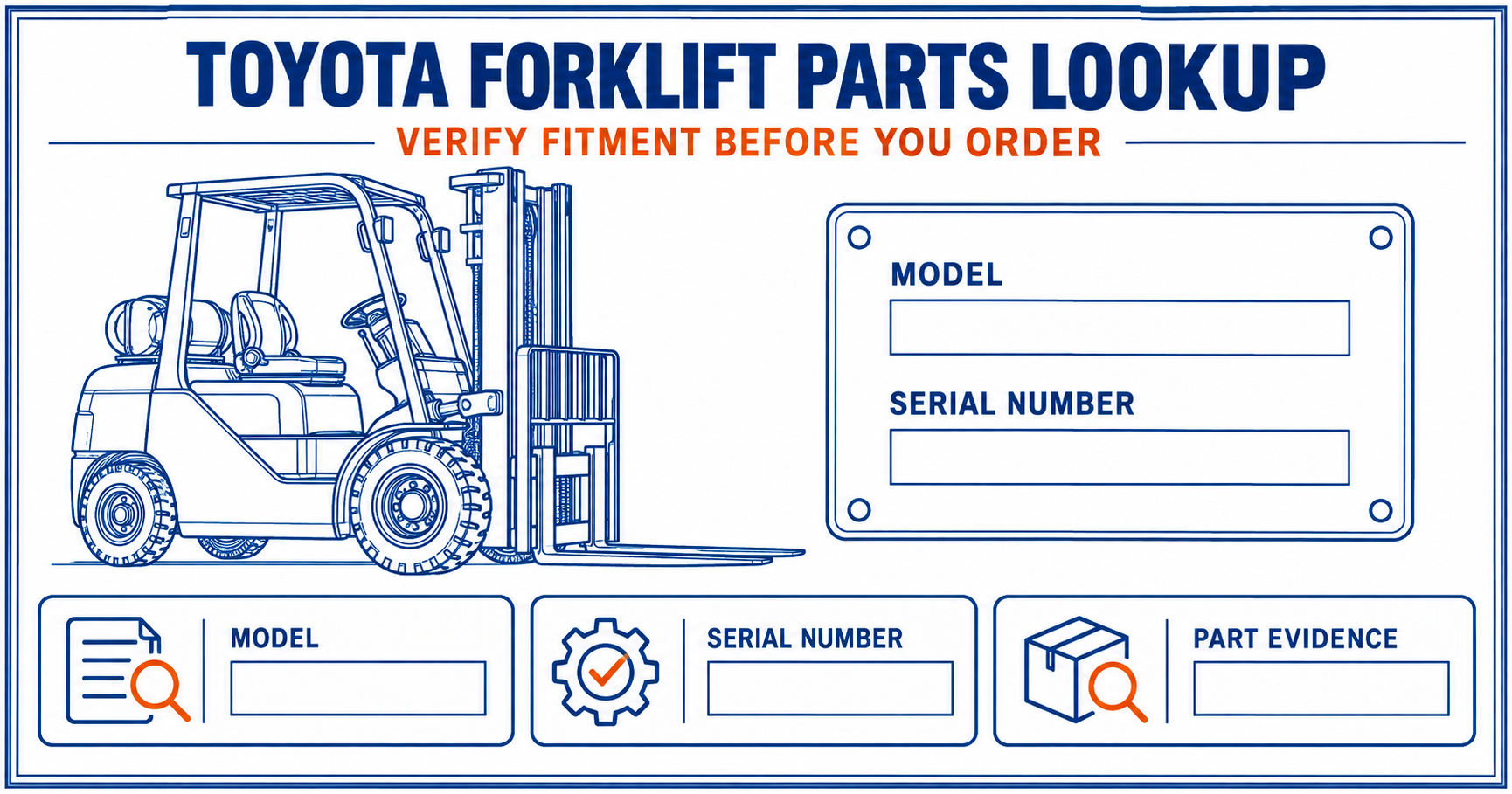
Start with the Toyota forklift model and complete serial number. Then choose the catalog, diagram or manual that matches the question, photograph the installed part and send a supplier-ready fitment packet. If the evidence conflicts or a key identifier is missing, pause the order and request a fitment review.
Key Takeaways
- Model and serial come before catalog browsing.
- Catalog, diagram and manual answer different questions.
- Installed-part evidence supports the component match.
- A visual match is not complete fitment proof.
- Pause when a required identifier or confirmation is missing.
Table of Contents
- Key Takeaways
- Toyota forklift parts lookup: the answer first
- Step 1: Record the Toyota forklift model and serial number
- Step 2: Choose the right reference: catalog, diagram, or manual
- Step 3: Match the part using numbers and installed-part evidence
- Step 4: Prepare a supplier-ready Toyota forklift parts quote packet
- Common Toyota forklift parts lookup mistakes to avoid
- When to pause the order and request a fitment review
- FAQ: Toyota forklift parts lookup questions
- Conclusion: verify the truck, then verify the part
- References
Toyota forklift parts lookup: the answer first
Start with the truck, not the part photo. For a reliable Toyota forklift parts lookup, record the complete model designation and serial number, note the equipment family and power source, then collect evidence from the installed component. A broad Toyota label, capacity badge, or similar-looking listing is only a starting clue.
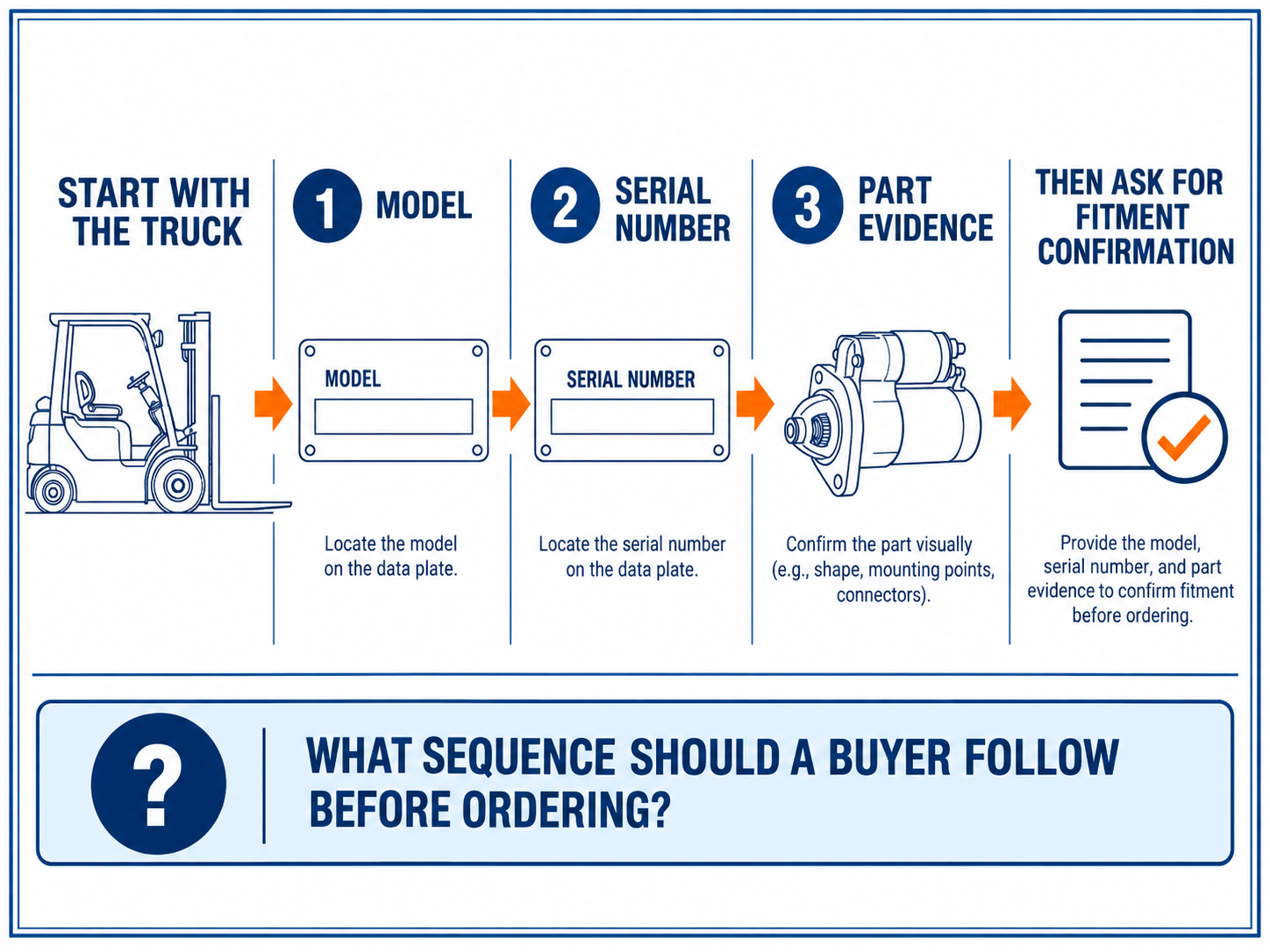
The minimum lookup packet contains four items:
- Truck identity: the exact Toyota model designation and complete serial number from the data plate.
- Equipment route: electric or internal combustion, plus the machine type and any relevant attachment or configuration.
- Component evidence: the installed part’s label, casting or OEM number, connector layout, mounting pattern, and clear photos.
- Request context: where the part is installed, what it is doing, and whether the request is for replacement, maintenance, or identification.
Toyota’s parts-service guidance uses model and serial information to identify the equipment and support replacement-parts lookup. It does not turn every part listed for a Toyota family into a universal fitment. Exact component fields still need to be checked against the unit, applicable reference, or supplier fitment review.
Lookup rule: Model and serial identify the truck. The installed-part record identifies the component. Use both before treating a Toyota forklift parts lookup as ready for a quote.
If the model or serial is missing, the data plate is unreadable, or the component evidence conflicts with the proposed listing, pause the order. The next useful action is a fitment review, not another broad search.
Step 1: Record the Toyota forklift model and serial number
The first step is to make the equipment identity exact. Copy the model designation and serial number directly from the data plate or other manufacturer identification record. Keep every letter, number, hyphen, and leading zero. Do not replace the full designation with a family label such as “8F,” a capacity description, or a fleet nickname.
Where the identification starts
Look for the equipment data plate in the operator area or another location identified for that truck. If the plate is dirty or damaged, clean the viewing area carefully and take a straight, well-lit photo. Do not guess characters that are hidden by glare or wear. Send the unclear image to the supplier and mark the uncertain characters instead of silently correcting them.
Toyota’s official parts guidance explains that the model and serial combination is used to identify the particular equipment and look up replacement parts. That makes the pair more useful than a model name by itself. The serial is not a decorative field to add later. It is part of the first lookup record.
What to copy exactly
Create a small record with these fields:
- Manufacturer: Toyota
- Model designation: exact text from the plate
- Serial number: complete text from the plate
- Power source: electric or internal combustion, if clear
- Equipment type: counterbalance, warehouse, reach, pallet, or another route
- Market or site information: only when the supplier asks for it
- Photo of the full plate and a close-up of the characters
Use the equipment family and power source to choose the right reference branch. Treat them as routing clues, not as final component compatibility. A parts catalog opened under the wrong family can return plausible-looking results that do not apply to the unit in front of you.
Identification check: The record is ready for the next step when another person can read the model and serial from your note and compare them with the data-plate photo without guessing.
Step 2: Choose the right reference: catalog, diagram, or manual
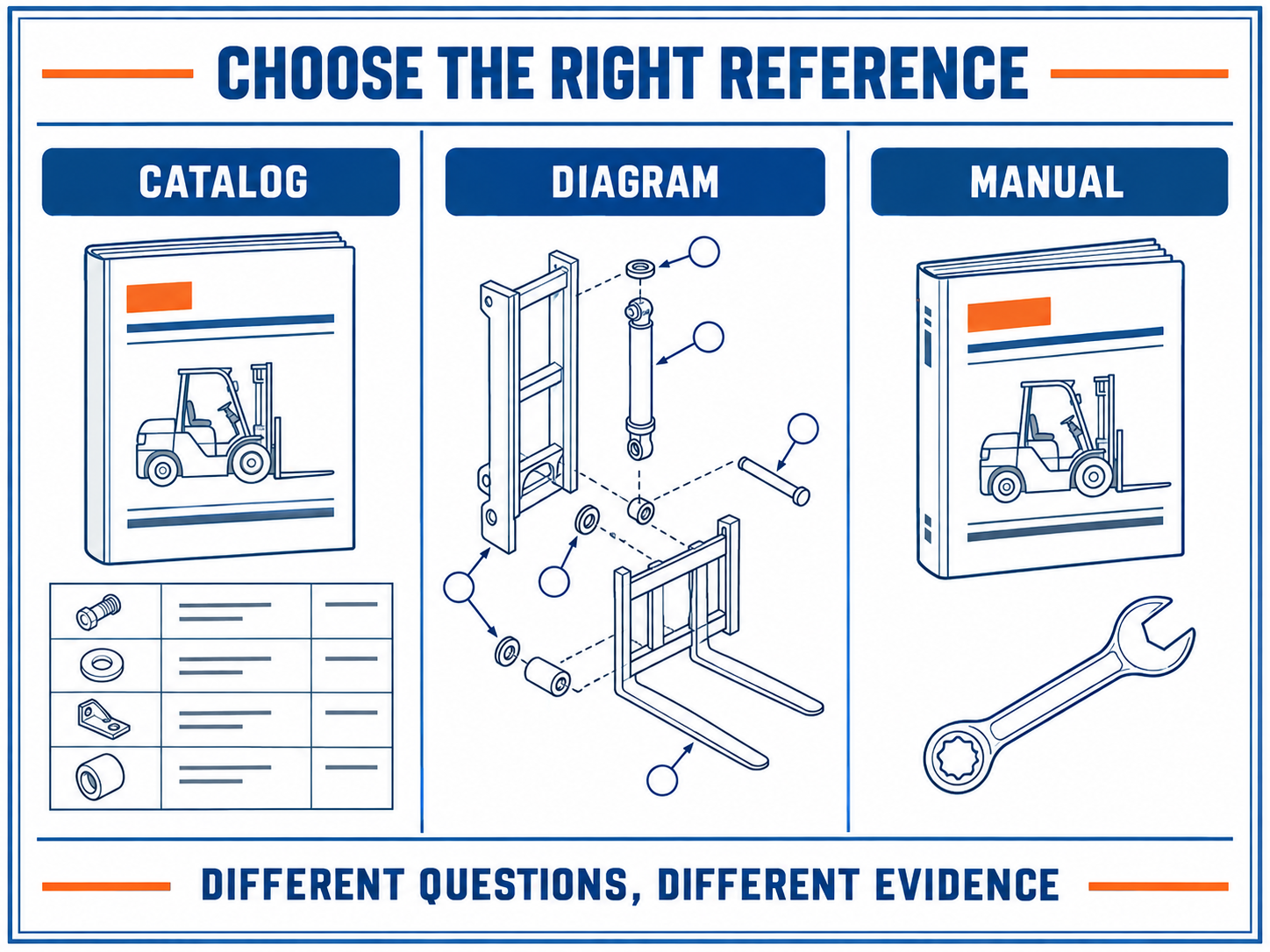
“Toyota forklift parts catalog,” “Toyota forklift parts diagram,” and “Toyota forklift manual” are related searches, but they do not describe the same job. Choose the reference according to the question you need to answer. Then keep the model and serial record attached while you work.
| Reference | Use it for | What it can help you find | What it does not prove by itself |
|---|---|---|---|
| Parts catalog | Browsing part families and listed references | Category, assembly name, part number, or replacement route | That a listed item fits every truck with the same brand or series label |
| Exploded parts diagram | Understanding assembly position and neighboring components | Item location, assembly relationship, and diagram callout | That the diagram applies to your exact serial range or configuration |
| Repair or service manual | Maintenance procedure, inspection, and repair instructions | Service sequence, warnings, adjustment information, or model-specific procedure | That the repair procedure is the correct replacement-parts lookup for a different unit |
Catalog versus diagram
A catalog is usually the faster starting point when you know the component family or have a part number. A diagram is useful when you know where the component sits in an assembly but do not know its name. Use the diagram to understand the assembly and its callout, then verify the callout against the model, serial range, and applicable catalog record.
When a manual is the better reference
Open a manual when the main question is how to inspect, remove, adjust, or service a component. Do not use “manual” as a substitute for fitment evidence. A repair instruction can explain a procedure while leaving the exact replacement reference dependent on the truck identity and parts record.
The important boundary is simple: a catalog or diagram helps you locate a candidate reference; the model, serial, installed-part evidence, and supplier confirmation decide whether that candidate should be quoted.
One more thing
For fleet maintenance managers who want one sourcing route, Kingstream Parts is a single-source forklift parts supplier covering 14 major brands, with OEM-compatible forklift parts backed by fast quotation. Request forklift parts sourcing support
Step 3: Match the part using numbers and installed-part evidence
Once the truck identity is fixed, move to the component. If the old part has an OEM number, casting mark, supplier number, or readable label, photograph it before removing or discarding the unit. Send the number exactly as shown, including suffixes and separators. A partial number can be useful, but label it as partial.
Part-number and cross-reference evidence
Ask the supplier to explain what the proposed number represents. It may be an original equipment reference, an aftermarket cross-reference, a component-only number, or an assembly number. Those are not interchangeable descriptions. Request the source of the cross-reference and ask whether the proposed item includes related pieces such as a connector, sensor, solenoid, gasket, seal, or mounting hardware when that distinction matters to the order.
Photos that reduce ambiguity
For most component lookup requests, prepare:
- One clear photo of the full installed part and its position on the truck.
- One close-up of every label, casting mark, or number.
- Photos of connectors, terminals, hoses, ports, brackets, mounting holes, and orientation.
- A side view showing the relationship between the component and nearby parts.
- A ruler or measured value only when the supplier asks for a dimension, with the measurement method stated.
- A photo of the equipment data plate linked to the same request.
Do not infer voltage, dimensions, rotation, connector type, mounting offset, or other component values from a stock photo. These are exact-unit fields. The supplier or applicable manual must confirm them for the proposed replacement.
What remains supplier-confirmed
Ask for a written response that connects the proposed part to the Toyota model and serial, identifies the evidence used, lists unresolved fields, and states whether the quote covers the complete assembly or one component. If the supplier cannot make that connection, keep the lookup open.
Evidence check: A part number is strongest when it agrees with the model and serial record, the installed-part photos, the assembly reference, and the supplier’s fitment response. One matching field is not a complete match.
Step 4: Prepare a supplier-ready Toyota forklift parts quote packet
The best Toyota forklift parts lookup request is short but complete. Put the identifying information in the message, attach the photos in a logical order, and ask the supplier to return the unresolved fitment fields instead of forcing you to guess them.
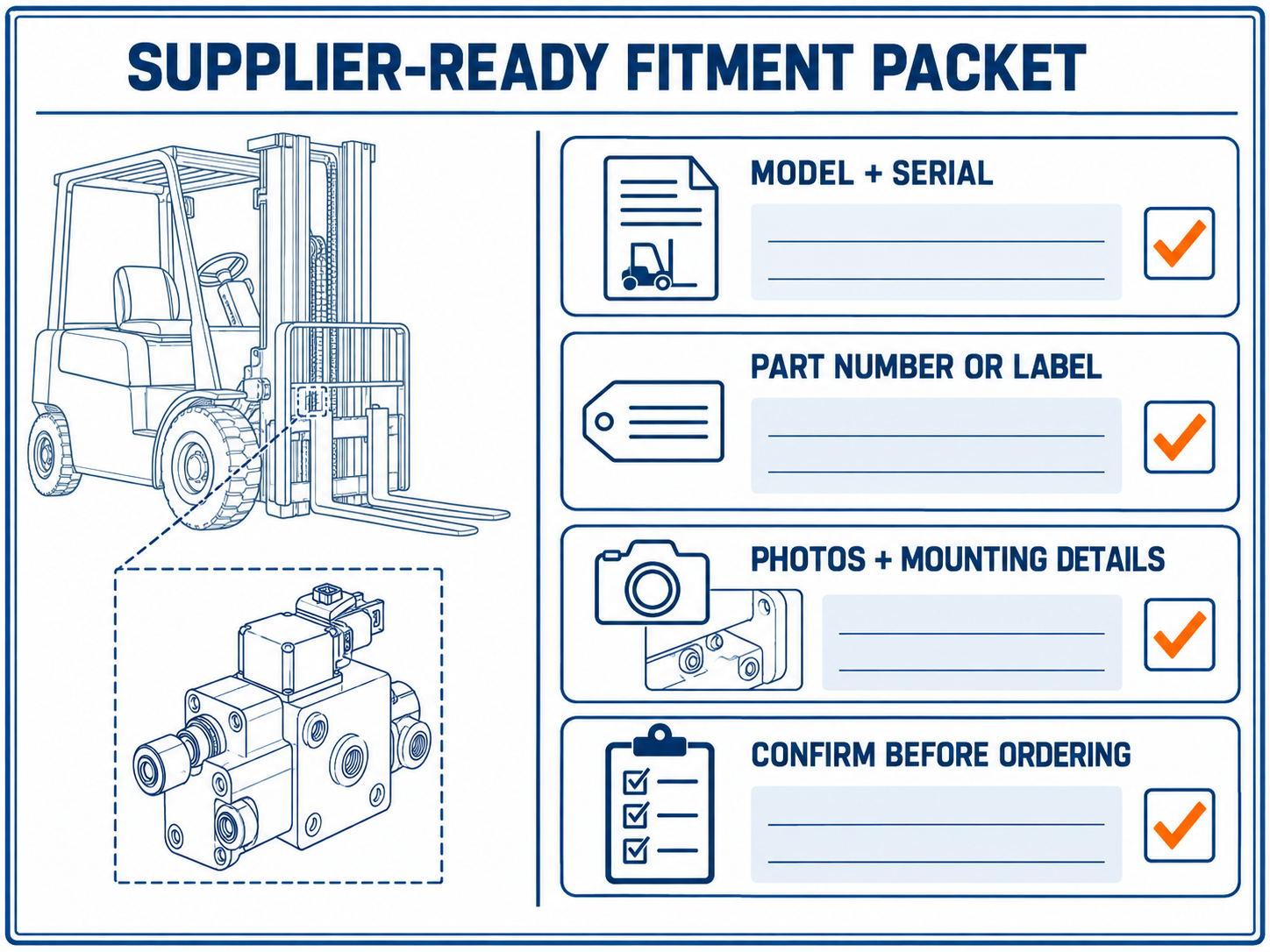
The message to send
You can use this structure:
Toyota forklift part lookup request
Model: [exact model designation]
Serial: [complete serial number]
Equipment and power source: [what is known]
Part requested: [component name, if known]
Existing number: [OEM, casting, or supplier number, or “not visible”]
Reason: [replacement, maintenance, damage, or identification]
Attachments: data-plate photo, installed-part photos, number close-up, and relevant assembly view.
The supplier checks to request
Ask the supplier to confirm the exact catalog or diagram reference, the proposed part number, and the fitment basis. Ask whether the quote is for a complete assembly or a component. If the part has electrical or mechanical specifications that affect compatibility, ask the supplier to state which fields were verified and which still require manual or technician confirmation.
Keep availability, warranty, lead time, return terms, and any commercial conditions in a separate part of the reply. Those are quote-stage details, not proof that a part fits. The same rule applies to an attractive price or a broad “fits Toyota” statement.
The packet is complete enough to move forward when the supplier can point from the truck identity to the proposed part and identify any remaining uncertainty in writing.
Common Toyota forklift parts lookup mistakes to avoid
Searching by brand only
“Toyota forklift” is not a complete fitment record. Add the exact model and serial before comparing a component listing. A broad brand search is useful for finding the right type of reference, not for approving a part.
Searching by a capacity label only
Capacity, tire type, or a generation label can help narrow the search, but it does not replace the data plate. Use those details to route the research, then return to the exact truck identity.
Confusing a diagnosis with a lookup
A symptom can explain why a part is being considered, but it does not name the failed component. A no-start, leak, warning light, or unusual noise can involve more than one system. Keep the diagnosis question separate from the parts lookup request.
Copying a number without its scope
A number from a diagram, listing, or old invoice is useful only when its assembly, model range, and serial applicability are clear. Ask what the number covers and whether it identifies a complete assembly or one replaceable piece.
Treating a visual match as final proof
A stock image can hide connector, mounting, orientation, or internal differences. Use photos to help the supplier investigate, not to remove the need for fitment confirmation.
When to pause the order and request a fitment review
Pause the order when a field could change compatibility and remains unknown. This includes a missing or unreadable serial number, conflicting part numbers, a component that appears modified, an unclear connector or mounting pattern, and a listing that names only a Toyota family without explaining its application.
Also pause when the requested component is being chosen only because of a symptom. The supplier may need to separate the component from a relay, cable, battery, control, hydraulic circuit, attachment, or another nearby system. That is a diagnosis boundary, not a reason to guess.
Send the missing photo, measurement, manual reference, or data-plate detail and ask what the supplier needs to complete the review. A short delay is preferable to approving a part whose evidence points to a different truck or assembly.
Stop condition: If the truck identity, component evidence, and proposed replacement do not tell the same story, the Toyota forklift part is not ready to order.
FAQ: Toyota forklift parts lookup questions
How can I search for forklift parts?
Start with the equipment manufacturer, exact model designation, and complete serial number. Add the component name or installed-part number if known. Then choose a catalog or diagram that matches the equipment route and ask the supplier to confirm the proposed reference against the same truck.
How can I identify a forklift part number?
Photograph the installed part’s label, casting, or number. If it is missing, send clear photos of the component, its connectors, mounting, position, and nearby assembly. A supplier can use those details to investigate, but a visual match alone is not a final fitment decision.
Where can I find spare parts for my Toyota forklift?
Use the manufacturer’s parts route, a qualified dealer, or an experienced forklift-parts supplier. Wherever you search, carry the model and serial record with the request. A catalog page or marketplace listing is only useful when its application and fitment evidence match the exact truck.
Where can I find a forklift parts catalog?
Look for the applicable manufacturer or supplier catalog after identifying the truck. If you need assembly position, use an exploded diagram. If you need removal or inspection instructions, use the service manual. These references support different questions and should not be treated as interchangeable.
Conclusion: verify the truck, then verify the part
A dependable Toyota forklift parts lookup follows one order: record the model and complete serial number, choose the catalog or diagram that matches the question, document the installed component, and ask the supplier to confirm fitment before you order. If a key identifier or component field is missing, keep the request in fitment review rather than turning an assumption into a purchase.
The goal is not to collect the longest list of Toyota parts. It is to create a traceable link between one truck, one component, and one confirmed quote.
References
- Toyota Material Handling. (n.d.). Forklift repair, service, & maintenance. Retrieved September 22, 2026, from https://www.toyotaforklift.com/parts-and-service
- Toyota Material Handling. (n.d.). Finding your model and serial number. Retrieved September 22, 2026, from https://www.toyotaforklift.com/help/mytoyota-store/articles/22978549001627-finding-your-model-and-serial-number
- Toyota Material Handling. (2018, March 28). Guide to common forklift replacement parts. Toyota Forklifts Blog. Retrieved September 22, 2026, from https://www.toyotaforklift.com/resource-library/blog/parts-and-service/guide-to-common-forklift-replacement-parts
Last reviewed and updated: September 2026. Author: Kingstream team. For tailored guidance, contact our team.