
TL;DR
Replace worn forklift brake pads in five steps: secure the truck, remove the wheel, pull and inspect the shoes, swap the friction material and check the drum, then bleed and test. Budget $10-$130 for parts; a complete brake job typically runs $800-$1,500 (the 2026 dealer survey puts a full job at $1,080 at $180/hr). Blow dust out every 250 hours, inspect drums at 2,000, and replace shoes at 5,000-7,000 hours.
Abstract
A step-by-step guide to inspecting and replacing forklift brake pads and shoes: the tools and safety sequence; how to tell worn friction material from serviceable; drum and rotor checks; bleeding; and a realistic parts-and-labor cost picture ($10-$130 in parts; $800-$1,500 complete).
Key Takeaways
- Inspect the brake drums every 2,000 hours; replace the shoes at 5,000-7,000 hours
- Blow brake dust out every 250 hours to protect the drums
- Grinding means steel-on-iron – budget for drums or rotors as well
- Parts are only $10-$130, but a complete brake job runs $800-$1,500
- Bleed the lines after reassembly or the pedal stays spongy
Table of Contents
- Abstract
- Key Takeaways
- By the Numbers
- Before You Start: Tools, Safety, and What This Job Costs
- Step 1: Prepare and Secure the Forklift
- Step 2: Remove the Wheel and Access the Brake Assembly
- Step 3: Remove and Inspect the Brake Shoes or Pads
- Step 4: Replace the Friction Material and Check the Drums
- Step 5: Reassemble, Bleed, and Test the Brakes
- Troubleshooting: 5 Common Forklift Brake Problems
- When to Call a Professional Instead
- FAQ
- Conclusion
- References
By the Numbers
- $10-$130 in parts for most makes
- $800 to $1,500 complete brake job with parts and labor (Intella Parts, 2026)
- $1,080 average full brake job in the 2026 dealer labor survey (Intella Parts, 2026)
- 5,000 to 7,000 operating hours between shoe replacements (Total Industries, n.d.)
- 2,000 operating hours between drum inspections (Total Industries, n.d.)
- 250 operating hours between brake dust blowouts (Total Industries, n.d.)
Before You Start: Tools, Safety, and What This Job Costs
A forklift brake pad replacement needs only basic shop tools, and the parts bill is smaller than most shops expect. Friction material runs $10 to $130 for most makes. A mechanic with basic tools can handle the job without dealer support.
Tools and parts you need
Most of these you already own; the friction material and hardware are the only purchases.
- Floor jack and jack stands
- Wheel chocks
- Lug wrench, socket set, brake spoon, and bleeder wrench
- New friction material (shoes or pads) plus springs and hardware
Safety rules for lifting and blocking
Neutralize the truck, chock the wheels, and set the parking brake before lifting. Lower the forks and mast first, then support the axle on jack stands. The truck never rests on a jack alone.
What a forklift brake job costs
| Cost item | Typical price |
|---|---|
| Friction material (shoes or pads) | $10 to $130 |
| Pair of grooved drums | About $1,650 (Total Industries, n.d.) |
| Dealer labor | $180/hr, 2026 national average (Intella Parts, 2026) |
| Complete brake job | $800 to $1,500 (Intella Parts, 2026) |
The intervals matter too: blow brake dust out every 250 hours, inspect drums at 2,000 hours, replace shoes at 5,000 to 7,000 (Total Industries, n.d.).
The 2026 Intella Parts dealer labor rate survey, published via BusinessWire, puts the national average shop rate at $180 per hour and a complete brake job at $1,080, so most forklift brake pad replacement work lands between $800 and $1,500 in total (Intella Parts, 2026). Parts alone typically run under 20% of that full-job figure; the drums, labor, and machining are the rest. Scored drums add about $1,650 a pair (Total Industries, n.d.).
Step 1: Prepare and Secure the Forklift
Forklift brake pad replacement starts with the truck secured, not a wrench. Live controls turn a routine brake job into a shop accident.
Chock the wheels and set the parking brake
Turn the key off and neutralize the transmission. Set the parking brake, then chock both sides of both drive wheels. A truck on a slight grade can creep even with the brake set, so do not trust it alone.
Lower the forks or mast before working
Run the mast and forks fully down before opening the brake area (OSHA, n.d.). A raised carriage can drop when a brake line or bleeder is disturbed. If the mast must stay up, use a rated stand.
Warning: Never reach under a raised mast or carriage. In shop reports, live controls caused accidents, including a near-miss when a reverse pedal, mistaken for a clutch, was pressed mid-service.
OSHA’s powered industrial truck standard, 29 CFR 1910.178, treats securing the unit as the precondition for service work: key off, transmission neutralized, wheels chocked, parking brake set, mast lowered or positively supported (OSHA, n.d.). Skip any one step and the forklift brake pad replacement starts under an unsafe condition.
Step 2: Remove the Wheel and Access the Brake Assembly
Most of the hours in a forklift brake pad replacement go to access, not the brake work. Break the lug nuts while the wheel touches the floor, jack the drive axle, set two jack stands, then pull the wheel.
Wheel and drum removal
Pull the drum by hand once the retaining hardware is out, and never pry against the machined face. A ridged drum grooves new shoes, so check it while off.
When the mast or floor plate blocks access
On some models the mast blocks the brake plate, and the wheel assembly or mast mount must come off first. On others the floor plate covers the drums, and owners describe taking the whole front apart. Check the service manual for your model’s access path. The access plan separates a clean forklift brake pad replacement from a second teardown.
Warning: Moving the mast or floor plate means handling a multi-ton assembly. Use a shop crane or rated stand, and keep hands clear of pinch points while moving it.
The access problem is what no parts page will tell you: the drums sit under the floor plate on the inside end of the drive motors, and on some models the mast blocks the brake plate until the wheel assembly or mast mount is removed. Plan the path before the 2,000-hour drum inspection, and the brake work is quick.
Step 3: Remove and Inspect the Brake Shoes or Pads
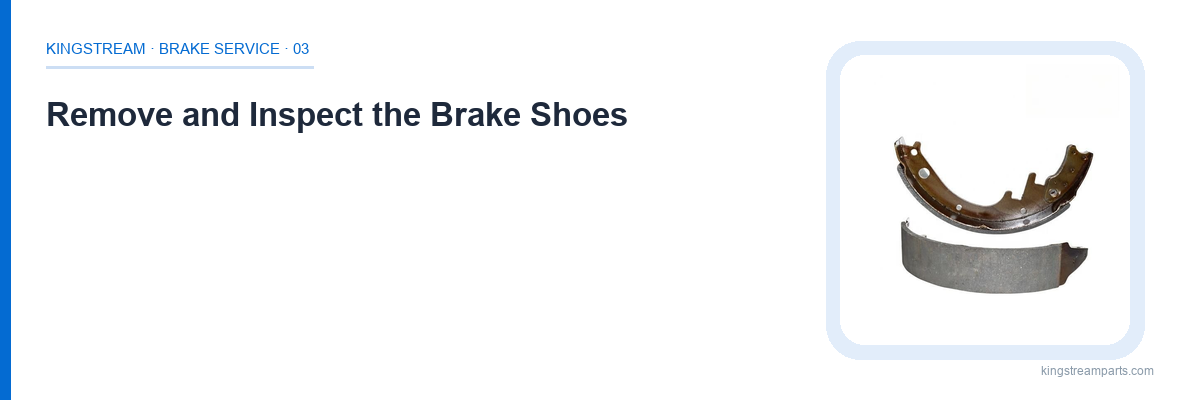
Forklift brake pad replacement starts with the inspection. Pull the shoes off the backing plates, measure the lining at its thinnest point, and read the wear pattern before ordering anything. Grinding means the friction material is gone, steel on iron, and the rotor is at risk.
A brake shoe is the curved metal carrier that presses the friction lining against the inside of the drum; the friction material is the replaceable lining, and the backing plate is the anchor the shoes pivot on. In a drum-brake forklift, replacing the pads means replacing that lining, so these three terms come up in every quote.
Removing the friction material
Release the return springs, slide each shoe off its pivot, and set the parts aside in order. Blow the brake dust out with low-pressure air and a respirator, then clean the plate with brake parts cleaner. Keep count as you go; a partial set leaves you a wheel short.
How to tell worn from serviceable
Most of a forklift brake pad replacement comes down to reading the wear patterns. Measure thickness at the thinnest point, not the middle, since one edge wears first and can reach the backing plate while the center still looks fine.
- Backing plate contact: worn out; replace it.
- Glazed lining: hard and shiny from heat; replace or refinish.
- Oil-soaked lining: dark and soft; replace, then trace the leak.
- Tapered wear: thick at one end; hardware failing.
- Metal-to-metal: no lining left; drum grooved (Conger Industries, n.d.; Lambert, 2015).
The "last hole" adjustment signal
Brake adjustment moves through the linkage holes. When you are at the last hole, the lining is used up, so order the full set at once: shoes, springs, hardware, plus drums if needed. Grinding past that point grooves the drum and turns the forklift brake pad replacement into a rotor job (Conger Industries, n.d.; Lambert, 2015).
Metal-to-metal grinding means the friction material is gone and steel is riding on iron; by then the rotor is grooved and costs are rising (Conger Industries, n.d.; Lambert, 2015).
Talk to a specialist
The friction material that fits your brake job depends on the model and brake type, and ordering the wrong part number costs an extra teardown. Send us your model and the part number you pulled, and we will send a fast quote for OEM-compatible shoes or pads from a single-source supplier covering 14 major brands. Get a quote for forklift parts
Step 4: Replace the Friction Material and Check the Drums
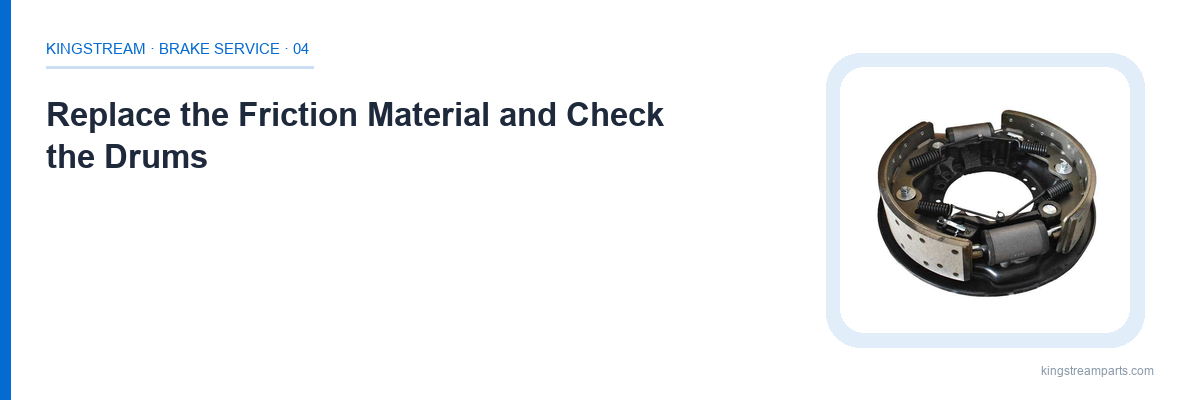
Complete a forklift brake pad replacement by swapping the friction material as a matched set, replacing the springs and hardware, and checking the drums. Linings worn to the backing plate leave grooves new pads cannot fix.
Shoe vs pad vs complete assembly
The right friction material for a forklift brake pad replacement depends on the brake type. Counterbalance trucks mostly use brake shoes in a drum; wet multi-plate systems use friction pads. Some models sell a pre-bonded complete assembly, in which the lining is bonded to the shoe rather than riveted and the bond is verified by shear testing (British Standards Institution, 2013). Owners report the pads are not riveted on and the rotor is sacrificed once the lining is gone. On a Crown 30SCTT, all eight pads are replaced when any are worn.
Drum and rotor checks
With the drum off, run a hand across the friction surface. Linings worn to the backing plate can groove the drum or rotor; a grooved drum needs machining or replacement, not a fresh set of pads alone (Conger Industries, n.d.). Ridges transfer from the shoes into the drum face, so neglect costs money.
| Condition found | What it means | Action |
|---|---|---|
| Thin lining, below service limit | Friction material spent | Replace the shoes |
| Grooved or scored drum | Metal-on-metal wear from old lining | Machine or replace the drum |
| Glazed lining | Heat-hardened surface, weak bite | Deglaze or replace |
| Oil-soaked lining | Seal or wheel cylinder leaking | Fix the leak, replace the set |
Torque and hardware
Swap the springs and hardware in the same job; new friction material on tired springs leaves the pedal lazy and shoes dragging. Torque the backing plate and wheel fasteners to spec. Caveat: torque values vary by model and year, so confirm the number against your truck’s service manual before final tightening.
Swapping the friction material is only part of a forklift brake pad replacement. Linings worn to the backing plate can groove the drum or rotor, requiring machining or replacement (Conger Industries, n.d.); two grooved drums run about $1,650 a pair (Total Industries, n.d.).
Step 5: Reassemble, Bleed, and Test the Brakes
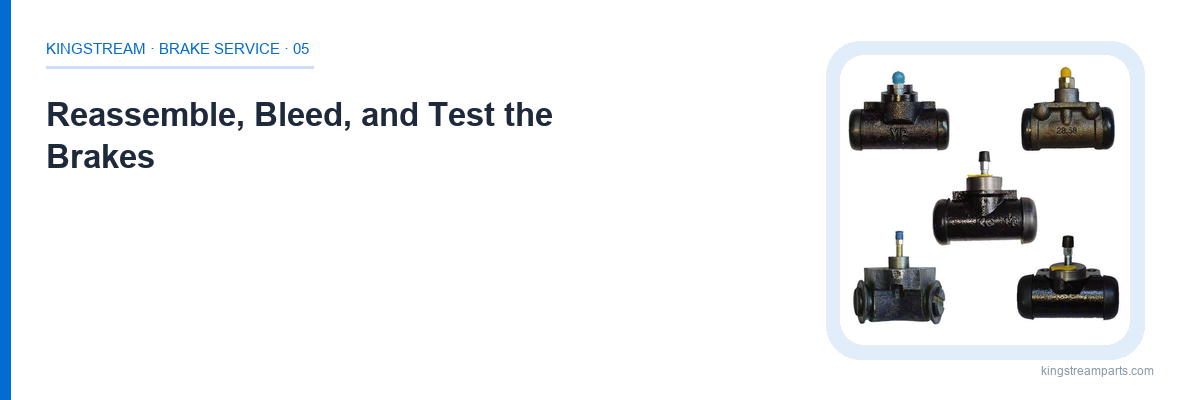
New shoes do nothing until the reassembled hydraulics push them. Air trapped in the lines during a forklift brake pad replacement compresses where fluid cannot, so the pedal goes spongy.
The bleed sequence is short: crack the bleeder, pump the pedal, close the valve, and top off the reservoir until the pedal holds firm. Friction material costs $10 to $130; the bleeding step that follows is what turns new parts into a working brake.
Bleeding the brake lines
With the wheel back on, crack the bleeder valve, pump the brake pedal, close the bleeder, and top off the reservoir. Repeat until the pedal is firm. The motion is the same as bleeding a clutch: crack the slave-cylinder bleeder, pump the clutch pedal, close it, and refill. Keep the reservoir full throughout.
Pedal feel and adjustment
A good pedal is firm and holds under steady pressure. If a full bleed leaves it soft, stop bleeding and find the cause. The common mistake is to bleed again before checking the valve and linings; bleeding alone cannot fix a seized valve or worn pads. In one community-reported Kalmar case, bleeding alone did not fix delayed braking; the real faults were a seized valve and worn pads. On wet multi-plate systems, old or contaminated oil makes brakes grabby or groaning, so switch to a low-foaming UTTO or TGH fluid. Check the linkage too.
Test sequence
After a forklift brake pad replacement, run these checks before carrying a load:
- Firm pedal that holds at a steady height.
- No leaks at the bleeder, wheel cylinders, or lines.
- Holds under load in a low-speed creep test, with the parking brake engaging cleanly.
Bleeding is the step that separates a forklift brake pad replacement from a finished brake job. Finish with a loaded creep test: the pedal must hold at a steady height and the parking brake must engage cleanly before the truck returns to service.
Troubleshooting: 5 Common Forklift Brake Problems
Most complaints surface after a forklift brake pad replacement: squeal, grinding, a spongy pedal, grabby wet brakes, and a sinking pedal. Use the table below.
| Symptom | Likely cause | Fix |
|---|---|---|
| Squeal, cold weather | Preloaded spring or lining | Verify stopping; leave it |
| Grind, metal-on-metal | Friction material gone (Conger Industries, n.d.) | Replace pads and drums |
| Spongy pedal | Air or old fluid in lines | Bleed and flush |
| Grabby, groaning | Old or contaminated oil | Low-foaming UTTO/TGH fluid |
| Pedal to floor | Seized valve, worn pads, master cylinder | Diagnose before buying |
Squeaking that may be normal
Often it is the preloaded return spring in the middle of the shoes. Cold-weather squeal from some linings does not cut stopping power; verify braking, then leave it.
Grinding
Steel-on-iron grinding means the friction material is gone and the rotor or drum is already damaged (Conger Industries, n.d.). Budget for drums, not just pads.
Spongy pedal
Air in the line, often from a hurried bleed after a forklift brake pad replacement, or old, contaminated fluid. Bleed the system, flush, then re-check pedal firmness.
Grabby brakes on wet systems
Old or contaminated oil on a wet multi-plate system makes brakes grab and groan; low-foaming UTTO or TGH fluid usually clears it.
Pedal to the floor
A delayed pedal usually means a seized valve or worn pads, not the master cylinder. Diagnose before you buy parts.
In one reported case, a dealer quoted about $800 for a brake master cylinder that costs $30 to $50 from aftermarket suppliers. The gap is why technicians recommend diagnosing pedal-to-the-floor complaints first: a seized valve or worn pads, not the cylinder, usually cause delayed braking.
When to Call a Professional Instead
Forklift brake pad replacement stays a DIY job only while the failure is limited to the friction material. Past that line, inching-valve and slave-cylinder faults, sealed wet-brake systems, and any truck still under factory warranty belong to a certified tech. A pedal that sinks to the floor, for example, is rarely a pad problem.
Warning: If the fault sits beyond the friction material (sealed wet-brake, inching valve, slave cylinder), the truck is under warranty, or no certified technician and shop insurance are on hand, stop the job and call a professional.
In a community-reported case, an owner replaced a master cylinder, wheel cylinders, a set of pads, and rebuilt the inching valve on a Clark C300 for roughly $200 in parts, while dealers quoted about $1,000 for the brake job and $800 for a master cylinder that costs $30 to $50 aftermarket. Where the job is safe to take in-house, that gap is the saving.
FAQ
Short answers to the questions that come up most often.
How much does it cost to change the brakes on a forklift?
Parts run $10 to $130. A complete brake job with labor typically runs $800 to $1,500; the 2026 dealer labor survey puts the average at $180 per hour and $1,080 for the full job.
How do I replace the brakes on my forklift?
Follow the five steps above: secure the truck, remove the wheel, pull and inspect the shoes, replace the friction material and check the drum, then bleed and test the system.
What type of brakes are on a forklift?
Most counterbalance trucks use shoe and drum brakes. Some models use disc pads, and electric trucks often run sealed wet multi-plate brakes. Check your model’s parts list before ordering.
Can I replace a brake pad myself?
Yes. With the right tools and the safety sequence above, a forklift brake pad replacement is within reach for most owners. Leave sealed hydraulic and wet brake systems to a professional.
How often should forklift brake pads be replaced?
Replace shoes every 5,000 to 7,000 operating hours. Blow brake dust out at 250 hours and inspect the drums at 2,000.
Why are my forklift brakes grinding?
Grinding means the friction material is gone and the shoes are riding steel on iron. Stop the truck, inspect the drum or rotor for scoring, and budget for machining or replacement before buying new pads.
Conclusion
A forklift brake pad replacement is a five-step job: secure the truck, pull the wheel and drum, inspect the shoes, swap the friction material and check the drums, then bleed and test the brakes.
Brake shoes should be replaced every 5,000 to 7,000 operating hours, with the drums inspected at 2,000 and dust blown out every 250 (Total Industries, n.d.). A complete brake job with parts and labor typically runs $800 to $1,500, while the parts alone cost $10 to $130 (Intella Parts, 2026).
Bleeding the lines after reassembly is what stops a spongy pedal. When steel-on-iron grinding appears, that hour count has already passed, so inspect the drums before ordering new friction material.
Kingstream Parts (kingstreamparts.com) supplies OEM and aftermarket forklift brake parts across major brands. Match the part number to your model before you start, and the job stays a half-day task.
References
- Intella Parts. (2026). Intella Parts releases 2026 forklift dealer labor rate survey. BusinessWire. https://www.businesswire.com/news/home/20260204574847/en/
- Total Industries. (n.d.). How much does it cost to repair forklift brakes. https://total-ind.com/blog/forklift-repair-service-brakes
- Conger Industries. (n.d.). Forklift brakes: Your guide to safety and maintenance. https://www.conger.com/forklift-brake-guide
- Lambert, S. (2015). Effects of ‘Black Steel’ and its Contribution to Premature Brake Pad Replacement and Brake Pad Failure. SAE Technical Paper Series, 1. https://doi.org/10.4271/2015-01-2666
- British Standards Institution. (2013). Road vehicles. Brake linings. Shear test procedure for disc brake pad and drum brake shoe assemblies. https://doi.org/10.3403/30188870
- Occupational Safety and Health Administration. (n.d.). Powered industrial trucks (29 CFR 1910.178). U.S. Department of Labor. https://www.osha.gov/laws-regs/regulations/standardnumber/1910/1910.178
Last reviewed and updated: August 2026. Author: Kingstream team. For tailored guidance, contact our team.