
TL;DR
The most common forklift brake failures come from 4 parts: brake shoes/pads, master cylinders, wheel cylinders and brake fluid. Hydraulic drum brakes dominate IC (internal combustion) trucks; wet-disc brakes dominate electric trucks, and electric trucks also add regenerative braking that IC trucks do not have. Budget $150-$500 per axle for a brake overhaul on a common forklift; OEM-genuine Kingstream parts carry a 12-month warranty, OEM-equivalent 6 months, aftermarket 3 months.
Abstract
Forklift brakes are the highest-wear safety system on a lift truck: a 3,000-lb forklift needs up to twice the stopping distance of a car, and OSHA 29 CFR 1910.178 makes brake inspection a pre-shift legal duty. The listicle breaks down the 10 brake parts that wear first, the 3 brake types (hydraulic drum, disc wet/dry, electric regenerative), how to diagnose the 6 most common brake problems, and a maintenance schedule that keeps a fleet OSHA-compliant.
Key Takeaways
- 3 brake types exist: hydraulic drum, disc (wet/dry), electric regenerative
- Brake shoes/pads, master cylinders, wheel cylinders and fluid fail first. Inspect them first
- OSHA 29 CFR 1910.178 makes brake checks a pre-shift legal duty
- A spongy pedal usually means air or fluid loss. Never drive it
- Electric forklifts add regenerative braking; IC trucks do not have it
- OEM-genuine parts: 12-month warranty; OEM-equivalent 6; aftermarket 3
Table of Contents
- Abstract
- Key Takeaways
- By the Numbers
- Why Forklift Brake Systems Fail, and Why It Matters
- How a Forklift Brake System Works: The 3 Types Compared
- 10 Forklift Brake Parts That Wear First (with Fitment Tips)
- Glossary
- 6 Common Forklift Brake Problems and How to Diagnose Them
- Forklift Brake Maintenance Schedule (OSHA & ANSI/ITSDF)
- How Much Do Forklift Brake Replacements Cost? (OEM vs Aftermarket)
- Frequently Asked Questions
- Conclusion: Keep the Brake System Fail-Safe
- References
Why Forklift Brake Systems Fail, and Why It Matters
A forklift brake system does work no car brake faces. A 3,000-lb truck rolling at 8 mph needs up to twice the stopping distance of a car (Linde Material Handling, n.d.), and it’s doing that inside aisles full of racking and people.
The legal stakes: OSHA 29 CFR 1910.178
OSHA 29 CFR 1910.178, the powered industrial truck standard, makes a pre-shift brake and safety inspection a legal duty for every operator. Defects in the forklift brake system rank among the most commonly cited OSHA violations (OSHA, n.d.), which tells you how often that daily check is skipped. Most warehouses have a written policy; few have a completed checklist.
What a worn brake actually costs a warehouse
The shoe is the cheap part. The real cost sits around a brake failure: an aisle goes down, the truck is out for a shift or more, and a citation trails the incident report. The maintenance schedule below is the cheaper fix, but first we need to see how a forklift brake system is built.
ANSI/ITSDF B56.1-2020 §7.16 gives the measurable line a service brake must hit: brakes must hold the loaded forklift against a drawbar drag of 25% of loaded weight, with pedal force capped at 150 lb (ANSI/ITSDF, n.d.). OSHA 29 CFR 1910.178 separately requires a daily pre-shift brake check (OSHA, n.d.). Both are published; both get skipped too often.
By the Numbers
- 25% of loaded weight is the drawbar drag a service brake must overcome (ANSI/ITSDF, n.d.)
- 150 lb maximum pedal force the standard allows (ANSI/ITSDF, n.d.)
- 2x the stopping distance of a passenger car for a 3,000-lb forklift at 8 mph (Linde Material Handling, n.d.)
How a Forklift Brake System Works: The 3 Types Compared
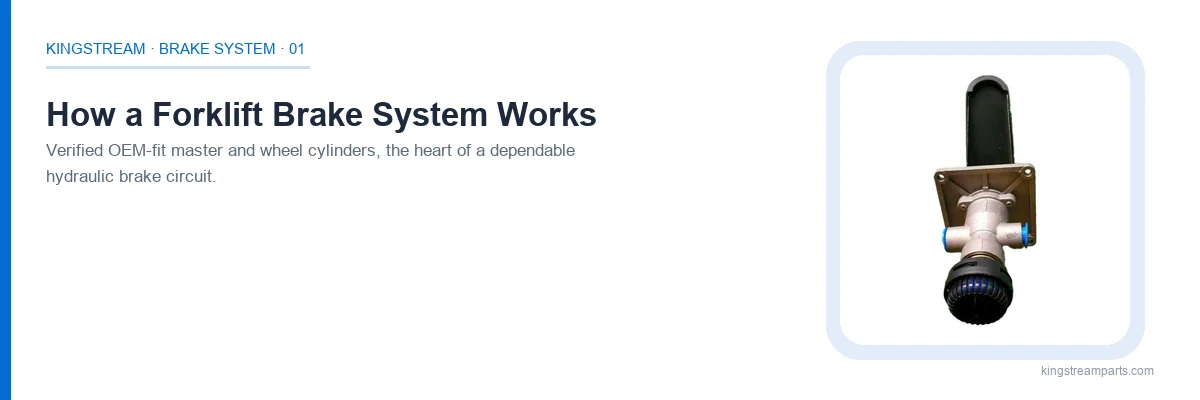
A forklift brake system follows the same hydraulic circuit a passenger car uses. Press the pedal, and fluid leaves the master cylinder, travels through lines and hoses, and reaches the wheel cylinders, which push shoes outward against a drum or clamp pads against a disc. The circuit is identical across powertrains. The hardware inside it isn’t, and that is what decides which parts wear first.
Hydraulic drum brakes (IC trucks)
Drum brakes dominate the IC side of the forklift brake system, meaning LPG and diesel units. Brake shoes carry friction lining and press outward against a rotating drum to slow the wheel. The parts that wear are the shoes, the drum, the wheel cylinder, and the springs and hardware. Some OEM service manuals specify two-person bleeding for the circuit, so don’t plan a solo fluid flush. (Hyundai, n.d.)
Disc brakes: wet vs dry
Disc brakes use a caliper and pistons that clamp pads against a rotor. They show up more on heavy, outdoor, or high-duty trucks because they shed heat better. The wet type runs oil-bathed, giving longer pad life and less fade in sustained use. The dry type is simpler and runs cooler but trades away that fluid cushion. Each is a reasonable choice; the duty cycle decides.
Electric regenerative braking
Electric trucks add a third path. The drive motor reverses into a generator, converting kinetic energy back into electrical energy to slow the truck. That cuts friction wear and brake dust. Mechanical friction brakes stay on board as the service and parking backup.
A common misconception is that regenerative braking replaces the mechanical brakes; it does not. The friction brakes stay the primary stopper, and surprisingly, the daily pre-shift inspection duty applies unchanged to electric trucks.
The table below maps the three forklift brake system layouts against the questions that matter at ordering time.
| Brake type | Where used | How it works | Key wear parts | Maintenance note |
|---|---|---|---|---|
| Hydraulic drum | IC, LPG, diesel trucks | Fluid pushes shoes outward against the drum | Shoes, drum, wheel cylinder, springs | Some OEM manuals specify two-person bleeding |
| Disc, wet or dry | Heavy, outdoor, high-duty trucks | Caliper pistons clamp pads against a rotor | Pads, rotor, caliper pistons | Wet runs oil-bathed; dry runs simpler and cooler |
| Electric regenerative | Electric trucks | Motor converts kinetic energy back to electricity | Pads and rotor wear slower | Mechanical brakes stay as the service and parking backup |
A separate mechanical parking brake, usually a lever pulling a cable to an actuator or secondary shoes, rides on most trucks with its own lever-stroke adjustment spec. Whatever forklift brake system a fleet runs, the circuit stays the same; the wear parts don’t. Knowing the type tells you which parts list applies next.
A forklift brake system is a hydraulic circuit: pressing the pedal moves fluid from the master cylinder through the lines to the wheel cylinders, which push shoes against a drum or clamp pads onto a disc. Wet and dry types share a 2-person bleed after service (Hyundai, n.d.), and electric trucks add regenerative braking that IC trucks lack.
10 Forklift Brake Parts That Wear First (with Fitment Tips)
A forklift brake system is only as good as its oldest component. Ten parts wear first and drive most brake repairs, from the shoes that grab the drum to the fluid that carries the pressure. We list them in the order failures usually appear.
We compared the Hyster and Hyundai wear limits and we used the ANSI/ITSDF B56.1 clause as the baseline for the drawbar-drag figures.
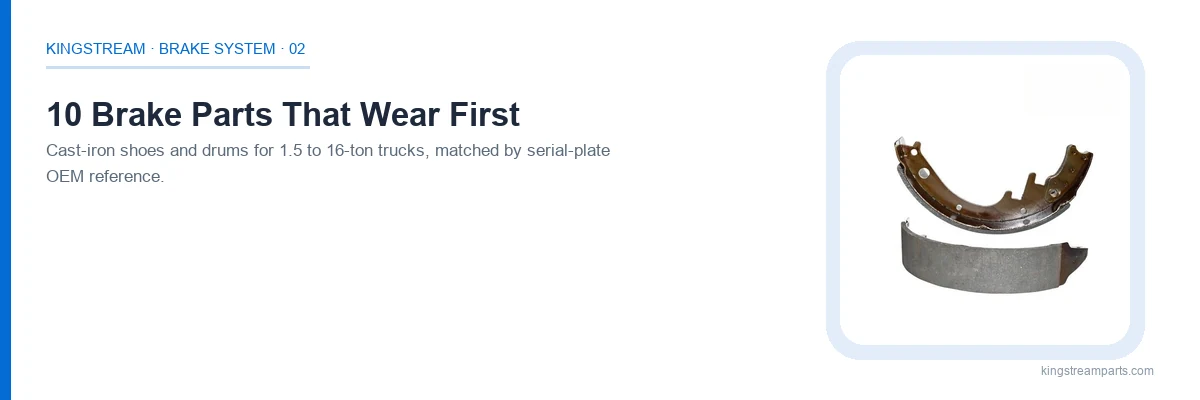
One rule covers the forklift brake system: verify every part by make, model, and serial number before ordering, and we build that check into every quote. Brake parts are not universal, so a shoe that fits a Toyota won’t seat on a Crown, and the same number rarely crosses Hyster, Yale, Komatsu, or TCM.
Brake shoes & pads
Shoes and pads carry the friction lining, the wear item in any forklift brake system. Replace shoes or pads when the lining is worn to within about 1 mm of the rivet head (Hyster, n.d.), and pull them sooner if the surface has glazed, turned shiny and hard from heat.
Brake drums & rotors
The drum or rotor is the rotating surface the lining grabs. Two failure modes dominate: an out-of-round bore and an oversized diameter from repeated grinding. Measure the internal diameter and runout against the OEM limit before cutting, and never grind more than the manual allows.
Master cylinder
The master cylinder turns pedal force into hydraulic pressure, the pressure source of a forklift brake system. Its common failure is an internal seal that leaks past the cup, so the pedal sinks and fluid level drops. When you fit a replacement, check the OEM procedure; several brands call for a two-person bleed afterward (Hyundai, n.d.).
The master cylinder is a reciprocating pump: a piston slides in a honed bore, and primary and secondary cups seal the chambers. A folded or scored cup lip lets fluid bypass the piston, and the pedal sinks.
Wheel cylinder
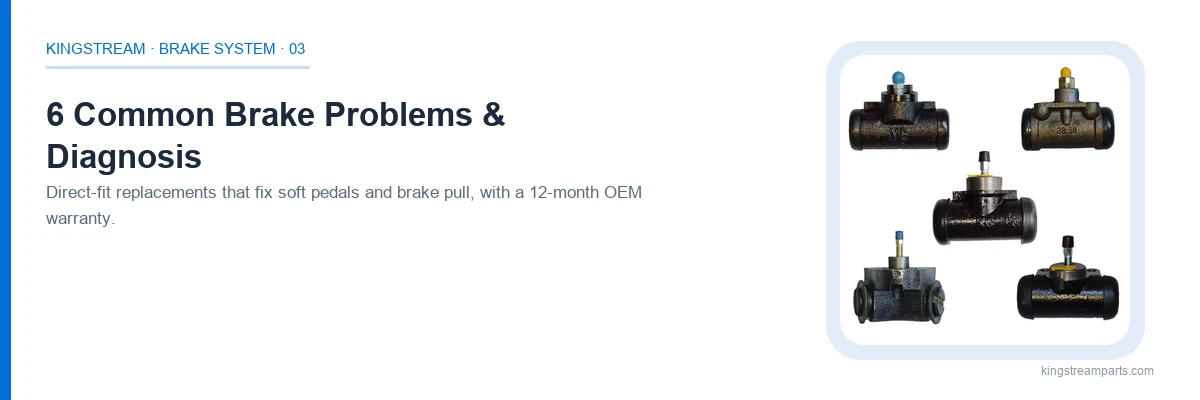
Wheel cylinders live inside the drum and push the shoes outward. They fail through seal leakage, corrosion, or a seized piston, and a puddle of fluid inside the drum is the usual clue. Fit a rebuild kit or new cylinder, then bleed the circuit.
Brake fluid
Brake fluid is the hydraulic medium, and age is its weakness. It draws moisture out of the air, which lowers the boiling point and invites fade on a heavy lift. Check level and condition at every service, and bleed on schedule rather than topping up the same fluid.
The most common mistake is topping up old fluid instead of flushing it on schedule; the moisture stays in the circuit, and fade returns.
Brake pedal & pedal assembly
The pedal is the operator’s only input into a forklift brake system, and its feel tells the story. Soft, spongy travel means air in the lines. A pedal that sinks to the floor means a leaking master cylinder. Too much free play before pressure builds means the adjustment is off.
Brake lines & hoses
Steel lines and rubber hoses move fluid to each wheel. Rubber perishes into cracks, steel corrodes, and fittings seep. Any leak, however small, drops pedal pressure. Inspect the full run for wet spots, bulges, or rust-streaked lines, not just the visible fittings.
Adjusters & cables
Adjusters and cables keep the shoe-to-drum clearance where it belongs. A seized adjuster or a stretched, corroded cable shows up as weak braking or a parking brake that won’t hold. Check the stroke against the OEM figure and set the adjuster to spec.
Parking brake parts
The parking brake shares the backing area, with its own lever, cable, actuator, and secondary shoes. Cables stretch and corrode with age, and lever stroke grows past spec. Adjust per the OEM procedure and test on a gentle incline with the engine off.
Backing plates & hardware
The backing plate is the frame that locates the shoes, and the springs and retainers keep them seated. Springs break and retainers corrode without warning. Replace hardware as matched sets, and never mix an old spring with a new one on the same axle.
Whatever part you’re swapping, the finish is the same: bleed the system, road-test the lift, and heat-check the drums after a few stops. Kingstream backs OEM genuine parts with a 12-month warranty, OEM-equivalent with 6 months, and aftermarket with 3 months.
Brake parts are not universal across lift truck brands, so every replacement in a forklift brake system is checked against the exact truck before ordering. On a Hyster, the OEM spec caps drum internal diameter at 317.5 mm, with no more than 1.5 mm of grinding (Hyster, n.d.). Measure before you machine, and the rebuilt axle stays within factory tolerance.
Your next step
Brake parts are not universal across lift truck brands, so a quote has to start with a fitment check against your exact truck. Kingstream sources OEM-compatible brake parts for 14 major brands and builds that make, model, and serial number check into every quote. Send your part numbers for a quote.
Glossary
- Lining: the friction material riveted or bonded to a brake shoe or pad; its remaining thickness is the main wear indicator.
- Wheel cylinder bore: the machined bore that guides the piston pushing the shoe outward.
- Brake fade: a temporary loss of stopping force from overheating, often worsened by moisture-laden fluid.
6 Common Forklift Brake Problems and How to Diagnose Them
Six problems account for most brake complaints on a forklift: a soft or spongy pedal, pull or fade, squealing or grinding, a parking brake that won’t hold, overheating, or no braking at all. Each pairs a symptom with a cause and a fix, so the forklift brake system is easy to trace.
Soft or spongy pedal
Air in the hydraulic system or fluid loss, the most common brake complaint on a forklift. Inspect the master cylinder, wheel cylinders, and lines, then bleed the system.
Warning: a soft or spongy pedal usually means air or fluid loss. Do not drive the truck until it’s bled.
Brake pull or fade
Pull: the truck drifts to one side, from uneven adjustment, a seized wheel cylinder, or contaminated lining. Replace linings as a set. Fade: stopping weakens after repeated stops, from glazed linings or low-boiling-point fluid. Flush the fluid per schedule.
Squealing or grinding
Worn lining near the rivets or backing plate. Grinding means metal on metal, so the shoes are overdue. Measure lining thickness and replace both shoes as a set.
Parking brake won’t hold
A stretched or corroded cable, a seized actuator, or lever stroke out of adjustment. Adjust lever stroke to spec, replace the cable or actuator, and test on a gentle incline.
Overheating brakes
Dragging shoes from an over-tight adjustment, a seized wheel cylinder, or a stuck parking brake. After service, confirm the wheel spins freely and recheck the adjustment per spec.
No braking at all
Total fluid loss from a ruptured line or blown seal, or a seized master cylinder. Do not drive the truck; take it out of service and inspect the full hydraulic circuit.
OSHA’s powered industrial truck standard, 29 CFR 1910.178, requires the forklift brake system to stay in safe condition and makes a daily pre-shift check the operator’s duty (OSHA, n.d.). A truck with defective brakes must be removed from service, which is why a soft pedal should end the shift.
Forklift Brake Maintenance Schedule (OSHA & ANSI/ITSDF)
A forklift brake system runs on a fixed maintenance clock, not on the first sign of trouble. OSHA 29 CFR 1910.178 makes a pre-shift brake check the operator’s daily duty (OSHA, n.d.). The 250-hour service catches wear early; the 2,000-hour service is the overhaul point. Our Forklift Preventive Maintenance Checklist covers the full daily-to-2,000-hour schedule.
One caveat: these hour intervals are fleet guidance, not a substitute for the OEM service manual for your exact model; heavy or abrasive duty can shorten every window.
| Service interval | Brake checks | Key references |
|---|---|---|
| Pre-shift (daily) | Brake pedal operation, brake response, parking brake, visible fluid leaks | OSHA 29 CFR 1910.178 (daily pre-shift inspection) |
| 250-hour | Lining thickness, drum/disc condition, adjusters, fluid level | OEM service manual |
| 500-hour | Wheel cylinders, lines/hoses, fluid condition (moisture, boiling point), springs | OEM service manual |
| 2,000-hour (major) | Full overhaul: shoes/pads, drums/rotors, cylinders, fluid flush, re-adjust | OEM manual + ANSI/ITSDF B56.1-2020 |
The full-span checklist:
- Brake pedal travel and reserve
- Brake response under load
- Parking brake holds on a grade
- Lining thickness above service limit
- Drum or rotor condition
- Fluid level, moisture, boiling point
Pre-shift inspection (daily)
The operator runs the check before the first load moves: pedal operation, brake response, parking brake hold, visible fluid leaks (OSHA, n.d.). A truck with a defective forklift brake system comes out of service until repaired (OSHA, n.d.).
250-hour and 500-hour service
At 250 hours: lining thickness, drum and disc condition, adjuster settings, and fluid level (Knott Brake, n.d.). At 500 hours: wheel cylinders, lines and hoses, brake fluid condition (moisture and boiling point), and hardware springs. Both service points catch wear before failure.
2,000-hour major service
The 2,000-hour service is the forklift brake system’s major overhaul: shoes and pads, drums and rotors, and cylinders replaced or machined, fluid flushed, and the system re-adjusted (Knott Brake, n.d.). After any brake work, bleed the system (OEM manuals often specify two-person bleeding), road-test, and heat-check the drums (Hyundai, n.d.).
OSHA 29 CFR 1910.178 requires a pre-shift inspection of every forklift before use, with the brake system on that list; defective brakes pull the truck out of service (OSHA, n.d.). ANSI/ITSDF B56.1-2020 §7.16 backs that with numbers: service brakes must hold at 25% drawbar drag, capped at 150 lb pedal force (ANSI/ITSDF, n.d.).
How Much Do Forklift Brake Replacements Cost? (OEM vs Aftermarket)
Plan on $150 to $500 for a full per-axle overhaul of your forklift brake system, parts and labor combined. The real spread comes down to truck class and which part tier you choose, so budget by tier, not by sticker shock.
Typical brake part costs by truck class
A low-end aftermarket wheel cylinder runs roughly $19 to $40. A master cylinder sits around $43 and climbs into the low hundreds by make and model. Brake shoe and pad kits run from budget kits near the $40 mark up to OEM kits priced by brand. Smaller three-wheel and cushion-tire trucks sit at the low end of every range; loaded counterbalance trucks pull each number toward the top.
OEM vs OEM-equivalent vs aftermarket warranty
OEM parts guarantee exact fit, but they typically cost 20 to 50% more than aftermarket. Aftermarket parts are cheaper and often faster to source, but quality varies between makers. That is why we publish warranty tiers instead of vague quality claims:
| Part quality | Warranty | Best for | Typical price |
|---|---|---|---|
| OEM genuine | 12 months | Fleets that want exact-fit certainty | Highest (brand-catalog pricing) |
| OEM-equivalent | 6 months | Balance of fit and cost | Mid |
| Aftermarket | 3 months | Budget repair on lower-stakes work | Lowest |
OEM genuine parts typically cost 20 to 50% more than aftermarket equivalents, which is why the warranty matters. Kingstream backs OEM parts for 12 months, OEM-equivalent for 6, and aftermarket for 3. Buy the tier that matches the duty; the extra cost buys certainty where it counts.
For a complete forklift brake system quote, browse our brake parts category or the steering and brake repair kits, then compare the tiers in our OEM vs aftermarket buying guide. The rule is simple: buy exact-fit certainty and the longest warranty for load-bearing work, aftermarket for low-stress repairs where price dominates.
Frequently Asked Questions
These eight questions cover the forklift brake system topics we hear most often. We’ve kept each answer short; the deeper detail lives above.
Why are there two brakes on a forklift?
Most forklifts have two brake pedals: a service brake for normal stopping and an inching pedal for precise maneuvering. The inching pedal lets the operator creep the truck at low speed without killing the drive.
The split keeps travel and hydraulic control independent.
How does a forklift brake system work?
Pressing the pedal moves hydraulic fluid from the master cylinder to the wheel cylinders, which push shoes against the drum or clamp pads on a disc. Electric models add motor braking.
A drop in pressure shows up fast as a soft pedal.
What are the different types of forklift brakes?
Three types cover most forklifts: hydraulic drum brakes on IC trucks, wet or dry disc brakes on heavy and outdoor machines, and regenerative motor braking on electric models.
The type also sets the service interval and what gets checked.
How often should forklift brakes be inspected?
OSHA 29 CFR 1910.178 requires a pre-shift inspection before each day’s first use, and most fleets add scheduled service at 250, 500, and 2,000 hours. Pedal, lining, and fluid get checked each time (OSHA, n.d.).
See Forklift Brake Maintenance Schedule for the full interval-by-interval plan.
How long do forklift brakes last?
There is no fixed universal hour figure; service life tracks duty. On normal duty, shoes and pads outlast a single service interval, and lining is measured rather than guessed.
Replace when lining sits about 1 mm from the rivet head.
What causes forklift brake failure?
Air or lost fluid produces a soft pedal, seized wheel cylinders stop the shoes from releasing, and glazed or worn lining cuts friction. Broken springs and contaminated fluid round out the list.
We cover each failure and its fix in the common problems section.
Why is the forklift brake pedal soft or spongy?
A soft pedal means air in the hydraulic system or a fluid leak. Pull the truck from service, find the leak, and bleed the system before it returns to work.
The common problems section lists the other symptoms that travel with a soft pedal.
Do electric forklifts have regenerative braking?
Yes. Electric forklifts convert kinetic energy back into electrical energy to slow the truck, which recharges the battery and reduces friction-brake wear. Internal combustion trucks don’t have it.
That is why an electric truck’s service brakes last longer.
Conclusion: Keep the Brake System Fail-Safe
A forklift brake system fails predictably when maintenance lapses. Three actions keep it fail-safe: the daily pre-shift check, the scheduled inspections, and pulling any soft-pedal truck from service for bleeding.
OSHA 29 CFR 1910.178 requires a pre-shift inspection of the brakes and controls before a powered industrial truck is used each day. (OSHA, n.d.) Any defect must be reported and the truck removed from service, which makes the daily check the cheapest failure-prevention step on the list.
Beyond daily, hold the 250-hour and 500-hour inspections and plan the 2,000-hour brake overhaul. Drum brakes on IC trucks, wet and dry discs on heavy-duty, and regenerative braking on electric models need different parts, so confirm the brake type and fitment against your exact truck before ordering. Kingstream warranty tiers are 12-month OEM genuine, 6-month OEM-equivalent, and 3-month aftermarket; match the tier to the duty. Start with the pre-shift check today, then browse the brake parts category.
References
- Occupational Safety and Health Administration. (n.d.). Powered industrial trucks (29 CFR 1910.178). https://www.osha.gov/laws-regs/regulations/standardnumber/1910/1910.178
- Occupational Safety and Health Administration. (1990). Brake drawbar drag requirements for forklifts (Standard interpretation). https://www.osha.gov/laws-regs/standardinterpretations/1990-06-21-0
- Industrial Truck Standards Development Foundation. (n.d.). Safety standard for low lift and high lift trucks (ANSI/ITSDF B56.1). https://ppsa.memberclicks.net/assets/TechnicalReferences/low_lift_and_high_lift_trucks.pdf
- Hyster Company. (n.d.). Service brakes repair (dry brake) (Hyster G004 S4.0FT-S5.5FTS Europe service manual, SRM 1247). https://www.aservicemanualpdf.com/Samplepages/SM-Hyster%20G004%20S4.0FT,%20S4.5FT,%20S5.5FT,%20S5.5FTS%20Europe%20Forklift.pdf
- Hyundai Heavy Industries. (n.d.). HDF50-70 forklift trucks service manual. https://s29508f7dd77d396d.jimcontent.com/download/version/1643654430/module/6293625066/name/Hyundai%20HDF50%2070%20Forklift%20Trucks%20Service%20Manual%20PDF.pdf
- Linde Material Handling Australia. (n.d.). Safe forklift speeds and braking guidelines in the warehouse. https://lindemh.com.au/about-us/knowledge-and-information-hub/technical-articles/what-is-the-speed-limit-for-forklifts-safe-speed-and-braking-guidelines-in-the-warehouse
- Knott Brake Company. (n.d.). Forklift brakes. https://knottbrake.com/our-industries-brake-application-types/forklift-brakes-2/
Last reviewed and updated: August 2026. Author: Kingstream team. For tailored guidance, contact our team.