
TL;DR
The forklift electrical system is six subsystems: starting, charging, battery, motors and control, switches and relays, lighting and metering. Around 90% of ‘electrical’ downtime is really a battery, cable, connector, or ground fault. Diagnose first, then order replacement parts by model, serial, and old part number.
Abstract
A forklift’s electrical system is six interconnected subsystems (starting, charging, battery, motors and control, switches and relays, and lighting and metering), and most downtime blamed on ‘electrical failure’ actually traces to the battery, cables, connectors, or grounds.
Key Takeaways
- Around 90% of electrical faults trace to battery, cables, connections, or grounds, not the controller.
- The electrical system is six subsystems: starting, charging, battery, motors, switches, and lighting.
- Measure before you replace: test battery and cables before ordering a controller or starter motor.
- Order electrical parts by model, serial, and old part number to get the right fit.
- Follow OSHA 29 CFR 1910.178 when charging and changing batteries.
Table of Contents
- Abstract
- Key Takeaways
- What Is a Forklift Electrical System?
- How the Forklift Electrical System Works
- The Six Subsystems and the Parts Inside Each
- Starting and Charging: Starter Motors, Alternators, and Regulators
- Batteries and Chargers: Lead-Acid vs. Lithium
- Drive Motor, Controller, and Traction Control
- Switches, Relays, and Wiring: the Truck’s Nervous System
- Common Electrical Faults and How to Diagnose Them
- Safety and Standards: OSHA, ANSI, and NFPA
- Choosing Replacement Parts and Sourcing Them Right
- Forklift Electrical System FAQ
- Conclusion
- Further Reading
- References
What Is a Forklift Electrical System?
A forklift electrical system is the network of parts that stores, distributes, and converts power on an electric truck, spanning six subsystems: starting, charging, battery, motors and control, switches and relays, lighting and metering.
Definition and scope
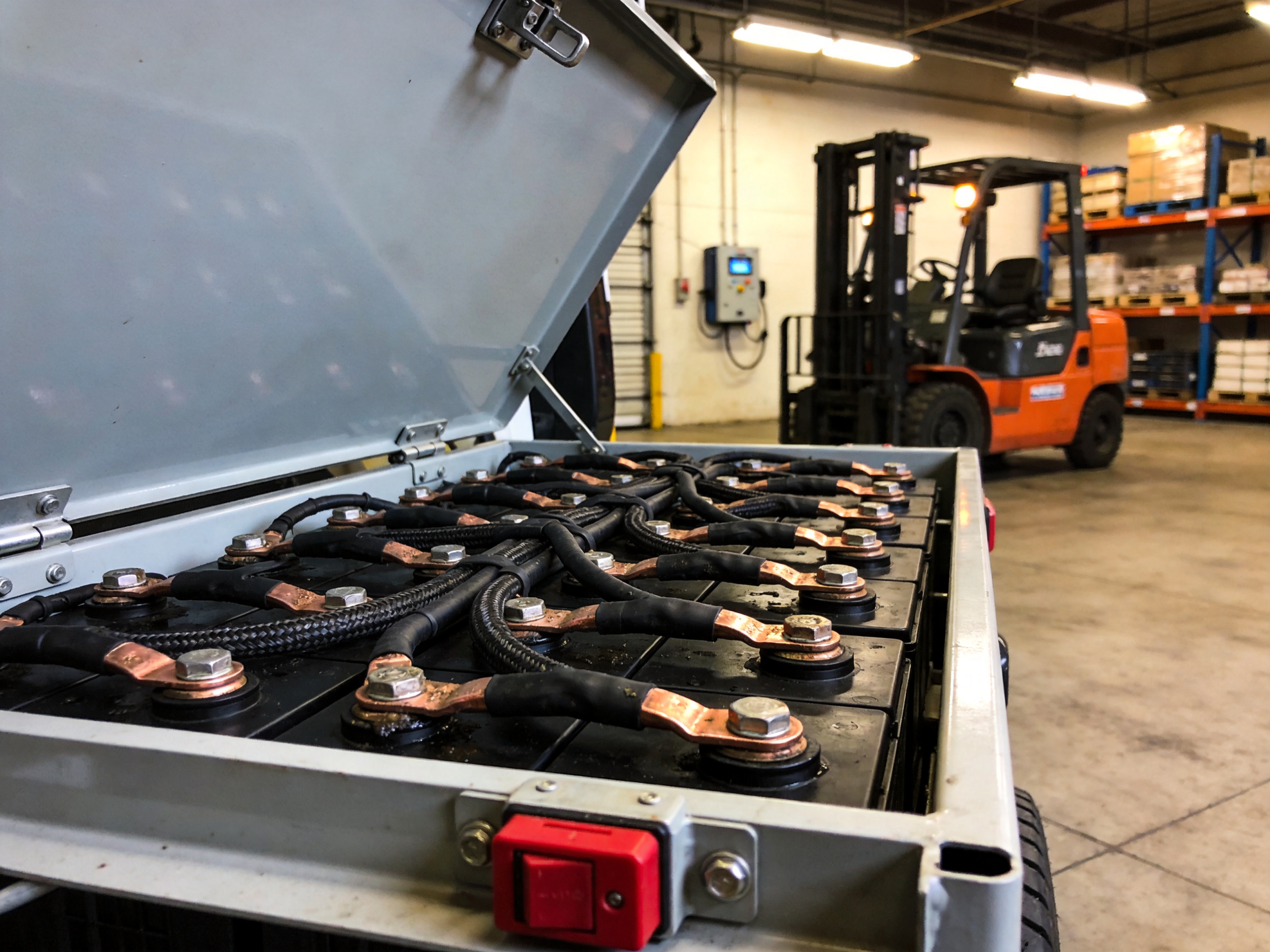
The battery supplies DC energy; the controller and contactor route it to the traction motor, which turns the drive wheels. Wiring harnesses, connectors, fuses, and grounds carry power to every function. OSHA 29 CFR 1910.178 governs the battery charging area (OSHA, n.d.).
Drivetrain scope varies: an engine-driven forklift carries a small electrical system (starter, generator, regulator, ignition), while an electric forklift adds the traction path (battery, controller, motors). Either way, the forklift electrical system is everything between stored energy and the work it powers, including the wiring that ties those parts together.
Why it matters for downtime
Most apparent forklift electrical problems are not controller failures. Roughly 90% of electrical faults trace to the battery, cables, plug connections, or grounds rather than the controller. The forklift electrical system usually fails at its simplest parts, so start with forklift electrical parts, not electronic control parts.
Electric forklifts now dominate the market: 78% of new industrial truck orders in the first three quarters of 2025 were electric, up from 76% a year earlier (KION Group, 2025). With most fleets electric, this six-part system, battery to lighting, decides warehouse uptime.
Glossary
- Controller: the computer governing motor speed, direction, and braking.
- Contactor: a heavy-duty relay that switches main motor current on and off.
- Traction motor: the drive motor that turns the wheels.
- DC-DC converter: the module that steps battery voltage down for lights and control circuits.
- BMS (battery management system): the module that monitors cell voltage, temperature, and state of charge on lithium battery packs.
How the Forklift Electrical System Works
An electric forklift runs on a closed circuit. The forklift electrical system chains battery to controller to motors: the traction motor drives the wheels, and the hydraulic pump motor powers the lift. The controller manages, not supplies, power.
From battery to motor
Current leaves the battery through heavy cables into the controller, which meters it to the motors. Press the accelerator and the controller varies voltage and frequency to the traction motor, turning speed into wheel torque. The hydraulic pump motor runs separately for the lift, so drive and lift never compete. We stock that chain in our electric forklift drive motors range and DC traction motor catalog.
AC vs. DC architecture
Older forklifts run DC motors fed straight from battery voltage. In a modern forklift electrical system, newer units run AC motors behind an inverter in the controller, which converts DC to variable-frequency AC. AC runs cooler, cuts brush maintenance, and recovers braking energy, so most new builds use it.
A 2020 study in Applied Sciences measured 40.72% energy-recovery efficiency from load lowering, a 15.35% cut in total energy use, and up to 74% maximum recovery on a 25-ton electric heavy forklift (Fu et al., 2020).
Reading the circuit forward makes diagnosis easier: battery, cables, controller, motors, and a ground return on every load. A weak link in that chain shows up at the motor, so we recommend testing from the battery forward instead of swapping parts from the controller backward.
By the Numbers
- 78% of new industrial truck orders are electric (KION Group, 2025)
- 74% maximum energy recovery on a 25-ton system (Fu et al., 2020)
The Six Subsystems and the Parts Inside Each
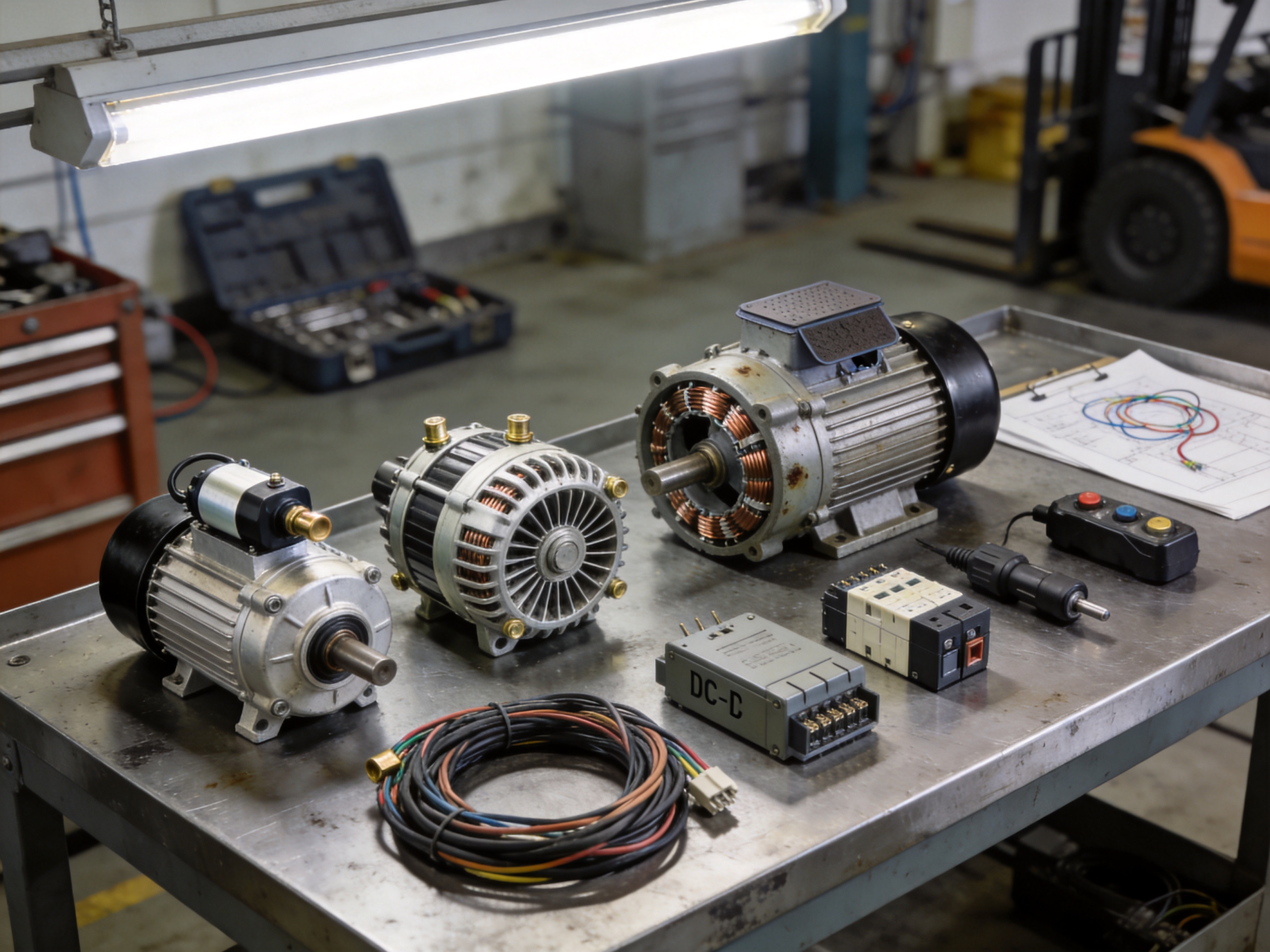
Viewed as one circuit, the forklift electrical system hides a lot of complexity. In practice it divides into six subsystems, each with a defined job and a short parts list. Naming the subsystem first shortens the hunt for most faults.
This guide is organized around that six-subsystem framework, and we use it to keep every fault search from wandering.
| Subsystem | Typical components | Parts category |
|---|---|---|
| Starting system | starter motor, starter relay, ignition switch | Starter motors |
| Charging system | generator, electronic regulator, battery cable | Generators |
| Battery and charging | start battery, drive battery, charger, connector | Batteries and chargers |
| Motors and control | drive motor, controller, carbon brush, contactor, DC-DC converter | Control electronics |
| Switches and relays | directional switch, relay, solenoid, fuse box, flasher, buzzer, horn | Directional switches |
| Lighting and meters | lights, gauges, wiper, wiring harness | Electrical parts |
Starting system
The starter motor works only during cranking. It joins a starter relay and the ignition switch to spin the engine to firing speed.
Charging system
Once the engine runs, the generator, often called the alternator, tops the battery back up. An electronic regulator holds output steady. The battery cable carries the charge.
Battery and charging
This subsystem is the current source: start batteries crank the engine, drive batteries power travel, and a battery charger refills both through its connector.
Motors and control
On electric models the drive motor moves the load. A controller governs it, a contactor switches high current, and a DC-DC converter feeds low-voltage loads. Carbon brushes and the control box complete the set.
Switches and relays
The directional switch, relays, solenoid, fuse box, flasher, buzzer, and horn handle the logic: what gets power, when, and how fast.
Lighting and meters
Lights, meters, dashboard gauges, wipers, and the wiring harness close out the list. They draw from the lighting category.
The forklift electrical layout divides into 6 subsystems: starting, charging, battery, motors and control, switches and relays, and lighting and meters. Starter motors and generators are often filed under engine-parts categories on parts sites, yet both are electrical by function and belong in the electrical story.
Starting and Charging: Starter Motors, Alternators, and Regulators
The starting and charging circuit is where the forklift electrical system gets misdiagnosed most often. The starter motor cranks the engine on internal-combustion and LPG forklifts through a relay or solenoid. A no-crank usually means battery voltage, cables, or the solenoid, not the starter.
Starter motor
The starter is a high-torque DC motor that spins the flywheel until compression takes over. A starter motor that clicks without turning points to voltage or a poor ground, not the motor.
Warning: Never crank a starter for more than 10 to 15 seconds at a time. Check the battery and grounds before blaming the starter.
Alternator and generator
Once the engine runs, the belt-driven generator recharges the battery and carries the electrical loads. A loose belt reads as a charging fault before the unit fails. Isuzu C240 and Mitsubishi S4S and 4D95 forklifts use belt-driven generators.
Electronic regulator
The electronic regulator is the part of the forklift electrical system that prevents overcharging. On a 12V system it holds output near 14V, and a regulator stuck high cooks cells, taking out the battery, the controller, or both. Test the 14V electronic regulator before condemning a generator that tests fine unloaded.
The reliable diagnostic order for this circuit is supply first, unit second: check battery voltage and cable condition, confirm the ground strap, and rule out a loose belt before testing the generator or condemning the starter. We recommend finishing with the regulator, since one that holds output near 14V on a 12V system protects both the battery and the controller from overcharge.
Work with us
Most electrical downtime traces to the battery, cables, connectors, or grounds rather than the controller, so the fix usually comes down to ordering the right replacement. Kingstream is a single-source supplier covering 14 major brands: send the truck’s make, model, serial number, and the old part number, and the sourcing team matches an OEM-compatible part and replies with availability and pricing. Request a parts match
Batteries and Chargers: Lead-Acid vs. Lithium
Within a forklift electrical system, the battery is where most electrical faults start, and chemistry sets the maintenance burden. Lead-acid wins on price; lithium wins on usable energy and charge time.
The trade-off is real, and it is the decision most fleets make first: pay less upfront for lead-acid, or earn it back in lithium service life and charging speed.
| Attribute | Lead-acid | Lithium-ion |
|---|---|---|
| Service life | Baseline | Roughly 3x longer (Logisnext, n.d.) |
| Charging time | 8 to 10 hours plus cool-down (Logisnext, n.d.) | 1.5 to 3 hours, opportunity charging (Logisnext, n.d.) |
| Usable capacity | 46% of rated (Yuca & Bagmanci, 2025) | Over 70% of rated (Yuca & Bagmanci, 2025) |
| Upfront cost | Low, the driver behind ~40.7% of sales (Yuca & Bagmanci, 2025) | Higher, offset over the longer service life (Yuca & Bagmanci, 2025) |
Lead-acid batteries
Lead-acid remains the default on upfront cost, about 40.7% of electric forklift sales (Yuca & Bagmanci, 2025). Only 46% of rated capacity is usable (Yuca & Bagmanci, 2025), and a full charge runs 8 to 10 hours plus cool-down (Logisnext, n.d.). Watering cells and cleaning corrosion are recurring chores.
Lithium-ion batteries
Lithium-ion roughly triples service life (Logisnext, n.d.) and opportunity-charges in 1.5 to 3 hours (Logisnext, n.d.). Usable capacity runs above 70% of rated (Yuca & Bagmanci, 2025). Buyers who switch cite cost-effective operation in 51.94% of decisions (Yuca & Bagmanci, 2025).
Battery chargers
The charger must match the battery’s voltage and chemistry; a mismatch causes gassing, overheating, and shortened life. OSHA charging-area rules live in 29 CFR 1910.178(g). The battery is the part of the forklift electrical system most often misdiagnosed as a controller failure. Our battery charger category lists units by voltage, such as the 24V HELI charger.
Lead-acid stays the default chemistry for about 40.7% of electric forklift sales because of low upfront cost, yet it delivers only 46% of rated capacity in usable energy. Lithium-ion roughly triples service life and restores charge in 1.5 to 3 hours instead of 8 to 10, and buyers choosing it cite cost-effective operation in 51.94% of decisions (Yuca & Bagmanci, 2025).
Drive Motor, Controller, and Traction Control
The traction motor is the workhorse of the forklift electrical system: it converts battery power into motion. On DC trucks a controller regulates speed and current; AC trucks use an inverter.
Drive (traction) motor
The forklift drive motor’s speed and torque set how the truck accelerates and climbs. A motor that runs but lacks power points to brushes, controller, or battery path, not the motor.
Controller and fault codes
The controller manages current to the motor within the forklift electrical system, and its fault codes are a technician’s first readout. General codes E03 (overcurrent) and E08 (undervoltage) appear on most systems. Both trace to battery, cable, or ground.
Contrary to what many fleets assume, the controller is the part least likely to be at fault.
Brand-specific codes such as F6-5 and FB-1 appear on Toyota-style controllers. On lithium trucks, BMS isolation faults are frequently misdiagnosed as controller or wiring failures, so any code is only a starting point for forklift electrical troubleshooting, not a diagnosis.
Carbon brushes, contactors, and DC-DC converters
Carbon brushes wear with hours of operation and limit motor life once past spec. Contactors fail often: welded, pitted, stuck open or closed. DC-DC converters step pack voltage down for control and logic circuits.
Tip: many "controller failures" are really battery, cable, connector, or ground faults. Test voltage, continuity, and grounds before spending on a replacement controller. On a DC truck, check brush wear and contactor condition next, since a worn carbon brush set produces the same low-power symptoms as a failing controller.
Switches, Relays, and Wiring: the Truck’s Nervous System
The switching layer of the forklift electrical system routes small signals to high-current work: switches, relays, solenoids, fuse box, flasher, buzzer, horn, and timer.
Directional switches and relays
The directional switch selects forward or reverse. A relay isolates and latches high current, closing its contacts on a small coil signal.
Wiring harnesses and grounds
Intermittent faults are most often fixed by cleaning connectors and inspecting the wiring harness. Ground straps and chassis grounds corrode, raising resistance. Inspect in this order:
- Clean connectors. Top fix for intermittent behavior.
- Check harness chafing. Flex points wear through insulation.
- Verify grounds. Measure straps; clean to bright metal.
- Re-seat relay sockets. A loose relay is a quick fix.
Lights, meters, and buzzers
Lights, dashboards, wipers, and buzzers share one harness and ground plane, so a corroded connector can silence the reverse alarm.
Most intermittent faults trace to the switching and wiring layer rather than the controller. The standard first repair is cleaning connectors and inspecting the wiring harness, because corroded ground straps and chassis grounds raise resistance until loads flicker, slow, or drop out.
Common Electrical Faults and How to Diagnose Them
Most forklift electrical system faults are not controller faults. The majority trace to the battery, cables, connectors, or grounds. Measure first.
No-start / no-power
A dead-on-key truck with no dash lights points to an open circuit: corroded battery connections, a blown fuse, a failed ignition switch, a stuck starter solenoid, or a bad ground.
Battery vs. electrical misdiagnosis
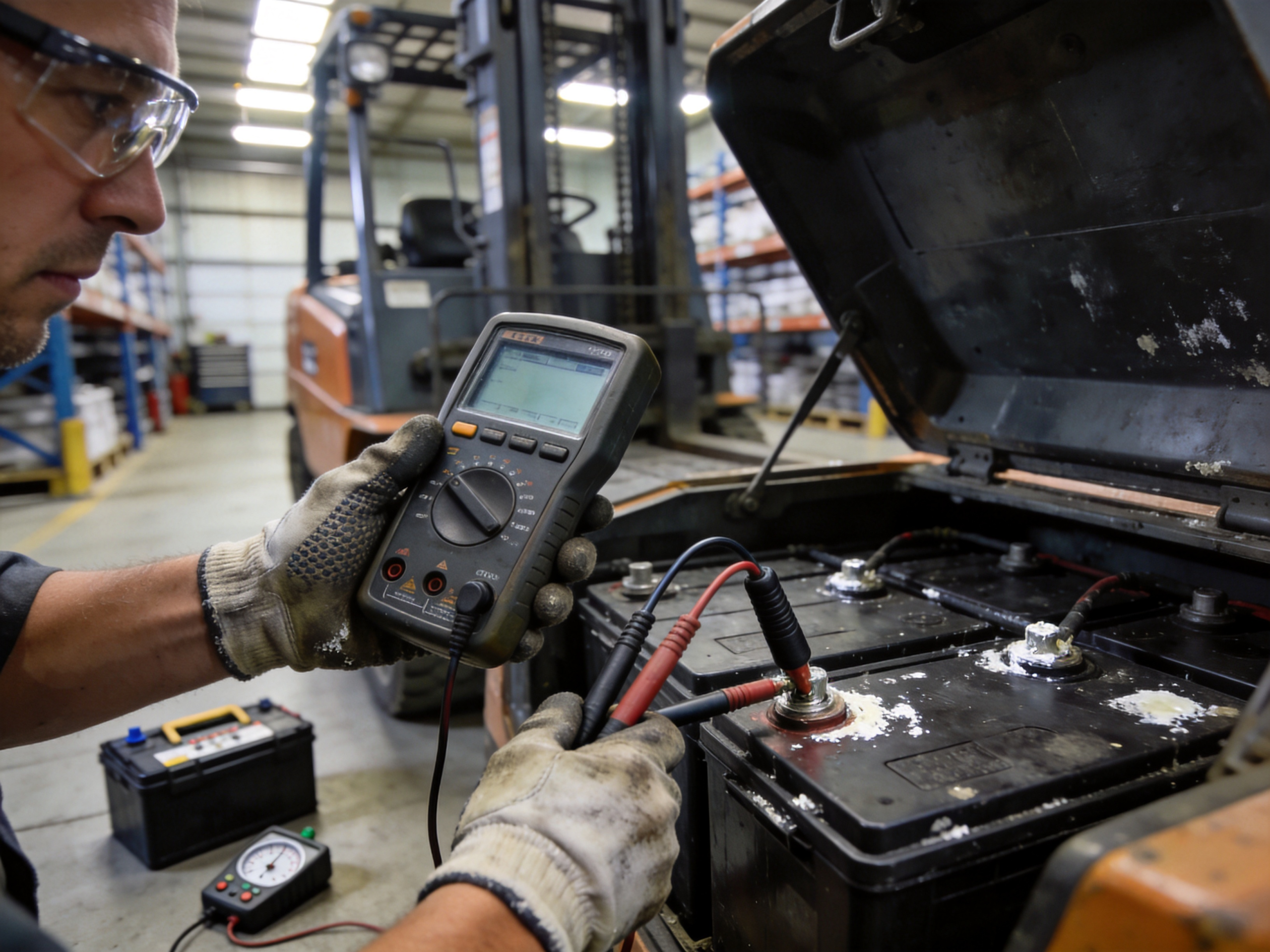
The costliest error in a forklift electrical system is replacing a controller that was never the problem. The common mistake is to skip the battery measurements and order the controller first. Intermittent faults often vanish once connectors and harnesses are cleaned.
Charging faults
Crank-then-die usually means a charger or battery problem, not a drive fault. Verify charging output first. See battery chargers.
Controller fault codes
Codes like E03 (overcurrent) and E08 (undervoltage) describe symptoms, not failed parts. In a forklift electrical system, undervoltage points at the battery and cables, so measure those before buying forklift controllers.
Run this forklift electrical troubleshooting order:
- Check battery voltage under load, not at rest; surface charge masks a failing pack.
- Clean and test terminals. Corrosion causes intermittent no-power.
- Check grounds and fuses, including fusible links.
- Test cables for voltage drop between battery and controller.
- Suspect the controller or motor last.
Field reports trace most apparent controller failures to the battery, cables, connectors, or grounds rather than the controller itself, with one source estimating roughly 90% of forklift electrical faults living outside the controller. Measure first, since replacement controllers are expensive.
Important to note: the 90% figure is a field estimate, not a lab measurement, and duty cycles vary.
Safety and Standards: OSHA, ANSI, and NFPA
A forklift electrical system is governed by three documents: OSHA 29 CFR 1910.178, ANSI/ITSDF B56.1, and NFPA 505 (OSHA, n.d.).
OSHA 29 CFR 1910.178
Paragraphs (g)(1) through (g)(12) cover battery charging and changing areas, the daily routine where hydrogen, acid, and live connections meet (OSHA, n.d.).
Per OSHA 29 CFR 1910.178(g), the charging area needs a "No smoking" sign, ventilation against hydrogen, a fire extinguisher within 25 feet, and eyewash per 1910.151(c) (OSHA, n.d.).
ANSI/ITSDF B56.1 and NFPA 505
ANSI/ITSDF B56.1 sets truck design and construction requirements, NFPA 505 governs charging-area ventilation, and UL 2580 addresses lithium battery safety.
OSHA 29 CFR 1910.178(g) governs the battery charging area. It requires "No smoking" signs, ventilation against hydrogen, a fire extinguisher within 25 feet, insulated tools, and eyewash under 1910.151(c). Compliance costs less than a hydrogen ignition in the charging room (OSHA, n.d.).
Choosing Replacement Parts and Sourcing Them Right
Once a fault in the forklift electrical system is diagnosed, the fix comes down to ordering a part that matches the machine’s spec. Fleet managers search by symptom first, then need a clean parts pathway, and measuring before replacing saves money.
OEM vs. aftermarket
OEM-compatible aftermarket parts balance cost and fit for most forklift electrical system repairs when you match voltage, mounting pattern, and connector type rather than relying on the part name alone. Warranty terms differ: OEM coverage typically runs 12 months, while aftermarket-grade parts carry shorter terms.
How to order the right part
A parts desk cannot match a part without these five details:
- Make and model. Confirm the exact truck and year.
- Serial number. Recorded from the nameplate.
- Old part number. Stamped on the failed part.
- Voltage and chemistry. Chargers and controllers are voltage-specific, so confirm both.
- Connector style. Match plugs and terminal layouts.
Sourcing from Kingstream
Kingstream’s electrical catalog holds roughly 185 parts across the electric parts and electronic control parts categories, from chargers like the HELI 24V battery charger to DC-DC converters. Each subsystem maps to a purchasable category, so a diagnosed fault routes directly to a matched replacement.
We compared the six-subsystem map against the live catalog while writing this guide, so every link above points to a real category.
Forklift Electrical System FAQ
How do I know if it’s a battery problem or an electrical system problem?
Most electric forklift electrical problems trace to the battery, cables, connectors, or grounds, roughly 90% of cases, not the controller itself. Start there: measure voltage under load, inspect terminals and connectors for corrosion, and test the ground straps before touching the controller.
Why won’t my forklift start or power on?
Check the battery charge, terminals, and ground strap first. A dead battery, corroded connector, or blown fuse stops the truck.
What does a controller fault code mean?
Fault codes name the subsystem the controller suspects. E03 flags overcurrent, E08 flags undervoltage. Fix the cause, a weak battery or chafed cable, before replacing the controller.
What are the key components of an electric forklift?
The key components of a forklift electrical system are the battery, controller, traction motor, hydraulic pump motor, contactors, switches, and wiring.
What is the difference between AC and DC motors in electric forklifts?
AC motors use an inverter and fewer carbon brushes. DC motors use carbon brushes with a simpler controller, costing less but wearing faster.
How often should you water a lead-acid forklift battery?
Check the electrolyte level weekly and top up with distilled water to the level indicator after charging, never before. Keep the plates covered and never overfill.
Conclusion
The forklift electrical system is six subsystems working as one circuit, yet most downtime starts in the battery, cables, connectors, or grounds, not the controller. The sequence therefore stays fixed: diagnose first, replace second. Every replacement part should match the truck’s make, model, and serial number against the old part number, and battery rooms must follow OSHA rules for charging, watering, and storage.
Those three habits cover most of what a working guide can give you. When the diagnosis is done, the electric parts category is the natural place to source what you identified, organized by component so the match against make, model, and serial stays straightforward.
Further Reading
Every subsystem covered above rewards a deeper look. When a starter motor fails to crank or an alternator stops charging, that is where a repair starts. Browse our forklift starter motors and battery chargers, and check the generator and controller categories for the rest of the forklift electrical system.
References
- U.S. Department of Labor, Occupational Safety and Health Administration. (n.d.). Powered industrial trucks (29 CFR 1910.178). https://www.osha.gov/laws-regs/regulations/standardnumber/1910/1910.178
- KION Group. (2025). Annual report 2025: Sectoral conditions. https://reports.kiongroup.com/2025/ar/management-report/report-on-the-economic-position/conditions/sectoral-conditions.html
- Yuca & Bagmanci (2025). From lead-acid to lithium-ion: Battery replacement and performance optimization in industrial forklifts. International Journal of Energy Studies, 10(3), 1091-1105. https://doi.org/10.58559/ijes.1717942
- Fu, Chen, Ren, Lin, Miao & Chen (2020). Potential energy recovery system for electric heavy forklift based on double hydraulic motor-generators. Applied Sciences, 10(11), 3996. https://doi.org/10.3390/app10113996
- Mitsubishi Logisnext Americas. (n.d.). Electric vs. internal combustion forklifts. https://www.logisnextamericas.com/en/unicarriers/blogs/electric-vs-internal-combustion-forklifts
Last reviewed and updated: August 2026. Author: Kingstream team. For tailored guidance, contact our team.