
TL;DR
If a forklift cranks but will not start, runs rough, or stalls under load, check the fuel filter, fuel supply, vacuum lines, LPG vaporizer/regulator, or diesel injection system first. This guide shows how LPG, diesel, and gasoline fuel systems are laid out, how to match each symptom to a likely component, and what to check before ordering a replacement part.
Abstract
IC forklifts run on LPG, diesel, or gasoline, and each fuel system has its own components, failure modes, and maintenance cadence. This guide explains the fuel system part by part, maps the most common problems to their root-cause components, and grounds the safety and maintenance guidance in OSHA 29 CFR 1910.178 and NFPA 58.
Key Takeaways
- LPG, diesel, and gasoline forklifts have different fuel-system layouts, so the same symptom does not point to the same part
- A clogged fuel filter or faulty vaporizer/regulator causes most no-start and rough-idle complaints
- OSHA 29 CFR 1910.178 and NFPA 58 define the refueling and LPG-cylinder storage procedures that prevent the most common field incidents
- Match the fuel pump, injector, or carburetor kit to the engine make and model, an off-spec part can cause dangerous lean or rich operation
- Diesel systems inject directly under high pressure; gasoline systems meter fuel to a carburetor or port injector; LPG systems vaporize liquid propane before the mixer
Table of Contents
- Abstract
- Key Takeaways
- What Is a Forklift Fuel System?
- Glossary
- Forklift Fuel Types Compared: LPG, Diesel & Gasoline
- Fuel System Components Explained
- By the Numbers
- Common Fuel System Problems & How to Diagnose Them
- Forklift Fuel System Maintenance
- Frequently Asked Questions
- Conclusion
- References
What Is a Forklift Fuel System?
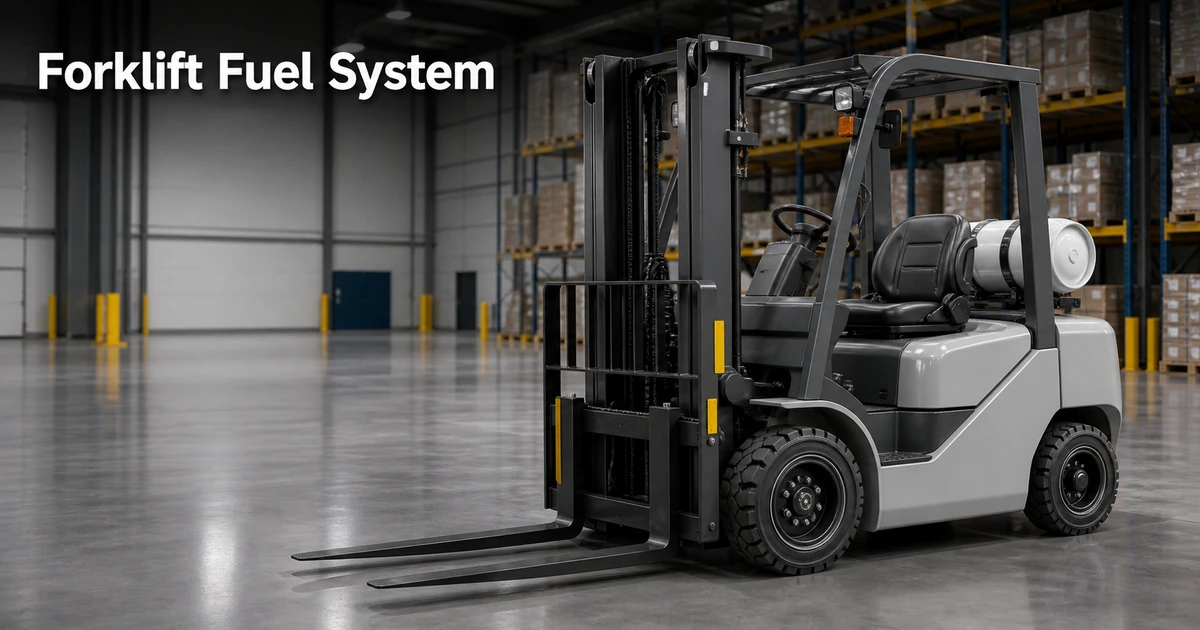
A forklift fuel system does three jobs: it stores fuel, moves it to the engine, and meters it into the air stream at the right rate for combustion. An LPG system holds liquid propane in a DOT-rated LPG cylinder (the gas itself ships under UN 1075) and depends on a vaporizer/regulator to convert the liquid to gas before it reaches the engine (PHMSA, 2024).
Most forklift fuel systems share that same architecture; the LPG variant is where the parts diverge. Diesel and gasoline machines store fuel in a tank, while propane forklifts carry a pressurized cylinder instead. In fleet maintenance, no-start complaints trace most often to the fuel system’s vaporizer/regulator rather than to the engine, which makes that component the first stop when a unit refuses to start. That ordering shapes the rest of this guide, because the diagnosis and maintenance sections lean hardest on the components named here.
How the fuel system feeds the engine
Delivery runs in a straight line from storage to combustion. A pump pulls fuel from the tank or cylinder, a filter strips contamination, and the carburetor or fuel injector meters a measured amount into the air drawn into the engine. On an LPG forklift, liquid propane first passes through the vaporizer/regulator, which converts it to gas and drops the pressure to a usable level, before a mixer blends the gas with air. A governor then throttles fuel or air delivery to hold engine speed steady as the load changes. The charge the piston compresses and ignites is the air-fuel mixture produced at the end of that line.
LPG vs diesel vs gasoline at a glance
The three fuels differ most in storage and metering. Diesel machines use a tank, a high-pressure injection pump, and injectors that spray fuel directly into the combustion chamber. Gasoline models store fuel in a tank and meter it through a carburetor or fuel-injection system. LPG forklifts hold pressurized liquid propane in a DOT-rated LPG cylinder (the gas itself ships under UN 1075) and feed the engine through a vaporizer/regulator and mixer. The full comparison table comes next, with component layout, ignition type, symptoms, and maintenance focus for all three. That split shows up daily in refueling: propane forklifts swap cylinders, while diesel and gasoline machines fill from a pump. That table is where the forklift fuel system choice narrows to running cost and duty cycle.
Glossary
- Vaporizer/regulator. Converts liquid propane to gas and reduces pressure before the mixture reaches the engine.
- Lock-off valve. A safety valve that shuts off fuel flow when the engine is off.
- Carburetor. A metering device that blends fuel with air, common on older gasoline and LPG engines.
- Fuel injector. A nozzle that sprays a measured fuel charge, used in diesel and newer gasoline systems.
- Governor. A device that limits engine speed by throttling fuel or air delivery.
- Excess-flow valve. A safety valve that trips shut when the LPG cylinder valve is opened too quickly, stopping a surge of gas.
- Water separator. A fuel-filter element on diesel units that pulls water out of the fuel before it reaches the injection pump.
Forklift Fuel Types Compared: LPG, Diesel & Gasoline
Warehouse and industrial forklifts run on one of three fuels: LPG, diesel, or gasoline. The type your forklift fuel system is built around dictates fuel storage, ignition, and the failure points you will chase on the shop floor. The at-a-glance preview above compressed the three into a line; this is the full component-level comparison. Top results in this space are nearly always LPG-only explainers or high-level fuel-choice guides, none comparing all three at the part level. We compared all three systems at the part level, which is where the repair and buying decision actually happens.
| Fuel | Fuel storage | System layout | Ignition | Typical failure points | Maintenance focus |
|---|---|---|---|---|---|
| LPG | Liquid propane in a DOT-rated LPG cylinder (UN 1075) (PHMSA, 2024) | Vaporizer/regulator and mixer ahead of the intake (PHMSA, 2024) | Spark, after vacuum-drawn vapor mixes with air (PHMSA, 2024) | Regulator and vaporizer wear | Regulator service, cylinder inspection |
| Diesel | On-truck fuel tank | High-pressure injection pump feeding injectors | Compression only, no spark plugs | Injection pump and injector wear | Filters, injectors, less spark work |
| Gasoline | On-truck fuel tank | Carburetor or port injectors | Spark via plugs | Carburetor deposits, ignition parts | Tune-ups, filters, plugs |
LPG forklift fuel systems
LPG is a common fuel for indoor warehouse and plant fleets (OSHA, 2026). The LPG forklift fuel system starts with a liquid propane cylinder, a DOT-rated design (the gas itself ships under UN 1075), mounted on the back of the truck (PHMSA, 2024). Propane leaves the tank as a liquid, vaporizes to gas, and is drawn through a demand regulator/vaporizer by engine intake vacuum, then mixed with air at the mixer ahead of the carburetor or intake (PHMSA, 2024). There is no pump pushing liquid; the engine does the pulling, which keeps the plumbing short. The regulator and vaporizer are the components that wear, and shop-floor forums consistently name cheap replacement regulators from IMPCO as the reliable fix. Operators generally prefer OEM parts, though a respected aftermarket unit earns its spot on the regulator.
Diesel forklift fuel systems
Diesel is the efficiency pick. A forklift diesel fuel system uses a high-pressure fuel-injection pump feeding injectors, and the charge ignites purely by compression, so there are no spark plugs. That compression ignition returns the best fuel efficiency of the three and the lowest CO risk at idle, which matters in poorly ventilated yards. The trade-offs are weight and noise; a diesel truck runs heavier and louder than its LPG or gasoline equivalents. When parts fail, the usual suspects are the injection pump and the injectors, both costlier to service than a regulator or carburetor.
Gasoline forklift fuel systems
Gasoline trucks are the most familiar of the three to diagnose. Fuel sits in a tank mounted on the truck and feeds either a carburetor or port injectors, and a spark plug lights the charge. Because the layout mirrors a conventional car engine, maintenance on a gasoline forklift fuel system carries over familiar habits: tune-ups, filters, and ignition parts dominate the schedule. The downsides are real. Gasoline forklifts have the weakest claim to indoor use, they return lower fuel economy than diesel, and carburetor versions accumulate deposits that need regular cleaning.
Dual-fuel and LP-gas conversions
A dual-fuel forklift runs on either gasoline or LPG and switches between them on the truck. The usual build starts with a gasoline machine fitted with a conversion kit that adds a cylinder, vaporizer, and mixer to the forklift fuel system, then a selector valve lets the operator pick the active fuel. The common question is whether you can switch fuels while operating. You can, but manufacturer guidance requires the change happen at idle, in neutral, with the truck stationary; operators who hot-switch under load risk voiding the warranty. Treat the switch as a stop-and-select operation, not a mid-task flip. Because a converted truck carries the same vaporizer and regulator as a pure LPG rig, its wear pattern and repair list look similar.
Across the three layouts, only the LPG system runs without a mechanical fuel pump: the engine’s intake vacuum draws vaporized propane through the demand regulator/vaporizer, which is why LPG failures concentrate on that component instead of on a pump (PHMSA, 2024). Diesel machines pressurize fuel with an injection pump, and their failures concentrate there instead (OSHA, 2026).
From here, the discussion shifts from fuel type to the parts themselves. The next section breaks down each component of the forklift fuel system, from tank and pump to filter and vaporizer, so a symptom can be traced back to the exact part that failed.
Fuel System Components Explained
Six components carry a forklift fuel system: the fuel tank (or LPG cylinder), the fuel pump, the fuel filter, the carburetor or injectors, the vaporizer and mixer on propane units, and the governor. Each has a distinct failure mode and a distinct replacement signal, and that pairing is what lets a parts buyer order with confidence instead of guessing.
Fuel tank and LPG cylinder
Diesel and gasoline forklifts store fuel in a frame-mounted tank that feeds the pump through a pickup line. Propane forklifts run from a pressurized liquid LPG cylinder, usually strapped to a bracket at the rear of the truck (OSHA, 2026). Counter to what many assume, the cylinder feeds the vaporizer as liquid, not vapor, and that distinction matters when ordering fittings. Tanks and cylinders take hard service, which is why a dented tank or a weeping fitting typically gets the unit replaced rather than patched.
The part most often replaced here is the lock-off valve. This electrically operated 12 V solenoid stops gas flow when the engine is off or when the ignition ground is interrupted. The two faults operators report are no 12 V at the valve and a valve stuck open. Both end with gas at the regulator when there should be none, and the valve is replaced rather than repaired.
Fuel pump and pressure regulation
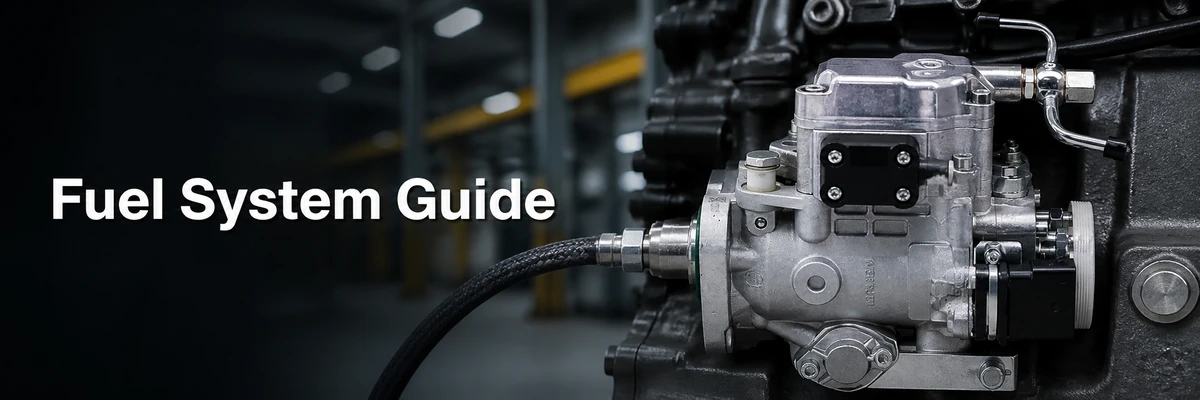
Diesel forklifts use a high-pressure fuel-injection pump, either inline or rotary, that pressurizes fuel ahead of the injectors. Gasoline units are less demanding: a pump in the tank or inline delivers low-pressure fuel to the carburetor or fuel rail. Mechanical wear in the high-pressure element is the usual end of a diesel injection pump, and the pump is expensive to replace, so protecting it upstream is where the filter earns its keep. Inline and rotary pumps are not interchangeable, so the family has to match when ordering. Fuel injection pumps and related engine parts are the categories to browse when replacement comes up.
Pressure regulation is bundled with the pump on diesel and gasoline trucks; on LPG units it lives in the vaporizer, covered below.
Fuel filter
Every forklift fuel system has a filter, and contaminated fuel is the top filter killer. Diesel units add a water separator, because water is what actually damages the injection pump. The replacement signal is an engine that hunts or stumbles under load, or a filter that looks dark and loaded when pulled. Diesel filter service is more demanding than gasoline because of that water-separator duty. Forklift fuel filters with separators cover most commercial lift trucks.
Carburetor vs fuel injection
Gasoline forklifts come in two flavors. A carburetor blends fuel and air mechanically and needs periodic adjustment; port fuel injection meters fuel electronically per cylinder and trades tuning for sensors. The injection pump is the diesel equivalent of both, and its injectors do the final metering. A rising idle or fuel smell points at the carburetor; a misfire locked to one cylinder points at an injector. Injector and fuel injection pump listings separate the two.
Vaporizer/regulator and mixer (LPG)
The vaporizer/regulator is the hot component on any propane forklift fuel system. Liquid propane enters it, vaporizes, and drops to working pressure; the mixer blends the gas with intake air before the carburetor or throttle body. Field reports center on torn diaphragms, sludge and oil buildup, seat wear, and internal leaks, and the accepted repair is OEM replacement over rebuild.
The mixer completes the propane side of the forklift fuel system, sitting between the regulator and the intake where the gas meets filtered air. The demand regulator opens on engine intake vacuum. When cranking voltage sags, the vacuum valve may not open, and operators commonly report trouble below roughly 9 VDC.
Governor
The governor is a mechanical or electronic speed limiter that cuts fuel when the engine over-revs. It protects the engine and the hydraulic system that shares the crankshaft. Whether the pickup is a mechanical linkage or a speed sensor, the job is the same: hold a set governed RPM under load. On older mechanical units, an unstable governed idle is the first sign of wear.
The table below is the fast reference for a forklift fuel system: part, function, failure, and the signal that says replace it.
| Part | Function | Typical failure | Replacement signal |
|---|---|---|---|
| Fuel tank / LPG cylinder | Stores fuel; cylinder holds liquid propane (OSHA, 2026) | Lock-off valve stuck or unpowered | Gas reaches regulator with engine off |
| Fuel pump / injection pump | Pressurizes and delivers fuel | Worn high-pressure element | Loss of pressure under load |
| Fuel filter | Traps dirt, separates water | Plugging from dirty fuel | Hunt or stumble under load |
| Carburetor / injectors | Meter fuel into intake air | Wear, clogged nozzles | Rising idle, single-cylinder misfire |
| Vaporizer/regulator (LPG) | Converts liquid to gas, regulates pressure | Torn diaphragm, sludge, seat wear | Rough idle, fuel smell, cold loss |
| Governor | Limits engine speed | Mechanical wear | Unstable governed idle |
Where we can help
The parts that fix most fuel system complaints are a short list, but they have to match the engine before they can fix anything. We are a single-source forklift parts supplier with OEM-compatible fuel system parts backed by fast quotation, so the vaporizer, filter, or injection pump you identify in this guide can reach your shop without a round of guess-and-check. Source the fuel system parts you need
By the Numbers
- 4-5 psi output at the vaporizer/regulator on Nikki-style propane systems, per field reports
- 12 V supply that must reach the LPG lock-off solenoid
- 2,000 hrs typical service norm between fuel filter changes, not a hard spec
Once the components of a forklift fuel system are mapped to their failure signals, the next step is diagnosis. The next section turns each signal above into a symptom-to-fault workflow, so a rough idle or a hard start leads to the right part the first time.
Common Fuel System Problems & How to Diagnose Them
Most forklift fuel system problems that look like engine trouble are fuel delivery trouble. On an LPG unit, the first suspect is the vaporizer-regulator, not the block. The diagnostic approach we follow stays the same across every fuel type: confirm cranking and spark, then trace fuel from tank to intake. That ordering separates a 15-minute fix from a replaced engine.
The classic disguise is a weak battery. The demand valve on an LPG forklift opens on engine intake vacuum, so a battery that cranks too slowly may never spin the engine fast enough to open it. What reads as fuel starvation is frequently a charging fault.
No-start and hard-start causes
The dominant complaint in forklift fuel system problems is no-start or hard-start, and most of the time the fault lives in the LPG vaporizer-regulator rather than the engine. Cold starts show it first. Liquid propane must vaporize before it burns, and cold fuel at low pressure will not. Technicians commonly work around this with priming aids, a regulator warmed by engine coolant, and slow crank bursts of 5 to 8 seconds.
Hard starting when hot is usually fuel physics, not a dead component: collapsed coolant hoses to the vaporizer cause regulator icing, and fuel lines routed near the exhaust can vapor-lock. Both read like a failed vaporizer but fix with hose replacement and rerouting.
Before condemning the vaporizer, confirm fuel is arriving. Two frequent no-fuel culprits are a faulty lock-off solenoid (no 12 V at the coil, or stuck open) and a tripped excess-flow valve, which happens when the tank valve opens too fast.
The sequence service guides commonly follow:
- Step 1: Battery and cranking. Confirm charge and cranking speed first.
- Step 2: Spark quality. A no-start stays electrical until proven fuel-related.
- Step 3: Lock-off solenoid. Check for 12 V at the coil, then free movement.
- Step 4: Fuel at the primer. The vaporizer primer should push fuel through when pressed.
- Step 5: Converter pressure. On a Nikki unit, service guides commonly check for roughly 4 to 5 psi.
- Step 6: Vacuum and hoses. Any intake vacuum leak starves the demand valve.
Only after those checks does the vaporizer become the suspect, and operators report more consistent results replacing the regulator with OEM or a well-regarded aftermarket unit such as IMPCO than rebuilding it.
Rough idle and stalling under load
A forklift fuel system that idles rough or dies under load points to three things in practice: an intake vacuum leak, a clogged fuel filter, or a worn vaporizer diaphragm. On an LPG unit, most forklift fuel system rough-idle complaints trace to the regulator or mixer adjustment, with a bad diaphragm the common hardware cause. An adjustment is a half-hour of work; a diaphragm is a replacement.
- Vacuum lines. Cracks and loose clamps change mixture at idle.
- Fuel filter. A clogged filter starves the system at full throttle.
- Diaphragm and adjustment. Set the mixer per spec before ordering parts.
- Stall under load. Watch converter pressure while the mast lifts.
An idle propane forklift that has gone without maintenance can push carbon monoxide in its exhaust to roughly 36,000 ppm (Fawcett et al., 1992; McCammon et al., 1996). At that level the gas is a genuine indoor hazard, so running-diagnosis tests belong outdoors or under active ventilation, and exhaust or air-flow faults get corrected before any other repair.
Warning: Carbon monoxide has no odor, and a neglected propane forklift at idle can emit roughly 36,000 ppm of it in the exhaust (Fawcett et al., 1992; McCammon et al., 1996). Run every no-start or rough-idle test outdoors or with the bay doors open, and treat a propane smell at the tank as a shutdown condition.
Fuel smell or leak diagnosis
Propane in the bottle is odorless; the smell you notice is an added odorant, so if you catch it at the tank or the regulator, gas is escaping where it should not. Shut the unit down, close the tank valve, and test the suspect joints with leak-detection fluid or soapy water while the forklift fuel system holds pressure. A persistent propane smell is a shutdown condition, not a symptom to work around.
Symptom-to-part quick map
The quick map below groups the most common forklift fuel system complaints by likely cause and first check.
| Symptom | Likely cause | First check |
|---|---|---|
| Propane forklift no start after a tank swap | Tripped excess-flow valve | Reopen the tank valve slowly, confirm 12 V at the coil |
| Hard start when cold | Vaporizer cannot vaporize cold fuel | Use a priming aid and slow crank bursts |
| Hard start when hot | Regulator icing from a collapsed coolant hose, or vapor lock | Inspect hoses and fuel line routing |
| LPG rough idle | Mixer or regulator adjustment, or a worn diaphragm | Set per spec before replacing |
| Stalls under load | Clogged filter or vacuum leak | Check fuel pressure and intake hoses |
| Propane smell at the tank | Leak | Shut down and test fittings with soapy water |
With a symptom mapped to a part and a check order in hand, the remaining work is prevention. Maintenance intervals and refueling procedures are the next section: keeping the forklift fuel system from failing again.
Forklift Fuel System Maintenance
Forklift fuel system maintenance runs on two clocks. The first is a five-minute daily walk-around that catches leaks and loose clamps before they strand a truck. The second is an interval schedule that replaces filters and validates the LPG vaporizer circuit on a set cadence. Skip the daily pass and a pinhole leak costs you a shift; skip the intervals and a worn filter starves the pump until it fails.
Daily and weekly checks
The daily pass needs no tools and no pit. Walk the unit, then work this routine:
- Sniff around the tank and engine bay for fuel odors.
- Inspect every fuel hose and clamp for cracks, kinks, and loose fittings.
- Confirm the LPG cylinder has no dents or obvious damage.
- Verify the cylinder inspection date has not lapsed.
- Check the forklift fuel filter housing for dirt, water, or seepage.
- Confirm the lock-off valve opens and closes cleanly on each start.
Nothing here takes more than a minute each, and the routine is the same whether the truck runs LPG, diesel, or gasoline. Weekly, add a closer look at the filter housing and the vaporizer body for seepage marks that a quick glance can miss.
Filter, hose, and cylinder-interval replacement
Filters and hoses wear on hours of operation, not calendar time. The norms most operators cite put fuel filter replacement at every 2,000 hours across fuel types, with the caveat that the service manual always wins. Hoses follow visual condition rather than a hard clock: any crack, kink, or soft spot at a clamp earns replacement on the spot. Here is the interval map:
| Maintenance task | LPG | Diesel | Gasoline |
|---|---|---|---|
| Fuel filter replacement | every ~2,000 hrs | every ~2,000 hrs | every ~2,000 hrs |
| Vaporizer glycol and coolant flow check | monthly | not applicable | not applicable |
| Licensed LPG system service | annual | not applicable | not applicable |
| O2 sensor condition | not applicable | not applicable | every ~2,000 to 3,000 hrs |
The three schedules differ more than the round numbers suggest. The LPG column carries a vaporizer glycol check and an annual licensed service that neither diesel nor gasoline trucks ever see; the gasoline column carries an O2 sensor watch. When the filter comes due, a fuel filter from the parts shelf is a quick swap that protects the pump and injectors and keeps the forklift fuel system’s pressure steady.
Refueling and storage safety
Refueling is where preventable forklift fuel system incidents cluster, and the procedure is regulated, not a preference.
Per OSHA 29 CFR 1910.178(f), the powered industrial truck standard points every US facility to NFPA 58 for LPG and NFPA 30 for gasoline and diesel refueling (OSHA, 2026).
OSHA 29 CFR 1910.178 is the federal powered industrial truck standard. Its fuel-handling provision, 29 CFR 1910.178(f), points every US facility to NFPA 58 for LPG and NFPA 30 for gasoline and diesel. OSHA refueling guidance and those codes require the engine off with the brakes set while fueling, no smoking or open flames in the refueling area, the nozzle held against the fill pipe, and prompt cleanup of spills before restart. (OSHA, 2026; NFPA, 2024)
LPG adds a second standard to the forklift fuel system owner’s list. NFPA 58 requires cylinders stored outdoors or in a ventilated enclosure, away from ignition sources, with the service valve protected from impact (NFPA, 2024; OSHA, 2024). A storage rack that lets a valve take a bump is a leak waiting to happen. DOT UN 1075 marks the propane itself in transit (PHMSA, 2024).
Whatever the fuel type, the interval map is a floor, not a ceiling. For the specific questions it leaves open, including the exact forklift fuel filter replacement interval, the FAQ below works through the answers.
Frequently Asked Questions
Here are direct answers to the forklift fuel system questions operators search for most, drawn from the parts, types, and maintenance sections above.
Q: How does a propane forklift fuel system work?
Liquid propane from a DOT-rated LPG cylinder (the gas itself ships under UN 1075) flows into a vaporizer/regulator that turns it into gas (PHMSA, 2024). Intake vacuum then draws the gas through a demand regulator, where it mixes with air at the mixer before the carburetor or injection system meters it into the engine. There is no mechanical fuel pump; the engine’s own suction does the pulling.
Q: What type of fuel do forklifts run on?
LPG, or propane, is a common fuel in warehouses and distribution centers. Others burn diesel through a high-pressure injection pump and injectors, and a smaller share run gasoline by carburetor or port injection (OSHA, 2026). Diesel units add a fuel-water separator to the maintenance list, while LPG units concentrate wear on the vaporizer and regulator.
Q: What are the correct procedures for refueling a forklift?
Refueling is governed by OSHA 29 CFR 1910.178, whose fuel-handling provision points to NFPA 58 for LPG and NFPA 30 for gasoline and diesel. The routine requires the engine off, the brakes set, no smoking or open flame, the nozzle held against the fill pipe, and immediate cleanup of any spill (OSHA, 2024; NFPA, 2024). Propane cylinders then store in a ventilated outdoor area with their valves protected (NFPA, 2024; OSHA, 2024).
Q: Why won’t my propane forklift start after I change the tank?
Most often a tripped excess-flow valve from opening the tank valve too quickly. Open the valve slowly, then verify 12 V at the lock-off solenoid and prime the system. A failing demand regulator is the second suspect.
Q: Can I switch fuels while operating a dual-fuel forklift?
No. Manufacturers require switching at idle, in neutral, and stationary. Hot-switching under load voids the warranty, so time the change for a pause in the shift.
Q: Why does my LPG forklift run rough at idle?
Most often the vaporizer/regulator diaphragm, with mixer adjustment and a vacuum leak close behind. The fuel filter is a secondary suspect, so check it only after ruling out air-side causes. Rough idle that clears when you open the throttle usually points to the mixer, not the filter.
Q: How often should I replace the forklift fuel filter?
Service norms commonly cite around 2,000 hours of operation, so follow the OEM-specified interval. Inspect the filter sooner if you notice power loss, rough running, or hard starts on LPG units. Replacement is cheap next to the damage a plugged filter does to the vaporizer.
Conclusion
LPG, diesel, and gasoline forklifts all move fuel from storage to the engine through a pump, filter, and carburetor or injector, but the parts that fail are fuel-specific: the vaporizer/regulator on LPG, the injection pump on diesel, and the carburetor on gasoline. Most no-start and rough-idle complaints trace to the fuel filter, the lock-off valve, or the vaporizer/regulator, all replaceable in an hour with engine-matched parts. Keep the daily walk-around and the interval schedule above, ground every refueling and cylinder-storage practice in OSHA 29 CFR 1910.178 and NFPA 58, and treat a persistent propane smell as a shutdown condition rather than a symptom to work around.
References
- Fawcett, T. A., Moon, R. E., Fracica, P. J., Mebane, G. Y., Theil, D. R., & Piantadosi, C. A. (1992). Warehouse workers’ headache: Carbon monoxide poisoning from propane-fueled forklifts. Journal of Occupational Medicine, 34(1), 12-15. https://pubmed.ncbi.nlm.nih.gov/1552375/
- McCammon, J. B., McKenzie, L. E., & Heinzman, M. (1996). Carbon monoxide poisoning related to the indoor use of propane-fueled forklifts in Colorado workplaces. Applied Occupational and Environmental Hygiene, 11(3), 192-198. https://doi.org/10.1080/1047322X.1996.10390604
- Occupational Safety and Health Administration. (2026). Powered industrial trucks eTool: Internal combustion power sources. U.S. Department of Labor. https://www.osha.gov/etools/powered-industrial-trucks
- Occupational Safety and Health Administration. (2024). Powered industrial trucks (29 CFR 1910.178). U.S. Department of Labor, eCFR. https://www.ecfr.gov/current/title-29/subtitle-B/chapter-XVII/part-1910/subpart-N/section-1910.178
- Occupational Safety and Health Administration. (2024). Storage and handling of liquefied petroleum gases (29 CFR 1910.110). U.S. Department of Labor, eCFR. https://www.ecfr.gov/current/title-29/subtitle-B/chapter-XVII/part-1910/subpart-H/section-1910.110
- National Fire Protection Association. (2024). NFPA 58: Liquefied petroleum gas code (2024 ed.). https://www.nfpa.org/codes-and-standards/nfpa-58-standard-development/58
- Pipeline and Hazardous Materials Safety Administration. (2024). Hazardous materials table, special provisions, and other requirements (49 CFR 172.101). U.S. Department of Transportation, eCFR. https://www.ecfr.gov/current/title-49/subtitle-B/chapter-I/subchapter-C/part-172/subpart-B/section-172.101
Last reviewed and updated: August 2026. Author: Kingstream team. For tailored guidance, contact our team.