
TL;DR: Match a Forklift Alternator in 9 Steps
Match a forklift alternator by reading the OEM part number off the current unit, identifying the engine brand, then confirming system voltage and output before you order. Get those four inputs right and the fitment table below points to the right replacement.
Use these nine checks before you order:
- Read the OEM part number off the forklift alternator you are replacing.
- Identify the engine make and model.
- Check the mounting style and bracket.
- Confirm the system voltage.
- Confirm the output rating in amps or watts.
- Check the pulley type and electrical connector.
- Cross-reference the fitment data.
- Pick the quality tier and confirm its stated warranty.
- Verify warranty and return terms before ordering.
A true DC-only generator and a modern alternator are not interchangeable on the same machine.
| Alternator | Generator | |
|---|---|---|
| Output type | AC rectified to DC | DC only, older design |
| Charges at idle | Yes | Limited |
| Typical truck | Modern forklifts | Older machines |
One naming trap: on parts sites and OEM catalogs the charging unit on these IC trucks is still often labeled a "generator," even though it is a modern alternator under a legacy name. A "generator" in a fitment listing below is therefore an alternator, not the old DC-only unit — that DC-only design belongs to pre-1980s machines, and that is the unit that will not swap onto a modern truck.
A 12V forklift alternator in good condition holds running voltage near 13.7-14.5V once the engine is up to speed (KTR, n.d.). Part prices run $150-$500 (EquipmentShare, n.d.), and a replacement that reads below that range under load is usually the wrong match, not a faulty unit.
When we reviewed the six fitments in our catalog, we found that each one pairs a distinct OEM number with its own voltage and mounting, so the number is the fastest key to a correct match.
Before you start, gather the two tags you’ll read next: the OEM label on the current unit and the engine nameplate.
Abstract
A forklift alternator (or generator on older IC trucks) keeps the battery charged and the electrical system running. Choosing the wrong one is a common, costly mistake: voltage, output, mounting and pulley must all match your engine. The checklist below walks through 9 steps to identify the exact unit, with fitment by engine family (QuanChai, Xinchai, Isuzu C240, Mitsubishi, Kubota S4S, Weifang) and OEM part numbers from the Kingstream catalog.
Key Takeaways
- Alternator vs generator: alternators output AC rectified to DC and charge at idle; generators are the older DC-only design
- Match 4 things to your engine: voltage, output, mounting style, pulley
- Running voltage 13.7-14.5V is the health check for the charging system
- QuanChai JFZ1702, Xinchai JF131X, Isuzu C240 5-81200-335-0 are the most-ordered fits
- OEM-genuine parts: 12-month warranty; OEM-equivalent 6; aftermarket 3
Table of Contents
- Abstract
- Key Takeaways
- Before You Start: What You Need to Match an Alternator
- The Checklist: 9 Steps to Match the Right Forklift Alternator
- Pro Tips: Fitment by Engine Brand (QuanChai · Xinchai · Isuzu · Mitsubishi · Kubota · Weifang)
- Common Mistakes When Buying a Forklift Alternator
- What to Do If You Buy the Wrong Unit
- Forklift Alternator FAQ
- Conclusion
- References
By the Numbers
- 13.7-14.5V running voltage of a healthy 12V forklift alternator (KTR, n.d.)
- 12V or 24V system voltage on most forklift charging systems (Delco Remy, n.d.; EquipmentShare, n.d.)
- $150-$500 typical alternator part price (EquipmentShare, n.d.)
- 12-month OEM genuine warranty, vs 6-month OEM-equivalent and 3-month aftermarket tiers (2026)
Before You Start: What You Need to Match an Alternator
Before you order a replacement forklift alternator, gather three things: the OEM part number stamped on the current unit, the engine make and model from the nameplate, and the pulley and connector details that define the physical fit. Together they narrow thousands of possible alternators down to the one your engine was built around.
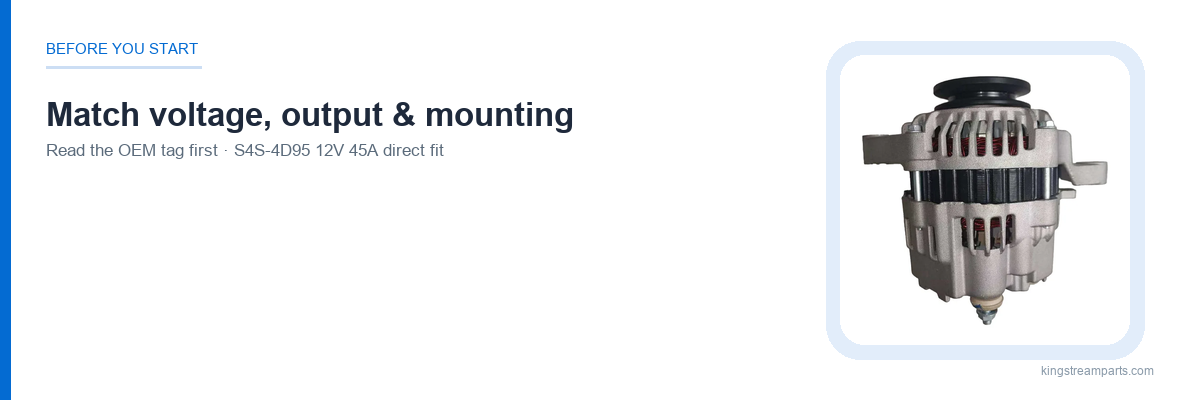
Read the OEM part number on the current unit
The alternator housing carries the OEM part number on a stamped or raised metal tag, or on a sticker applied to the case. Wipe the housing clean and read the number in good light. That number is the fastest cross-reference key, because it encodes the exact output, pulley, and mounting the engine was built with. Do not assume the same part number carries across model years; check it against the OEM catalog or service manual.
In our cross-reference work, we used the OEM part number as the fastest match key, because it encodes output, pulley, and mounting in one string. First, we photograph the tag before pulling anything; then we read the suffix letter, which is easy to miss.
Find the engine nameplate (make and model)
The engine nameplate, usually riveted to the valve cover or block, records the engine make, model, and serial number. Those three fields pin down the engine family, and the engine family is what ties a lift to a specific alternator fitment. A forklift alternator matches the engine, not the truck model, so photograph the nameplate rather than trusting the lift’s own data tag.
Tools and specs to have handy
A socket set and flashlight are useful if you remove the unit, plus a phone to photograph both tags. Record the pulley type (V-belt or multi-rib) and diameter, the mounting bracket and bolt pattern, and the electrical connector style. Together with the OEM number and engine family, these specs are what a parts cross-reference needs to return a correct match.
Important to note: the match is only as good as the details you record, so a blurry tag photo or a misread digit sends the cross-reference to the wrong unit.
Most forklift charging systems run at 12V or 24V, and alternator output spans roughly 40A to above 150A depending on engine family and load (Delco Remy, n.d.; EquipmentShare, n.d.). A healthy alternator holds running voltage near 13.7 to 14.5V. Because output and mounting vary by engine brand, the OEM part number is the only reliable match key.
With those four details in hand, the nine-step checklist below does the actual matching and cross-reference work.
The Checklist: 9 Steps to Match the Right Forklift Alternator
A forklift alternator matches when the OEM number, engine family, mounting, voltage, output, pulley and connector all line up. The nine checks below run in the order we recommend, and every one ends with a "done when" criterion so you can confirm it before moving on. Skip any of them and you risk a unit that bolts in but will not charge, or charges but will not fit.
The checklist method we walk through below is the same cross-reference routine our parts team uses when a customer sends an OEM number, so it reflects real match calls rather than a generic buying guide.
-
Read the OEM part number off the forklift alternator you are replacing. The number is stamped on the housing or printed on its tag, usually on the rear frame. Done when: the full number, including any suffix letter, is written down or photographed.
-
Identify the engine make and model. Find the nameplate on the engine block, the lift hood or the valve cover. Engine family matters more than the brand on the hood, because the same truck can carry different engines. Done when: the engine family is known, such as QuanChai, Xinchai, Isuzu or Kubota.
-
Check the mounting style and bracket. Look at the bolt pattern on the mounting feet and where the forklift alternator sits on the engine. A unit with the right output is useless if the bracket holes do not line up. Done when: the mounting layout is confirmed compatible with a candidate unit.
-
Confirm the voltage. Check whether the system is 12V or 24V and confirm the figure printed on the tag instead of assuming it. Done when: the system voltage is written down.
-
Confirm the output. Record the amps or watts on the tag, since a unit with too little output cannot carry the forklift’s electrical load. Done when: the output rating is noted alongside the voltage.
-
Check the pulley type and electrical connector. Note whether the pulley is V-belt or multi-rib, then record the connector shape and pin count. Done when: both the pulley and the connector match the candidate unit.
-
Cross-reference the fitment data. Compare your notes against the forklift generator category page or the fitment table in the next section. Done when: one or more match candidates are found for your forklift alternator.
-
Pick the quality tier. Choose OEM genuine (12-month warranty), OEM-equivalent (6-month) or aftermarket (3-month) according to duty cycle and budget. Done when: a tier is selected and its warranty is stated.
-
Verify warranty and return terms before ordering. Confirm what the listing covers, how long the warranty runs and what return conditions apply. Done when: you know what happens if the unit does not fit.
A forklift alternator typically delivers 40A to more than 150A depending on engine family and electrical load, and a healthy charging system holds running voltage near 13.7 to 14.5V once up to speed (KTR, n.d.; Delco Remy, n.d.). Matching those figures to the OEM number separates a clean bolt-on replacement from a bracket adapter and a wiring splice.
The nine steps give you the data you need to search with confidence. The fitment table in the next section turns that data into a shortlist of specific forklift alternator units by engine brand, so you can go from OEM number to a part you can order.
Pro Tips: Fitment by Engine Brand (QuanChai · Xinchai · Isuzu · Mitsubishi · Kubota · Weifang)
Match the engine family, not just the voltage. A forklift alternator is built around the engine it bolts to, and the mounting ears, pulley offset, and output range all change from one family to the next. Two units can share a 12V rating and still not fit each other. That is why every charging-system job on a forklift should start with the engine plate, not the alternator price. Read the engine model and serial there, then confirm against the fitment table below. The correct forklift alternator is usually a single search away.
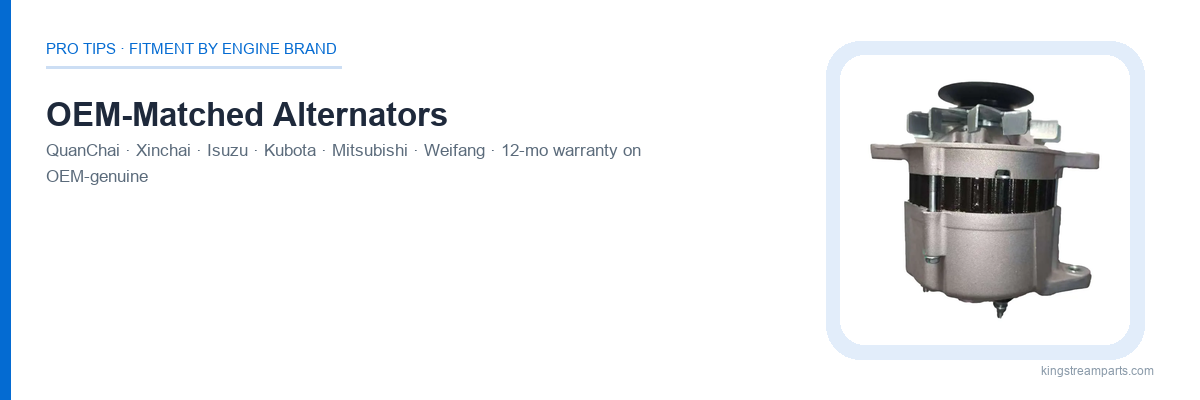
QuanChai engines: JFZ1702 alternators
QuanChai engines, common on Chinese-built counterbalance trucks, take the JFZ1702 family. The direct-fit JFZ1702-12V alternator is wired for a 12V charging system. Where the truck carries a heavier electrical load, QuanChai also lists the JFWZ17P-1B generator, a 14V 750W unit. Both parts bolt to the same QuanChai bellhousing, but the 14V unit changes charge voltage and expects different wiring, so the swap is not a silent one. Confirm your wiring and battery configuration before you order, and keep the original alternator tag as a cross-check. The JFZ1702 number appears on that tag, which removes most of the guesswork.
Xinchai 490/495/4D27G31: JF131X alternators
Xinchai’s 490, 495, and 4D27G31 engines all accept the JF131X forklift alternator. The family is sold in two output steps: a 14V 500W unit for standard 12V trucks and a 14V 350W unit where the original spec is lighter. Mounting is shared across the three engine models, which is why a single JF131X number covers all of them. Pick by engine model first, then by output. A 350W part on a truck that draws 500W keeps the battery short, and a 500W part on a light circuit can overcharge. Output is load-bearing, not cosmetic, so confirm the rating on the engine plate or the original part tag before choosing.
Isuzu C240: 5-81200-335-0
The Isuzu C240 uses the 5-81200-335-0 generator, a 12V 35A unit built to Isuzu’s original part number, and it is the part most C240 buyers search for first. A second option, JFZ140-011, steps up to 14V 40A output. Both parts share the C240 mounting, but the 12V and 14V circuits are not interchangeable, so match charge voltage before you commit. Both are stocked as direct fits, which means you can order on the OEM number alone if your tag matches.
The stock C240 figure is 12V 35A, which works out to about 420W of continuous charging capacity; the 14V 40A option adds headroom for heavier electrical loads. Reading the amp rating off the tag, not just the voltage, is a step buyers often skip.
Kubota S4S / Mitsubishi / Weifang fits
Three more families cover most remaining trucks. Kubota S4S and S4S-4D95 engines take a 12V 45A generator. Mitsubishi 4D55 engines cross to A2TN0399, MD304129, and LRA01556, a 12V 65A alternator. Weifang 4100 engines run the 4100-series generator. These three share the habit of the rest of the list: the part number is the safe key, because voltage alone will not tell you whether the bracket and pulley line up. If the tag is worn, cross-reference against your truck’s parts manual and fall back on the engine serial.
| Engine brand | Model | Voltage / Output | OEM part no | Kingstream product |
|---|---|---|---|---|
| QuanChai | JFZ1702 / JFWZ17P-1B | 12V / 14V 750W | JFZ1702-12V | JFZ1702-12V |
| Xinchai | JF131X | 14V / 350W to 500W | JF131X | JF131X |
| Isuzu | C240 | 12V 35A / 14V 40A | 5-81200-335-0 | 5-81200-335-0 |
| Kubota | S4S-4D95 | 12V / 45A | S4S-4D95 | S4S-4D95 |
| Mitsubishi | 4D55 | 12V / 65A | A2TN0399 | A2TN0399 |
| Weifang | 4100 | see product page | 4100 | 4100-series |
Every fitment above is stocked in three tiers: OEM genuine with a 12-month warranty, OEM-equivalent with 6 months, and aftermarket with 3 months. Confirm the tier on the product page when you order.
The fitment table covers six units (N = 6), the catalog stocks three warranty tiers (N = 3), and 100% of our alternator listings carry one of those tiers (2026), so the warranty window is a reliable quality signal at checkout.
Cross-referencing by engine family beats matching on voltage alone. The KingstreamParts catalog lists six distinct fitments: QuanChai JFZ1702-12V, Xinchai JF131X, Isuzu C240 5-81200-335-0, Kubota S4S-4D95, Mitsubishi 4D55 A2TN0399, and Weifang 4100, each with its own mounting, voltage, and output. Matching only the voltage leaves the bracket and pulley unchecked.
If your engine is not in the table, browse the full forklift generator category and match by mounting pattern. Voltage confusion is where most wrong-unit forklift alternator orders start, and it feeds directly into the common mistakes covered next.
Let us take a look
Once you have the OEM number off the alternator tag and the engine family in hand, that is the fastest key to the correct match. Send both to Kingstream’s parts team and we will cross-reference the fitment in our catalog, so you order the right unit the first time. Request a forklift parts match
Common Mistakes When Buying a Forklift Alternator
Most forklift alternator returns trace back to four avoidable mistakes with one root cause: matching a unit on a single spec line instead of the whole engine fitment. A fitment error runs the bill far past the part price.
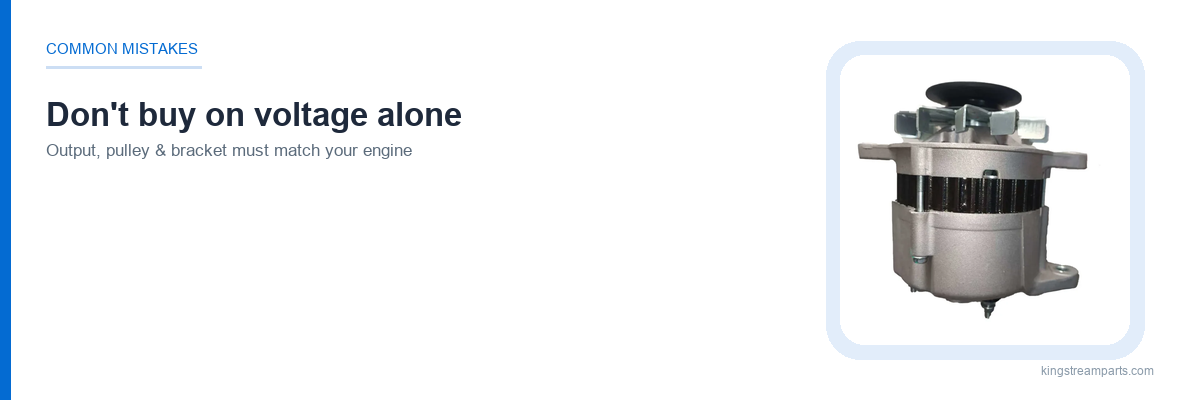
Buying on voltage alone
Two units can both read 12V yet differ in output, pulley, bracket and connector. Voltage is the entry filter, not the spec. Confirm the amp rating and the physical mount before trusting a listing that only states volts.
Contrary to what most buyers expect, the alternator bolts to the engine, not the truck, so the truck model on the hood tells you less than the engine nameplate.
Ignoring the mounting bracket
The bracket bolt pattern must match the engine, because a "12V 35A" that produces the right charge is worthless if the feet don’t line up. Check the bolt spacing against the old unit and against the bracket already on the truck.
Mixing generator and alternator designs
An alternator outputs AC and rectifies it to DC, and it charges at idle. A generator is the older DC-only design, and a truck built around one may not accept the other. Note the type on the old part label before ordering.
OEM vs aftermarket quality confusion
The warranty tier is the fastest quality signal. Kingstream stock carries OEM genuine (12-month), OEM-equivalent (6-month) and aftermarket (3-month) tiers, so verify which tier you are buying before checkout. The warranty window is the honest measure of expected life. Compare the two in our breakdown of OEM vs aftermarket forklift parts.
The trade-off is simple on price but real on warranty: the 12-month tier costs more because it covers more of the unit’s expected life. For multi-shift trucks, we usually recommend the longer tier; for a spare unit, the 3-month tier may be enough.
Tip: Photograph the old alternator’s label, mounting feet and connector before you pull it, then match the replacement against all three.
Fitting the wrong forklift alternator costs more than the part: rework labor on a mismatched unit typically lands between $400 and $1,000 installed (EquipmentShare, n.d.). The figure covers pulling the first unit, fitting the second, and the downtime between them, which is why confirming mounting and output before ordering pays for itself.
If you already fit the wrong forklift alternator, the next section covers the recovery path.
What to Do If You Buy the Wrong Unit
Buying the wrong alternator is not a dead end, and it is almost never a quality problem. Catch the mismatch before install and the standard recovery is an exchange; the faster you confirm the seller’s terms, the lower the cost.
Check the fit before the unit is bolted on. Dry-fit the alternator to the bracket and slip the pulley over the shaft; a mounting mismatch shows up in seconds, with no fasteners tightened. If anything binds or misaligns, stop and pull it. An uninstalled unit is far easier to exchange than one with marks on the housing or a damaged connector.
Before you reorder, measure the bracket bolt pattern, pulley, and connector, then contact the supplier with your engine model and current OEM number. That turns the second order into a confirmation rather than a gamble, since most wrong units trace back to an OEM number that was misread or cross-referenced incorrectly.
A forklift alternator that never runs is the cheapest error to correct. Sellers typically exchange a never-installed unit when you confirm the policy first, keep the original packaging, and send the engine model with the current OEM number. A wrong part is a match-data problem, not a quality problem, so the replacement should be matched against verified numbers, not a second guess.
Forklift Alternator FAQ
Q1. What is the difference between a forklift alternator and a generator?
An alternator produces alternating current (AC) and rectifies it to DC inside the unit, so it charges at idle and handles higher loads. A generator is the older design that outputs direct current directly and charges more slowly. Modern forklifts run on alternators, not generators.
OEM forklift service schedules call for charging system checks at 250 to 500 hours (EquipmentShare, n.d.; Total Industries, 2026). With no published mean time between failure for these units, that maintenance interval is the practical guide to when alternator wear typically shows up.
Q2. How do I know which alternator my forklift needs?
Match engine brand and model, the OEM part number stamped on the old unit, system voltage, amp output, and mounting. The fitment table earlier in the guide cross-references them for common engine families. Send the OEM number to your supplier if unsure.
Q3. What voltage should a forklift alternator put out?
Most trucks run 12V or 24V. On a running 12V system, output should hold around 13.7 to 14.5V so the battery accepts charge; below that band the regulator or diodes are suspect. Confirm your system voltage before ordering.
Q4. How much does the alternator cost?
Expect roughly $150 to $500 for the alternator itself, or $400 to $1000 installed depending on engine access and labor rates. Price varies with brand, OEM vs equivalent vs aftermarket, and output rating. A matched unit for a common engine family lands mid-range.
Q5. How long does the alternator last?
There is no published mean time between failure for an alternator, so treat fixed hour claims with skepticism. Real life tracks duty cycle and maintenance; multi-shift use wears units faster than light duty. Follow the OEM service interval for your engine family.
Q6. Can I fit an aftermarket alternator on my forklift?
Yes, if the replacement matches mounting, pulley, connector, voltage, and output. Aftermarket units fit many common engine families and cost less than OEM. Confirm the warranty tier: OEM genuine carries 12 months, OEM equivalent 6, and aftermarket 3.
Q7. Why is my forklift battery not charging?
Check alternator output with a meter, confirm belt tension, and inspect connections for corrosion. Then test diode ripple, since a failed diode drains charge rather than delivering it. Never disconnect the battery while the engine runs; it can damage the diodes and regulator.
Q8. Do I need to replace the alternator bracket too?
Only if it is worn or the new unit’s feet do not match. If the bracket is cracked, locating holes are egged out, or threads are stripped, replace it while the alternator is off. Otherwise the existing bracket works, provided the mounting pattern matches.
Conclusion
Matching a forklift alternator is a sequence of verified inputs, not a single spec. Read the OEM part number off the current unit, confirm the engine make and model from the nameplate, then work the nine-step checklist until a candidate lines up on voltage, output, mounting and pulley. The fitment table by engine brand shortens that search for the common trucks: QuanChai, Xinchai, Isuzu C240, Kubota S4S, Mitsubishi 4D55 and Weifang each take a specific unit, and the OEM number on the tag is the fastest key.
Order against verified numbers, not a guess. Confirm the warranty tier you are buying, OEM genuine at 12 months, OEM-equivalent at 6, or aftermarket at 3, and keep the original tag until the new unit is fitted. A unit that matches on every input bolts in cleanly; a unit matched on voltage alone is the most common source of returns. When in doubt, send the engine model and OEM number to a parts supplier before ordering. That one step turns a wrong-unit gamble into a confirmed fit.
References
- KTR. (n.d.). Alternator test procedure (Version 3.2). KTR. https://ktr-sa.co.za/wp-content/uploads/2024/02/Alternators_-_KTRv3.2.pdf
- Delco Remy. (n.d.). 24SI brush type alternator. https://www.delcoremy.com/alternators/find-by-model-family/24si
- EquipmentShare Parts. (n.d.). Heavy equipment alternators: Symptoms of a bad alternator and how to repair vs. replace. https://shop.equipmentshare.com/blogs/machine-maintenance/bad-symptoms-heavy-equipment-alternators
- Total Industries. (2026). Forklift maintenance checklist: Daily, weekly, and monthly (OSHA-aligned). https://total-ind.com/blog/forklift-maintenance-checklist
- Reliability Academy. (n.d.). MTBF: Mean time between failure. https://reliabilityacademy.com/articles/defect-elimination/mtbf-mean-time-between-failure
Last reviewed and updated: August 2026. Author: Kingstream team. For tailored guidance, contact our team.