
TL;DR
Choose a side shifter by verified carriage and truck data first, then compare movement, attachment weight, hydraulic needs, and product scope.
Key Takeaways
- Match the attachment to the truck carriage before comparing price or brand.
- Separate side-shift-only carriages from combined fork-positioner units.
- Treat load center and data-plate review as capacity checks, not optional paperwork.
- Use product-specific values only within their stated SKU scope.
- Request hydraulic, hook, hose, and residual-capacity details before quotation.
Table of Contents
- Key Takeaways
- What a forklift side shifter does
- Fitment checks to complete before comparing models
- Side-shift-only carriage or combined fork positioner?
- Capacity and load center: what the data plate changes
- Hydraulic and mechanical specifications to verify by SKU
- What to ignore in a side-shifter listing
- How to prepare a fitment check and quote request
- FAQ: forklift side shifter questions buyers ask
- When to delay the purchase
- Conclusion
- References
What a forklift side shifter does
A forklift side shifter moves the fork carriage or fork assembly left and right without requiring the operator to reposition the entire truck. It is useful when the truck is aligned with a pallet but the forks need a small lateral correction. The attachment does not remove the need to check carriage fitment, load center, capacity, or hydraulic compatibility .
Side shift versus moving the whole truck
For a forklift side shifter, the side-shift function changes the lateral position of the load. Steering the truck changes its entire path. That distinction matters in racking, container loading, and other spaces where a small fork correction is faster or safer than another truck maneuver. The correct amount of travel remains a product specification, not a universal side-shifter value.
Where the attachment helps
A side shifter suits repeated pallet alignment, offset pickup points, and loading work where the truck cannot move freely. A fork positioner solves a different problem by changing the distance between the forks. Some products combine both functions, so the name on a listing does not tell the complete operating scope .
The decision this guide supports
Select the attachment family first, then verify the truck, carriage, capacity implications, hydraulic circuit, and product-specific dimensions. Ask the supplier to mark each field confirmed, unknown, or not applicable before approval.
Citation capsule: A forklift side shifter is a hydraulic attachment that moves the forks laterally while the truck stays aligned with the load. A combined unit may use 2 auxiliary circuits, but that is a product-specific configuration, not a universal requirement. The carriage, load center, attachment weight, hydraulic circuit, and product scope must be verified before purchase (Toyota Material Handling, n.d.).
Glossary
- Side shifter. An attachment that moves the fork carriage laterally.
- Fork positioner. An attachment that adjusts the spacing between the forks.
- Carriage class. The mounting class used to match an attachment to the truck carriage.
- Load center. The horizontal distance from the fork face to the load’s center of gravity (Toyota Material Handling, n.d.).
Fitment checks to complete before comparing models
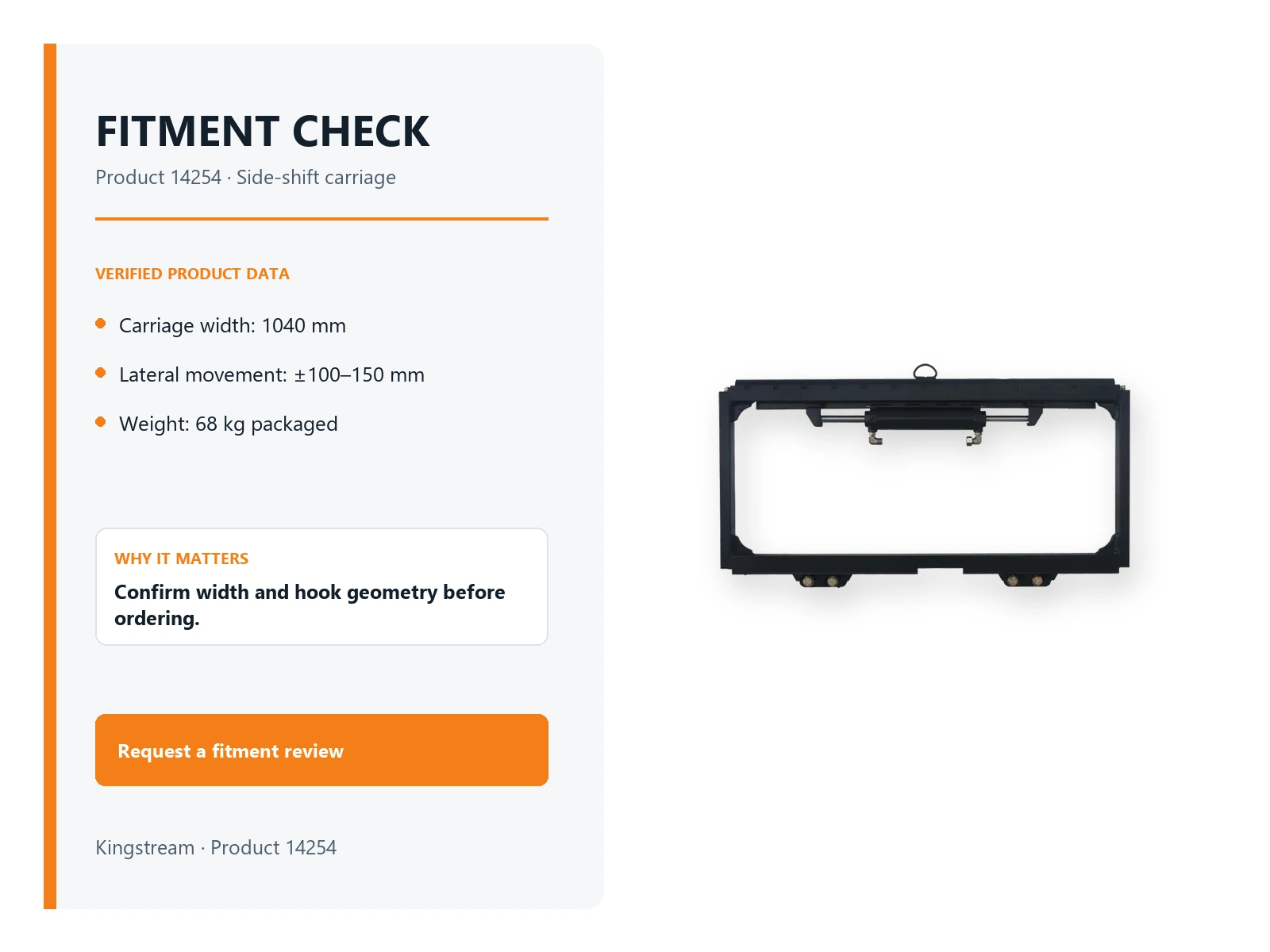
For a forklift side shifter, confirm basic fitment before treating price as a meaningful comparison. Buyers can record listed prices early, but a cheaper attachment that does not match the truck is not a valid comparison. Start with truck identification and the existing carriage, then record the hydraulic function, connections, load center, and operating requirement (Occupational Safety and Health Administration, n.d.; Toyota Material Handling, n.d.).
Truck make, model, capacity, and mast details
Record the manufacturer, exact model, serial range, nominal capacity, fuel or power type, mast type, lift height, and rated load center. Nominal tonnage is only one input because actual capacity depends on configuration and the data plate. Send a clear plate photograph with the quote request.
The attachment may add front-end weight and change the load position. Ask whether the proposed attachment has capacity information for the truck and mast combination. If the answer is unknown, treat the listing as not ready for self-service ordering. It can still be a quote-stage candidate while the supplier confirms the buyer’s truck configuration.
Carriage width and ISO or FEM class
To fit a forklift side shifter, measure the existing carriage at the attachment interface. Record its width, class, and hook or mounting arrangement. A brand in the product title is not fitment proof. The product must match the physical interface and approved truck capacity.
The two product pages below illustrate why listing evidence and buyer fitment evidence must stay separate. Their published values describe the named SKUs only. They do not establish a universal specification for every forklift side shifter.
Hook-on versus integrated mounting
Ask whether the attachment hangs on the existing carriage, replaces it, or uses another mounting arrangement. For a hook-on unit, request hook spacing, throat dimensions, pin details, and wear limits. For a carriage replacement, request the full interface drawing and the parts that transfer from the old unit.
Hydraulic circuit and connection details
Confirm a spare auxiliary function for side shifting. Record documented pressure and flow, valve control, hose routing, coupler type, and whether the selected SKU needs one or two functions. A generic hydraulic label is not enough (Cascade Corporation, n.d.).
- Truck make, model, serial range, and data-plate photo.
- Carriage class, measured width, hook layout, and mounting photographs.
- Load center, attachment allowance, and intended load profile.
- Available auxiliary functions, pressure, flow, hoses, and couplers.
- Required movement, fork spacing, duty cycle, and work environment.
Fitment warning: Do not approve a side shifter from a photograph or brand list alone. Ask for a written response against every fitment field, including fields the supplier cannot verify.
Citation capsule: A side-shifter quote should identify the forklift model and serial range, carriage class and width, mounting interface, available auxiliary circuit, load center, and capacity information. A listing that says 2.5 to 8 ton or ISO Class 2/3/4 still does not confirm physical or hydraulic fitment for the buyer’s truck.
Side-shift-only carriage or combined fork positioner?
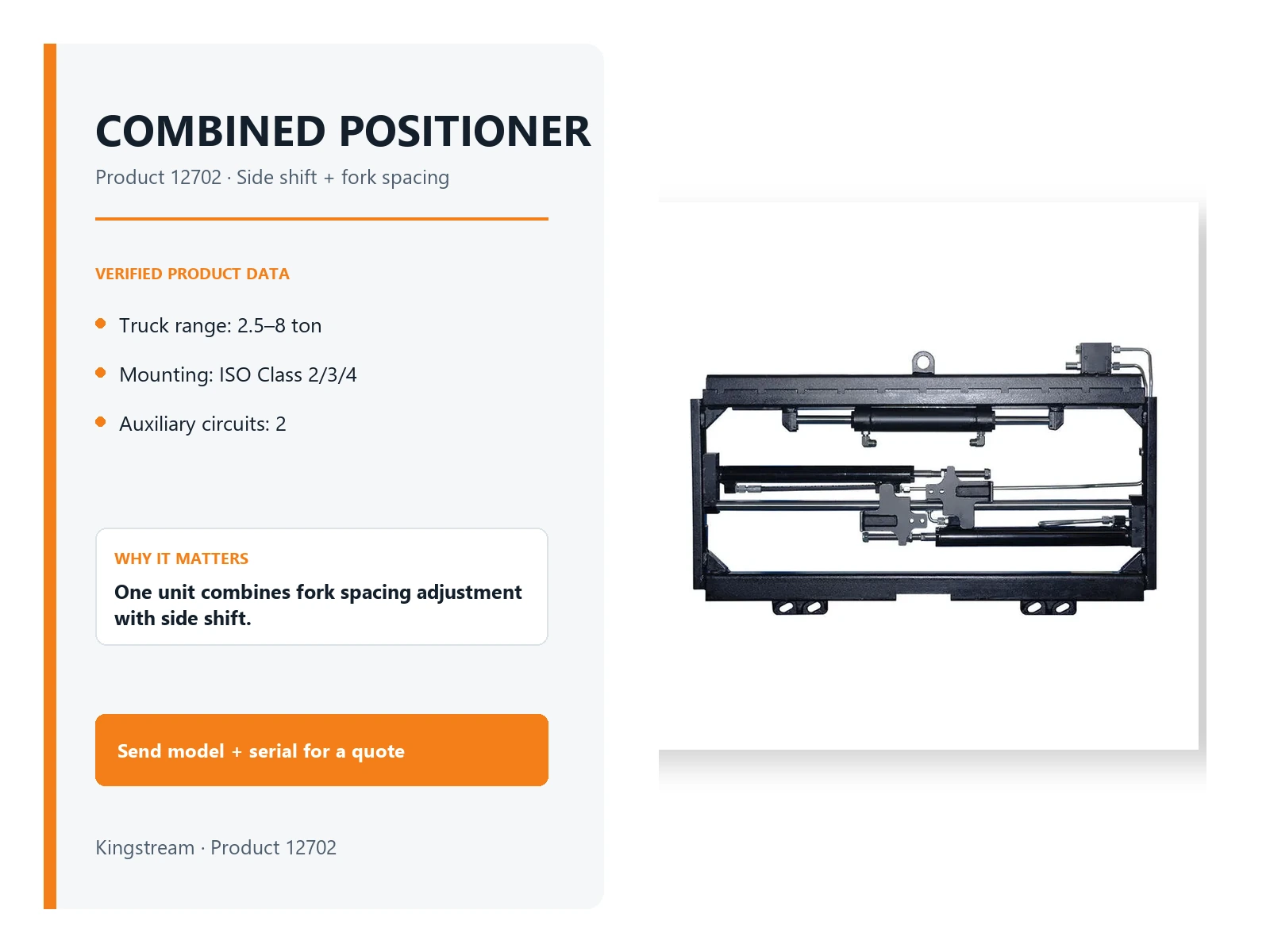
The two attachment families solve related but different jobs. A side-shift-only carriage moves the forks laterally as a group. A combined fork-positioner/side-shifter also changes fork spacing, may require another auxiliary function, and needs its own capacity review .
When a side-shift-only carriage is enough
Choose the side-shift-only path when fork spacing already suits the loads and the recurring problem is lateral alignment. This forklift side shifter still requires carriage width, class, mounting, travel, weight, pressure, and flow checks. A simpler function does not reduce the need for fitment evidence.
Kingstream product 14254 is a current example of this path. Its listing states a 1040 mm carriage width and lateral movement of ±100 to ±150 mm. It also lists 68 kg packaged weight and use with a diesel forklift that has an auxiliary hydraulic circuit. These are product-specific values for that listing .
When fork spacing must also change
Select an integrated unit when loads have different pallet widths and the operator needs hydraulic fork spacing as well as lateral alignment. Confirm auxiliary-circuit count. If the truck has only one suitable function, the attachment may need a different valve or hose arrangement.
Kingstream product 12702 is listed as an integrated hydraulic sideshifting positioner for 2.5 to 8 ton trucks, ISO Class 2, 3, and 4 carriages, with two auxiliary circuits. The first function operates fork spacing and the second operates side shift. The listing also states bolt-on mounting with standard ISO hooks. Those details must remain scoped to product 12702 .
Decision table for the two attachment types
| Check | Side-shift-only carriage | Integrated fork positioner and side shifter |
|---|---|---|
| Main movement | Moves the fork assembly laterally | Moves laterally and changes fork spacing |
| Hydraulic functions | Confirm the side-shift function | Product 12702 listing states 2 circuits |
| Best fit | Loads with a stable fork spacing | Loads with changing fork spacing and alignment needs |
| First checks | Width, class, hooks, travel, capacity | Class, truck range, 2 circuits, hooks, capacity |
Do not select the combined unit merely because it has more functions. Use it when those functions remove a real operating constraint and the truck can support them. Do not select a side-shift-only carriage when operators must repeatedly leave the truck to reset fork spacing.
Citation capsule: A side-shift-only carriage moves forks laterally. An integrated fork positioner/side-shifter also adjusts fork spacing and can require two auxiliary circuits. The correct choice depends on the load-handling task, the truck’s hydraulic functions, carriage class, and the exact product listing .
A smaller ask
Once the truck, carriage, and hydraulic details are gathered, Kingstream’s forklift parts sourcing service can help source OEM-compatible parts covering 14 major brands and provide a fast quotation. Contact the sourcing team
Capacity and load center: what the data plate changes
Adding an attachment changes the truck’s front-end configuration. Its weight and position can move the load center forward. OSHA states that attachments can affect stability, visibility, and capacity, and directs users to update capacity plates or tags when rated information changes (Occupational Safety and Health Administration, n.d.).
Why attachment weight matters
The 68 kg packaged weight listed for Kingstream product 14254 is one capacity-review input. It is not a universal side-shifter weight and should not be subtracted from every truck’s rating. The result depends on the attachment, mast, lift height, load center, and truck configuration (Toyota Material Handling, n.d.).
Why load center is part of the calculation
Toyota defines load center as the horizontal distance from the fork face to the load’s center of gravity. A forklift side shifter can move the attachment and load interface forward, so review the actual configuration. The original rated capacity may not describe that lifting condition. Use the truck data plate and the OEM’s capacity information (Toyota Material Handling, n.d.).
What must be rechecked before operation
Ask the truck manufacturer or an authorized qualified party whether written approval and a revised data plate are needed. Confirm residual capacity at the intended lift height and load center, then check visibility, stability, attachment capacity, and operator training before return to service.
Never rely on a universal percentage reduction for a side shifter. A figure copied from another truck can be wrong even when the attachment looks similar. Identify the attachment weight and geometry, obtain rated capacity for the configuration, and update truck information before use (Occupational Safety and Health Administration, n.d.; Toyota Material Handling, n.d.).
Warning: A side shifter does not preserve the truck’s original capacity by default. Do not approve an order or operation until the attachment, load center, and revised capacity information are confirmed (Occupational Safety and Health Administration, n.d.; Toyota Material Handling, n.d.).
Citation capsule: Attachment weight and changed load center can alter a forklift’s rated capacity. OSHA and OEM guidance must control the review. The buyer should obtain the configuration-specific capacity and data-plate decision rather than apply a universal derating percentage to every side shifter (Occupational Safety and Health Administration, n.d.; Toyota Material Handling, n.d.).
Hydraulic and mechanical specifications to verify by SKU
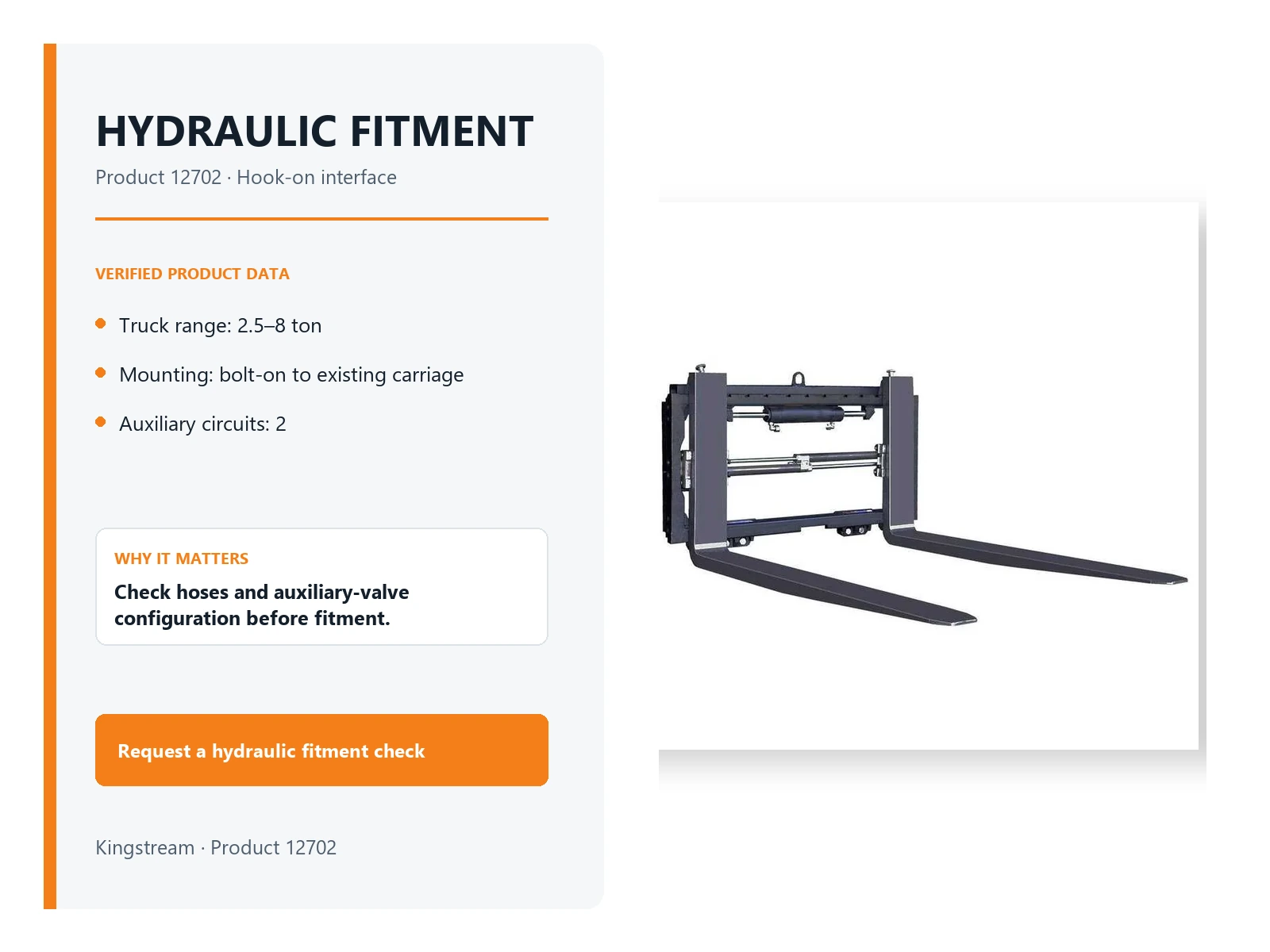
The useful specification matches the exact truck and attachment. Ask for the product drawing, manual, capacity information, and hydraulic limits together. A page listing only class or nominal capacity leaves installation questions unanswered.
Side-shift travel and carriage width
For a forklift side shifter, side-shift travel describes how far the fork assembly can move laterally. Carriage width describes the interface size. They answer different questions. A carriage can have enough travel for a task and still fail to mount to the truck. Product 14254 lists a 1040 mm carriage width and ±100 to ±150 mm lateral movement. Use those values only when evaluating that product .
Ask whether the listed width is the attachment width, required carriage width, or another measurement. Request a drawing when the listing is unclear, and record the measurement method in the quote.
Hydraulic pressure, flow, hoses, and couplers
Do not fill an unknown Kingstream hydraulic pressure or flow value from a competitor page. The current parameter pack does not verify one universal pressure or flow specification for the Kingstream side-shifter range. Those values must be confirmed by SKU and truck model.
The Cascade F-Series service material shows why this field is model-specific. It states 3500 psi, or 245 bar, maximum pressure and different flow limits by model. Its 55F and 65F example uses 1, 2, and 3 GPM as minimum, recommended, and maximum. This is a Cascade example, not a Kingstream specification (Cascade Corporation, n.d.).
Request these hydraulic details in writing:
- Required and maximum pressure for the exact attachment.
- Minimum, recommended, and maximum flow for the exact model.
- Hose size, fitting type, and quick-coupler requirement.
- Valve function, control location, and whether one or two circuits are needed.
- Bleeding, cycle-testing, and commissioning instructions.
Hooks, pins, guides, and wear limits
A hook-on attachment must seat on the carriage with the correct throat, pin arrangement, spacing, and allowable play. A worn hook or guide can look like a hydraulic fault. Kingstream evidence does not verify universal hook dimensions or wear limits, so mark them unknown until the SKU drawing or supplier confirmation resolves them.
What the current Kingstream listings verify
The table separates current product-page evidence from fields that still need a drawing, supplier response, or buyer information. “Not published” means the public page does not verify the field; it does not prove that the product lacks the feature. The listed prices and warranty terms are current SKU information and should be rechecked when a quote is requested.
| Field | Product 14254: side-shift carriage | Product 12702: integrated positioner | How to use the evidence |
|---|---|---|---|
| Article role | Secondary product example for side-shift-only work | Quote-stage example for combined fork positioner and side shifter | Neither is a complete self-service fitment proof |
| Published product scope | 1040 mm carriage width; ±100 to ±150 mm lateral movement; 68 kg packaged weight; diesel auxiliary-circuit description | 2.5 to 8 ton truck range; ISO Class 2/3/4; 2 auxiliary circuits; bolt-on mounting with standard ISO hooks | Keep each value attached to its named SKU |
| Listed price and warranty | $816; 3-year warranty | $399.99; 1-year warranty | Current listing values, not market standards; confirm in the quotation |
| Still to confirm | Exact carriage class, hook geometry, pressure, flow, hoses, couplers, and configuration-specific residual capacity | Exact carriage and hook dimensions, pressure, flow, hoses, couplers, attachment weight, and configuration-specific residual capacity | Ask the supplier for SKU-specific documents and the buyer’s truck data |
| Final fitment status | Not confirmed from the listing alone | Not confirmed from the listing alone | Do not convert a page-level product scope into a universal compatibility claim |
Specification rule: Compare values only when the field name, measurement basis, product scope, and source type match. If one listing states a range and another gives a single value, keep both forms and explain the difference instead of averaging them.
Citation capsule: Side-shifter travel, carriage width, hydraulic limits, hose connections, hook geometry, and wear limits are separate fitment fields. Product 14254 and product 12702 provide different verified field sets. Cascade’s hydraulic figures describe its own F-Series models and must not be copied into a Kingstream product specification (Cascade Corporation, n.d.).
What to ignore in a side-shifter listing
Some forklift side shifter listing language sounds precise but does not answer the purchase question. Treat it as a verification lead, not approval evidence.
Unscoped brand compatibility claims
“Fits all major brands” does not identify the truck model, serial range, carriage width, class, hook geometry, or hydraulic connection. Ask for the verified product scope and fields still requiring measurement.
A universal capacity-reduction percentage
The same attachment weight can produce different results on different trucks. Ignore a fixed derating percentage unless it belongs to the exact configuration and is supported by OEM or approved capacity documentation (Occupational Safety and Health Administration, n.d.; Toyota Material Handling, n.d.).
Marketing language without a drawing or manual
Words such as heavy-duty, high performance, or easy installation do not replace a drawing, pressure limit, flow range, hook detail, or commissioning instruction. A useful listing makes unknowns visible.
Buying rule: A product is not fitment-confirmed until the listing, drawing, manual, or supplier response identifies the physical interface, hydraulic requirements, and capacity path for the buyer’s truck.
How to prepare a fitment check and quote request
The best quote request for a forklift side shifter is a small technical record, not a copied product name. It lets the supplier separate a side-shift-only carriage from a combined unit and identify missing evidence before pricing dominates the discussion.
Information to photograph or record
Send the data plate, truck model and serial information, carriage photographs, measured width, class, hook layout, hydraulic connection photographs, and intended load profile. Add load center, lift height, required lateral movement, and whether fork spacing must adjust.
For a replacement cylinder or side-shift part, send the old part number, manufacturer marking, mounting measurements, port details, available rod or barrel dimensions, and mounting photographs. A cylinder title does not prove another truck uses the same geometry.
Questions to send the supplier
- Is the attachment side-shift-only or a combined fork positioner and side shifter?
- Which truck model, serial range, carriage width, and class are confirmed?
- What are the exact travel, weight, hook, and mounting values for this SKU?
- What pressure, flow, hose, coupler, and auxiliary functions are required?
- What capacity information or OEM approval is needed after installation?
- Which parts, hoses, brackets, pins, and wear components are included?
Pre-installation and commissioning checks
Before installation, compare the shipped attachment with the quote and drawing. Confirm hook seating, hydraulic ports and hoses, and clearance around the mast and load. Follow the manual for bleeding and function testing, run unloaded cycles first, then use the approved capacity and operating procedure.
Ask the supplier to mark each field confirmed, unknown, or not applicable. This makes missing specifications visible and gives the maintenance team a record for the truck documentation.
FAQ: forklift side shifter questions buyers ask
What is a side shift attachment for a forklift?
A side shift attachment moves the fork carriage laterally so the operator can correct load alignment without repositioning the whole truck. It does not automatically confirm capacity, carriage fitment, or hydraulic compatibility .
What is a side shifting fork positioner?
It is a combined attachment that provides side shift and hydraulic fork-spacing adjustment. The two functions may require two auxiliary circuits. Check the exact product listing and truck valve configuration before ordering .
What is side shifting?
Side shifting is the lateral movement of the fork assembly relative to the truck. It is different from steering because the truck remains aligned while the forks move left or right.
How do I match a side shifter to my forklift carriage?
Start with the truck model, serial range, carriage class, carriage width, hook arrangement, and mounting method. Then verify hydraulic connections, travel, attachment weight, load center, and the capacity information for the complete configuration. A matching brand name is not enough (Toyota Material Handling, n.d.).
How does a side shifter affect forklift capacity?
The attachment adds weight and can change the load center. OSHA and OEM guidance should control the capacity review and data-plate decision. Do not apply a fixed percentage to every truck. Obtain configuration-specific capacity information before operation (Occupational Safety and Health Administration, n.d.; Toyota Material Handling, n.d.).
What hydraulic flow and pressure does a forklift side shifter need?
There is no single value that applies to every side shifter. Pressure and flow depend on the attachment model and the truck circuit. Cascade’s F-Series material gives model-specific examples, but those figures cannot be reused as a Kingstream specification. Request the exact SKU limits and connection requirements (Cascade Corporation, n.d.).
Citation capsule: The short answer to the main side-shifter questions is consistent: the attachment moves forks laterally, a combined positioner also changes fork spacing, and fitment depends on the carriage, hydraulics, load center, and capacity review. Model-specific documents control every final number (Occupational Safety and Health Administration, n.d.; Toyota Material Handling, n.d.).
When to delay the purchase
Delay the forklift side shifter order when it cannot be scoped to the truck and carriage. Missing information is a purchase condition, not a paperwork gap.
Missing carriage or hydraulic information
Wait when the carriage width, class, hooks, hydraulic pressure, flow, hoses, or couplers are unknown. Ask for the drawing or a supplier response tied to the exact SKU.
Unconfirmed capacity and OEM approval
Wait when the attachment weight or changed load center has not been reviewed, or when the revised data-plate and OEM approval path is unclear. A low unit price does not compensate for an unapproved capacity assumption (Occupational Safety and Health Administration, n.d.; Toyota Material Handling, n.d.).
A product that cannot be scoped to a SKU
Wait when a page uses a broad brand list or generic side-shifter wording but provides no product-specific field set. The next action is to send the quote checklist and ask the supplier to mark every field confirmed, unknown, or not applicable.
Stop condition: If carriage fitment, hydraulic compatibility, or configuration-specific capacity remains unknown, do not treat the attachment as ready for self-service ordering or operation from the public listing alone. Move it to supplier confirmation instead of treating the product as defective.
Conclusion
The fastest way to choose a forklift side shifter is to verify the truck and carriage before treating movement or price as a final comparison. Confirm the mounting interface, hydraulic circuit, attachment weight, load center, and configuration-specific capacity information for the exact SKU. If a field remains unknown, hold self-service ordering, keep the product in quote stage, and ask the supplier to mark it confirmed, unknown, or not applicable.
References
- Occupational Safety and Health Administration. (n.d.). Powered industrial trucks: Attachments. U.S. Department of Labor. https://www.osha.gov/etools/powered-industrial-trucks/types-fundamentals/parts/attachments
- Toyota Material Handling. (n.d.). The forklift load center: A consideration of gravity. Toyota Material Handling. https://www.toyotaforklift.com/resource-library/blog/toyota-products/the-forklift-load-center-a-consideration-of-gravity
- Cascade Corporation. (n.d.). F-Series sideshifter service manual. Cascade Corporation. https://webcdnprd.cascorp.com/import_downloads/220526R7_F-SSServ.pdf
- Kingstream Parts. (2026). Forklift side shift carriage, 1040 mm. Kingstream Parts. https://kingstreamparts.com/product/forklift-side-shift-carriage-1040mm/
- Kingstream Parts. (2026). Forklift sideshifting positioner, 2.5-8 ton. Kingstream Parts. https://kingstreamparts.com/product/forklift-sideshifting-positioner-2-8t/
Last reviewed and updated: September 2026. Author: Kingstream team. For tailored guidance, contact our team.