
TL;DR
Do not replace a forklift hydraulic pump based on slow lifting alone. Check fluid, filter, suction restrictions, relief path, and measured pressure, then match the replacement by truck model, pump specifications, mounting, and part number.
Abstract
A forklift hydraulic pump problem should be confirmed with a symptom-to-test workflow before a replacement is ordered. The guide connects diagnosis with the fitment data needed for a quote.
Key Takeaways
- Slow lift, noise, heat, and no pressure can come from the pump or another hydraulic component, so test before ordering.
- Gear, piston, and vane pumps differ in construction and application; the replacement must match the original system.
- Confirm make, model, serial number, old pump number, displacement, flow, pressure, rotation, shaft, ports, and mounting.
- Use the eight live hydraulic-pump products as a starting category, not as unverified model compatibility claims.
- A quote request should include the truck data, pump photos, old part number, quantity, and operating requirements.
Table of Contents
- Abstract
- Key Takeaways
- Why a Forklift Hydraulic Pump May Not Be the Real Fault
- How a Forklift Hydraulic Pump Works: Gear, Piston & Vane Types
- Forklift Hydraulic Pump Problems: Symptoms and Tests
- How to Match a Forklift Hydraulic Pump Before Buying
- Forklift Hydraulic Pump Replacement and Quote Checklist
- Frequently Asked Questions
- Conclusion
- References
Why a Forklift Hydraulic Pump May Not Be the Real Fault
Slow lifting does not prove a forklift hydraulic pump has failed. Check fluid and filters, inspect the suction side for leaks or air entry, then measure pressure against service specifications. Replace the pump if testing shows insufficient flow or pressure. (Occupational Safety and Health Administration, n.d.; Naval Education and Training Professional Development and Technology Center, 2015a; National Institute for Occupational Safety and Health, 1999)
Symptoms that point toward the pump
A pump becomes more suspect when slow lifting pairs with hot oil, a whine, or low measured pressure. These are clues, not proof. Compare lift, tilt, and steering: one affected function points toward its valve, cylinder, or hose, while several suggest a shared supply problem. (Parker Hannifin Corporation, n.d.; Engineering Library, 2015)
Triage first:
- Record cold or warm and unloaded or loaded behavior.
- Check reservoir level and fluid. Inspect the filter and suction side for restriction or leaks.
- Note whether noise changes with engine speed.
- Test pressure at the specified point with a rated gauge. Follow the manual; never deadhead a circuit. If pressure is low, test valves and cylinder leakage before ordering parts.
Warning: Isolate the truck and follow lockout procedures before opening a hydraulic line. NIOSH FACE case report 99TX231 documents a forklift technician fatality involving a falling carriage. Support the mast before investigating unexplained movement. (Occupational Safety and Health Administration, n.d.; Naval Education and Training Professional Development and Technology Center, 2015a; National Institute for Occupational Safety and Health, 1999)
Faults that can look like pump failure
Nearby faults can mimic pump failure:
- Low fluid or inlet air can starve the pump, while a blocked filter or hose can create noise and weak lift.
- A relief valve set low or stuck open can divert flow and lower pressure.
- An unloading or control valve left open can make a rotating pump seem unable to build pressure.
- Downstream cylinder leakage can slow movement even with adequate pump pressure, including at a cylinder or hose.
Stoyanov, Tashev, and Mitev’s 2025 paper, Design of a Forklift Hydraulic System with Unloading Valves for Load Handling, identifies unloading valves in forklift load-handling system design. An open unloading valve explains why pressure-path testing should precede a pump order: diverted flow can mimic a failed pump. (Stoyanov et al., 2025; Engineering Library, 2015)
Before replacement, record the pressure reading and fluid condition, then add truck identification and the old pump number. Include pump flow and mounting data when checking fitment.
How a Forklift Hydraulic Pump Works: Gear, Piston & Vane Types
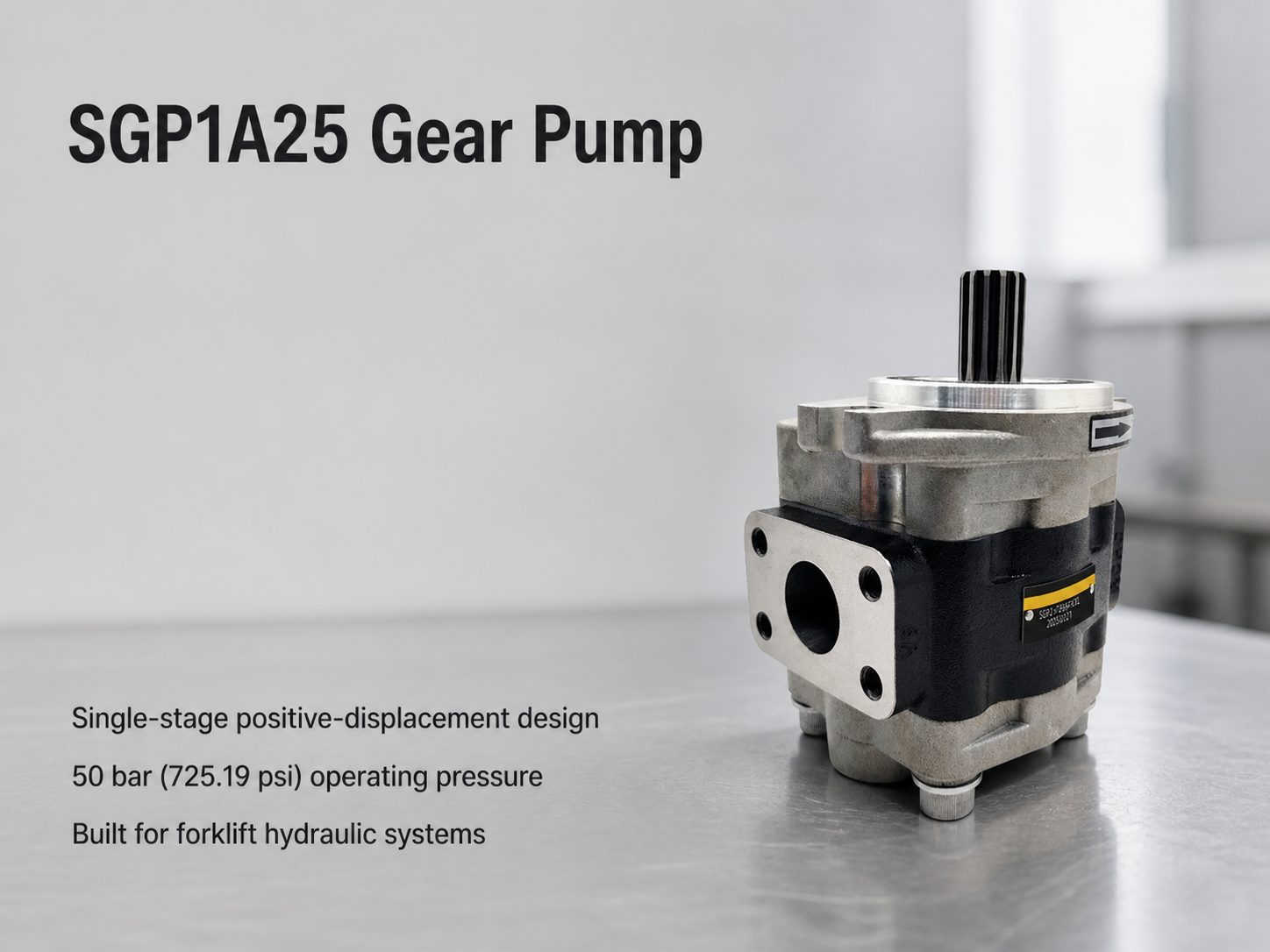
A forklift hydraulic pump converts mechanical energy from the engine or motor into hydraulic flow. The control valve directs that flow to lift cylinders, tilt cylinders, or steering actuators, while return oil travels back to the reservoir. A forklift hydraulic pump creates flow first; system resistance turns that flow into pressure. (Naval Education and Training Professional Development and Technology Center, 2015; Engineering Library, 2015)
What the pump does in the hydraulic circuit
The pump draws filtered oil from the reservoir through the suction line and pushes it into the pressure line. When an operator moves a control, the valve routes flow to an actuator. Cylinder area converts pressure into force, while piston travel converts flow into movement speed. An unloading or relief path can limit pressure or divert flow, so a weak lift does not automatically prove pump failure. (Naval Education and Training Professional Development and Technology Center, 2015; Engineering Library, 2015)
The 2025 paper by Stoyanov, Tashev and Mitev, Design of a Forklift Hydraulic System with Unloading Valves for Load Handling, places unloading valves inside the load-handling design. That technical detail matters because valve state can divert or limit pump delivery, making a pressure reading meaningful only when load and control conditions are recorded. (Stoyanov et al., 2025; Engineering Library, 2015)
Pump types and common trade-offs
Gear pumps use intermeshing gears to move oil in repeated pockets. They are compact and common in forklift applications, but flow remains closely tied to shaft speed and displacement. Piston pumps use reciprocating pistons and suit higher-pressure or variable-displacement designs, with greater mechanical complexity. Vane pumps use sliding vanes in a rotor cavity to produce smooth, stable flow, but require clean oil and controlled clearances. (Naval Education and Training Professional Development and Technology Center, 2015)
| Pump type | How it moves oil | Common trade-off |
|---|---|---|
| Gear | Intermeshing gear pockets | Compact and straightforward, flow follows shaft speed (Naval Education and Training Professional Development and Technology Center, 2015) |
| Piston | Reciprocating pistons | High pressure or variable displacement, more parts (Naval Education and Training Professional Development and Technology Center, 2015) |
| Vane | Sliding vanes in a rotor cavity | Smooth flow, greater sensitivity to contamination and wear (Naval Education and Training Professional Development and Technology Center, 2015) |
Why pressure and flow are different
Flow is the volume moved per unit of time, commonly stated in L/min or GPM, and it mainly affects actuator speed. Pressure is force per unit area, commonly stated in bar or psi, and rises when a load or restriction resists flow. A pump rated for high pressure is not automatically a high-flow pump. In a fixed-displacement design, shaft speed and internal leakage influence flow, while load and the relief setting influence working pressure. (Naval Education and Training Professional Development and Technology Center, 2015)
For a forklift hydraulic pump replacement, compare displacement and expected flow first. Then verify the pressure rating and rotational direction. Check the shaft, port layout, plus mounting separately. Matching only the outside shape can produce a pump that bolts on but delivers the wrong operating result. (Naval Education and Training Professional Development and Technology Center, 2015; Parker Hannifin Corporation, 2014)
Your next step
For forklift parts sourcing, request a quote from a single-source supplier covering 14 major brands, with OEM-compatible forklift parts backed by fast quotation.
Forklift Hydraulic Pump Problems: Symptoms and Tests
A forklift hydraulic pump problem needs a symptom-to-test check before replacement. Slow lifting, pump noise, heat, or no pressure can start with oil, filtration, suction, valves, hoses, cylinders, or the pump. Check the circuit in that order, then compare measured pressure or flow with the applicable service manual.
Slow or weak lifting
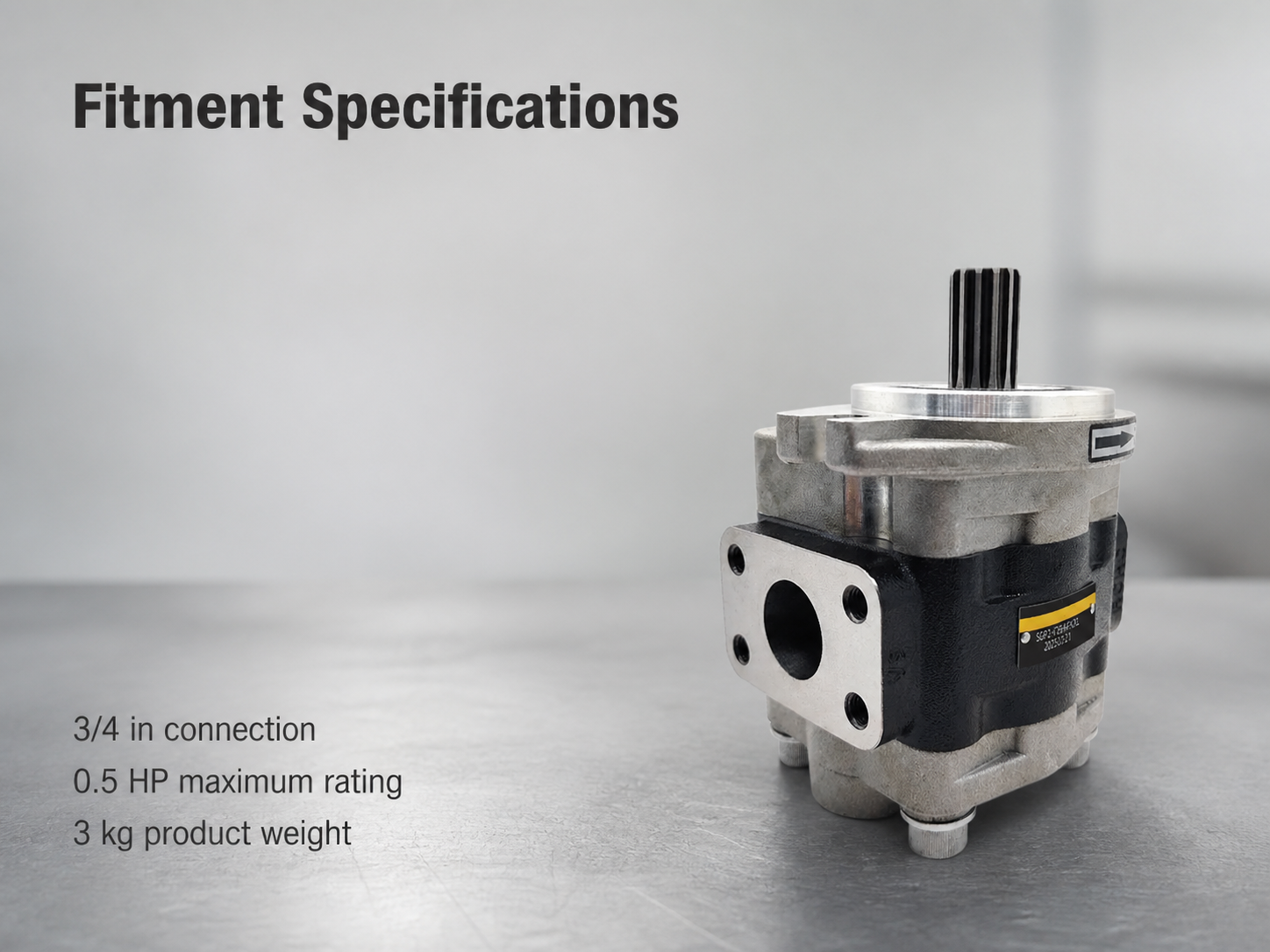
Forklift hydraulic pump symptoms such as slow or weak lifting do not prove pump wear. Check fluid level and condition, the return filter, suction hose, inlet fittings, and signs of air entry. A restricted filter or suction path can starve the pump. A relief or unloading valve passing oil can reduce lift performance. Downstream cylinder leakage or a control-valve problem can produce the same complaint. (Occupational Safety and Health Administration, n.d.; Parker Hannifin Corporation, n.d.; Engineering Library, 2015)
Ask when the symptom appears. Lift speed that falls only under load points toward a capacity or pressure problem, while movement that stays slow calls for flow, engine-speed, linkage, and restriction checks. Record the load condition and control used; do not treat a single operator impression as a pump diagnosis.
Pump noise, cavitation, and overheating
Forklift hydraulic pump noise, including whining, rattling, or growling, calls for an inlet-side inspection. Low fluid, a blocked suction screen, collapsed hose, loose inlet connection, incorrect fluid, or air leaks can interrupt the oil supply and create cavitation. Foamy oil and rising temperature strengthen the case for an inlet or relief-path problem, but do not identify one failed part alone. (Parker Hannifin Corporation, n.d.)
Heat can build when oil is forced across a relief or unloading path for too long. Check whether the control is held against the end of travel, then inspect the valve path and fluid condition. Stop testing if noise worsens, oil leaks, or temperature exceeds the service-manual limit.
No pressure or pressure that will not hold
A forklift hydraulic pump that produces no pressure may have a disconnected drive, failed coupling, empty or aerated inlet, open relief valve, unloading circuit issue, severe internal wear, or an open downstream path. Pressure that will not hold can point to relief-valve leakage, cylinder or valve leakage, or a damaged hose. Gauge location and test method matter, so use the manufacturer’s service procedure. (Parker Hannifin Corporation, 2014; Parker Hannifin Corporation, n.d.; Naval Education and Training Professional Development and Technology Center, 2015; Engineering Library, 2015)
A safe test sequence
Safety first: Park on a level surface, apply the parking brake, lower the forks, shut down the truck, and relieve hydraulic energy as the service manual directs. If an elevated carriage must remain up, use the manufacturer’s mechanical support procedure. A NIOSH FACE case report, 99TX231, involved a forklift technician fatality associated with a falling carriage. (Occupational Safety and Health Administration, n.d.; National Institute for Occupational Safety and Health, 1999)
Use a plain, repeatable sequence for how to test a forklift hydraulic pump:
- Confirm the truck make, model, serial number, fluid specification, and symptom. Model-specific pressure, flow, speed, and test-point values are service-manual dependent.
- Inspect fluid level and condition, filter condition, suction hose, inlet fittings, visible leaks, drive coupling, and control linkage. Run only checks allowed by the service manual, noting changes with load and control position.
- Connect a calibrated gauge at the specified test point. Measure pressure under the specified operating condition, without inventing a target or assuming a reading from another truck model.
- If pressure is low, isolate the relief or unloading path and downstream leakage before condemning the pump. If pressure matches the manual but lift remains weak, investigate flow restriction, cylinder leakage, or the control valve. Stop when the result is unsafe or unclear, then save readings and pump identification for a technician or parts quote.
Stoyanov, Tashev, and Mitev’s 2025 paper on forklift hydraulic-system design specifically discusses unloading valves for load handling. That detail supports a practical diagnostic rule: when a forklift will not build pressure, inspect the unloading or relief path before condemning the pump. A pressure complaint can originate elsewhere in the circuit. (Stoyanov et al., 2025; Engineering Library, 2015)
How to Match a Forklift Hydraulic Pump Before Buying
Truck and engine identification
Start with the truck, not the product thumbnail. Record the forklift make, exact model, serial number, engine designation, and the old pump number stamped on its tag or housing. Include the old pump’s photos, showing the nameplate, mounting face, shaft end, and ports. Model names often span several production changes, so the serial number narrows the correct configuration. That record is the fitment key for a forklift hydraulic pump. Copy the number exactly, preserving its punctuation and letter codes. A broad make or model name does not identify every pump configuration. (Occupational Safety and Health Administration, n.d.; Kingstream, n.d.)
Pump specifications that control fitment
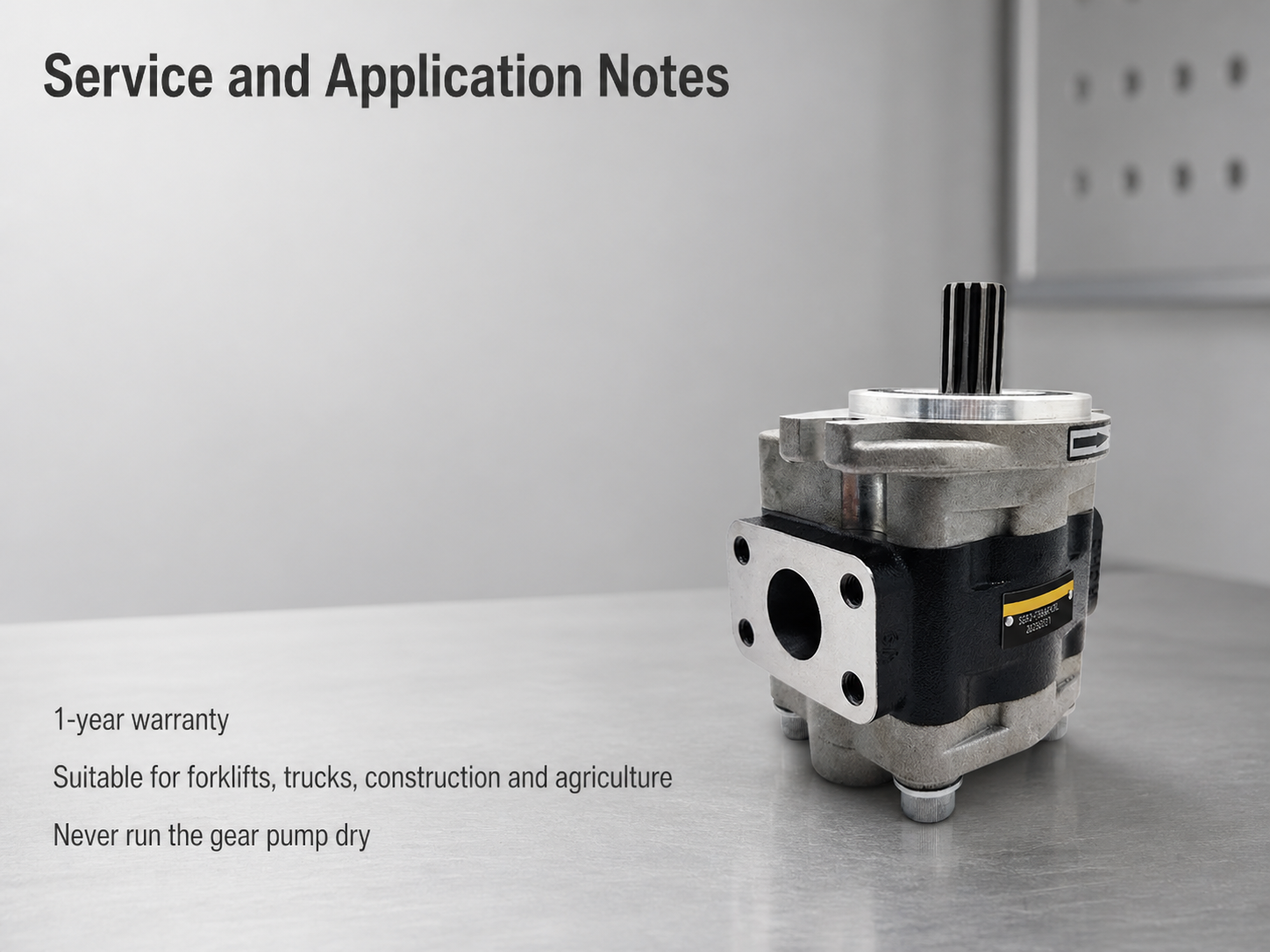
Match the replacement to the working requirements, not only to a similar-looking gear pump. Confirm displacement, required flow, pressure rating, and rotation. Displacement describes the pump’s volume per revolution; flow depends on displacement and operating speed. Pressure must suit the circuit and relief setting. Rotation is viewed from the specified shaft end, so state that viewing direction when requesting a quote. For a forklift hydraulic pump quote, put those values in one line so the supplier can compare them without interpreting a photo.
Use the original pump plate, service data, or a measured test result where available. Do not guess a larger displacement or pressure rating to compensate for slow lifting. The fault may be in the oil, filter, suction path, relief valve, or another actuator. (Naval Education and Training Professional Development and Technology Center, 2015a; Parker Hannifin Corporation, 2014)
| Check | Record | Why it matters |
|---|---|---|
| Truck | Make, model, serial, engine | Separates production variants |
| Old pump | Number, photos, nameplate | Supports cross-reference |
| Hydraulic | Displacement, flow, pressure, rotation | Matches circuit demand |
| Interface | Shaft, flange, mounting, ports | Prevents installation mismatch |
Mounting, shaft, rotation, and port checks
Compare the mounting pattern, flange shape, pilot diameter, bolt spacing, shaft diameter, shaft length, key or spline, and shaft-end rotation. Measure where practical. A pump can have the correct displacement yet fail to mount, engage the drive, or rotate correctly. The same forklift hydraulic pump family may be offered with different shaft or flange arrangements, so the interface must be checked as a separate fitment step.
Record every port’s position, size, thread or connection type, and function. Mark inlet and outlet orientation in the photos. Check whether the pump is single or dual section and whether an adapter, coupling, gasket, or relief arrangement is part of the installation. These mechanical and port details are fitment data, not cosmetic details. (Parker Hannifin Corporation, 2014; Naval Education and Training Professional Development and Technology Center, 2015a)
When a product photo is not enough
A photo of a forklift hydraulic pump can suggest a pump family, but it cannot prove internal displacement, pressure capability, rotation, or serial-range fitment. The verified Kingstream category contains eight live pump products across CBHYCK, CBQ, CBKA, CBW, CBHYA, CBHZ, and FG20/H20/FG30 families. Treat that category as a starting catalog only. No SKU should be treated as compatible until the seller confirms the supplied truck and pump data. (Kingstream, n.d.; Parker Hannifin Corporation, 2014)
Quote-ready checklist:
- Truck identity: make/model/serial; engine plus quantity.
- Old pump evidence: number/nameplate plus clear photos from all sides.
- Hydraulic data: displacement/flow; pressure/rotation; symptom plus any pressure-test reading.
- Mechanical interface: shaft dimensions, key/spline, flange, pilot, bolt pattern, mounting measurements, port locations/sizes, thread or connection type, and inlet/outlet labels.
Stoyanov, Tashev, and Mitev’s 2025 design paper, "Design of a Forklift Hydraulic System with Unloading Valves for Load Handling," treats unloading valves as part of the load-handling system. That detail matters when matching a pump: operating pressure and circuit behavior must be confirmed together, not inferred from an old housing or product photo. (Stoyanov et al., 2025; Engineering Library, 2015)
Forklift Hydraulic Pump Replacement and Quote Checklist
Replace, rebuild, or inspect first
Inspect first when the symptom is unconfirmed. Rebuild only after teardown verifies a serviceable pump core and shaft plus working surfaces. Replace when damage, wear, or uncertain repair scope makes a tested replacement clearer. Slow lifting alone does not prove that the forklift hydraulic pump has failed. (Parker Hannifin Corporation, n.d.; Naval Education and Training Professional Development and Technology Center, 2015a)
Use pressure-test results with fluid, filter, suction, relief, hose, valve, or cylinder checks. If they point to the pump, compare rebuild and replacement scopes using the same fitment data. That ties the decision to evidence, not a product thumbnail.
What affects hydraulic pump price
Price depends on the exact unit and work included, not the phrase "hydraulic pump." Variables include pump series, required pressure, displacement or flow, shaft and flange arrangement, port configuration, quantity, plus whether the request covers complete replacement or rebuilding. Live product titles show 100 bar, 25 MPa, and 250 bar labels, so check pressure against the truck circuit rather than a similar name. (Kingstream, n.d.; Naval Education and Training Professional Development and Technology Center, 2015a)
List OEM, compatible or rebuilt options separately. Ask what is included: the pump, seals, coupling and any adapter, gasket, testing or shipping. That makes quotations comparable without inventing a price.
What to send with a quote request
Send the supplier one complete set:
- Truck make, model, serial, engine, quantity.
- Old pump part number and nameplate; photos of the housing, mounting face, shaft end, and ports.
- Required pressure, displacement or flow, rotation, pressure-test reading.
- Mounting and flange details, pilot and bolt pattern, shaft dimensions, port size, connection type, inlet/outlet orientation; symptom, load behavior, fluid condition, and inspection, rebuild, or replacement scope.
Kingstream’s live category lists 8 products across CBQ, CBHZ, CBW, CBHYA, CBHYCK, CBKA, and FG20/H20/FG30 families. That inventory gives a replacement search a concrete starting point, but series labels do not prove compatibility. The supplier still needs the truck’s brand, model, serial number, and pump interface details before a quote can be checked. (Kingstream, n.d.)
Frequently Asked Questions
These answers cover diagnosis, pump types, replacement steps, cost questions, and no-pressure faults. Use equipment data and test results to guide a quote, because a symptom alone does not establish pump fitment.
Q: How do I know if a hydraulic pump is bad?
A: A bad hydraulic pump is more likely when measured pressure stays low after fluid, filter, suction, relief, valve, hose, and cylinder checks. Slow lifting alone is not proof. A 2025 forklift hydraulic-system paper specifically addresses unloading valves for load handling, reinforcing the need to assess the complete circuit before ordering a pump (Stoyanov et al., 2025; Engineering Library, 2015).
Q: What are three types of hydraulic pumps?
A: The three common types are gear, piston, and vane pumps (Naval Education and Training Professional Development and Technology Center, 2015). They differ in construction and operating characteristics, so a replacement must match the original pump and system requirements. Confirm the truck model, serial number, old pump number, displacement or flow, pressure, rotation, shaft, ports, and mounting before purchase. Pump type alone does not establish interchangeability; verify the original data.
Q: How much does a hydraulic pump cost?
A: There is no dependable single price for a forklift hydraulic pump. A quote should be based on truck and pump identification, required pressure and flow, mounting details, and supplier confirmation (Kingstream, n.d.). Treat a catalog price as a starting point, not proof of compatibility or the total order cost. Ask which specifications, quantity, shipping, and services the quote includes.
Q: How to replace a hydraulic pump?
A: First confirm the pump is the fault, isolate the truck, and record the old pump number and fitment data. Match the replacement to the make, model, serial number, pressure, flow, mounting, shaft, rotation, and ports. Have installation and system checks completed by a qualified technician (Occupational Safety and Health Administration, n.d.; Kingstream, n.d.). Follow the truck maker’s service procedure for fluid handling and post-installation testing.
- Confirm truck and pump identification.
- Compare specifications and physical fitment.
- Verify the match before ordering.
Q: What causes a forklift hydraulic pump to not build pressure?
A: Causes include low or contaminated fluid, a restricted filter or suction path, a relief-path problem, or a fault in the pump, control valve, hose, or cylinder (Naval Education and Training Professional Development and Technology Center, 2015; Engineering Library, 2015; Parker Hannifin Corporation, 2014; Occupational Safety and Health Administration, n.d.). Check these in sequence and use a measured pressure reading before ordering a replacement. If pressure remains low, stop the replacement decision and have the circuit tested before selecting a pump.
Conclusion
To troubleshoot a forklift hydraulic pump, confirm the symptom with fluid, filter, suction, valve, cylinder, pressure, and, where specified, flow checks before ordering a part. If the pump remains the likely fault, match the replacement to the truck’s make, model, serial number, old pump number, pressure, flow, rotation, shaft, ports, and mounting.
Use the Kingstream category as a catalog starting point, not as a compatibility guarantee. Send the supplier the recorded truck and pump data, photos, quantity, and test results so the quote can be checked against the actual application. A key limitation of any general guide is that exact pressure, flow, and fitment requirements remain model-specific, so follow the truck maker’s service procedure or ask a qualified technician to verify them.
References
- Kingstream. (n.d.). Forklift hydraulic pump. Kingstream Parts. https://kingstreamparts.com/product-category/forklift-hydraulic-components/forklift-hydraulic-pump/
- Naval Education and Training Professional Development and Technology Center. (2015). Chapter 4: Pumps. In Fluid power (NAVEDTRA 14105A). Engineering Library. https://engineeringlibrary.org/reference/hydraulic-pumps-navy
- Engineering Library. (2015). Chapter 6: Valves from the U.S. Navy fluid-power training course (NAVEDTRA 14105A). Engineering Library. https://engineeringlibrary.org/reference/hydraulic-valves-navy
- Stoyanov, Y., Tashev, A., & Mitev, P. (2025). Design of a forklift hydraulic system with unloading valves for load handling. EEPES 2025, 85. https://doi.org/10.3390/engproc2025104085
- National Institute for Occupational Safety and Health. (1999). A forklift shop technician for a dealer who services, sells, and rents material handling equipment, in Texas, died when the carriage of a forklift fell and one of the fork’s tines crushed his chest (FACE report 99TX231). CDC Stacks. https://stacks.cdc.gov/view/cdc/166435
- Occupational Safety and Health Administration. (n.d.). ETool: Powered industrial trucks, operating the forklift, pre-operation. U.S. Department of Labor. https://www.osha.gov/etools/powered-industrial-trucks/operating-forklift/pre-operation
- Occupational Safety and Health Administration. (n.d.). 1910.178: Powered industrial trucks. U.S. Department of Labor. https://www.osha.gov/node/45950
- Occupational Safety and Health Administration. (n.d.). Control of hazardous energy (lockout/tagout): Energy control program. U.S. Department of Labor. https://www.osha.gov/etools/lockout-tagout/hot-topics/energy-control-program/energy-control-circuitry-prohibition
- Parker Hannifin Corporation. (2014). C136 variable displacement axial piston pump: Service manual (HY28-2688-02). Parker Hannifin. https://www.parker.com/content/dam/Parker-com/Literature/Hydraulic-Pump-Division/Hydraulic-Pump-Division-STATIC-FILES/Sales-Catalogs—Thumbnails/Piston-Pumps-Open-Circuit/Axial-Piston-Pumps-for-Closed-Circuit-Applications/HY28-2688-02_C136ServiceManual_OCT2014.pdf
- Parker Hannifin Corporation. (n.d.). P09S series troubleshooting. Parker Hannifin. https://www.parker.com/content/dam/Parker-com/Literature/Hydraulic-Pump-Division/Premier-Series-Files/LT2-00039-2-A1.pdf
Last reviewed and updated: August 2026. Author: Kingstream team. For tailored guidance, contact our team.