
TL;DR
Use forklift drive axle as the starting search term, but do not order from the keyword alone. Match the complete assembly or individual component to the truck’s brand, model, capacity, part number, mounting pattern, brake interface, and service condition.
Abstract
A forklift drive axle replacement is a fitment decision, not a generic parts search. This guide shows how to separate a complete assembly from a housing, differential, half shaft, hub, or reducer, then verify brand, model, capacity, part number, mounting, and brake interfaces before requesting a quote.
Key Takeaways
- Confirm whether the repair needs a complete drive axle assembly or one serviceable component.
- Record brand, model, capacity, serial range, part number, mounting, and brake details before ordering.
- Use housing, differential, half shaft, hub, and reducer terms only when the inspection identifies that component.
- Compare the live drive-axle product category against fitment evidence, not a visually similar photo.
- Delay the purchase when the nameplate, dimensions, brake interface, or failure diagnosis is uncertain.
Table of Contents
- Abstract
- Key Takeaways
- Why forklift drive axle fitment matters before you order
- Complete assembly or individual drive axle part?
- Seven fitment checks for a forklift drive axle replacement
- Drive axle components compared by failure and use case
- How to inspect and test before buying
- What to ignore and when to delay a drive axle purchase
- Frequently Asked Questions
- Conclusion
- References
Why forklift drive axle fitment matters before you order
A forklift drive axle can look correct in a product photo and still fail fitment. The safe starting point is the truck identity, followed by the axle code, capacity, mounting pattern, brake interface, and the failed component. That evidence turns a broad search into a quote a supplier can check.
The repair decision is larger than the axle name
“Drive axle” can describe a complete assembly, a housing, a differential, a half shaft, a wheel hub, or a reducer. Those parts sit in the same repair conversation, but they do not solve the same failure. A complete unit may be the right answer after major internal damage. A housing or shaft may be enough when the surrounding parts are serviceable.
The mistake is treating visual similarity as compatibility. Forklift axles vary by brand, model, capacity, serial range, brake arrangement, wheel connection, and mounting geometry. The catalog contains separate groups for complete assemblies, housings, differentials, shafts, hubs, and reducers, so the product type must be settled before price comparison. (Kingstream Parts, n.d.)
The evidence a parts buyer should collect
Before opening several listings, record:
- Truck identity: brand, model, capacity class, serial range, and power type.
- Axle identity: stamped code, old part number, casting number, or assembly label.
- Interfaces: mounting holes, axle width, wheel or hub pattern, brake connection, and clearance points.
- Condition: the symptom, damaged component, visible cracks, leaks, gear noise, or looseness.
- Photos: the nameplate, complete axle from several angles, connection points, and any readable markings.
Warning: A broad “forklift axle” match is not enough to approve an order. Stop and collect the missing identifier when the listing does not prove model, capacity, or interface compatibility.
The Kingstream drive axle category is organized into 10 component groups, including complete assemblies, housings, differentials, shafts, hubs, and reducers. That structure supports a practical fitment rule: first identify the truck and repair scope, then compare the candidate’s interfaces. A product photo alone cannot establish compatibility. (Kingstream Parts, n.d.)
Decide the repair scope first. Comparing a complete assembly with a single axle part only makes sense after you know which repair the truck needs.
Complete assembly or individual drive axle part?
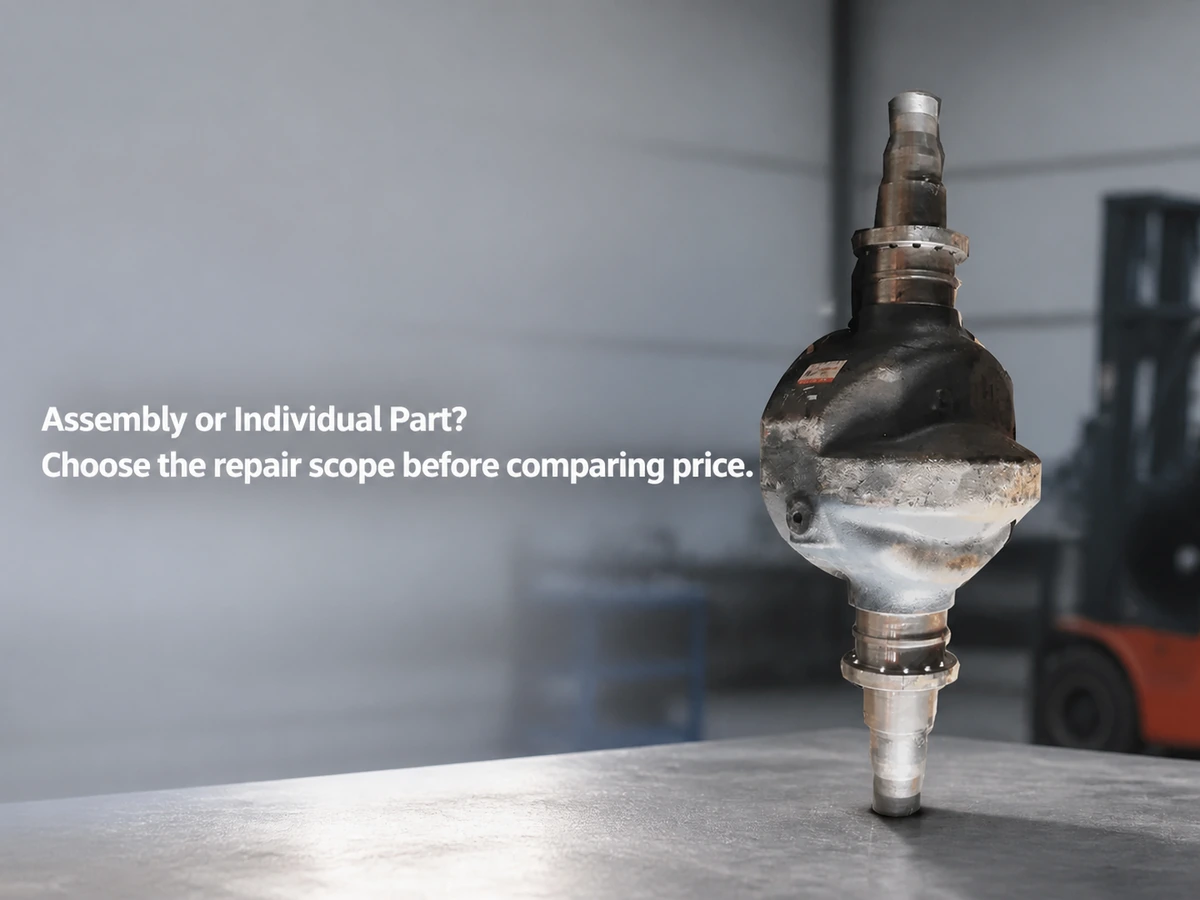
Choose a complete drive axle assembly when the internal condition is uncertain, several connected parts are damaged, or the replacement must arrive as a matched unit. Choose an individual housing, differential, half shaft, hub, or reducer when inspection identifies one failed component and the remaining assembly is suitable for reuse.
When a complete assembly makes sense
A complete unit reduces the number of interfaces the buyer must rebuild and inspect. It can be a sensible route after collision damage, severe gear damage, a cracked housing, or a repair history that leaves the internal condition unknown. The request should still include the truck brand, model, capacity, serial range, axle code, brake arrangement, and mounting information. “Complete” describes the supply scope, not automatic fitment.
The local product set includes complete assemblies such as the Xilin 31202000005 for QDD30, the Fonsokar 91K31-10100 for F19C and F28B, and a HELI QDQ-QAD-3035-25 assembly identified for a 3T application. These examples show why a model or part-number trail matters more than a generic axle label. (Kingstream Parts, n.d.)
When to source a housing, differential, shaft, hub, or reducer
An individual part is usually the better scope when the failed area is known and the rest of the drive axle can be inspected, measured, and reused. The terminology is functional:
- Housing: the structural body that locates and protects the internal drive components. A housing candidate needs casting, mounting, width, and brake evidence.
- Differential: the gear group that divides drive to the wheels. Match its assembly code, gear arrangement, and axle application rather than choosing a part that only shares the word “differential.”
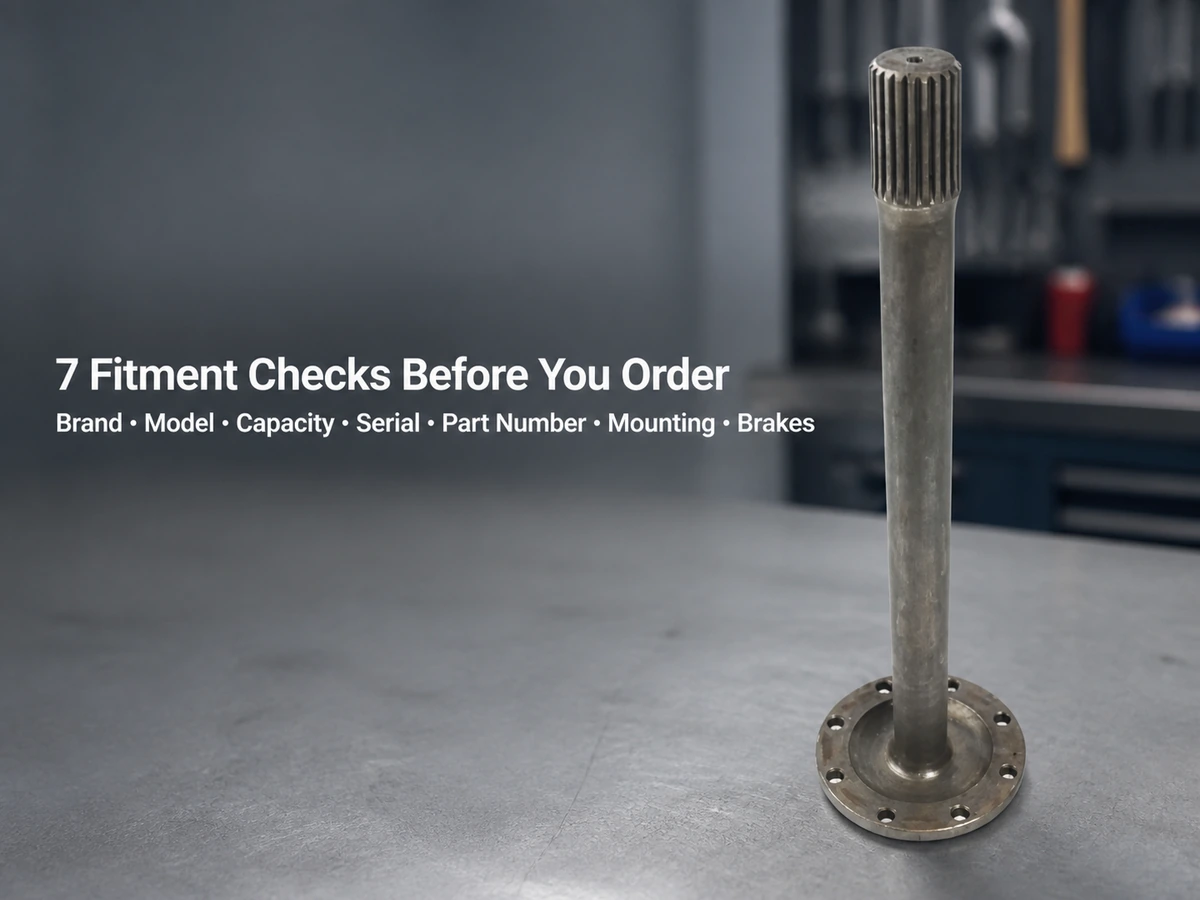
- Half shaft or axle shaft: the torque-carrying shaft between the differential and wheel-side reduction or hub. Spline, length, and end geometry are decisive.
- Wheel hub: the wheel-side connection. Check the hole pattern, bearing arrangement, wheel position, and brake relationship.
- Reducer or planetary carrier: the wheel-side reduction assembly or its carrier. Compare the gear or carrier identifier, mounting, and side position.
The local catalog separates these families into subcategories. It lists 6 complete drive-axle assemblies, 4 housings, 4 differentials, 5 half-shaft or drive-shaft entries, 7 hub entries, and 7 reducer or planetary-carrier entries in the relevant filtered groups. Those counts describe current catalog organization, not interchangeable parts. (Kingstream Parts, n.d.)
The component-scope comparison
| Repair scope | Use it when | Evidence to confirm before ordering |
|---|---|---|
| Complete assembly | Damage spans multiple internal or structural parts, or condition is uncertain | Brand, model, capacity, serial range, assembly number, mounting and brake interface |
| Housing | The shell is cracked, distorted, or otherwise unusable, while internals can be transferred | Casting or part number, width, mounting points, brake and wheel clearance |
| Differential | Gear damage is isolated and the housing and shafts pass inspection | Differential number, gear arrangement, axle application and side details |
| Half shaft or axle shaft | Shaft wear or breakage is confirmed | Length, spline or end profile, part number and wheel-side fit |
| Hub or reducer | Wheel-side damage is localized | Hole pattern, bearing or gear details, side position and brake relationship |
The most useful comparison is not assembly versus part in the abstract. It is verified repair scope versus unverified scope. Use the forklift drive axle parts category to review the relevant families, then send the fitment record before treating a similar-looking listing as a match.
Use that record for seven checks a supplier can cross-reference.
Seven fitment checks for a forklift drive axle replacement
The strongest forklift drive axle request connects the truck identity to the replacement interfaces. Before ordering, work through seven checks: brand, model, capacity, serial range, part number, mounting, and brakes. Add wheel and clearance photographs when the assembly is unusual or the nameplate is incomplete.
A forklift drive axle replacement should be screened through 7 fields: brand, model, capacity, serial range, part number, mounting, and brakes. OSHA’s pre-operation guidance treats steering, brakes, controls, noise, and vibration as inspection concerns, so the quote should connect the axle identifier to the observed interface or symptom. (Occupational Safety and Health Administration, n.d.)
Brand, model, capacity, and serial range
- Record the brand and exact model. A brand name alone is too broad. Copy the model exactly from the truck plate, including letters, numbers, suffixes, and hyphens.
- Record the rated capacity or capacity class. Capacity helps separate visually similar axle families used on different truck sizes. Do not infer it from the axle’s apparent size.
- Record the serial range. Serial breaks can change an assembly, brake interface, wheel connection, or mounting detail even when the model name stays similar.
These three fields define the vehicle application. A quote that says only “forklift rear axle” leaves the supplier to guess which product family is intended. The local catalog includes examples tied to specific applications, such as CPCD40/CPCD45 housing, C16 axle shaft, and F19C/F28B complete assembly listings. Use those labels as cross-reference clues, not as permission to skip the truck plate. (Kingstream Parts, n.d.)
Part number and axle identification
- Copy every readable identifier. Photograph stamped numbers, tags, casting marks, and the old supplier label. Preserve leading zeros and suffixes. If two numbers appear, send both and explain where each was found.
Part-number evidence narrows the search faster than a broad keyword. It also helps separate a complete assembly from a housing or a service part. A title such as “drive axle” does not tell the buyer whether the item includes the differential, shafts, hubs, brakes, or reducer. Ask the supplier to state the included scope in writing when the listing is not explicit.
Treat the number as evidence, not as the entire diagnosis. Compare the marking with the truck model and the physical part. An old number can be incomplete, superseded, or attached to a subassembly rather than the complete axle. Sending the number’s location in the photograph helps a supplier decide whether it identifies the housing, shaft, hub, or full assembly.
Mounting, brake, wheel, and clearance interfaces
- Measure the mounting interface. Record hole count, center spacing, flange shape, bracket position, and overall width where practical. Photograph the mating face with a ruler or another known scale.
- Confirm the brake interface. Identify the brake type and how it connects to the axle or hub. A mechanically similar axle can still be wrong when the brake mounting or actuation arrangement differs.
- Confirm wheel and clearance details. Photograph the hub or wheel pattern, side position, tire clearance, steering clearance, and nearby transmission or chassis connections.
Quote rule: OSHA’s powered industrial truck materials treat steering, brakes, drive controls, noise, and vibration as pre-operation inspection concerns. A replacement request should therefore include both the part identifier and the symptom or interface evidence that explains why the axle is being changed. (Occupational Safety and Health Administration, n.d.)
What to photograph for a quote
Send a small, labeled photo set rather than one distant image:
- the truck nameplate and serial plate;
- the full axle installed on the truck;
- the front, rear, top, and side of the removed or exposed assembly;
- the mounting face, brake connection, hub, shaft end, and damaged area;
- every readable number, casting mark, and product label.
Name files with the truck model and view, then describe what is visible. This reduces back-and-forth and lets a supplier compare the request with the correct forklift drive axle family. Include one sentence explaining the operating symptom and one sentence stating whether the truck is still in service. Those details help separate an urgent safety hold from a routine sourcing request. If one of the seven checks is unknown, mark it unknown instead of filling the gap with an assumption.
See what we would find
For this fitment decision, a single-source forklift parts supplier covering 14 major brands offers OEM-compatible forklift parts backed by fast quotation. Send your parts requirements to start a sourcing conversation.
Drive axle components compared by failure and use case
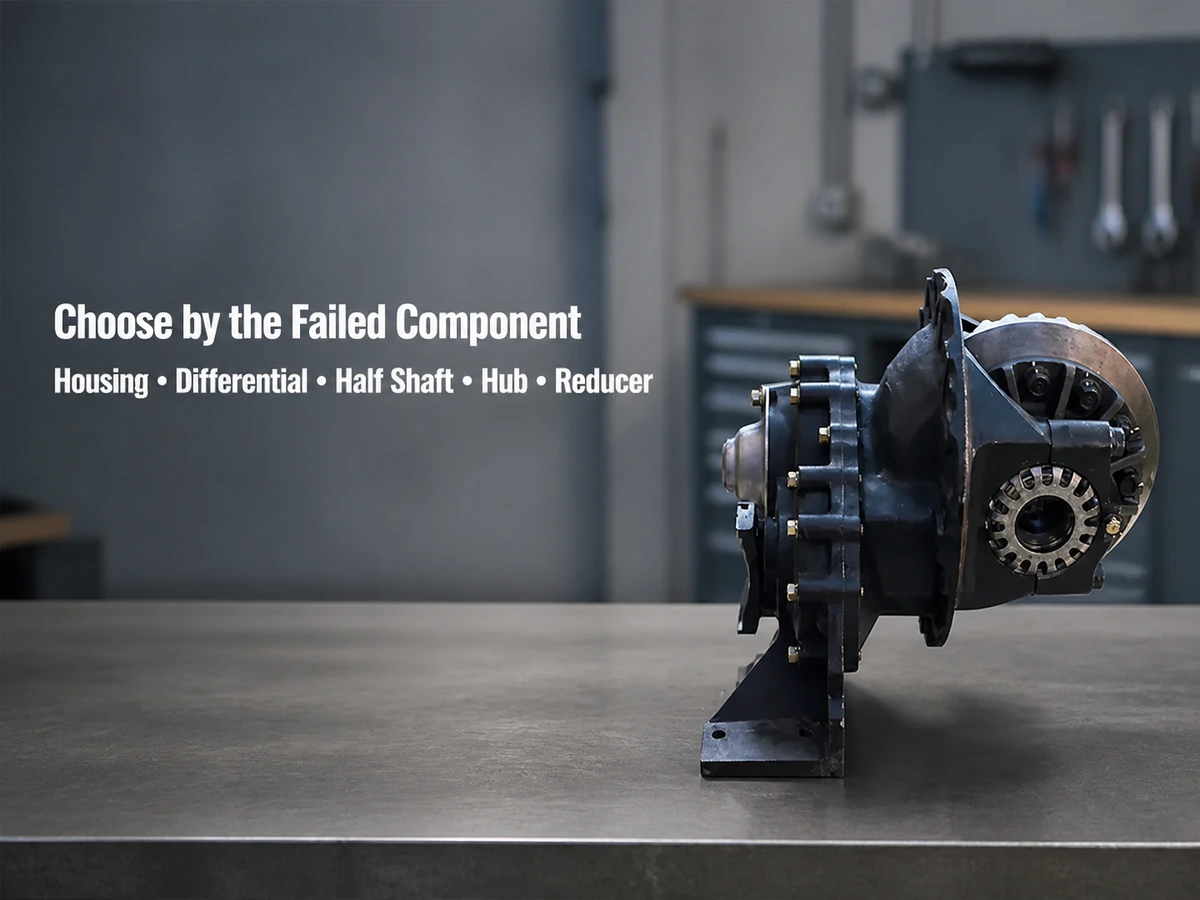
The right drive axle part follows the failed component, not the most familiar product name. Housing damage points to a structural replacement, gear damage may point to a differential or reducer, and a broken torque path may point to a shaft. A complete assembly remains a separate option when several areas are affected or condition cannot be proven.
Housing and differential
A housing is the structural reference for the rest of the axle. Look for cracks, distortion, damaged mounting faces, and evidence that internal components no longer sit squarely. A visually clean housing can still be the wrong width or mounting pattern, so its casting or part number must stay connected to the truck application.
The differential handles the gear relationship between the driven wheels. Gear noise, damaged teeth, metal contamination, or abnormal backlash can justify a differential-focused inspection, but those symptoms can also involve the reducer or shaft. The useful buyer question is not “do I need a differential?” It is “which component failed, and what evidence separates it from the adjacent component?”
Half shaft and wheel hub
A half shaft or axle shaft transfers torque toward the wheel side. Length, splines, end profile, and side position can matter more than the shaft’s overall appearance. A replacement shaft that is close in length but wrong at the spline or hub interface is not a practical match.
A wheel hub provides the wheel-side connection and may be tied to bearings, brakes, or a reduction assembly. Confirm hole pattern, bearing details, wheel position, and the relationship to the brake before choosing a hub. The catalog includes a Hangcha drive-axle hub identified for CPD20J, CPD25J, and CPD30J electric applications, illustrating why the application string belongs in the comparison record. (Kingstream Parts, n.d.)
Wheel reducer and complete assembly
The reducer or planetary carrier belongs to the wheel-side power path. Inspect gear teeth, carrier holes, side position, and the surrounding hub and housing before deciding whether the reducer alone is the repair scope. A reducer listing should not be treated as a complete axle listing simply because both contain the word “assembly.”
| Component | Failure or inspection clue | Best use case | Fitment evidence |
|---|---|---|---|
| Housing | Crack, distortion, damaged mounting face | Structural replacement | Casting number, width, mounting and brake interface |
| Differential | Gear damage, abnormal backlash, contamination | Internal gear repair | Differential number and axle application |
| Half shaft | Break, worn spline, incorrect end profile | Torque-path repair | Length, spline, side and part number |
| Wheel hub | Hole, bearing, or wheel-side damage | Wheel connection repair | Hole pattern, bearing and brake relationship |
| Reducer or carrier | Gear, carrier, or wheel-side reduction damage | Reduction-stage repair | Gear or carrier number, side and mounting |
| Complete assembly | Multiple faults or uncertain internal condition | Full replacement scope | Truck identity plus assembly and interface proof |
The relevant catalog snapshot contains 6 complete assemblies and 7 reducer or planetary-carrier entries, but availability does not make those products substitutes. Use the component family to narrow the search, then use the seven fitment checks to decide whether the candidate can be quoted. (Kingstream Parts, n.d.)
By the Numbers
- 6 assemblies in the filtered complete-drive-axle group (Kingstream Parts, n.d.)
- 4 housings in the filtered housing group (Kingstream Parts, n.d.)
- 7 hubs in the filtered hub group (Kingstream Parts, n.d.)
The catalog counts are a planning snapshot. They describe the number of relevant product records found during research, not a promise that every record fits one forklift.
How to inspect and test before buying
Inspect the truck, identify the axle, separate drivetrain symptoms from tire or brake symptoms, and document the damaged component before choosing new, used, or rebuilt supply. A short evidence trail is more useful than a confident diagnosis based on one noise or one product photo.
Check the truck and axle identification
Start with the nameplate, model, capacity, serial range, and every axle or casting number. Photograph the installed unit before removal when possible. Then compare the mounting face, wheel-side pattern, brake arrangement, and nearby transmission connection with the candidate listing. Record unknown fields as unknown.
Separate axle faults from tire, brake, and transmission faults
Use a simple sequence:
- Describe the symptom: noise, vibration, leak, binding, loss of drive, or visible damage.
- Locate the symptom: housing, differential, shaft, hub, reducer, brake, tire, or transmission area.
- Check adjacent systems: a brake drag, damaged tire, loose wheel connection, or transmission problem can imitate an axle fault.
- Inspect the failed area: look for cracks, gear damage, loose fasteners, worn splines, bearing play, or fluid evidence.
- Match the repair scope: choose the component only after the surrounding interfaces are identified.
OSHA’s powered industrial truck guidance and NIOSH’s daily-inspection material support checking the truck before operation, including controls, brakes, steering, unusual noise, and vibration. A suspected axle fault should not be used as a reason to keep an unsafe truck in service. (Occupational Safety and Health Administration, n.d.; National Institute for Occupational Safety and Health, 2022)
Caution: Stop operation and follow the site’s qualified maintenance procedure when steering, braking, structural damage, wheel security, or uncontrolled movement is involved. The article’s fitment checklist does not replace a service manual or a trained inspection. (Occupational Safety and Health Administration, n.d.)
Document condition for new, used, or rebuilt options
For a new part, confirm the exact application and included components. For a used part, request clear condition photos, identification marks, and evidence of cracks, gear wear, corrosion, or missing hardware. For a rebuilt part, ask what was replaced, measured, or tested and which items remain original.
The decision is not simply new versus used. The practical distinction is a documented condition versus an unknown one, supported by a fitment record. When the failure location or interface cannot be confirmed, delay the purchase and send the complete photo set for cross-reference.
Keep the inspection record with the quote. Note the date, truck hours if available, removed-part markings, fluid condition, and the reason the part was rejected or approved. That record gives the next reviewer a clear boundary between an observed condition and an assumption, especially when a used or rebuilt option is being compared with a new assembly.
What to ignore and when to delay a drive axle purchase
Ignore a listing’s broad “fits forklifts” wording until it is backed by model, serial, part-number, and interface evidence. Delay the order when the candidate is visually similar but the mounting, brake, wheel, or repair scope remains unverified.
OSHA’s vehicle-maintenance guidance supports qualified inspection and maintenance before a truck returns to service. Apply the same discipline to a replacement: hold any generic “fits forklifts” listing until 6 identifiers and interfaces are documented, including model, serial range, part number, mounting, brakes, and wheels. (Occupational Safety and Health Administration, n.d.)
Marketing details that do not prove fitment
Terms such as heavy-duty, premium, OEM style, direct replacement, or fast shipping may describe the offer, but they do not prove that the part belongs on a specific truck. A clean product photo also proves very little about spline, bolt pattern, brake connection, side position, or included components.
The local category snapshot contains products assigned to Forklift Drive Axle Parts, but category membership signals availability, not automatic fitment. (Kingstream Parts, n.d.)
Red flags that require more information
- The title names an axle but does not say whether it is complete or component-level.
- The model is missing, abbreviated, or inconsistent with the truck plate.
- The image shows a different brake, hub, or mounting arrangement.
- The part number is absent, partially hidden, or copied without its source location.
- The seller cannot confirm what is included in the quoted scope.
How to send a complete sourcing request
Send the truck brand, model, capacity, serial range, old part number, suspected failed component, dimensions, brake details, and labeled photos. Include the preferred condition, such as new, used, or rebuilt, but let the evidence determine whether that option is realistic. A request with seven fitment checks gives the supplier something to cross-reference instead of a generic keyword to interpret.
Bottom line: When one required identifier is missing, the fastest safe action is usually to collect the missing evidence, not to choose the closest-looking forklift drive axle listing.
Frequently Asked Questions
Buy by verified application and repair scope, not by the phrase “forklift drive axle” alone. The questions below cover the terminology and evidence buyers most often need before requesting a quote.
Q: What is the drive axle assembly?
A drive axle assembly is the connected axle unit that transfers drive to the wheels and houses or connects related components such as the differential, shafts, hubs, and reduction parts. The exact included scope varies by product, so ask whether the quote covers the complete assembly or only one component.
Q: What is the drive axle of a forklift?
It is the powered axle in the forklift drivetrain. It should not be confused with the steer axle, which guides the truck, or with a wheel reducer, shaft, housing, or differential sold as an individual part. The model and axle application determine the correct replacement family.
Q: How much does a drive axle replacement cost?
There is no reliable universal price. Cost changes with the truck brand and model, complete assembly versus individual component, new versus used or rebuilt condition, included brake or hub parts, and shipping requirements. Send fitment evidence first so a supplier can quote the correct scope instead of a visually similar item.
Q: What is the difference between a steer axle and a drive axle on a forklift?
The drive axle transmits power to the driven wheels. The steer axle changes the truck’s direction and is not a substitute for the powered axle. Confirm which end of the truck contains the suspected fault before searching, because a steering hub or rear steering axle can appear in results for a drive-axle query.
Q: Should I replace a complete drive axle assembly or one component?
Replace the complete assembly when several areas are damaged or internal condition is uncertain. Choose a housing, differential, shaft, hub, or reducer when the failure is isolated and the remaining interfaces pass inspection. The decision should follow the symptom, identification marks, and measurements.
Q: What information should I send for forklift axle fitment?
Send brand, exact model, capacity, serial range, axle or casting number, old part number, mounting measurements, brake arrangement, wheel or hub pattern, suspected failed component, and labeled photos. If a field is unknown, say so. An explicit gap is safer than an assumed match.
If the truck has already been disassembled, include the removed part beside a ruler and photograph both mating faces. A supplier can then compare the physical interface with the catalog identifier instead of relying on the product title alone.
The same evidence supports both a complete forklift drive axle request and a component-level request. It also makes the supplier’s confirmation easier to audit before payment.
Conclusion
(See verdict in main body sections.)
References
- Kingstream Parts. (n.d.). Forklift drive axle parts. Kingstream Parts. https://kingstreamparts.com/product-category/forklift-drive-axle-parts/
- Occupational Safety and Health Administration. (n.d.). Powered industrial trucks: Operating the forklift, pre-operation. U.S. Department of Labor. https://www.osha.gov/etools/powered-industrial-trucks/operating-forklift/pre-operation
- Occupational Safety and Health Administration. (n.d.). Powered industrial trucks (29 C.F.R. § 1910.178). U.S. Department of Labor. https://www.osha.gov/laws-regs/regulations/standardnumber/1910/1910.178
- Occupational Safety and Health Administration. (n.d.). Powered industrial trucks: Vehicle maintenance. U.S. Department of Labor. https://www.osha.gov/powered-industrial-trucks/vehicle-maintenance
- National Institute for Occupational Safety and Health. (2022). Conducting a daily inspection of powered industrial trucks. Centers for Disease Control and Prevention. https://www.cdc.gov/niosh/docs/wp-solutions/2022-100/default.html
Last reviewed and updated: August 2026. Author: Kingstream team. For tailored guidance, contact our team.