
TL;DR
Start with the wheel’s job on the truck, then verify diameter, width, bore or hub, bearing or bolt pattern, and exact equipment fitment before comparing PU wheel options.
Key Takeaways
- Identify whether the replacement is a drive, load/support, or caster wheel before comparing products.
- Match diameter and width to the existing wheel and clearance envelope.
- Confirm bore, hub, bearing, axle, or bolt pattern according to wheel type.
- Treat load rating, durometer, and exact vehicle fitment as SKU-specific evidence.
- Delay the order when the listing cannot be tied to the truck configuration or required mounting details.
Table of Contents
- Key Takeaways
- Why pallet truck wheel fitment matters more than PU material
- The pallet truck wheel replacement framework: role first, dimensions second
- PU drive wheels: match the hub and torque-bearing interface
- PU load and support wheels: confirm bore, bearing, and set configuration
- PU caster wheels: verify the axle, bearing, and steering assembly
- PU wheel comparison: what is listed, what is missing, and what to ask
- How to prepare a pallet truck wheel replacement request
- What to ignore in a PU wheel listing
- When to delay a pallet truck wheel replacement order
- FAQ
- Conclusion
- References
Why pallet truck wheel fitment matters more than PU material
Replacing a pallet truck wheel starts with the wheel’s position, not the PU label. The part may be a powered drive wheel, a load or support wheel under the forks, or a caster assembly. Each position uses a different mounting interface, so a similar photograph does not prove a correct replacement.
Use this guide when a pallet truck wheel is worn or unidentified and you need to prepare a replacement request. Identify the wheel position, measure the main dimensions, record the bore, bearing, axle, hub, or bolt pattern, then confirm the truck make, model, and serial number before ordering.
For a pallet jack or pallet truck wheel replacement, use this order: identify the wheel position, record the dimensions and mounting interface, then confirm the exact truck configuration. Manufacturer catalogs organize these parts by application, size, bore, bearing, hub, or OEM part number, not by color alone (Blickle, n.d.).
The broad benefits associated with PU, such as quiet rolling, floor protection, non-marking performance, and resistance to wear, are useful screening criteria. They do not prove that a wheel will fit a particular axle or carry a particular load. Compound, hardness, load rating, bearing arrangement, and warranty remain product-specific fields (Blickle, n.d.; Toyota Material Handling, 2018).
Important caveat: Treat a general PU wheel description as a starting point. Do not approve a replacement until the wheel role, dimensions, mounting interface, and equipment fitment agree.
This page uses three wheel positions to explain one replacement task: gather enough evidence to distinguish a drive, load/support, or caster wheel before you request a quote. The linked Kingstream products are examples of listing fields, not universal fitment rules. If the exact SKU does not show a required value, ask for confirmation instead of guessing.
The pallet truck wheel replacement framework: role first, dimensions second
Use this sequence when a worn wheel needs replacement. It keeps the high-risk fitment questions ahead of price, color, or general material claims.
- Identify the wheel position. Decide whether the part is a powered drive wheel, a load or support wheel, or a caster wheel. Use the equipment manual, parts drawing, current wheel, and its location on the truck.
- Record the size and clearance. Measure overall diameter and tread width. Keep the original unit, either millimeters or inches, and record whether a listing uses diameter by width, diameter by width by bore, or a different convention (Blickle, n.d.).
- Confirm the mounting interface. For a support or caster wheel, confirm bore, axle, bearing, and spacer details. For a drive wheel, confirm hub dimensions, bolt count, bolt circle or slot pattern, and the relationship to the drive motor hub.
- Match the equipment evidence. Record the truck make, model, serial number, data plate information, and OEM part number when available. A brand name alone is not enough to establish compatibility (Toyota Material Handling, 2018).
- Separate visible values from confirmation values. A listing may show size and price while leaving rated load, bearing number, bolt circle, or exact model fitment open. Put those missing fields into the quote request instead of filling them with assumptions.
| Decision field | What to record | Why it changes the purchase |
|---|---|---|
| Wheel position | Drive, load/support, or caster | Determines the function and mounting path |
| Diameter and width | Exact measured values and unit | Affects clearance and whether the wheel occupies the same envelope |
| Bore or hub | Bore, axle, spindle, hub, or flange details | Prevents wobble, binding, or a non-installable replacement |
| Bearing or mounting pattern | Bearing number, spacer, bolt count, bolt circle, or slots | Determines whether the wheel can be installed on the existing assembly |
| Equipment identity | Make, model, serial, and OEM part number | Narrows the exact truck configuration |
| Load and compound data | Rated load, hardness, compound, and environment | Must be confirmed for the selected SKU, not borrowed from another wheel |
The first 4 fields are the minimum screen. The last 2 determine whether the supplier can responsibly complete the match. This is also why the article does not publish a universal capacity chart. Capacity depends on the wheel construction, position, equipment loading, and the manufacturer’s stated test or application basis (Blickle, n.d.).
A PU wheel quote should pass a 4-field minimum screen: wheel position, dimensions, mounting interface, and equipment identity. The article’s final 2 fields, load and compound data, stay SKU-specific rather than universal. Toyota Material Handling’s part-finding guidance also supports recording model and serial information before selecting a replacement.
PU drive wheels: match the hub and torque-bearing interface
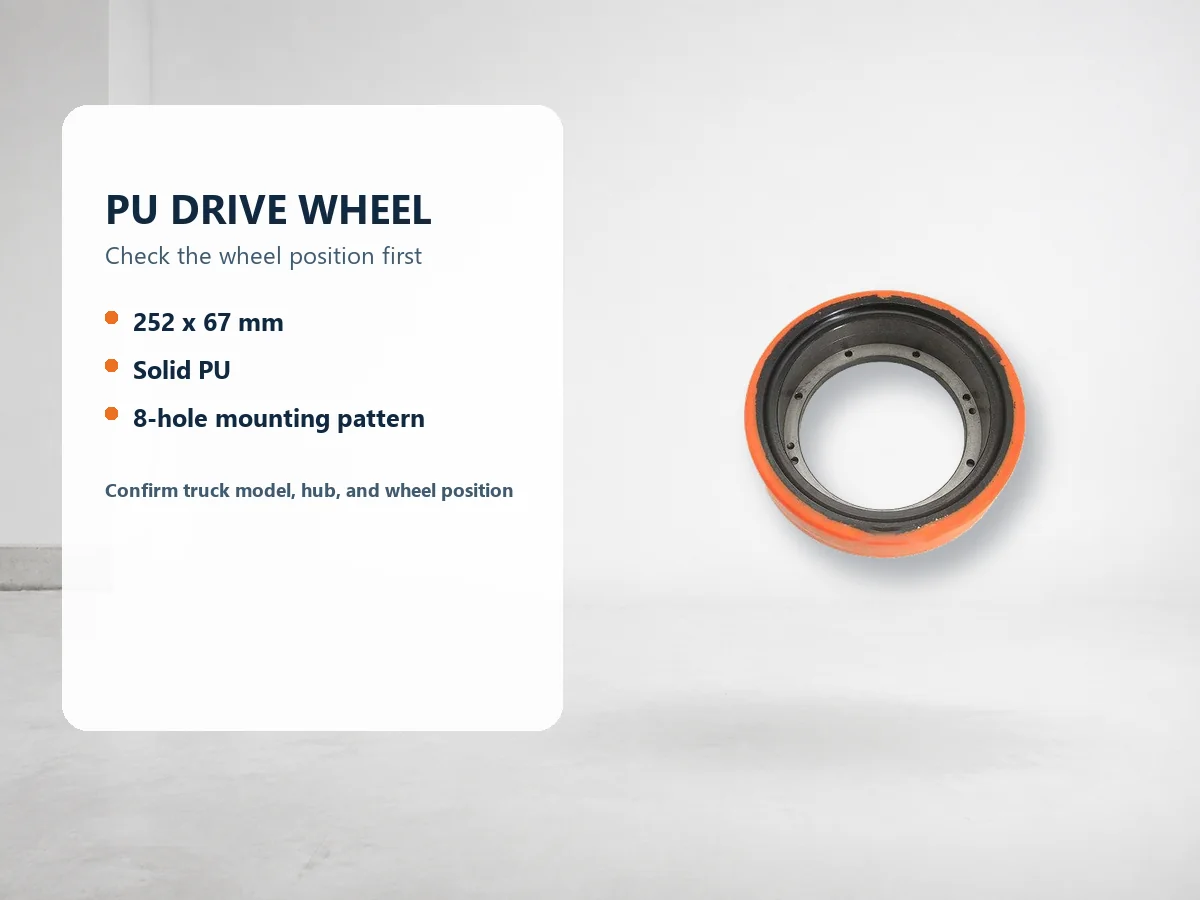
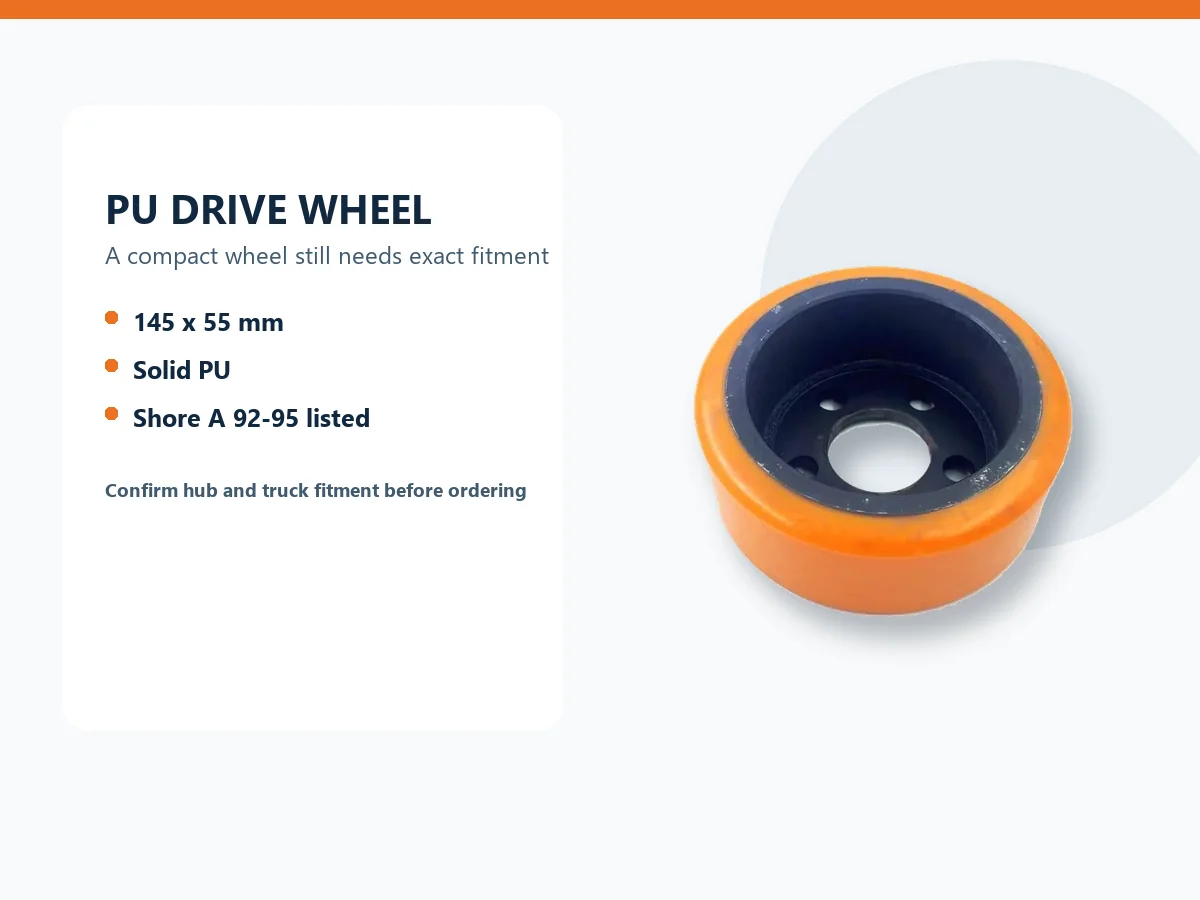
A drive wheel is the powered contact point between an electric truck and the floor. The replacement must transmit motor torque through the correct hub or mounting pattern while keeping the original ground clearance and chassis envelope. Its job is different from the small wheels under the forks, even when both use a PU tread.
For a drive-wheel request, record:
- Overall diameter and tread width. These are the first dimensional checks, but they are not sufficient by themselves.
- Hub width and hub geometry. Confirm how the wheel seats against the drive hub or flange.
- Bolt count, bolt circle, or slot pattern. The number of holes or slots is only one part of the interface. The circle diameter, hole size, and seating surface still need confirmation.
- Truck and drive-unit identity. Include make, model, serial number, and the old wheel or OEM part number.
- Rated load, compound, and hardness. Use the selected SKU’s technical sheet or supplier confirmation. Do not transfer a value from a similar diameter wheel.
The Kingstream catalog lists SKU PU-WHEEL-145-55 as a solid PU drive wheel with a 145 x 55 mm size, steel hub, listed Shore A 92 to 95 range, and a current catalog price of $28 (Kingstream Parts, 2026a). The listing also says it is intended for certain electric pallet-truck applications and should be replaced in pairs. Those are listing-level facts, not proof that the wheel fits every truck in those brands. The exact hub, truck, and load match still need to be checked before ordering.
Larger examples in the same category show why the mounting pattern matters. SKU PU-252-67-8 is listed as a 252 x 67 mm solid PU drive wheel with an 8-hole mounting description and a current catalog price of $36 (Kingstream Parts, 2026b). The listing does not by itself provide a universal bolt circle, load table, or complete model list. Those fields belong in the supplier confirmation step.
Caution: A drive wheel with the correct diameter but the wrong hub or bolt pattern is not a near match. It is a different fitment and should be held until the interface is verified.
PU load and support wheels: confirm bore, bearing, and set configuration
Load or support wheels are commonly found under the forks of pallet trucks, walkie stackers, and related warehouse equipment. They support the load side of the machine and roll through pallet entry points, floor joints, and turning movements. Their smaller size does not make fitment less important. Bore, bearing, axle, spacer, and wheel quantity can all change the replacement.
Start with the old wheel or the equipment drawing. Record the outside diameter, tread width, bore, bearing arrangement, axle size, and whether the machine uses a single or tandem set. Replacement catalogs commonly expose diameter and width, bore, bearing, and OEM part number as separate selection fields (Blickle, n.d.). If the listing says that a bearing is included, confirm the bearing number and the axle or spacer arrangement before treating it as ready to install.
Two Kingstream listings illustrate the difference between a product example and a universal rule. SKU PU-80-60-47 is listed as an 80 x 60 x 47 mm PU wheel with a metal core for pallet-truck support-wheel applications and a current catalog price of $4 (Kingstream Parts, 2026d). SKU PU-85-80-55 is listed as an 85 x 80 x 55 mm PU foam wheel for support-wheel positions, with a current catalog price of $5 (Kingstream Parts, 2026f). The dimensions and construction descriptions are useful for a shortlist, but neither listing supplies a universal rated load or a complete truck-model compatibility table.
When a machine uses tandem wheels, compare the complete set configuration, not only one wheel. Uneven wheel height or a different bearing arrangement can shift the load across the set. Before ordering, send a photograph of the old wheel, the measured dimensions, the axle or bearing details, and the equipment model. If the supplier cannot confirm the set configuration, the order should remain at the quote stage.
Load and support wheels can differ even when both are labeled PU. Kingstream’s PU-80-60-47 listing shows 80 x 60 x 47 mm and $4, while PU-85-80-55 is listed as 85 x 80 x 55 mm and $5. The dimensions are examples, not a universal load rating, so bearing, axle, set configuration, and truck fitment still need confirmation.
Need a fitment check? Send the pallet truck make, model, serial number, wheel position, measurements, and photos of the current wheel. We can confirm which details are still missing before you request a quotation.
PU caster wheels: verify the axle, bearing, and steering assembly
A PU caster wheel is a free-rolling support component used in a caster fork or steering assembly. It may look similar to a load wheel, but the surrounding fork, axle, swivel or fixed mount, and bearing arrangement determine how it works. The word “caster” in a product title should therefore be checked against the actual assembly and dimensions.
For a caster replacement, confirm:
- the wheel’s position and whether it swivels, steers, or runs in a fixed fork;
- outside diameter, tread width, and bore;
- bearing type, bearing number, axle size, spacer, and retaining hardware;
- fork clearance and side-to-side spacing; and
- the equipment model, current part number, and the load or operating environment supplied by the manufacturer.
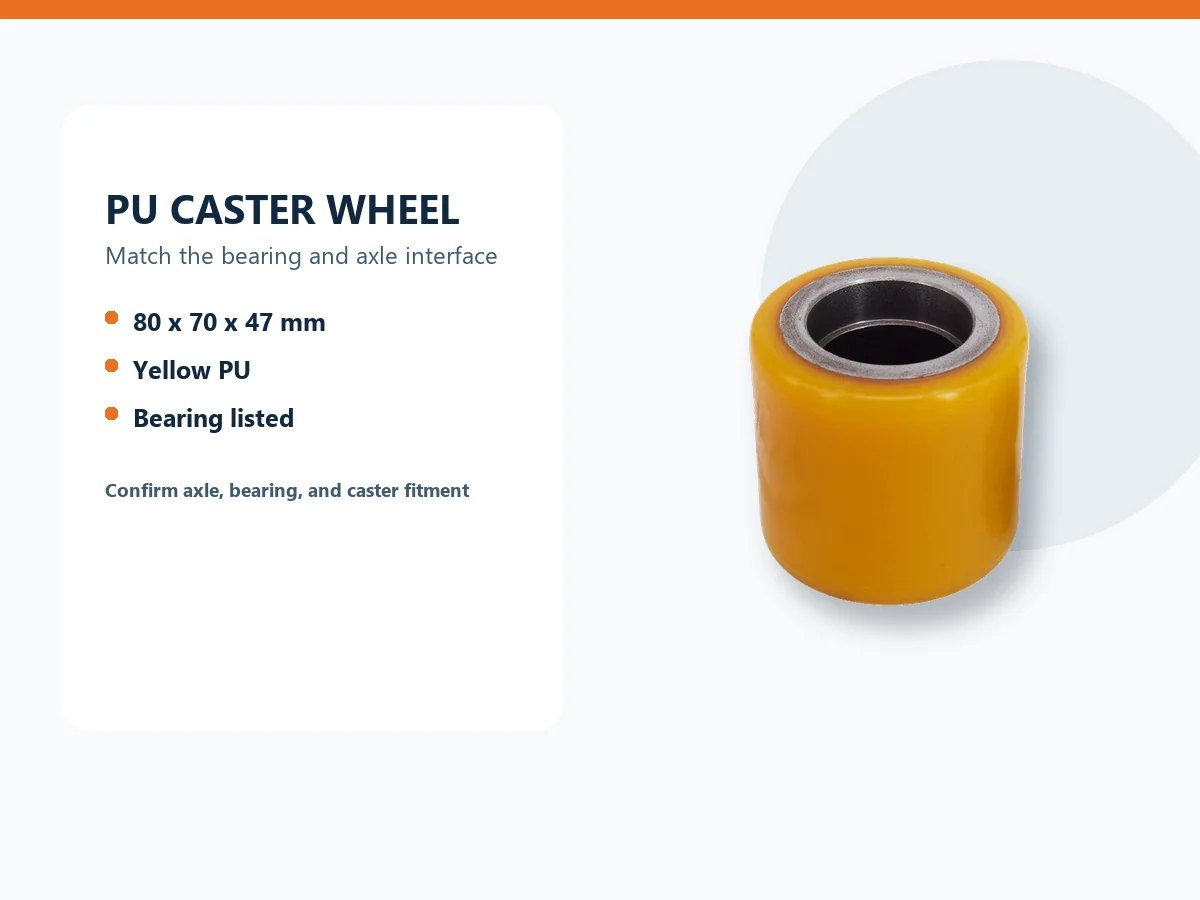
SKU PU-80-70-47C is listed as an 80 x 70 x 47 mm yellow PU caster trolley wheel with a bearing and a current catalog price of $2 (Kingstream Parts, 2026c). That makes it a useful example of the fields a buyer should look for. It does not establish that every 80 x 70 x 47 mm wheel, or every pallet truck with a 47 mm bore, is interchangeable.
The category also contains an item whose title and detailed description do not fully agree on the wheel role. SKU PU-250-80-17 is labeled as a drive wheel in its product name, while the listing description and URL identify a caster or support-wheel application (Kingstream Parts, 2026e). It is therefore a quote-only example until the wheel role, mounting pattern, and equipment fitment are confirmed. That is a useful purchasing lesson: a clean photograph or a familiar product name cannot resolve a taxonomy conflict.
Note: If the product title, description, photograph, and quote do not describe the same wheel position, pause the order and request a corrected specification or a fitment review.
PU wheel comparison: what is listed, what is missing, and what to ask
The table below is a screening tool, not a substitute for the equipment manual or supplier confirmation. The prices are current catalog examples and can change. They should not be read as a market-wide price range or as proof that one wheel is a better fit than another.
| Wheel path | Example listing fields | Fields still needing fitment confirmation | Current catalog example |
|---|---|---|---|
| Drive wheel | 145 x 55 mm, solid PU, steel hub, listed Shore A 92 to 95 | Truck model and serial, hub geometry, bolt or slot pattern, rated load, warranty | SKU PU-WHEEL-145-55, $28 (Kingstream Parts, 2026a) |
| Drive wheel | 252 x 67 mm, solid PU, 8-hole mounting description | Bolt circle, hole size, truck fitment, rated load, warranty | SKU PU-252-67-8, $36 (Kingstream Parts, 2026b) |
| Load/support wheel | 80 x 60 x 47 mm, PU tread on metal core | Exact equipment, bearing number, axle and spacer, rated load | SKU PU-80-60-47, $4 (Kingstream Parts, 2026d) |
| Support wheel | 85 x 80 x 55 mm, PU foam construction | Exact equipment, axle or bearing arrangement, rated load | SKU PU-85-80-55, $5 (Kingstream Parts, 2026f) |
| Caster wheel | 80 x 70 x 47 mm, yellow solid PU, bearing listed | Bearing number, axle, fork clearance, equipment fitment, rated load | SKU PU-80-70-47C, $2 (Kingstream Parts, 2026c) |
| Ambiguous category item | 250 x 80 x 17 mm, 10-hole description | Wheel role, bolt circle, equipment, rated load, warranty | SKU PU-250-80-17, quote only (Kingstream Parts, 2026e) |
The comparison shows what a buyer can and cannot confirm from a typical listing. Size and price may be visible, while the fields that determine installation and safe use remain open. Resolve those fields before approving an order.
Price belongs later in the sequence. A $2 caster wheel and a $28 drive wheel are not direct alternatives because they serve different positions and contain different mounting interfaces. Compare price only after the wheel role and fitment fields are aligned. For a fleet quote, also ask whether the price is per wheel or per set, whether bearings or hardware are included, and whether the selected quantity matches the machine configuration.
A PU wheel price is meaningful only after the wheel position and interface match. The comparison includes a $2 caster example, a $4 load/support example, and a $28 drive-wheel example, but those products serve different positions. Kingstream’s listed prices are SKU-level catalog examples, not a market-wide price range or proof of interchangeability.
How to prepare a pallet truck wheel replacement request
Send the supplier a short set of photos and measurements instead of a product name alone. This reduces clarification cycles and makes it easier to reject a near match before money or installation time is committed.
- Photograph the current wheel in position. Show the wheel location, surrounding fork or hub, fasteners, and any molded or stamped markings. Include a separate close-up of the worn tread, bore, bearing, or bolt pattern.
- Photograph the truck information. Record the make, model, serial number, data plate, and the OEM part number from the manual or old part if available.
- Measure the replacement envelope. Record outside diameter, tread width, bore or hub, and the unit used. For a drive wheel, add hub width, bolt count, hole size, bolt circle, or slot pattern. For a load or caster wheel, add axle, bearing, spacer, and retaining details.
- Describe the working context. Note indoor or outdoor use, floor type, ramps, contamination, temperature, duty cycle, and the load context. These details help the supplier choose or confirm the compound, but they do not replace a rated-load value.
- Ask for the missing technical fields. Request the exact rated load, compound or durometer, bearing number, mounting drawing, included hardware, warranty, and model-specific fitment for the quoted SKU.
Your request can be as short as this:
Quote request: Please confirm a PU [drive/load/support/caster] wheel for [make, model, serial]. Current part or marking: [part number]. Measured size: [diameter x width x bore or hub]. Mounting: [bearing, axle, bolt count, bolt circle, or slots]. Quantity: [number]. Please confirm exact fitment, rated load, compound or hardness, included hardware, warranty, and price per wheel or set.
Do not replace a missing value with a guess from another product. Manufacturer guides and replacement catalogs use these fields because they change the fitment decision, not because every wheel shares one universal specification (Blickle, n.d.).
A complete PU wheel quote request has 5 practical parts: a current-wheel photo, truck model and serial, measured size, mounting details, and the technical fields still needing confirmation. The request template asks for price per wheel or set, rated load, compound or hardness, hardware, warranty, and exact fitment before ordering. Blickle’s guide likewise treats wheel dimensions and application as selection fields.
What to ignore in a PU wheel listing
Some listing language helps with initial discovery but cannot approve an order by itself.
A common mistake is to treat the wheel’s color or diameter as a fitment code. Neither one identifies the bore, hub, bearing, bolt pattern, or equipment compatibility, so use those values only as screening clues.
- Color is not a fitment code. Yellow, orange, brown, or another color may identify a product family or a visual preference. It does not confirm bore, hub, bearing, bolt pattern, capacity, or equipment compatibility.
- Diameter alone is not compatibility proof. Two wheels can share an outside diameter and still differ in width, bore, hub, bearing, mounting pattern, or wheel position.
- “Heavy duty” needs a rated field. Ask for the rated load, test basis, position, speed or operating condition where relevant, and the exact SKU scope. A general adjective is not a load table.
- A hardness range is not a complete application recommendation. Hardness must be tied to the compound and the selected wheel. Do not copy a value from a drive wheel into a caster or load-wheel quote.
- “OEM replacement” needs a match. Ask which OEM part number, model, serial range, or drawing the statement refers to. Brand coverage without a defined scope is incomplete evidence.
These 5 checks are not anti-product. They make the product information usable. A listing with fewer but clearly scoped fields is more valuable than a longer page that repeats broad performance claims without a drawing, bearing number, load value, or model reference.
When to delay a pallet truck wheel replacement order
Delay the order when any of these 6 conditions remains unresolved:
- the listing does not clearly identify whether the wheel is a drive, load/support, or caster wheel;
- the diameter and width are known, but the bore, hub, bearing, axle, or mounting pattern is not;
- the product title and description assign different wheel roles;
- the rated load is missing for the selected application;
- the truck model, serial, OEM part number, or data-plate information has not been checked; or
- the quote changes the SKU, quantity, price basis, or included hardware without explaining why.
This does not mean every wheel needs a long engineering report. It means the evidence must be complete enough for the decision being made. If the product page has a clear size but the interface is unknown, ask for a drawing. If the interface is clear but the load or compound is unknown, ask for the SKU datasheet or supplier confirmation. If the category description itself is inconsistent, keep the item at quote stage.
The fastest safe purchase is usually the one with the clearest request: truck identity, wheel position, measured dimensions, mounting details, quantity, and the exact fields that still need confirmation. Once those agree, compare price and delivery against genuinely equivalent options.
FAQ
What is a PU caster wheel?
A PU caster wheel is a free-rolling support component used in a caster fork or steering assembly. Confirm its position, outside diameter, tread width, bore, bearing, axle, spacer, fork clearance, and equipment fitment because a similar-looking load wheel is not automatically interchangeable.
How do I measure a pallet truck wheel?
Measure the outside diameter, tread width, and bore, keeping the unit and the listing’s dimension convention clear. Then record the bearing arrangement, axle or spacer details, wheel position, and whether the truck uses a single or tandem set. Send the measurements with the truck model or serial information and photos because dimensions alone do not prove fitment.
Conclusion
Choose a PU wheel by role and fitment, not by the material label or a similar-looking photograph. First identify whether the part is a drive, load/support, or caster wheel. Then verify the measured dimensions, bore or hub, bearing or mounting pattern, and the truck or pallet-truck identity.
Use the named Kingstream listings in this guide as SKU-level examples only. If the wheel position, interface, rated load, or equipment match is still unclear, keep the request at the quotation stage and ask for the missing drawing or confirmation. Once the fitment evidence agrees, compare price, quantity, hardware, warranty, and delivery on genuinely equivalent options.
References
- Blickle. (n.d.). PU wheels: For smooth and quiet mobility. https://www.blickle.com/guide/pu-wheels
- Blickle. (n.d.). Pallet truck wheels for warehousing and logistics. https://www.blickle.com/guide/pallet-truck-wheels
- Toyota Material Handling. (2018). How to make decisions between polyurethane and nylon pallet jack wheels. https://www.toyotaforklift.com/resource-library/blog/toyota-products/how-to-make-decisions-between-polyurethane-and-nylon-pallet-jack-wheels
- Kingstream Parts. (2026). Forklift PU drive wheel, 145 × 55 mm orange electric. https://kingstreamparts.com/product/pu-drive-wheel-145x55mm/
- Kingstream Parts. (2026). Forklift drive wheel, 252 × 67 mm, 8-hole PU for electric pallet truck. https://kingstreamparts.com/product/forklift-parts-wheel-252_67-pu-252-67/
- Kingstream Parts. (2026). Forklift PU caster trolley wheel, 80 × 70 × 47 mm yellow. https://kingstreamparts.com/product/forklift-parts-wheel-bearing-pu-80-70/
- Kingstream Parts. (2026). Forklift PU wheel, 80 × 60 × 47 mm pallet truck yellow. https://kingstreamparts.com/product/forklift-parts-wheel-80_60-pu-80-60/
- Kingstream Parts. (2026). Forklift PU wheel, 85 × 80 × 55 mm yellow. https://kingstreamparts.com/product/forklift-parts-wheel-85_80-pu-85-80/
- Kingstream Parts. (2026). Forklift PU drive wheel, 250 × 80 × 17 mm, 10-hole orange. https://kingstreamparts.com/product/forklift-parts-wheel-caster-pu-250-80/
Last reviewed and updated: September 8, 2026. Author: Kingstream team. For tailored guidance, contact our team.