
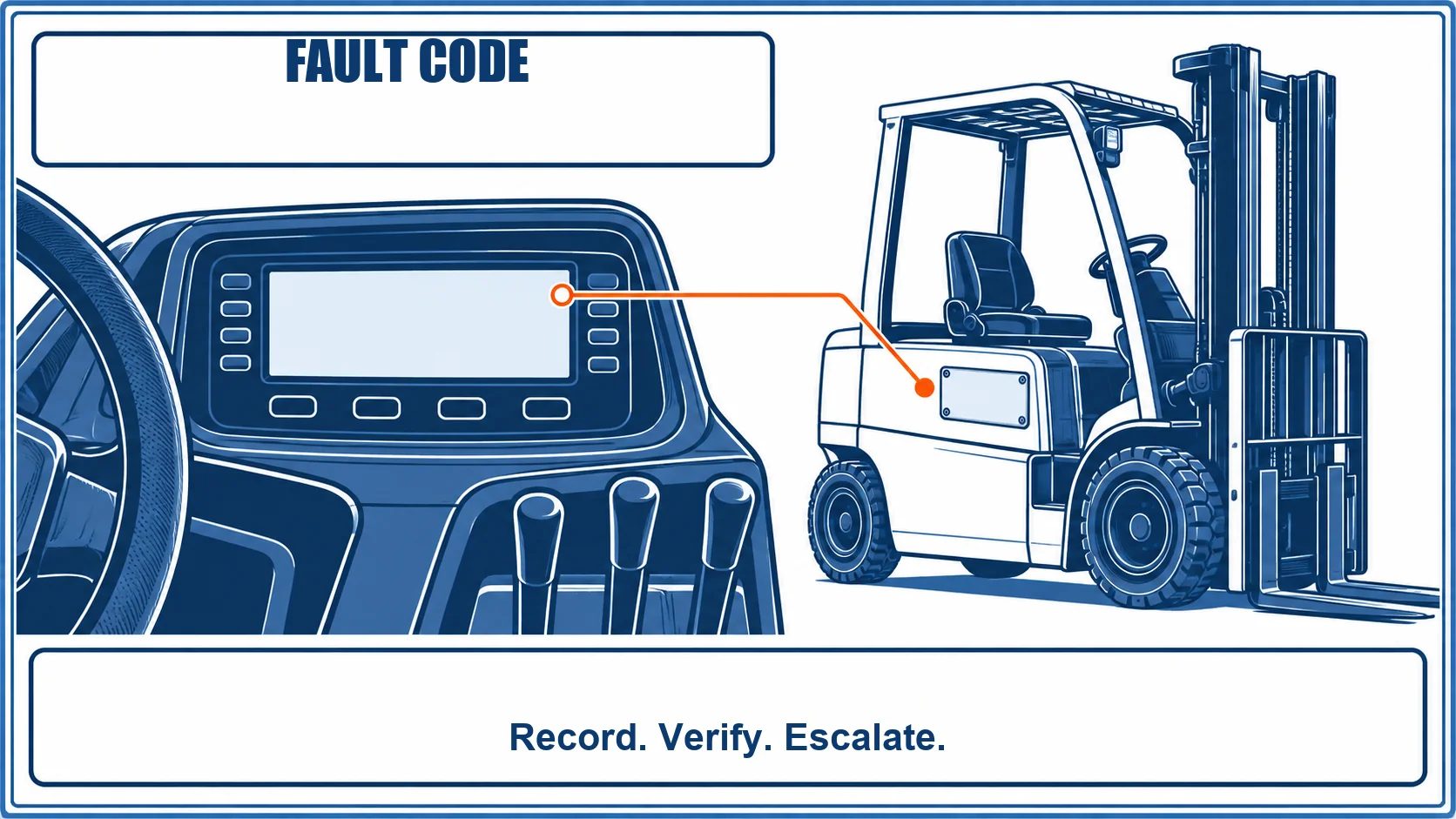
TL;DR
Record the complete code exactly as displayed, note the symptoms and operating context, and identify the forklift by model and serial number. If the truck is defective or unsafe, remove it from service. Verify the code only against service information that applies to that truck, and have an authorized technician confirm the diagnosis before replacing a part.
Table of Contents
- What to do first when a Toyota forklift shows a fault code
- Step 1: Stop, record, and verify before you troubleshoot
- Step 2: Record the exact code and what happened
- Step 3: Check that the code reference fits your exact truck
- Step 4: Do not treat a fault code as a parts diagnosis
- Step 5: Know when to stop and what to send for service
- Conclusion
- References
What to do first when a Toyota forklift shows a fault code
Toyota forklift fault codes are diagnostic clues, not confirmed parts diagnoses. Capture the exact display and identify the truck before looking up any definition. If the truck behaves abnormally, loses a safety-related function, or appears defective, follow your site procedure and stop using it until qualified personnel assess it.
Do not assume that a code copied from a forum or a broad online list applies to your machine. Write the code exactly as displayed, including letters, digits, punctuation, and any accompanying text. Record the model and serial from the data plate. Note the symptom and when it appeared. Then compare the information with service documentation that covers that truck.
Toyota’s 2016 description of its Electronic Diagnostic system says dealer technicians enter both a forklift model and its associated error code. The tool then returns a probable cause and repair information. That model-plus-code workflow sets a practical limit: identify the truck before treating an online code match as a diagnosis. A code can direct the next check, but it does not prove which component failed.
Warning: Do not keep operating a forklift that is defective or unsafe just to see whether the code returns. Preserve what you can observe safely, report the condition, and let authorized personnel decide the next test.
The process is short: stop if safety is in question, record what the display actually shows, and verify it against information for the exact machine. The sections below turn those three actions into a service-ready report.
In a 2016 announcement, Toyota described T.E.D. as a dealer-technician system that accepts a forklift model and associated error code, then returns a probable cause and repair information. The model-specific input matters: capture the display and truck identity before treating an online match as diagnostic direction.
Step 1: Stop, record, and verify before you troubleshoot
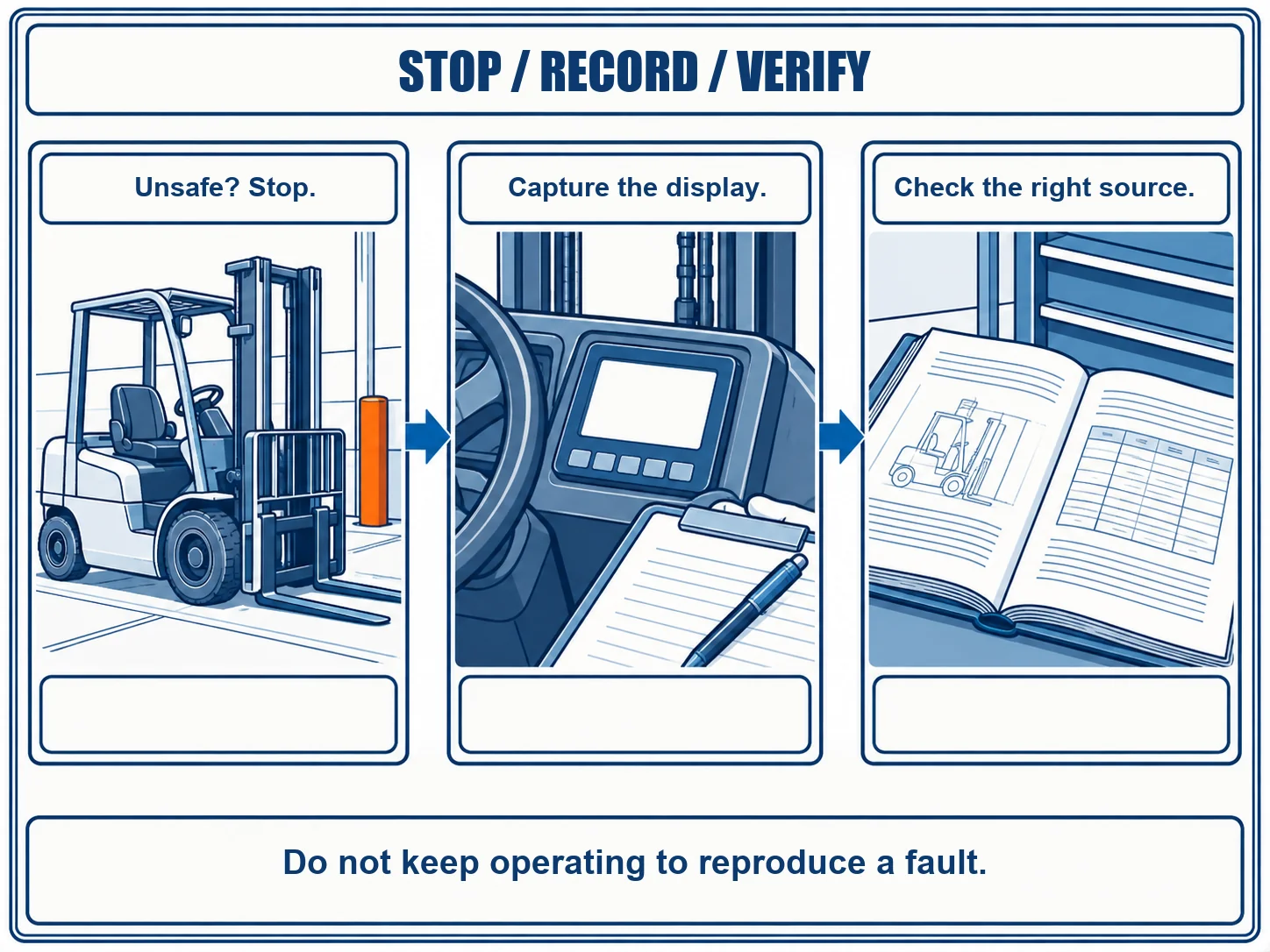
Use this sequence before anyone attempts a reset, opens a panel, disconnects a component, or orders a part. An operator’s job is to report what the truck displays and how it behaves. A technician’s job is to diagnose and repair it using the applicable service procedure.
- Stop the task if the truck is unsafe. If steering, braking, lifting, travel, a warning system, or another safety-related function is affected, follow the site’s shutdown and reporting procedure. Park or secure the machine only as trained and only when it is safe to do so. Do not continue operating to reproduce the fault.
- Record the display as seen. Write down the complete code and any accompanying message. Photograph the display only if doing so does not delay a safe stop or put anyone near moving equipment. Do not paraphrase a code from memory.
- Verify before changing the state. Note whether the display remains present if that is safely observable. Do not assume every Toyota model labels codes as active or stored. Do not use a generic key-cycle or reset sequence. The applicable operator or service manual should determine what a trained person may do next.
OSHA’s powered industrial truck rule says a truck found defective, in need of repair, or unsafe must be taken out of service until restored to safe operating condition. The same standard says repairs are made by authorized personnel. This is the operating boundary, not a diagnosis of what a particular code means.
If the truck appears safe and your employer’s procedure permits observation, record the display and symptoms without dismantling the truck. If the condition is uncertain, stop and ask a supervisor or authorized service provider. A brief report is more useful than an attempted repair that changes the evidence.
Under 29 CFR 1910.178, a powered industrial truck that is defective, needs repair, or is unsafe must be removed from service until restored; repairs must be performed by authorized personnel. Use that rule as a safety boundary, not as a code-interpretation guide.
Step 2: Record the exact code and what happened
The first note should preserve the display, not interpret it. A missing character can point to a different entry in the service information. Keep the code in its original format, including leading zeros, hyphens, letters, and spacing. If the screen shows a message alongside the code, copy both.
| Record this | Why it helps service interpret the report |
|---|---|
| Complete code and exact display text | Preserves the identifier without an operator’s paraphrase |
| Model and serial number from the data plate | Ties the report to the truck that generated the code |
| Function affected and observable symptoms | Separates the displayed code from what the truck actually did |
| When the code appeared and what was happening | Gives the technician operating context without assuming a cause |
| Whether the code remains visible, if safely observable | Distinguishes a current display from a recalled message without assuming every model labels status |
| Photos of the display and data plate, if permitted | Reduces transcription errors when the report is handed off |
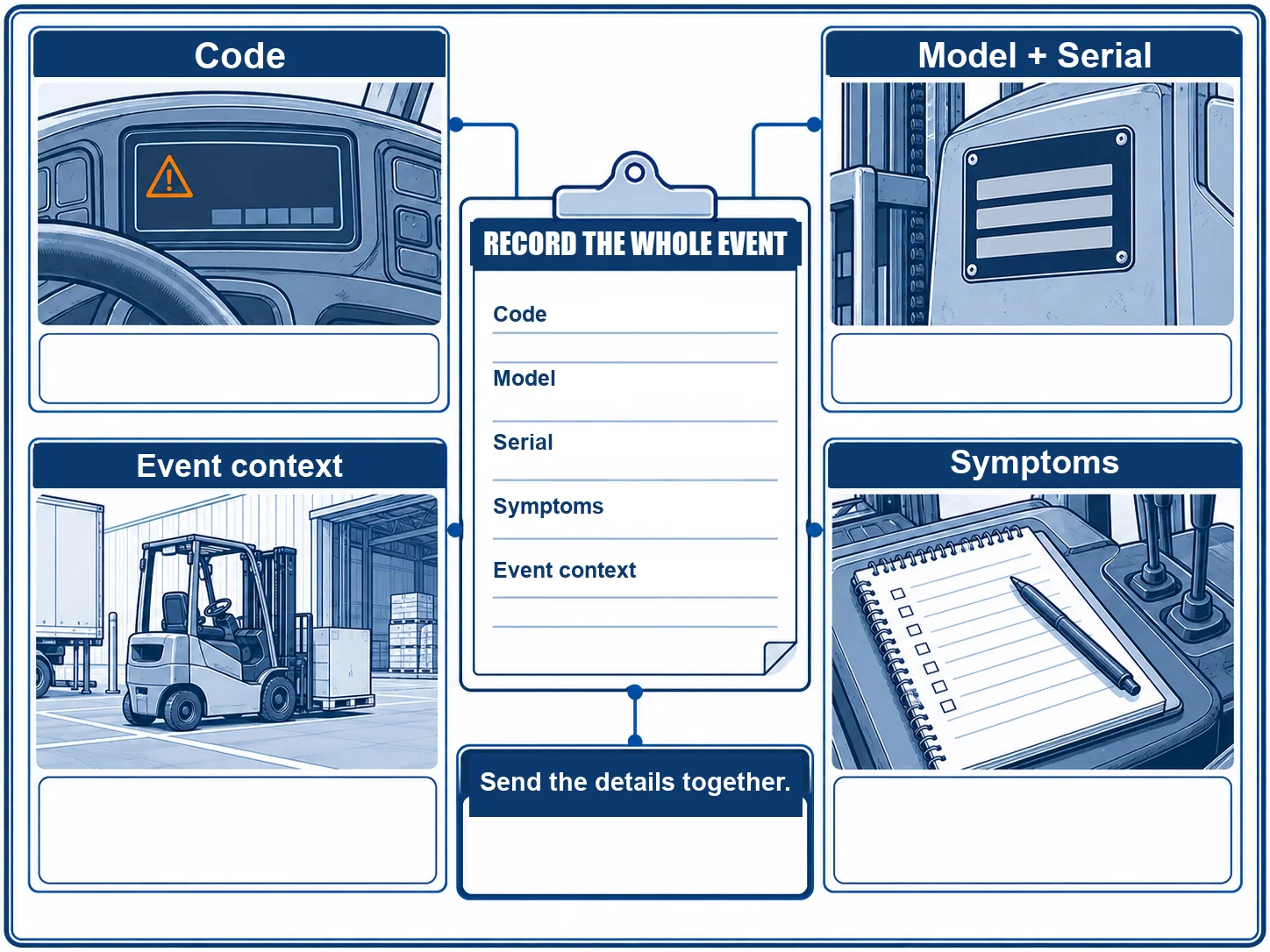
Keep observation and interpretation in separate fields. For example, write "code shown: [exact characters]; travel stopped after key-on" rather than "travel controller failed." The first statement records what someone saw. The second names a cause that has not yet been established. If a technician later confirms a cause, add it as a separate service finding.
Toyota’s Help Center explains that a forklift’s model and serial number are found on its data plate and that the pair helps identify equipment for service and parts support. Record both exactly. If a plate is damaged or unreadable, photograph what remains and ask service how to confirm the truck identity rather than guessing from a partial model label. Toyota’s 2016 description of T.E.D. says dealer technicians enter a forklift model and associated error code to receive a probable cause and repair information.
Toyota’s 2016 description of T.E.D. says dealer technicians enter a forklift model and associated error code to receive a probable cause and repair information. Toyota’s Help Center says the truck’s model and serial number are on the data plate and help dealers identify equipment for technical support and parts matching. Record both identifiers with the exact code.
Where we can help
Once a technician confirms a replacement is needed, include the truck’s model and serial details in the parts request instead of treating the fault code as a parts diagnosis. Kingstream Parts is a single-source forklift parts supplier covering 14 major brands, with OEM-compatible parts backed by fast quotation. Discuss a forklift parts sourcing request
Step 3: Check that the code reference fits your exact truck
A code list is useful only when its coverage matches the forklift being diagnosed. Before applying a definition, check the document title, truck family or model, serial-number coverage, and the system described. If any of those details are missing, treat the page as a lead for further research, not as authority to repair the truck.
Toyota’s published description of its T.E.D. diagnostic system is specific about the inputs: a dealer technician enters a forklift model and its associated error code. Toyota says the system returns a probable cause and repair information, including photos and diagrams. It does not present that workflow as a public universal lookup table for every Toyota forklift.
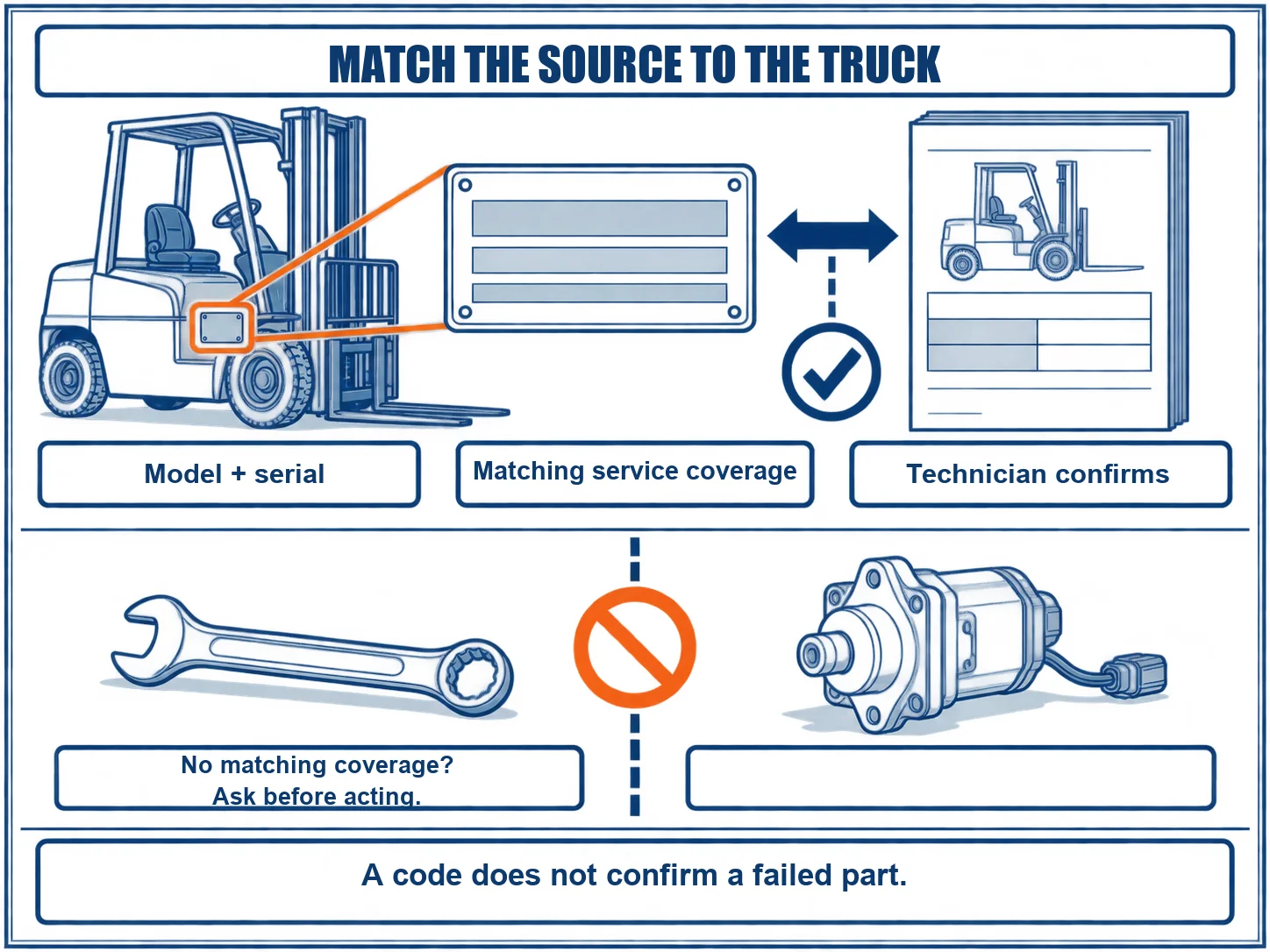
Use this check before trusting a result:
- Match the truck first. Use the full model and serial from the data plate. Similar-looking model names are not proof that the same document applies.
- Check the document’s coverage. Confirm that its listed model, system, and serial range include your truck. If the source does not state coverage, do not infer it.
- Prefer the applicable manual or authorized service channel. Toyota directs users to its dealer network for equipment help. A dealer technician can check the code against the right service information for that truck.
- Keep online lists in their lane. A forum post, scan of a manual, or third-party code page may help locate a question, but it does not establish that the code definition or procedure applies to your serial range.
The practical inference from Toyota’s model-plus-code diagnostic workflow is that the model is part of the lookup, not optional background. A result that gives a code meaning without saying which truck it covers leaves an applicability gap. Resolve that gap with the correct service information before testing or replacing anything.
Toyota’s 2016 description of its dealer diagnostic system ties a code lookup to a forklift model and returns a probable cause rather than a universal parts verdict. Match the model and documented coverage first; if a source omits its applicable truck range, leave the code unresolved and confirm it with authorized service.
Step 4: Do not treat a fault code as a parts diagnosis
A fault code is one input to troubleshooting. It may narrow the system or condition a technician needs to check, but the code alone does not show which physical part failed, whether a connector or wiring issue is present, or whether a replacement component is required. Those conclusions come from the model-specific diagnostic procedure and the inspection or test results it calls for.
Keep these stages separate in the service note:
- Observation: the exact characters and message on the display.
- Symptom: what the truck did or stopped doing.
- Diagnostic finding: what the applicable procedure or technician inspection confirmed.
- Part decision: the component and part number selected after the failure and fitment are verified.
Toyota’s 2016 description of T.E.D. says a dealer technician enters a forklift model and associated error code and receives a probable cause with repair information. The wording matters. A probable cause directs investigation; it is not a guarantee that a named component is defective. Do not turn a code copied from a generic list into a parts order.
This distinction also protects fitment. Toyota says model and serial information helps identify equipment and match parts for a particular truck. Even after a repair need is confirmed, the part still needs to be checked against the truck’s model and serial range.
Before discussing a replacement, ask the service provider to confirm three items: the diagnosed failure, the service procedure or inspection that supports it, and the part number or fitment for the exact truck. If those are not available yet, the next step is diagnosis, not substitution by appearance or by a broad model-family label.
Toyota’s 2016 description of T.E.D. says dealer technicians submit a forklift model and associated error code to receive a probable cause and repair information. That output guides diagnosis; it does not establish that a particular component failed or that a replacement fits. Confirm the diagnosis and model-and-serial fitment before ordering.
Step 5: Know when to stop and what to send for service
Take the truck out of service if it is defective, needs repair, or is unsafe. In the United States, OSHA’s powered industrial truck standard requires it to remain out of service until it is restored to safe operating condition, and says repairs must be made by authorized personnel. The standard does not tell an operator how to decode a Toyota message, so use the applicable Toyota service information for that part.
When you contact a supervisor, dealer, or qualified service provider, send a compact report rather than a guessed diagnosis:
- Toyota forklift model and serial number from the data plate
- Exact fault code and any display message, copied character for character
- The function affected and what the truck did immediately before the code appeared
- When it happened and whether the display remains visible, if safely observed
- Photos of the display and data plate, when site rules permit
- Any inspection or work already completed by authorized personnel
Tell the recipient which facts are observations and which are confirmed service findings. If someone has already scanned or reset the truck, include that detail and who performed it. Do not omit a change simply because the code disappeared; service personnel need the history to decide which procedure applies.
Before sourcing a component, ask the technician to confirm the failure and the part’s fitment to the exact model and serial range. Toyota’s public help information says those identifiers are used to communicate with dealers about technical assistance and to match parts to a particular piece of equipment.
OSHA’s 29 CFR 1910.178 requires unsafe or defective powered industrial trucks to be removed from service until restored, with repairs performed by authorized personnel. A complete handoff includes the exact code, model and serial, observed symptoms, and any work already done. It gives service personnel evidence to verify, not a parts diagnosis to accept.
Conclusion
When Toyota forklift fault codes appear, keep the display and truck identity together. Record the full message, symptoms, and operating context. If the truck is defective or unsafe, remove it from service and leave repair work to authorized personnel. Then verify the code against service information that covers the exact truck and serial range.
A code is a diagnostic lead, not a part number. Treat a failure as confirmed only when the applicable procedure or technician inspection supports it, and verify fitment before selecting a replacement. If a code source does not state which trucks it covers, leave the definition unresolved and ask qualified service personnel to confirm the next step.
References
- Occupational Safety and Health Administration. (n.d.). 1910.178 – Powered industrial trucks. https://www.osha.gov/laws-regs/regulations/standardnumber/1910/1910.178
- Toyota Material Handling. (2016, February 5). Toyota launches forklift electronic diagnostic system. https://www.toyotaforklift.com/news/toyota-launches-forklift-electronic-diagnostic-system
- Toyota Material Handling. (n.d.). Help center. https://www.toyotaforklift.com/help
Last reviewed and updated: September 2026. Author: Kingstream team. For tailored guidance, contact our team.