
TL;DR
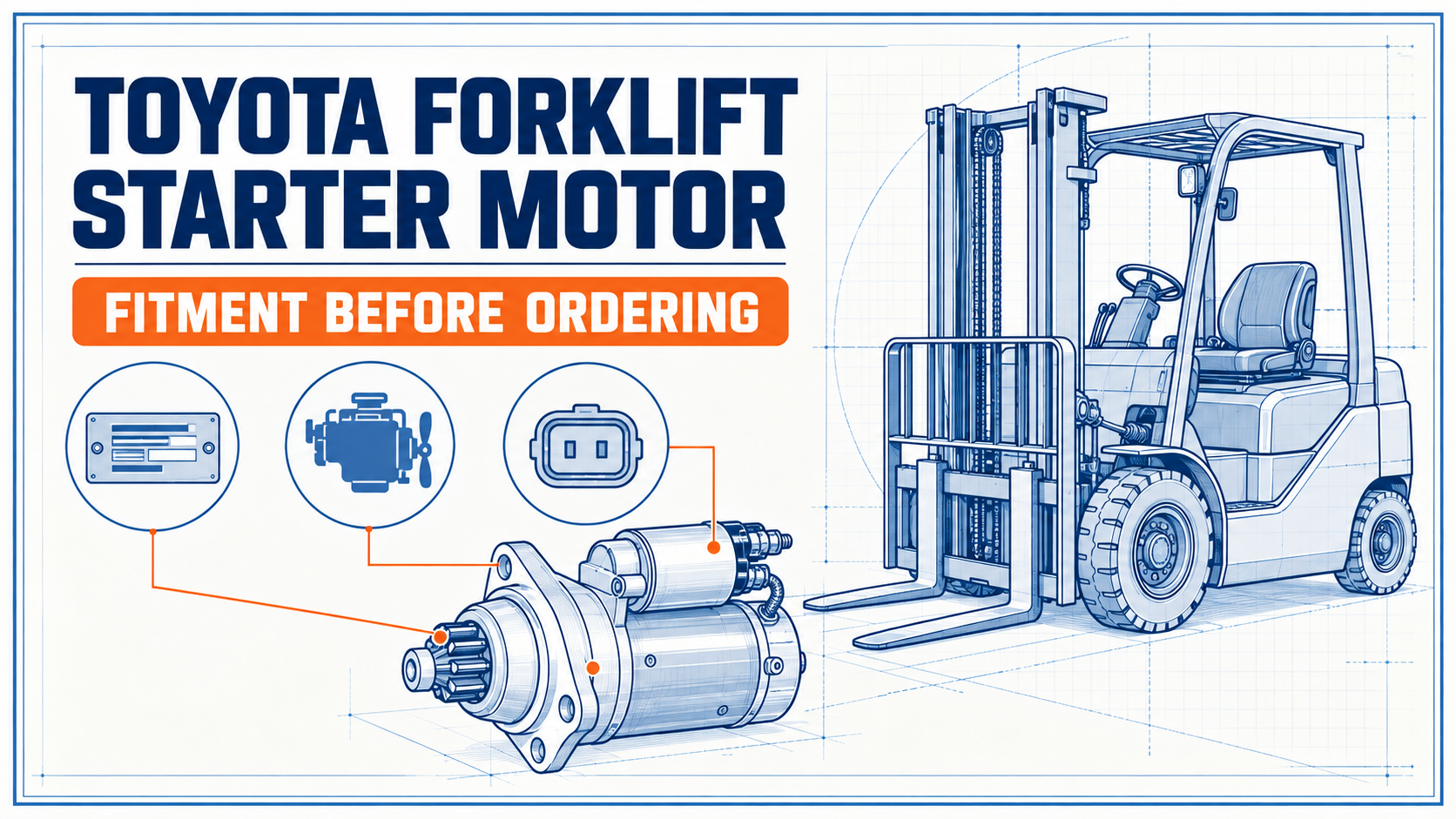
Start with the Toyota model and serial number, then photograph the installed starter’s label, pinion, mounting flange, wiring connector, and solenoid. Treat voltage, rotation, drive type, tooth count, and mounting dimensions as exact-unit checks. If the evidence is incomplete, delay the order and request a fitment review. For the wider Toyota forklift parts request, keep the same model-and-serial record attached.
Key Takeaways
- Use model and serial together; a Toyota model name alone is not a complete fitment record.
- Photograph the installed starter before removing it or ordering a replacement.
- Keep starter-motor, solenoid, battery-cable, and ring-gear checks separate.
- Treat voltage, tooth count, rotation, drive type, and mounting as exact-unit fields.
- Delay the order when the listing cannot be tied to the truck and installed unit.
Table of Contents
- Key Takeaways
- Toyota forklift starter motor: what to confirm first
- The fitment decision framework: identify the truck, then the starter
- Use case 1: replacing a Toyota forklift starter motor
- Use case 2: checking the starter solenoid before replacing the motor
- Comparison table: evidence that supports a starter quote
- How to verify the replacement before you buy
- What not to infer from a Toyota forklift starter listing
- When to delay the Toyota forklift starter order
- Conclusion
- References
Toyota forklift starter motor: what to confirm first
A Toyota forklift starter motor should be matched to the exact truck and the installed unit, not ordered from the brand name alone. Start with the complete model number and serial number from the data plate. Then photograph the installed starter, including its label or casting mark, pinion, mounting flange, wiring connector, and solenoid.
The quickest fitment packet contains:
- Truck identity: Complete Toyota model number and serial number.
- Starter identity: Any OEM, casting, or supplier number visible on the installed unit.
- Mechanical evidence: Pinion, housing, flange, mounting holes, offsets, and any shim or nose details.
- Electrical evidence: Voltage, rotation, drive type, terminal arrangement, and solenoid connector, confirmed for the installed unit.
- Failure context: What happens when the key is turned, and whether the issue could involve the solenoid, battery cable, relay, battery, or ring gear instead.
Do not treat a broad model list, a copied product photo, or a similar-looking starter as complete fitment proof. Toyota’s official identification guidance connects model and serial information to replacement-parts lookup, while component-level values still need exact-unit or manual confirmation.
If the model or serial is missing, the starter label is unreadable, or the electrical and mechanical details conflict, pause the order. A fitment review is cheaper than repeating a wrong-part shipment and losing another maintenance window.
This is especially important when a fleet contains several Toyota trucks that share a series name or capacity class. The part request should identify the specific truck being repaired, not simply the brand represented in the warehouse.
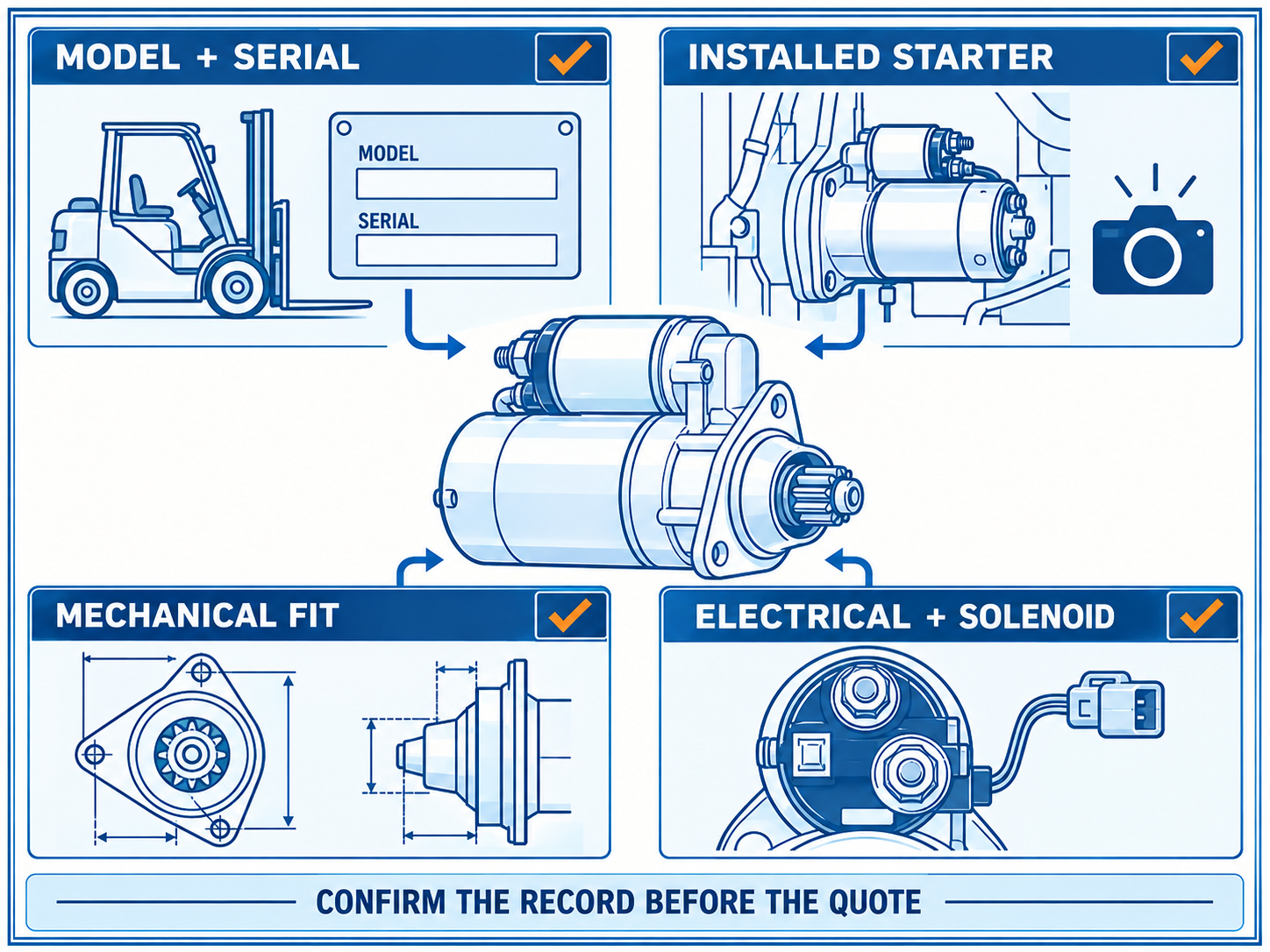
Fitment rule: Model and serial identify the truck. Photos and exact starter fields identify the component. Both parts of the record are needed before a Toyota forklift starter motor quote is treated as ready to approve.
Toyota Material Handling’s model and serial guidance supports starting with truck identity, while this checklist adds the installed-unit record. The fitment packet has 2 sides: the exact truck record and the component evidence. Send the data plate, starter label, photos, and interface details before treating a Toyota forklift starter quote as order-ready.
The fitment decision framework: identify the truck, then the starter
Use a fixed order when matching a Toyota forklift starter motor. The order matters because a component listing can look precise while still describing several engine or model variations. The buyer’s job is to separate confirmed information from fields that still require a supplier or manual check.
Step 1: record the data plate
Write the model number exactly as it appears on the equipment data plate. Do not shorten it to a family name or replace it with a fleet nickname. Record the serial number beside it, including letters, hyphens, and leading zeroes if they appear. Toyota’s official parts guidance states that the model and serial combination is used to identify the equipment and look up replacement parts.
If the plate is damaged or missing, photograph the plate area and ask the service team how to confirm the frame marking or another official identifier. The Toyota forklift models guide can help separate series names, but it does not replace the exact truck record. Do not guess the production version from color, capacity, or the appearance of the counterweight.
Step 2: record the installed unit
Before removal, take clear photos of the starter from both sides. Include the label, casting mark, solenoid, connector, battery terminal, mounting flange, bolt holes, and pinion gear. Record any number that could be an OEM number, remanufacturer number, or previous replacement number. The number is evidence to verify, not permission to assume that every cross-reference is interchangeable.
Step 3: flag the exact-unit fields
Ask the supplier or qualified technician to confirm the starter’s voltage, rotation, drive type, pinion tooth count and diameter, mounting pattern, flange orientation, nose length, and solenoid connector. These are not universal Toyota values. They are fitment fields that apply to the particular truck, engine, starter design, and replacement being quoted.
Keep four labels in your notes:
- Confirmed: Visible on the truck, installed unit, or applicable manual.
- Buyer supplied: A photo, measurement, symptom, or number supplied with the request.
- Supplier confirmed: A cross-reference, inclusion detail, or availability statement confirmed during quotation.
- Unknown: A field that still blocks a confident order.
The labels also improve internal handoff. A buyer can supply photos and truck identity, a technician can report test context, and the supplier can return a proposed cross-reference with its assumptions visible. That separation prevents a catalog description from being mistaken for a diagnostic result or a buyer observation from being mistaken for a manufacturer specification.
When a supplier asks for "the starter number," send the full record rather than one isolated number. Include the model, serial, photo set, symptom, and any prior replacement information. A number copied from a damaged label can be incomplete, and a previously installed aftermarket unit may not represent the original factory configuration.
This framework turns a broad Toyota forklift starter search into a traceable fitment request. It also makes uncertainty visible instead of hiding it behind a product title.
Decision rule: Do not compare starter specifications until the truck identity is fixed. Model and serial identify the application; the installed-unit record then tests whether the proposed starter matches the actual electrical, drive, and mounting requirements.
Toyota Material Handling’s model and serial guidance makes Step 1 the equipment identity check. Step 2 records the installed unit, and Step 3 flags exact-unit fields such as voltage, rotation, drive, pinion, mounting, and connector details. This sequence keeps a broad Toyota forklift starter listing from becoming an unsupported fitment verdict.
Use case 1: replacing a Toyota forklift starter motor
When the starter motor is already the confirmed replacement target, the goal is not to collect every possible Toyota part number. The goal is to give the supplier enough evidence to match the proposed replacement to the truck and the unit being removed.
Evidence to photograph
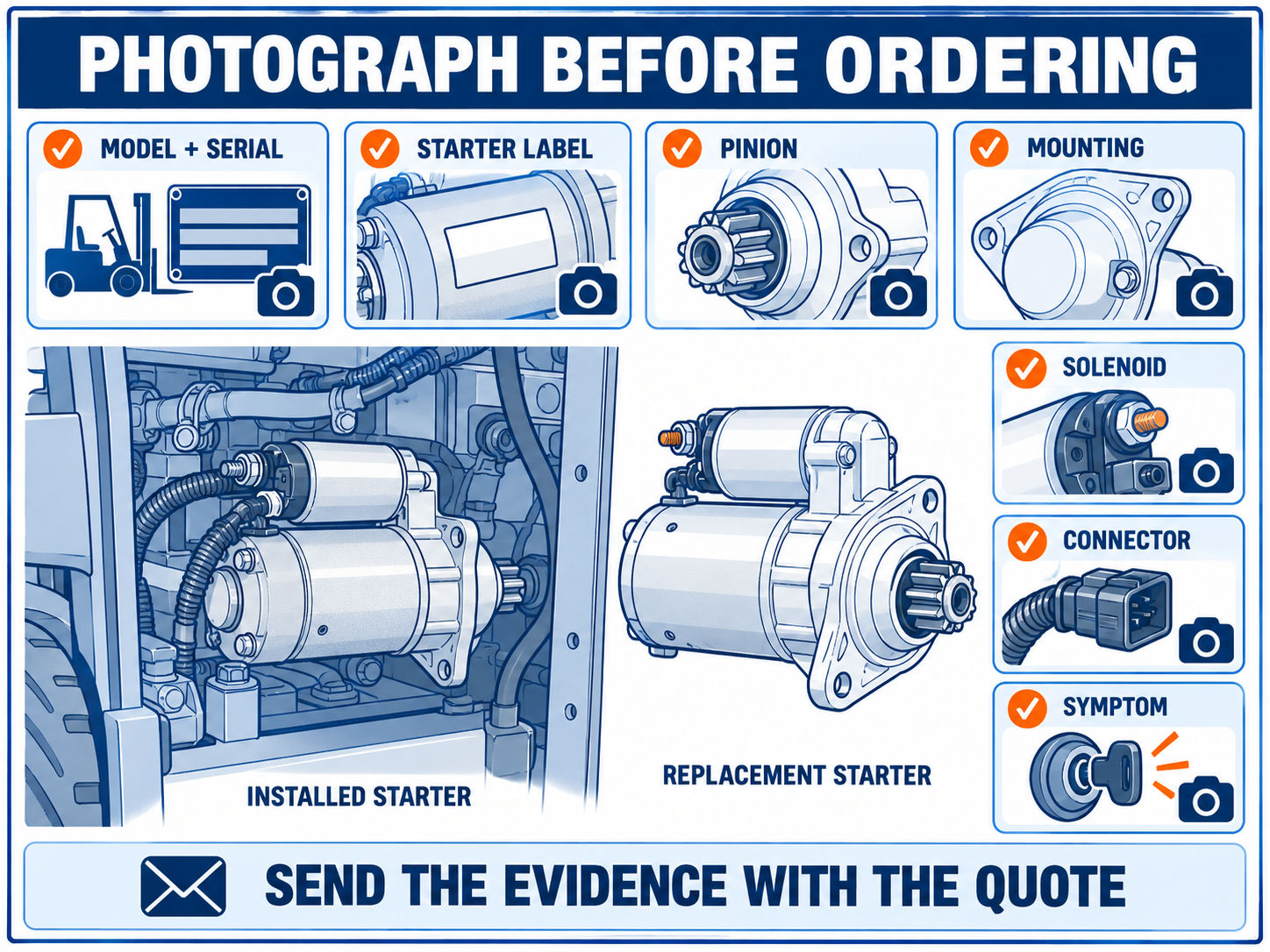
Send a clear set of photos with the model and serial number:
- The complete equipment data plate.
- The starter installed in the truck, before removal if safe and practical.
- The starter label, stamping, or casting mark.
- The pinion gear close-up, with the teeth visible.
- The mounting flange and every bolt hole.
- The solenoid, terminal positions, and control connector.
- Any shim, spacer, unusual bracket, or damaged ring-gear area.
Add a short description of the symptom: no crank, slow crank, a click without engagement, grinding, free spinning, or a starter that remains engaged. This description does not prove the failed part, but it helps the technician decide whether the replacement question is ready for a fitment review.
Photograph connectors before disconnecting them and keep the images with the truck record. If the old starter has already been removed, place it beside a ruler or another neutral scale only for identification context, not as a substitute for the supplier’s required measurements. Note any corrosion, broken terminal, missing shim, altered bracket, or non-factory wiring that could explain why a direct visual comparison is misleading.
This is a quote-stage checklist, not a removal procedure. Follow the site’s safety controls and applicable manufacturer or powered-industrial-truck procedures before removing the component.
Fields to confirm with the supplier
Ask the supplier to state the exact replacement or cross-reference being proposed, the voltage, rotation, drive type, pinion details, mounting pattern, and whether the solenoid is included. Ask them to identify any field that was inferred from a model list rather than verified from the model, serial, manual, or installed-unit photos.
Do not approve an order because the housing looks similar. A starter can share a general shape while differing in its gear engagement, flange orientation, wiring, or electrical configuration. If a field is not visible or documented, keep it marked unknown and ask for confirmation before purchase.
If the supplier proposes more than one option, ask what evidence separates the options. The useful answer is a model and serial scope, an exact cross-reference, or a documented match to the installed unit. A longer model list is not automatically stronger evidence.
Replacement boundary: A Toyota forklift starter motor is order-ready only when the truck identity and the proposed unit’s electrical, mechanical, and solenoid details have been reconciled. A model list alone is not a compatibility verdict.
Toyota Material Handling’s model and serial guidance should anchor the request, while the replacement workflow adds 7 photographs: data plate, installed starter, label, pinion, flange, solenoid, and unusual hardware. Those images do not prove a failure; they give the supplier a traceable record to compare with the proposed replacement.
See what we would find
A Toyota forklift starter motor quote is easier to review when the model, serial number, and installed-unit evidence travel together. If you want a second set of eyes, request a forklift parts sourcing quote. The service covers 14 major brands and OEM-compatible forklift parts backed by fast quotation.
Use case 2: checking the starter solenoid before replacing the motor
The phrase Toyota forklift starter can describe the complete starter assembly, the motor section, or a separate starter solenoid or magnetic switch. That distinction matters when the truck will not crank. A click, slow crank, free spinning, or intermittent starting event can involve more than the motor itself, so the parts request should not begin with an assumed diagnosis.
What the solenoid changes
Record the solenoid’s label, connector, terminal arrangement, and relationship to the installed starter. Ask whether the proposed replacement includes the solenoid or supplies the motor only. If a separate solenoid is being considered, request its exact part identification and the reason it has been separated from the complete starter quote.
Also preserve the starting-circuit context. A technician may need to check the battery state, battery cables, ground path, relay, ignition or control circuit, and ring gear before approving a component replacement. For the broader circuit, see the forklift electrical system guide. Those checks belong to qualified diagnosis, not to a generic online fitment promise.
For the parts request, describe the event without choosing the part in advance. "One click and no crank," "slow crank after the truck warms up," and "starter spins without turning the engine" are different observations, but none of them alone establishes which assembly should be purchased. Attach the model and serial record to every observation so a later test result stays connected to the correct truck.
What it does not prove
A solenoid symptom does not prove that the starter motor is good or bad. A starter that turns slowly may reflect resistance in a cable or a weak battery. A click may reflect the solenoid, control circuit, or low available voltage. Grinding may require inspection of the drive gear and ring gear. The correct next action depends on the truck and the test evidence.
Use the article’s fitment workflow to prepare the parts conversation, then let a qualified technician define the failed component. This keeps a starter-solenoid keyword useful without turning the page into a complete no-start repair manual.
If the supplier asks whether the solenoid is included, answer from the proposed assembly and the installed-unit photo, not from a generic product title. Request the inclusion detail in writing so the quote can be compared with the component that was actually removed. If the starting problem may involve the battery, use the Toyota forklift battery fitment guide as a separate check.
Component rule: Quote the complete starter, the motor, or the solenoid only after the supplier understands which assembly is installed and which failure has been confirmed. Do not use a symptom as a universal part number.
Toyota Material Handling’s official parts portal is a parts-lookup resource, not a diagnosis of a no-start event. The symptom record still matters: "1 click and no crank," "slow crank after the truck warms up," and "starter spins without turning the engine" can lead to different checks, so confirm the assembly before ordering.
Comparison table: evidence that supports a starter quote
The table below separates the information a buyer can provide from the information a supplier or applicable manual must confirm. It is designed for a Toyota forklift starter motor quote, not for ranking products or publishing universal specifications.
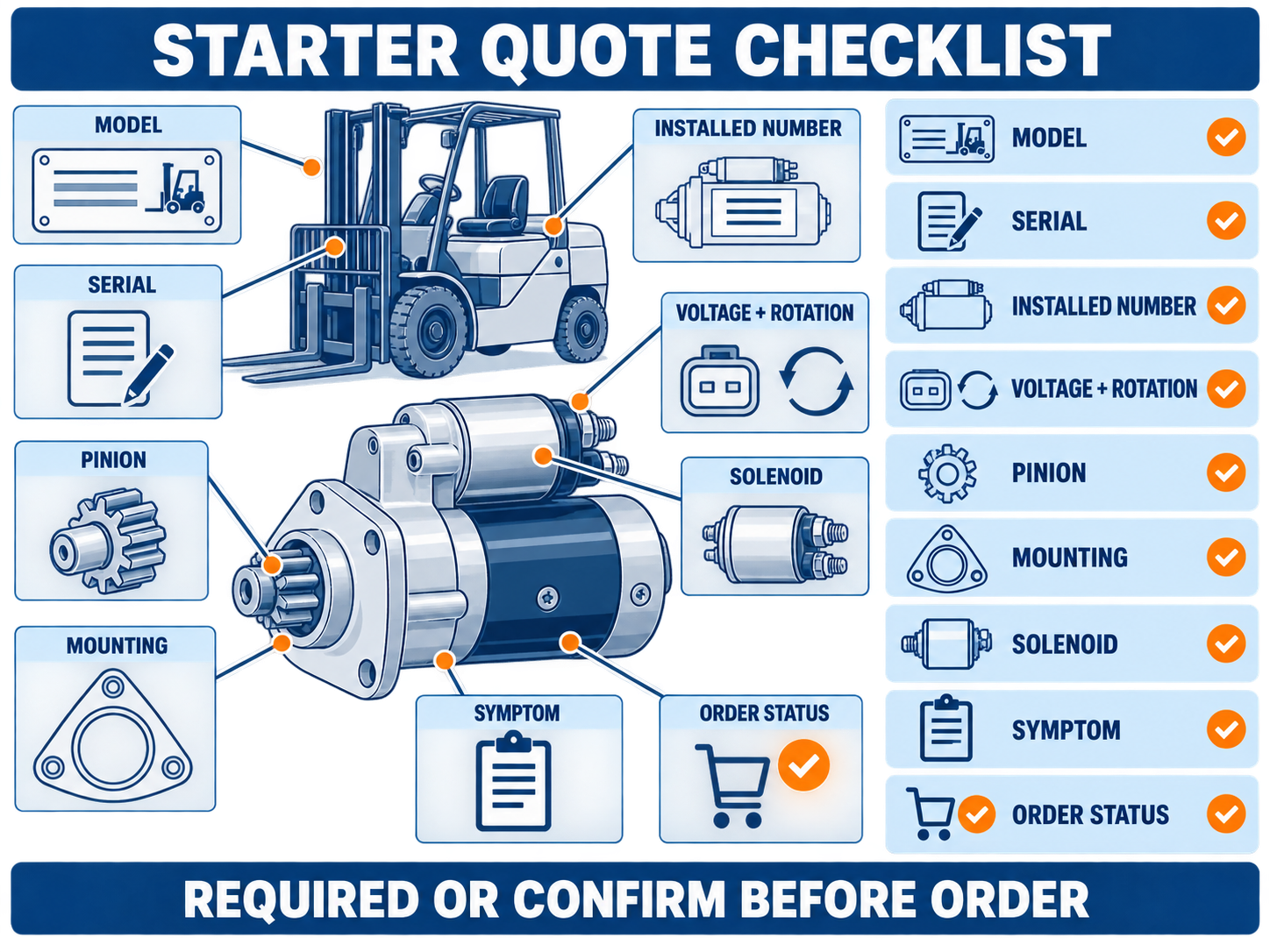
| Fitment field | Why it matters | Who supplies it | Useful evidence | Order status |
|---|---|---|---|---|
| Model number | Identifies the truck family and configuration path | Buyer | Clear data-plate photo and transcription | Required |
| Serial number | Narrows the exact truck and production configuration | Buyer | Data-plate photo or verified frame marking | Required |
| Installed starter number | Connects the replacement request to the unit being removed | Buyer and supplier | Label, casting, or OEM number photo | Confirm before order |
| Voltage and rotation | Prevents an electrical or operating mismatch | Supplier or manual | Exact-unit label, manual, or fitment review | Confirm before order |
| Drive type and pinion details | Determines engagement with the engine’s ring gear | Supplier or technician | Pinion close-up, tooth count, diameter, and drive description | Confirm before order |
| Mounting pattern and orientation | Prevents a housing that cannot seat correctly | Buyer and supplier | Flange photo, bolt-hole pattern, offsets, and nose details | Confirm before order |
| Solenoid and connector | Distinguishes a complete assembly from a motor-only or separate switch request | Buyer and supplier | Connector, terminal, and inclusion photos | Confirm before order |
| Symptom and test context | Helps avoid replacing the wrong part | Buyer and qualified technician | No-crank, click, grind, slow-crank, or free-spin record | Diagnose separately |
The difference between "required" and "confirm before order" is intentional. The truck identity must be present at the beginning. Component fields can be confirmed during the quote, but they should not be silently assumed.
Read the table from left to right. First ask whether the field identifies the application. Then ask who owns the evidence and whether the evidence is visible in the request. Finally ask whether the supplier has returned a confirmation that can be saved with the purchase record. This sequence keeps a persuasive listing from skipping the fields that actually control fitment.
If a listing gives only a Toyota model family and a product photo, treat the row as incomplete. If a supplier can connect the model, serial, installed-unit evidence, and proposed replacement details, the quote has a traceable basis.
The same logic applies when a replacement is described as new, remanufactured, aftermarket, or OEM-compatible. Those labels describe the offer category or seller positioning. The OEM vs aftermarket forklift parts guide explains the procurement distinction, but it does not remove the need to verify the truck, the installed unit, and the exact component interface.
Buyer-to-supplier handoff: Send the rows marked required first, attach the photos, and ask the supplier to return the unresolved fields in writing. This creates a record of what was checked and what remains conditional.
Toyota Material Handling’s model and serial guidance supports treating the first 2 rows, model number and serial number, as the application identity. The comparison table then adds 7 more fitment fields, including installed starter number, electrical, drive, mounting, solenoid, and symptom context. That separation makes quote gaps visible before purchase.
How to verify the replacement before you buy
Use this final sequence after the supplier proposes a Toyota forklift starter motor:
- Match the truck: Confirm that the quote names the complete Toyota model and serial number you supplied.
- Match the component: Compare the proposed part or cross-reference with the installed starter label, casting, connector, flange, and pinion photos.
- Confirm the exact fields: Ask the supplier to state the voltage, rotation, drive type, pinion details, mounting pattern, and solenoid inclusion for the proposed unit.
- Separate diagnosis from fitment: If the failure has not been confirmed, ask whether the quote is for a complete starter, motor section, solenoid, or a diagnostic review.
- Record the unknowns: Do not approve the order while a field that changes compatibility is still an assumption.
Keep the final response simple enough to audit later. Save the quoted part number, the supplier’s fitment wording, the photos used for the match, and the fields that were confirmed or left conditional. If the truck is serviced by more than one person, this record prevents the next buyer from restarting the same identification work from memory.
The final supplier message can be short:
Please confirm the starter option for Toyota [model] serial [serial]. Attached are the data plate, installed-starter label, pinion, mounting flange, solenoid, and connector photos. Please state the proposed part number or cross-reference, voltage, rotation, drive type, pinion details, mounting match, and whether the solenoid is included. Please identify any field that still requires fitment review.
This process does not promise that a public listing contains enough information. It tells the buyer exactly what to request when the listing is incomplete.
If the proposed part is supplied as a cross-reference, ask whether the reference covers the complete assembly or only one internal component. Also confirm whether the supplier needs the old unit returned, whether a core or exchange condition applies, and which unanswered field would change the quoted option. The forklift parts sourcing guide gives a broader buyer-side framework. These are quote-stage questions, not universal market rules.
Pre-order check: Approve the order only when the truck identity, installed-unit evidence, and proposed replacement fields tell the same story. If they do not, return to fitment review before purchase.
What not to infer from a Toyota forklift starter listing
Treat these statements as incomplete until they are tied to the actual truck and installed unit:
-
"Fits Toyota forklifts." This may cover several model families, engines, years, or starter designs. Ask which model and serial range was used for the fitment statement.
-
"Direct replacement." The label does not replace confirmation of voltage, rotation, drive, pinion, mounting, wiring, and solenoid inclusion.
-
"Same shape." A similar housing can still have a different flange, gear, connector, or nose arrangement.
-
"Starter included." Confirm whether the offer is a complete assembly, motor section, solenoid, or another repair component.
-
"OEM equivalent." Ask which exact part number or tested cross-reference supports that wording. Do not treat marketing language as Toyota authorization.
-
"One part for every series." Treat that wording as a prompt to ask for the exact model, serial scope, engine or power configuration, and component evidence. A broad compatibility statement may be useful for discovery, but it is not the final approval step.
The safer question is not "Does this look like my starter?" It is "Which evidence connects this proposed unit to my model, serial, installed component, and starting system?"
If the answer is only a broad model list or a stock image, keep the fitment status open.
The practical test is whether another qualified person could review the same record and understand why the proposed unit was selected. If the answer depends on an unexplained assumption, ask for the missing evidence instead of stretching the listing beyond what it actually says.
When to delay the Toyota forklift starter order
Delay the order and request a fitment review when any of these conditions apply:
- The complete model or serial number is missing.
- The installed starter number, connector, pinion, or mounting evidence is unreadable.
- The proposed unit’s voltage, rotation, drive type, or pinion details are not confirmed.
- The symptom points to a possible solenoid, cable, battery, relay, or ring-gear issue, but no qualified diagnosis has separated those possibilities.
- The supplier cannot explain whether the quote includes the motor, complete starter, or solenoid.
The correct next step is to send the missing photo, measurement, or identification detail. A short delay protects the buyer from a wrong-part order and gives the supplier a traceable basis for the quote. Use the forklift preventive maintenance checklist separately for planned service intervals; it does not replace starter fitment evidence.
Do not let urgency turn an unresolved fitment field into a guess. If downtime is critical, tell the supplier which evidence is available now and which field needs confirmation, so the response can focus on the actual blocker.
Stop condition: If a field can change compatibility and remains unknown, the Toyota forklift starter motor is not ready to order.
Conclusion
(See verdict in main body sections.)
References
- Toyota Material Handling. (n.d.). Finding your model and serial number. Retrieved September 18, 2026, from https://www.toyotaforklift.com/help/mytoyota-store/articles/22978549001627-finding-your-model-and-serial-number
- Toyota Material Handling. (n.d.). Toyota forklift parts store. Retrieved September 18, 2026, from https://shop.toyotaforklift.com/en
- Electronic Code of Federal Regulations. (2026). 29 C.F.R. § 1910.178, powered industrial trucks. https://www.ecfr.gov/current/title-29/section-1910.178
Last reviewed and updated: September 2026. Author: Kingstream team. For tailored guidance, contact our team.