
TL;DR
Start with the symptom and the cooling-system checks, then match the radiator or related part by forklift model, engine, dimensions, mounting points and hose connections before ordering.
Abstract
This guide connects forklift overheating symptoms to the cooling component that should be checked first, then shows the model, dimensions, connections and engine details a buyer should verify before requesting a replacement radiator quote.
Key Takeaways
- Overheating can come from airflow, coolant circulation, pressure control or a leak, so replacing the radiator first can miss the real fault.
- A replacement radiator match needs the forklift make and model, engine model, old-part dimensions, mounting points, hose locations and any readable part number.
- The cooling system includes the radiator, water pump, fan, thermostat, cap, hoses and coolant, and each component leaves different diagnostic clues.
- A quote request becomes easier to verify when the buyer sends the model plate, engine details, photos and measurements together.
- Use a safe cool-down and pressure-release procedure before opening or testing a hot cooling system.
Table of Contents
- Abstract
- Key Takeaways
- What Is a Forklift Cooling System?
- How a Forklift Radiator Works
- Common Forklift Overheating Symptoms and Causes
- How to Test the Cooling System Before Replacing Parts
- Forklift Radiator Replacement Fitment Checklist
- Radiator, Water Pump, Fan and Other Cooling Parts Compared
- Forklift Cooling System Maintenance
- Frequently Asked Questions
- Conclusion
- References
What Is a Forklift Cooling System?
The radiator’s job
A forklift cooling system removes excess heat from the engine so combustion, lubrication and clearances remain within their operating range. The radiator is the heat exchanger at the center of that process. Hot coolant leaves the engine, passes through narrow radiator tubes, gives heat to the surrounding air through the fins, and returns cooler to the engine. A forklift radiator therefore works as part of a circuit, not as an isolated panel. (Schiavon Ieno et al., 2021)
The practical buying lesson is simple: an overheating complaint does not automatically prove that the radiator needs replacement. Restricted fins can reduce airflow, while a weak water pump, stuck thermostat, damaged cap, low coolant or leaking hose can produce a similar temperature symptom. Diagnose the system first, then select the part that the evidence supports. Once the fault is identified, the forklift engine cooling parts category groups the related product families.
The parts that work together
The main loop includes the radiator, water pump, thermostat, fan or fan blade, radiator cap, hoses and coolant. The engine creates heat; the pump circulates coolant; the thermostat manages warm-up and flow; the fan moves air through the fins; and the cap controls system pressure. Hoses carry coolant between these components. For the broader system context, see the forklift engine fitment guide. (Durgun et al., 2015)
Quick answer: Start with the symptom and the cooling-system checks. Match a replacement radiator only after confirming the forklift model, engine, dimensions, mounting points and hose connections.
Glossary
-
Core: The tube-and-fin section where coolant transfers heat to air.
-
Pressure cap: A cap that seals the filler neck and controls cooling-system pressure at its rated value.
-
Fitment: The combination of application, dimensions, mounting points, ports and connections that makes a part suitable for a specific truck.
-
Forklift radiator: A heat exchanger that removes heat from engine coolant by transferring it to air through tubes and fins. It depends on coolant circulation and airflow, so a radiator symptom must be interpreted with the rest of the cooling system.
-
Water pump: The cooling-system component that circulates coolant between the engine and radiator. A pump problem can reduce heat transfer or cause leakage, which may look like a radiator fault until circulation and seal condition are tested. (Durgun et al., 2015)
-
Thermostat: A temperature-controlled valve that manages coolant flow during warm-up and operation. Its service behavior helps distinguish a circulation or temperature-control fault from a damaged radiator. (Durgun et al., 2015)
-
Cooling fan: The airflow component that moves air across radiator fins, often through a shroud. Cracks, wobble, drive faults or obstruction can reduce heat rejection even when the radiator core is intact.
-
Radiator hose: A flexible connection that carries coolant between the engine, radiator and other cooling components. Leaks, collapse, kinks or incorrect routing can restrict circulation and create symptoms that resemble radiator failure.
How a Forklift Radiator Works
Coolant-to-air heat transfer
The engine transfers combustion heat into coolant passages around the cylinders and head. The water pump moves that heated coolant to the radiator. Inside the radiator, the fluid travels through small tubes while fins spread the heat over a larger surface. Air pulled or pushed by the cooling fan passes across those fins, and the cooled fluid returns to the engine. That is the basic path behind a working forklift radiator. (Schiavon Ieno et al., 2021)
The radiator cannot reject heat effectively if the tubes are restricted internally or the fins are packed with dust. It also cannot compensate for a coolant level that is too low to maintain circulation. A clean-looking outside surface is useful evidence, but it is not a complete test.
A common mistake is to treat a clean fin surface as proof that a forklift radiator is healthy. Internal tube restriction, low coolant or weak circulation can still limit heat rejection, so an external visual check is evidence for the next test, not a complete diagnosis. (Schiavon Ieno et al., 2021)
Why airflow and circulation both matter
Airflow and circulation must work together. A damaged fan blade, loose shroud or blocked fin pack can reduce the air side of heat transfer. A worn water pump, stuck thermostat, collapsed hose or trapped air can reduce the coolant side. A faulty pressure cap can allow coolant to boil or escape at the wrong pressure. See the forklift electrical system guide when a fan drive issue may involve the truck’s electrical controls. (Durgun et al., 2015)
Warning: Let the engine cool before opening the cap. A pressurized cooling system can release hot coolant and steam. Follow the truck manufacturer’s service procedure and use appropriate protective equipment. (Occupational Safety and Health Administration, n.d.)
What the process shows: If temperature rises only under load, check airflow, fin condition and coolant circulation before ordering a forklift radiator. If coolant escapes or the system cannot hold its rated pressure, inspect the cap, hoses and radiator for the leak path.
Common Forklift Overheating Symptoms and Causes
Overheating is a symptom, not a parts diagnosis. Record when the temperature rises, whether coolant is visible, whether the fan is turning, and whether the truck loses power or produces steam. Those details narrow the first inspection and reduce the chance of replacing a forklift radiator when another component is responsible. The preventive maintenance checklist helps turn those observations into a repeatable fleet routine. (Durgun et al., 2015)
| Symptom | Likely cause | First check |
|---|---|---|
| Temperature rises during loaded work | Blocked fins, weak airflow, low coolant or restricted circulation | Check coolant level, fin pack, fan and hose condition |
| Temperature rises soon after start | Low coolant, thermostat problem or trapped air | Inspect level and leaks, then follow the service test for thermostat and air removal |
| Coolant under the truck | Hose, clamp, radiator tank, drain point or water-pump seal leak | Let the system cool and trace the highest wet point |
| Steam or strong coolant smell | Loss of coolant or pressure, hot surface contact or boil-over | Shut down safely, keep clear of steam and inspect after cool-down |
| Fan turns slowly or wobbles | Damaged fan blade, drive issue or shroud interference | Check blade condition, clearance and drive operation |
| No visible leak but repeated low level | Small leak, cap fault or unresolved circulation problem | Pressure-test the system with the correct equipment |
A short triage checklist
- Record the pattern: Note whether the fault appears at idle, during travel, under load or after shutdown.
- Check the level cold: Compare the level with the manufacturer’s procedure; do not open a hot cap.
- Inspect the airflow path: Look for dust, chaff, oil film, bent fins, loose shrouds and fan damage.
- Trace the leak: Check tanks, hose joints, clamps, cap area and pump seal after the system cools.
- Separate symptoms: A temperature rise with normal airflow points toward circulation or pressure checks, not automatically to a new radiator.
Warning: Do not continue operating a truck that is steaming, losing coolant rapidly or showing a dangerous temperature. A short shutdown can prevent an overheating event from becoming engine damage. (Occupational Safety and Health Administration, n.d.)
The first check should produce a testable next step. If the fin pack is blocked, cleaning may be appropriate. If the radiator is leaking from a damaged tank or core, collect fitment information before requesting a replacement. If the fan, pump, thermostat or cap fails its test, quote that product family instead. Confirm the application against the available forklift radiators before treating a listing as a direct fit.
Where we can help
For fleet maintenance managers sourcing forklift parts across major brands, Kingstream is a single-source forklift parts supplier covering 14 major brands, with OEM-compatible forklift parts backed by fast quotation. Request a fast quotation.
How to Test the Cooling System Before Replacing Parts
Use an ordered inspection rather than replacing the most visible component first. The sequence below is designed to separate a radiator fault from an airflow, circulation, pressure or hose fault. Use the truck’s service manual for test limits and disconnect procedures because temperature, pressure and belt arrangements vary by model.
Start with a safe visual inspection
- Step 1: Identify the truck. Record make, model, serial or model-plate information, engine identification and operating symptoms.
- Step 2: Cool the system. Park safely, shut the engine down and wait until the system is cool before removing a cap or touching a hose.
- Step 3: Check the cold level and condition. Look for low level, contamination, oil traces, rust-colored fluid or evidence of repeated top-ups.
- Step 4: Inspect the radiator face. Check for packed dust, bent fins, blocked passages, damaged tanks and wet areas. Do not straighten fins aggressively or use a cleaning method that damages the core.
Check airflow, circulation and pressure
- Step 5: Check the fan path. Inspect the fan blade, shroud, drive, clearance and rotation. A fan that is cracked, loose or obstructed cannot move the designed air volume.
- Step 6: Check circulation and leaks. Inspect hoses for collapse, kinks and soft sections. Test the thermostat, water pump and cap with the approved procedure and equipment. (Durgun et al., 2015)
- Step 7: Compare the evidence. A blocked or damaged core supports a radiator repair or replacement request. A failed pump, thermostat, cap or hose supports a different part request.
Important: A replacement forklift radiator is justified by evidence such as a damaged core or tank, a confirmed leak that is not repairable, or restricted internal flow after related components have been checked. Do not treat a visual resemblance or one high-temperature reading as fitment proof. (Kurland, 1971)
When testing, record the observed condition, the tool used and the result. This gives a supplier useful context and makes it easier to compare an old part with a proposed replacement. If the engine has overheated severely, stop and involve a qualified technician before continuing operation.
Forklift Radiator Replacement Fitment Checklist
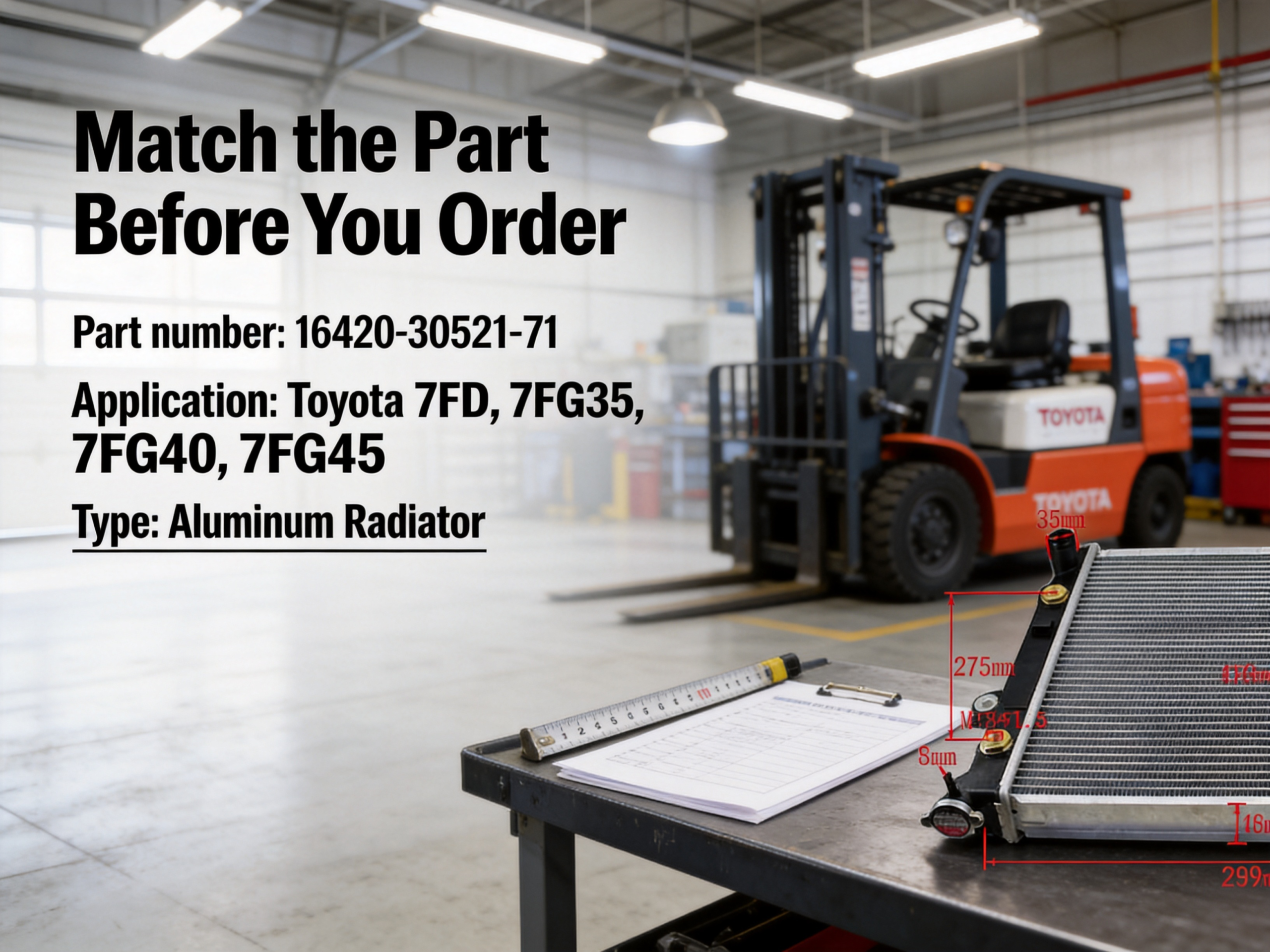
The safest forklift radiator replacement request contains identity, measurements and photographs together. A radiator that looks similar can still have the wrong core size, tank arrangement, inlet and outlet position, bracket spacing or engine application. Use the old part and the truck as references, not a generic catalog image alone. (Kurland, 1971)
Record the forklift and engine identity
- Truck: Make, model, serial number and approximate capacity.
- Engine: Engine brand, model and fuel type, plus any readable engine plate information.
- Old part: Part number, casting or label marks, and every product photo from front, rear, side and connection views.
- Operating context: Reason for replacement, such as leaking tank, damaged core, corrosion or repeated overheating.
Measure the old radiator
Measure the core height, core width and overall thickness. Record whether each measurement is taken from the core or from the complete assembly. Measure filler-neck position, tank height, hose neck diameter and the distance between mounting points. Photograph the tape measure in place so a supplier can see the reference edges.
| Fitment item | What to record | Why it matters |
|---|---|---|
| Core and assembly size | Height, width and thickness with measurement reference | Determines available space and heat-transfer area |
| Mounting points | Bracket type, hole count, hole spacing and offset | Prevents a visually similar part from failing installation |
| Connections | Inlet, outlet, drain and filler-neck location and diameter | Confirms hose routing and connection compatibility |
| Application | Forklift model, serial range and engine model | Separates parts that share a general appearance |
| Identification | Old part number, label, photos and supplier reference | Helps cross-check catalog records before quoting |
Confirm mounting and hose connections
Before ordering, compare the proposed drawing or product photos with the old radiator. Ask the supplier to confirm the application and any model-year or serial-range limitation. If dimensions, ports or brackets are not published, send the missing measurements instead of assuming a direct fit. A brand cross-reference guide can help organize a readable manufacturer or part-number match before the request is sent.
By the Numbers
- 6 checks: identity, engine, dimensions, mounts, connections and old-part markings.
- 4 views: front, rear, side and connection photos make a quote easier to verify.
- 1 package: combine the model plate, engine details, measurements and reason for replacement in one request.
Radiator, Water Pump, Fan and Other Cooling Parts Compared
The cooling category contains several different product families. Matching the symptom to the correct family helps prevent a broad “cooling part” request from producing the wrong quote. Use the table as a first sorting tool, then confirm the model and application before ordering. (Kurland, 1971)
| Product family | Main job | Evidence that points here | Information to send |
|---|---|---|---|
| Radiator | Transfers coolant heat to air | Damaged core, tank leak, blocked internal flow or non-repairable corrosion | Model, engine, dimensions, mounts, ports and old-part photos |
| Radiator cover | Protects or directs the radiator area | Cracked, missing or poorly fitting cover, or damaged mounting features | Truck model, cover photos and mounting measurements |
| Water pump | Circulates coolant through the engine and radiator | Circulation problem, pump noise, shaft play or seal leakage | Engine model, pump photos and any readable part number |
| Thermostat | Controls coolant flow during warm-up and operation | Incorrect warm-up behavior or a thermostat that fails its service test | Engine model and service-test result |
| Fan blade | Moves air through the radiator | Cracks, wobble, damage, incorrect rotation or weak airflow | Blade diameter, mounting pattern and engine or drive details |
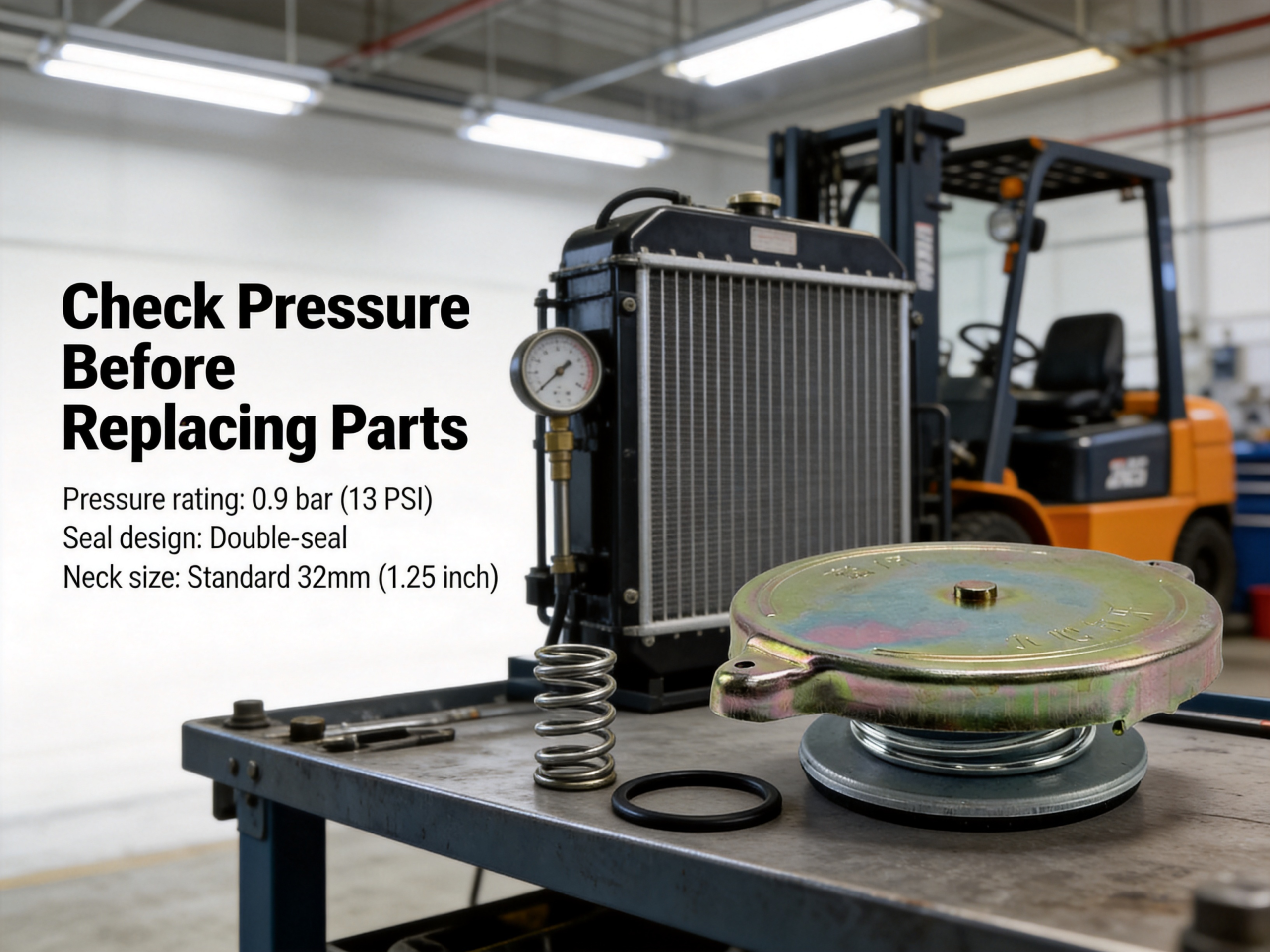
| Radiator cap | Seals and controls system pressure | Wrong pressure behavior, damaged seal or failed pressure test | Cap rating, neck size, photos and truck application |
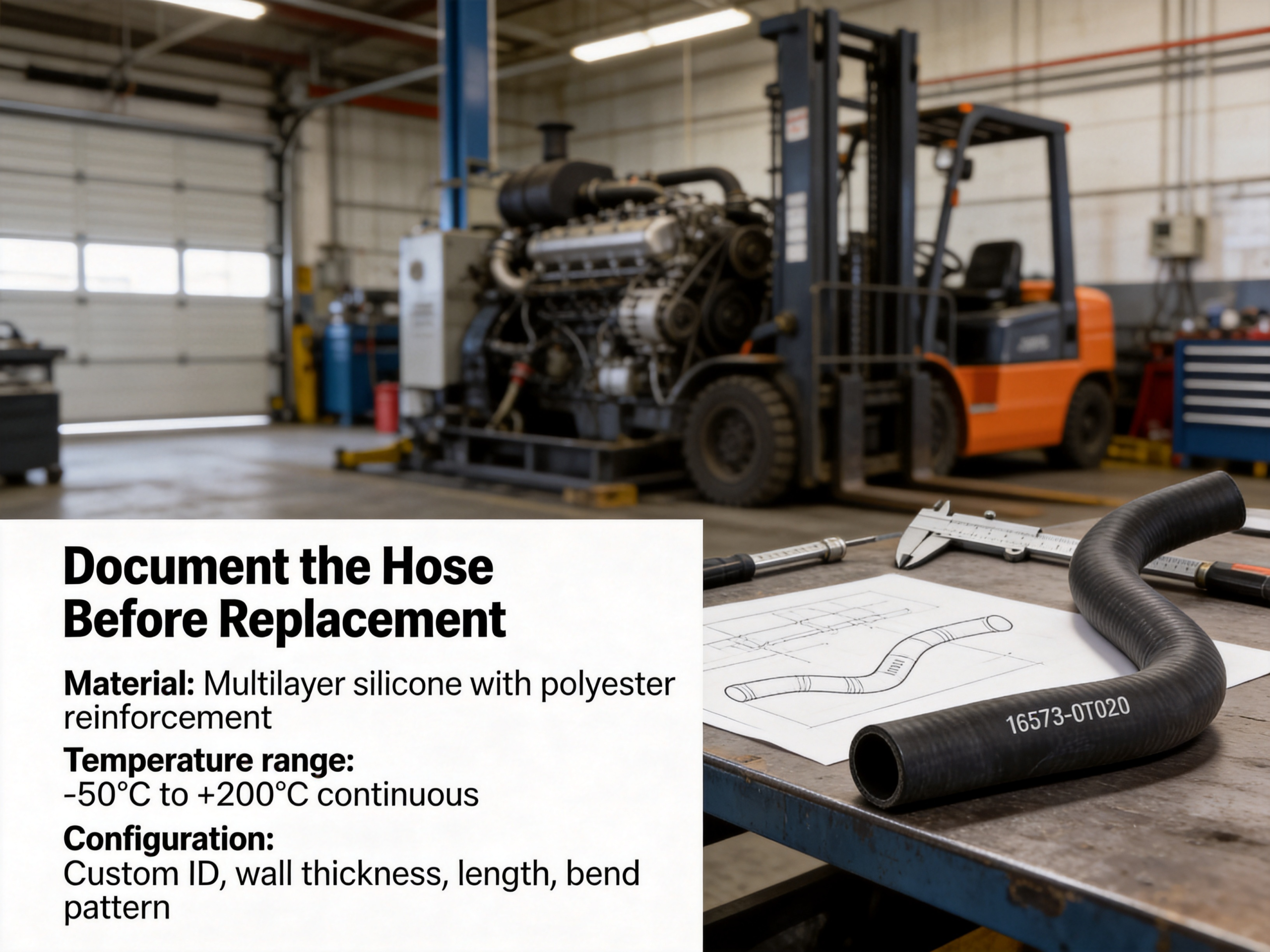
| Radiator hose | Carries coolant between components | Leak, soft section, collapse, kink or incorrect routing | Inside diameter, length, bend pattern, material and photos |
Choose the category from the evidence
Radiator means the heat-exchange assembly is the subject of the quote. Water pump means circulation is the suspected fault. Fan blade and radiator cover belong to the airflow and protection side. Radiator cap belongs to pressure control, while radiator hose belongs to the flexible connection path. These terms are related, but they are not interchangeable. For a confirmed circulation issue, review the forklift water pumps category rather than sending a radiator-only request.
Glossary
-
Direct replacement: A part presented as matching the required application and installation points. Confirm the supplier’s fitment evidence before treating it as plug-and-play.
-
Cross-reference: A comparison between a readable old-part number and another catalog or manufacturer number. It is a lead for verification, not proof by itself.
Forklift Cooling System Maintenance
Routine inspection finds cooling faults before a truck reaches a severe overheating condition. Build the checks into the existing service routine and record defects with photos. The best interval follows the forklift and engine manufacturer’s maintenance schedule, adjusted for dust, load, ambient temperature and operating hours.
Forklift cooling maintenance covers 4 recurring checks: coolant level, airflow through the fin pack, coolant circulation and leak evidence. Record the condition when the truck is cool, then compare findings with the manufacturer’s service interval and operating context. This sequence helps separate a repeat root cause from a radiator that actually needs replacement.
Daily and scheduled checks
- Before operation: Look for coolant beneath the truck, damaged hoses, loose clamps, a blocked radiator face and an abnormal fan condition.
- When cool: Confirm the coolant level and inspect the cap seal, filler neck and visible tank areas according to the service procedure.
- During scheduled service: Clean the air side with a method approved for the core, inspect the shroud and check pump, thermostat and hose condition.
- After a fault: Record the symptom, repair, replaced part and fitment evidence so a repeat failure can be traced.
Dust, debris and working conditions
Warehouses, yards and recycling environments can load radiator fins with dust or fibers. A clean-looking engine bay can still have restricted passages between the fins. Do not bend the core or force debris deeper into it. If the system repeatedly overheats after cleaning, return to the ordered checks for circulation, pressure and leaks instead of repeating the same cleaning step.
When replacement is more practical than repair
Replacement is more practical when the core or tank is damaged beyond a reliable repair, the part cannot hold the required pressure, or corrosion and restriction continue after service. Before requesting a forklift radiator replacement, preserve the old part’s measurements, photos, markings and truck identity. That record reduces the chance of repeating the original fitment problem. The OEM versus aftermarket buying guide provides a useful comparison framework for the final quote review.
By the Numbers
- 4 areas: level, airflow, circulation and leaks belong in every repeat inspection.
- 1 record: keep the symptom and repair history with the truck or fleet file.
Frequently Asked Questions
What is a radiator in a forklift?
A forklift radiator is the heat exchanger that removes heat from engine coolant and transfers it to air moving through the fins. It works with the water pump, thermostat, fan, cap, hoses and coolant, so an overheating symptom should be tested across the complete cooling system. (Schiavon Ieno et al., 2021)
How do I know if my radiator is bad?
Look for a confirmed leak, damaged tanks or core, blocked passages, repeated coolant loss, or restricted flow after related components have been checked. A high temperature by itself does not identify the radiator as the failed part. Let the system cool and follow the truck’s approved inspection and pressure-testing procedure.
What kind of coolant does a forklift use?
Use the coolant type, concentration and service interval specified for the forklift and engine. Do not choose by color alone, mix incompatible products or open a hot pressure cap. If the specification is missing, identify the truck and engine first, then confirm the required coolant with the manufacturer or qualified service source. (Occupational Safety and Health Administration, n.d.)
Where is the radiator on a forklift?
On an internal-combustion forklift, it is normally in the engine-cooling airflow path behind or beside the engine compartment, with a fan and shroud directing air through it. Exact access and orientation vary by truck, so use the model service information rather than reaching into a running machine.
Can a bad water pump make a forklift overheat?
Yes. A water pump that cannot circulate coolant properly can cause overheating even when the radiator fins look clean. Check for pump leakage, abnormal noise, shaft or drive problems and the service-test result before ordering a radiator. (Durgun et al., 2015)
What measurements should I send when asking for a forklift radiator quote?
Send the forklift make, model and serial information; engine model and fuel type; old-part number; core and overall dimensions; mounting-hole spacing; hose and filler-neck locations and diameters; and clear photos from multiple sides. Explain the failure symptom and include any model-specific fitment concern. That package lets a supplier compare the replacement against the actual truck. The forklift parts sourcing guide covers the same information handoff from a buyer’s perspective.
Quick reference
Cooling-system fault: Diagnose level, airflow, circulation, pressure and leaks before choosing a part.
Replacement radiator request: Include identity, measurements, connections, markings and photos.
Safe next step: Stop a steaming or rapidly losing-coolant truck and wait for a qualified inspection.
Conclusion
(See verdict in main body sections.)
References
- Schiavon Ieno, J. P., Novazzi, L., & Albuquerque Neto, C. (2021). Thermal-hydraulic study for an engine cooling radiator. EVR 2021. https://doi.org/10.26678/abcm.evr2021.evr21-0031
- Durgun, İ., Odabaşıoğlu, A., & Ayartürk, H. (2015). Engine cooling system without radiator. Anais do XXIII Simpósio Internacional de Engenharia Automotiva, 144-152. https://doi.org/10.5151/engpro-simea2015-pap142
- Kurland, C. N. (1971). Computer program for engine cooling radiator selection (SAE Technical Paper No. 710209). SAE International. https://doi.org/10.4271/710209
- Occupational Safety and Health Administration. (n.d.). Sample daily checklists for powered industrial trucks. U.S. Department of Labor. https://www.osha.gov/training/library/powered-industrial-trucks/checklist-0
Last reviewed and updated: September 2026. Author: Kingstream team. For tailored guidance, contact our team.