
TL;DR
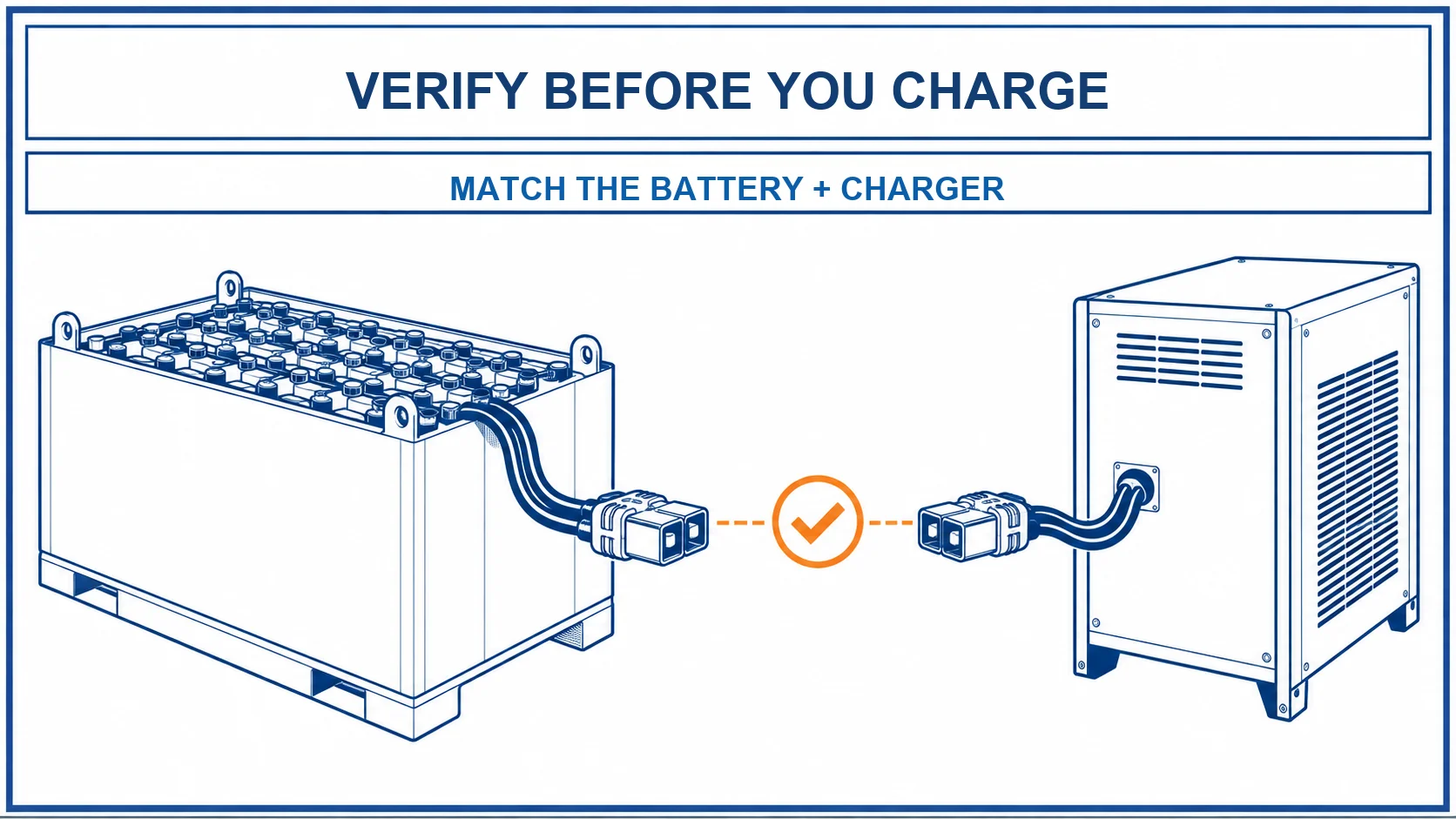
Before charging a Toyota forklift, identify the installed battery and verify that the charger is approved for that exact battery. Prepare the designated charging area using the applicable OSHA safeguards, then follow the battery and charger instructions for the actual chemistry and model. Toyota describes multiple charging methods, but no single voltage, charge time, or procedure applies to every Toyota forklift. Stop and verify if labels conflict, equipment is damaged, or the correct documentation is unavailable.
Table of Contents
- Before connecting: identify the battery and matched charger
- Prepare the designated charging area
- Follow the charging instructions for the installed battery
- Understand Toyota’s charging-method tradeoffs
- Stop and verify when something does not match
- Toyota forklift battery charging FAQs
- The practical rule: verify first, then charge
- References
Before connecting: identify the battery and matched charger
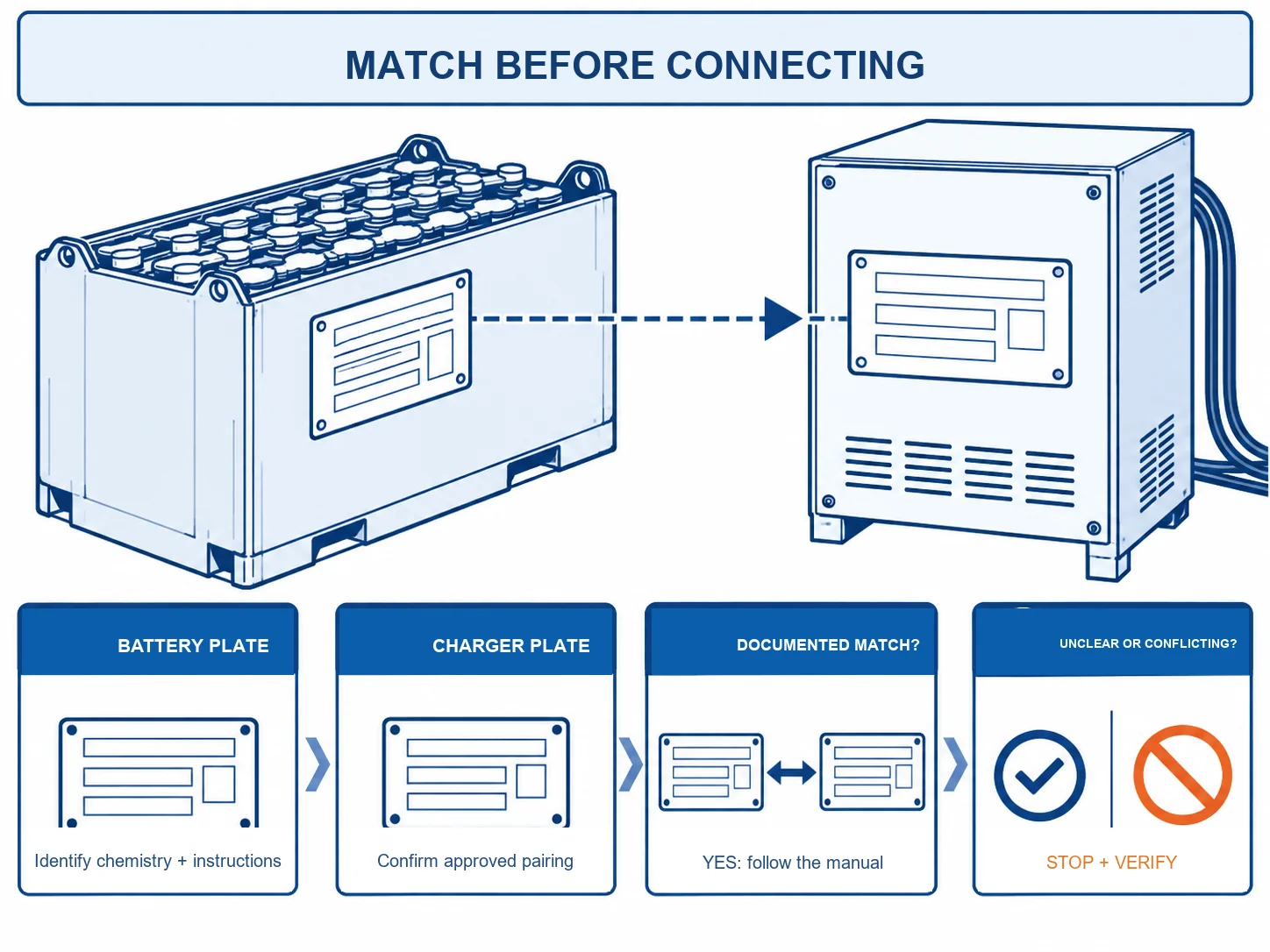
There is no single charging recipe for every Toyota forklift. Checks 1 through 3 start at the battery data plate and end by resolving missing or conflicting instructions; the charger check in between confirms the approved pairing. Toyota describes compatible chargers for its lithium-ion batteries, so a truck badge or a plug that fits does not establish compatibility.
1. Read the battery data plate
Start at the battery, not with the forklift model name. Record its maker and chemistry. Note the model or part identifier, then copy any charging instructions shown on the plate. A fleet may operate several Toyota truck families, and a previous owner may have changed a battery. The truck’s brand therefore does not identify the battery chemistry by itself.
If the plate is inside a compartment, use the operator instructions for opening it. Do not reach across exposed terminals or move a heavy battery to find a label. Battery removal is a separate maintenance task that requires the correct equipment and trained personnel.
2. Match the charger’s identity and rating
Read the charger data plate and the battery maker’s instructions together. Confirm that the charger is approved for the battery chemistry and the specific battery system. Check the model identifiers, connector, charge profile, and any communication or control requirements stated by the manufacturers. A physical plug match does not confirm the electrical or software compatibility of the pair.
Toyota describes its lithium-ion batteries with compatible Toyota chargers and battery-management communication. That is evidence for those Toyota battery systems, not a blanket statement that any Toyota charger works with every Toyota forklift battery.
3. Resolve missing or conflicting information before charging
Use the manuals for the installed system. If one is missing, contact the equipment manufacturer or an authorized service provider with the model and serial information from the relevant data plates. Do not choose a charger by appearance, rated connector alone, or another truck’s setup.
- Proceed when the battery is identified and its documentation confirms the charger and charging method.
- Pause when the chemistry, charger profile, or connector instructions are unclear.
- Stop when labels conflict, a cable or connector is damaged, or the equipment displays an unresolved fault.
Warning: Do not treat "it plugs in" as compatibility evidence. Confirm the battery and charger as a documented pair before applying power.
The compatibility check establishes which instructions apply to the installed battery. It does not determine whether a replacement battery or charger is needed.
Prepare the designated charging area
OSHA guidance for electric-truck battery charging identifies 4 facility safeguards: electrolyte-spill response, fire protection, charger protection from truck damage, and ventilation for fumes from gassing batteries. It also calls for the designated area and a positioned truck with its brake applied. Follow the battery manual and site procedure.
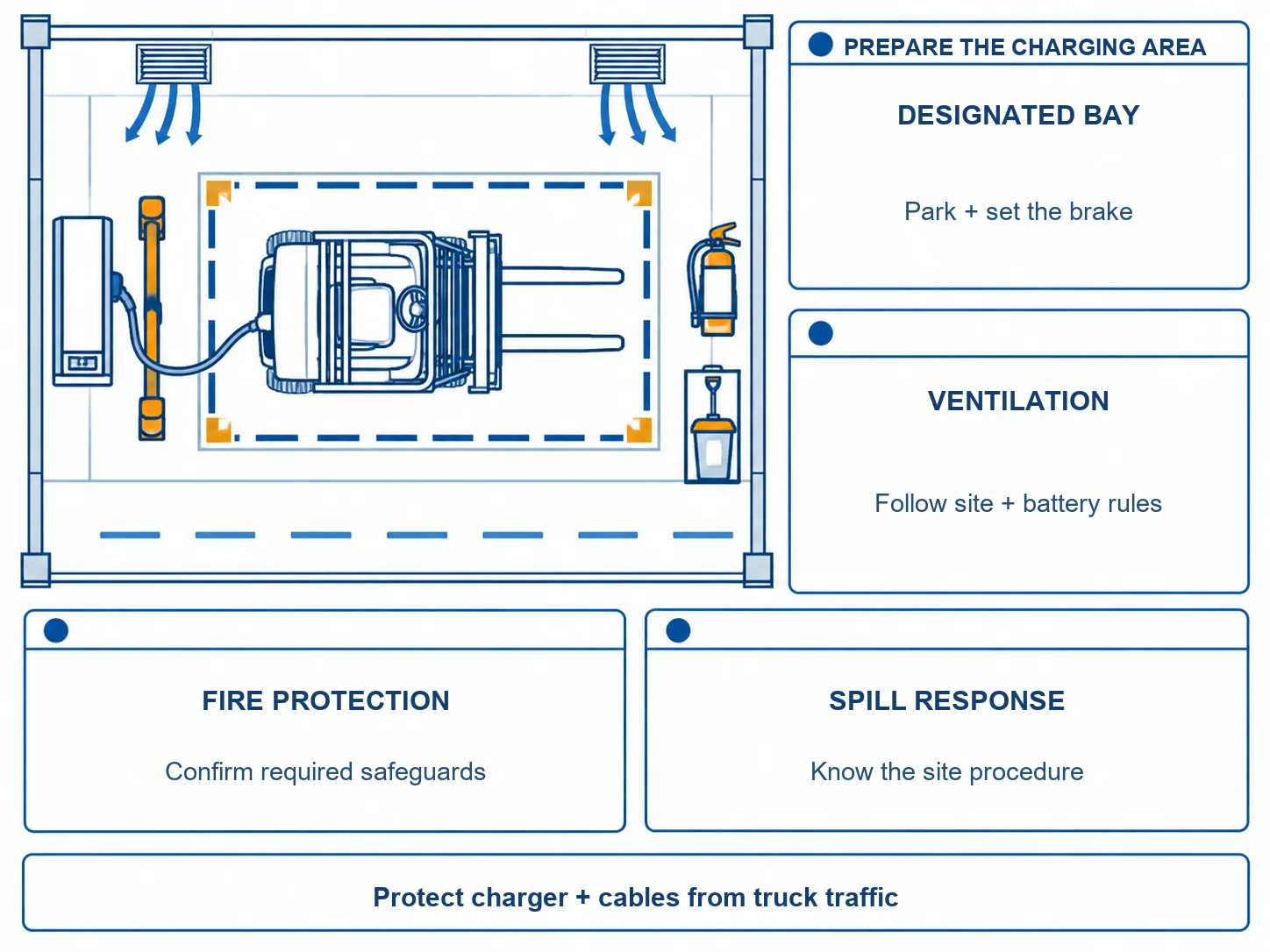
Before connecting the charger, check the work area rather than focusing only on the battery:
- Use the site’s designated charging location, with the truck positioned and its brake applied.
- Keep the charger and its cables where a moving truck cannot crush or strike them.
- Confirm the required ventilation and fire protection for the battery and facility.
- Know the site’s spill-response plan and keep ignition sources away from a lead-acid charging area.
OSHA’s eTool gives additional battery-charging guidance for electric trucks. It describes ventilation, fire protection, spill response, and protection of the charging apparatus. Its detailed gas and electrolyte precautions focus on lead-acid batteries, so do not assume each handling step applies identically to a sealed lithium-ion system. Use the lithium-ion manufacturer’s instructions for that battery.
Keep the truck and people in a safe position
OSHA guidance says to position the truck and apply the brake before battery charging or changing. Follow the facility’s authorization, training, and personal-protection requirements for the battery work being done. If the work involves opening a lead-acid battery, electrolyte, battery removal, or lifting equipment, use the facility’s approved procedure.
The charging location should support an orderly start and finish. Keep tools and loose metal away from an uncovered lead-acid battery. Do not leave a damaged cable across a travel path. Avoid improvising a charging station beside a production lane because the charger happens to be nearby.
Note: The legal standard identifies charging-area protections. Your site safety plan and battery manual determine the work steps, protective equipment, and emergency response for the battery being handled.
If a required safeguard is missing, stop and ask the site’s safety lead or qualified maintenance contact to resolve it before charging. A safe location is part of the charging procedure, not a facility detail to check afterward.
Follow the charging instructions for the installed battery
Lead-acid and lithium-ion batteries follow 2 distinct charging paths, so their procedures should not be blended. OSHA’s eTool describes lead-acid clamp and venting precautions, while Toyota specifies compatible chargers and battery-management communication for its lithium-ion systems. Confirm the installed battery and charger instructions before starting either procedure.
Lead-acid: use the charger maker’s connection procedure
For a lead-acid truck, begin with the site’s charging procedure and the charger manufacturer’s instructions. OSHA’s powered-industrial-truck eTool says to position the truck, apply the brake, use the designated area, and follow the recharger maker’s recommendations for attaching and removing cables. It also says to turn off the charger before connecting or disconnecting clamp connections. If the setup uses a plug connector rather than clamps, follow the truck and charger manuals for that connector.
The same OSHA guidance calls for functional vent caps and open battery or compartment covers during charging to dissipate heat, and says to keep smoking, open flames, sparks, electric arcs, and metal objects away from uncovered batteries. These instructions matter to lead-acid charging because gassing and electrolyte exposure can create hazards. Do not improvise a clamp order, polarity, or service step from a different truck. Use the manufacturer’s exact sequence.
Some lead-acid batteries require electrolyte checks, watering, equalization, or a full-charge and cooldown routine. Those are battery-maintenance instructions, not universal steps for every electric forklift. Have trained personnel follow the exact battery manual. Do not add water, open a sealed battery, or change the charger rate based on a generic web guide.
If the battery becomes unusually hot or electrolyte escapes from a vent, stop the charging attempt if it is safe to do so and follow the facility’s emergency procedure. Keep people clear and contact the trained maintenance lead. Do not restart charging at a different rate unless the equipment instructions and qualified personnel direct that action.
Lithium-ion: use the compatible charging system
Toyota’s lithium-ion material describes compatible chargers and a battery-management system that communicates with Toyota forklifts and chargers for specific product families. Confirm the exact installed battery and approved charger. Then follow the instructions for that system. Do not assume that the lead-acid routine, maintenance checks, connector sequence, or charging limits also apply to lithium-ion equipment.
Toyota notes that its lithium-ion batteries do not require the same kind of lead-acid cooldown and equalization routine described for certain fast- or opportunity-charging applications. That difference does not mean every lithium-ion battery can use any charger or charging method. Compatibility still belongs to the exact battery and charger documentation.
Use the manual for the truck in front of you
Model family, battery chemistry, charger design, and operating instructions can vary. If the documents give different steps, do not combine them into a compromise procedure. Pause, record the battery and charger identifiers, and ask the equipment provider or qualified service contact to resolve the discrepancy.
A smaller ask
If the charging checks leave a separate parts need, Kingstream provides single-source forklift parts sourcing across 14 major brands, with OEM-compatible parts backed by fast quotation; share a parts sourcing request.
Understand Toyota’s charging-method tradeoffs
Toyota compares 3 charging methods for different shift patterns. Conventional charging uses planned downtime, while the other two methods, fast and opportunity charging, use pauses during the operating day at different rates. The right choice depends on battery chemistry, charger compatibility, shift pattern, and the installed system’s instructions. A method label alone does not authorize a change.
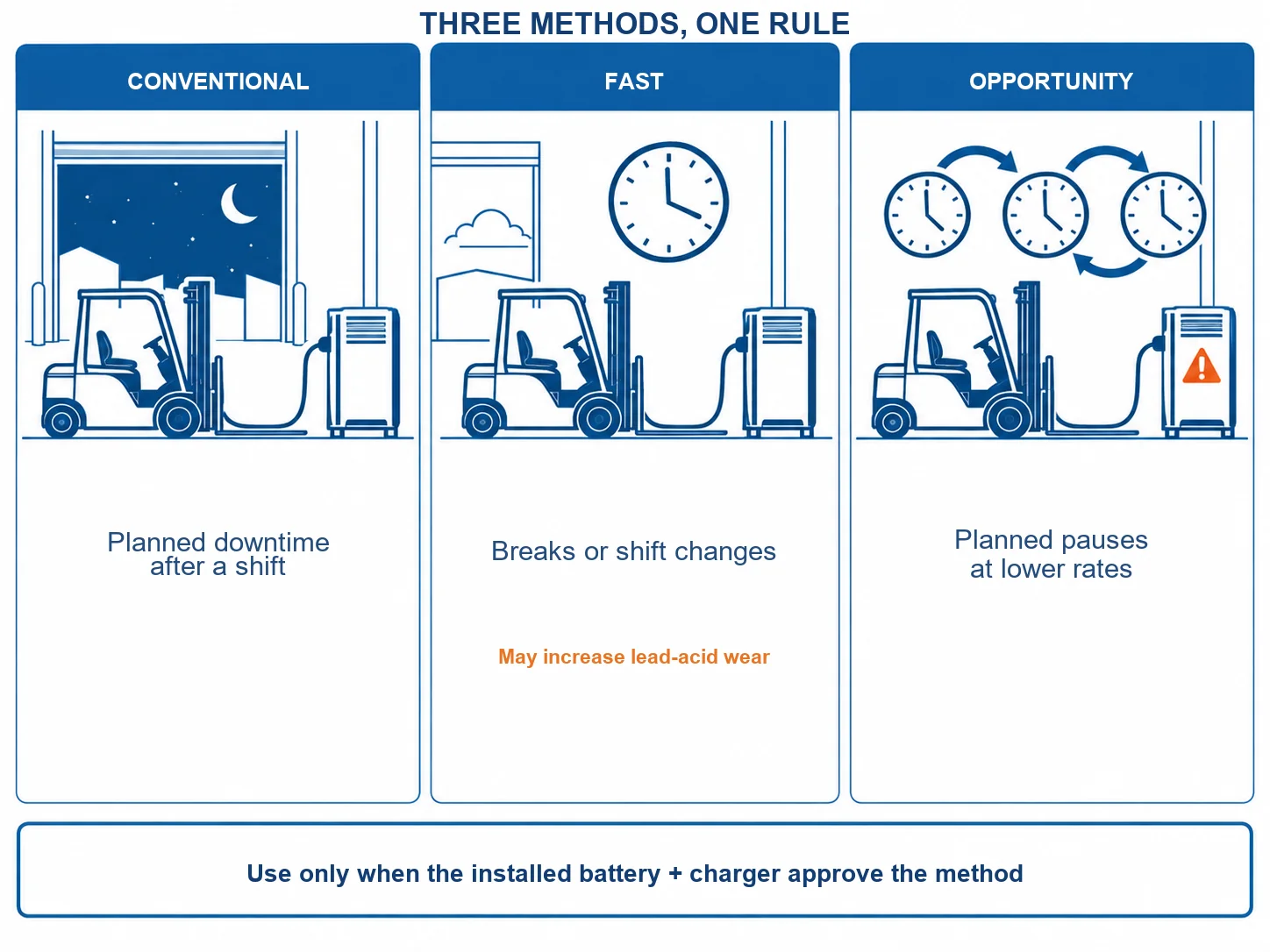
| Method | Typical operating pattern | Tradeoff Toyota identifies | What to verify |
|---|---|---|---|
| Conventional charging | Charge after a shift when the truck can remain out of service. | It can suit a one-shift operation with planned downtime. Multi-shift use may require additional batteries and handling or storage capacity. | Confirm the battery’s full-charge and return-to-service directions. |
| Fast charging | Add charge during breaks or between shifts using dedicated charging equipment. | It can reduce downtime. Toyota cautions that fast charging may increase wear on lead-acid batteries. | Confirm the installed battery system and its maintenance plan support fast charging. |
| Opportunity charging | Charge at lower rates during breaks or shift changes on a consistent schedule. | It can help reduce battery changes in some multi-shift operations, but requires compatible chargers and a consistent operating plan. | Verify charger compatibility, timing rules, and any lead-acid full-charge or cooldown requirements. |
These are not interchangeable labels for "plug it in whenever convenient." Toyota’s guidance notes that lead-acid batteries used in fast- or opportunity-charging applications may need periodic full charging. The battery instructions may also call for equalization and a cooldown to help maintain service life. The exact schedule depends on the battery and application. Do not copy a maintenance interval from a general article into a fleet procedure without checking the battery documentation.
Toyota also says lithium-ion batteries do not need the same type of cooldown and equalization used for lead-acid batteries. That is a chemistry-level distinction, not a universal shortcut. The exact charger and battery system must still support the selected method.
Choose by the actual operation, not by the method’s name
An operation with one shift and available downtime may have different needs from a facility running multiple shifts. A charging plan should account for when a truck is used, when it can be parked, the number of batteries and chargers, and the battery maker’s approved routine. If those facts are unknown, keep the current documented method and ask a qualified provider to assess a change.
Do not use "fast" as a reason to increase a charger setting. Do not treat opportunity charging as permission to top off every battery on every break. The method name describes a fleet strategy; the installed system’s manuals define the permitted charging behavior.
Stop and verify when something does not match
Pause the charging task when the battery or charger cannot be identified, the labels conflict, or a cable, connector, or battery case appears damaged. A plug that fits does not prove the charger is approved. Keep the truck out of service as directed by the site’s procedure, and ask qualified maintenance personnel to verify the equipment before another attempt.
Use the following stop-and-check sequence:
- Do not energize an uncertain setup. Turn equipment off using the documented procedure if it is safe to do so.
- Record the identifiers. Note the truck model and serial, battery model, and charger model from their data plates.
- Describe the mismatch. Include the label conflict, connector condition, charger indication, or observed battery condition without guessing at a cause.
- Refer the issue. Give the information to the site’s trained maintenance contact or equipment provider and follow their direction.
If a lead-acid battery becomes unusually hot or electrolyte comes from the vents during charging, OSHA’s eTool identifies those as conditions requiring attention. Stop the task if safe, keep people clear of the exposure, and follow the facility’s emergency response. Do not restart or change settings without the battery-specific instruction and qualified authorization.
Record any charger display message or truck warning exactly as shown, including the equipment identifiers. Do not clear a warning or repeat the charge cycle just to see whether it disappears. A service technician can use those details to check the correct manual and inspect the system. The article does not provide a Toyota fault-code table or a repair sequence.
The guide does not diagnose Toyota fault codes or prescribe repairs. It also does not establish that a replacement battery or charger is needed. The immediate decision is narrower: charge only after the installed equipment and its instructions are positively identified.
Toyota forklift battery charging FAQs
How to properly charge a forklift battery?
Identify the battery and charger, confirm the pair in their documentation, prepare the designated charging area, and follow the equipment-specific connection and charging sequence. OSHA’s eTool gives additional guidance for lead-acid forklift batteries. Toyota lithium-ion systems have compatible-charger requirements, so do not apply lead-acid service steps to a sealed lithium-ion battery.
When should your forklift battery be charged?
Use the schedule and charge indicators specified for the battery and charger in the truck. Toyota describes conventional charging after a shift as one approach, while fast and opportunity charging use planned breaks or shift changes in some operations. Those are fleet strategies, not a single schedule for all Toyota forklifts.
The operator should use the truck’s charge indicator and workplace procedure, then apply the battery maker’s stated limits. Do not wait for a generic percentage or copy another fleet’s break schedule.
How long does it take to charge a forklift battery?
There is no reliable universal time. Charge duration depends on the battery, its state of charge, the compatible charger, and the charging method. Use the charger display and equipment instructions for the installed system. Do not estimate from another Toyota truck or extend charging because a general guide gives a different time.
If the displayed estimate conflicts with the manual or an approved fleet procedure, ask the maintenance lead to resolve it. The label "Toyota" alone does not provide enough information to calculate a charging window.
How do I safely charge a forklift battery?
Use the designated charging location, keep the truck positioned with its brake applied, and follow the applicable battery and charger instructions. OSHA’s powered-industrial-truck rules address charging areas, ventilation, spill response, fire protection, and protection of the charger from truck damage. Lead-acid charging also requires attention to ignition sources and the battery’s venting instructions.
Only trained personnel should perform tasks their site assigns to trained staff. For exposed electrolyte, damaged connections, or an unclear warning, stop and follow the emergency or maintenance procedure instead of improvising.
Is it okay to do a quick battery charge on a forklift?
Only when the approved procedure for the installed system allows it. Toyota says fast charging may increase wear on lead-acid batteries. The battery instructions may require periodic full charging. They may also call for equalization and a cooldown. Toyota’s lithium-ion guidance describes a different system, but compatibility still has to be confirmed for the exact equipment.
Fast charging and opportunity charging are also not the same thing. Toyota describes fast charging as partial charging during breaks or between shifts, while opportunity charging uses lower charging rates at planned pauses. Neither name overrides the battery’s approved charging plan.
The practical rule: verify first, then charge
Start every Toyota forklift battery charging task by reading the battery and charger labels together. Confirm the approved pairing and the exact procedure. Prepare the designated area, use the charging method authorized for that battery, and stop if equipment is damaged or instructions conflict.
Toyota forklifts can use different battery and charging systems. A familiar brand name does not make their procedures interchangeable. Use the manuals for the equipment installed in the truck. If any part of that match remains uncertain, wait for qualified confirmation before charging.
For a fleet, keep the approved charger pairing and battery-specific routine with the site’s maintenance records. That makes the next shift less likely to rely on memory or another truck’s setup. When the battery, charger, or procedure changes, verify the instructions again before the equipment returns to its normal charging routine.
References
- Toyota Material Handling. (n.d.). Assessing forklift charging methods. https://www.toyotaforklift.com/resource-library/blog/energy-solutions/assessing-forklift-charging-methods
- Toyota Material Handling. (n.d.). Lithium-ion battery. https://www.toyotaforklift.com/solutions/energy-solutions/lithium-ion-batteries
- Occupational Safety and Health Administration. (n.d.). Powered industrial trucks (29 C.F.R. § 1910.178). U.S. Department of Labor. https://www.osha.gov/laws-regs/regulations/standardnumber/1910/1910.178
- Occupational Safety and Health Administration. (n.d.). Powered industrial trucks: Types and fundamentals: Power sources: Electric. U.S. Department of Labor. https://www.osha.gov/etools/powered-industrial-trucks/types-fundamentals/power-sources/electrical
Last reviewed and updated: September 2026. Author: Kingstream team. For tailored guidance, contact our team.