
TL;DR
Start with the signal state and truck context, decide whether operation should stop, verify the meaning in the correct Toyota documentation, and preserve the code and symptoms before requesting a part.
Key Takeaways
- A warning light is a signal to verify, not a part number.
- Model and serial information determine which Toyota documentation applies.
- Color, steady or flashing state, buzzer, code, and symptoms change the next action.
- Unsafe or persistent warnings require a stop-use decision before parts sourcing.
- A supplier needs the warning evidence and truck identity before confirming fitment.
Table of Contents
- Key Takeaways
- Toyota forklift warning lights: what to do first
- Before interpreting the symbol, capture the warning context
- How to decide whether the forklift can keep working
- Check the warning in a safe, model-specific order
- Why a warning light is not a parts diagnosis
- When to stop and request model-specific service
- Toyota forklift dashboard symbols and fault codes: FAQ
- Conclusion: prepare the evidence before ordering a part
- References
Toyota forklift warning lights: what to do first
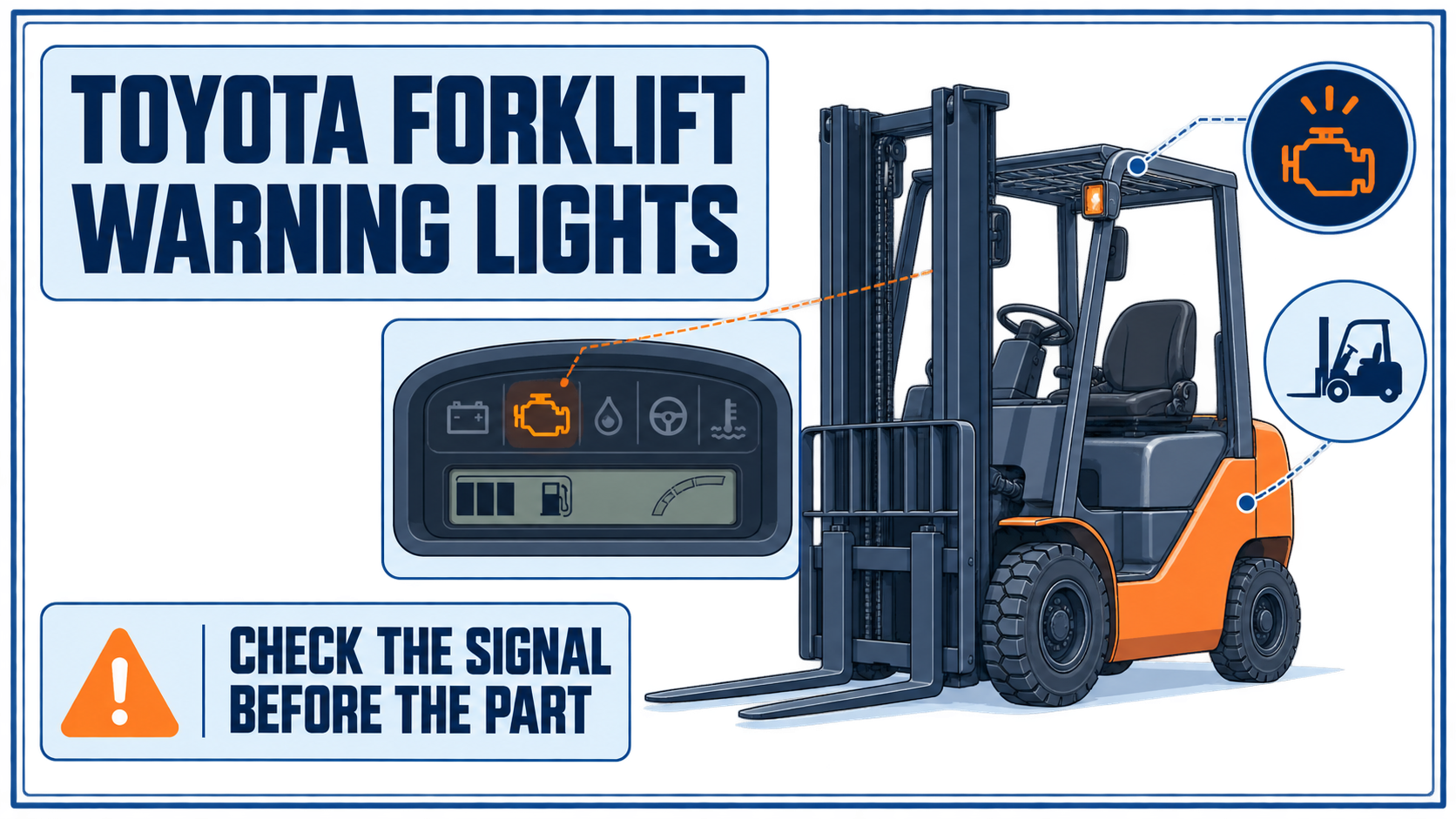
A Toyota forklift warning light is a signal to identify and verify, not a part number to order. Start with the icon, color, steady or flashing state, and the exact truck information. If the light is red, flashing, paired with a buzzer, or accompanied by a change in braking, steering, lifting, temperature, leaks, or engine behavior, stop the truck safely and request a qualified review.
Use the following first screen:
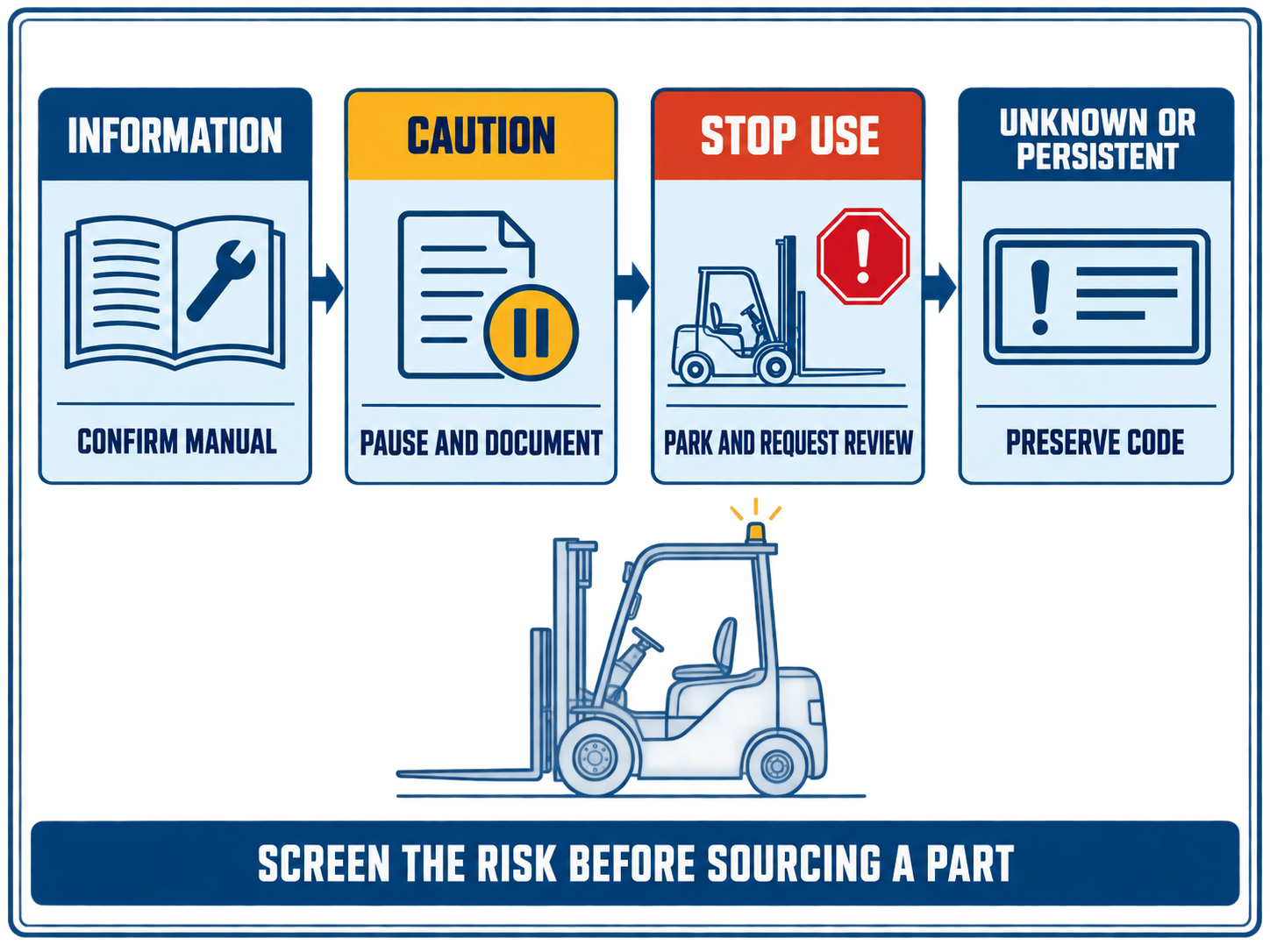
- Information indicator: Record it, then confirm its meaning in the correct operator manual. Do not assume the same icon has the same meaning on every Toyota series.
- Caution or maintenance signal: Pause the job, check only what the applicable manual permits, and confirm whether the signal clears. Treat a persistent light as unresolved. If the truck identity is unclear, use the Toyota forklift models guide before moving to parts research.
- Red, flashing, buzzer, or performance warning: Park in a safe location, lower the load when safe, secure the truck, and keep it out of service until the condition is understood. A powered industrial truck found defective or unsafe must be taken out of service until it is restored to safe operating condition.
OSHA 29 CFR 1910.178(p)(1) covers powered industrial trucks found defective or unsafe.
The useful question is not only, "What does the symbol mean?" It is also, "What changed, and what evidence does the technician need?" A photo of the display, the model and serial plate, any code, and the operating symptoms will usually make the next conversation more productive than a guessed component name.
Note: Toyota’s official documentation route is the starting point for model-specific manuals. Symbols and fault-code actions can vary by truck series, generation, power type, and configuration, so a generic chart is only a lookup clue. OSHA 29 CFR 1910.178(p)(1) supports stopping an unsafe truck.
Before interpreting the symbol, capture the warning context
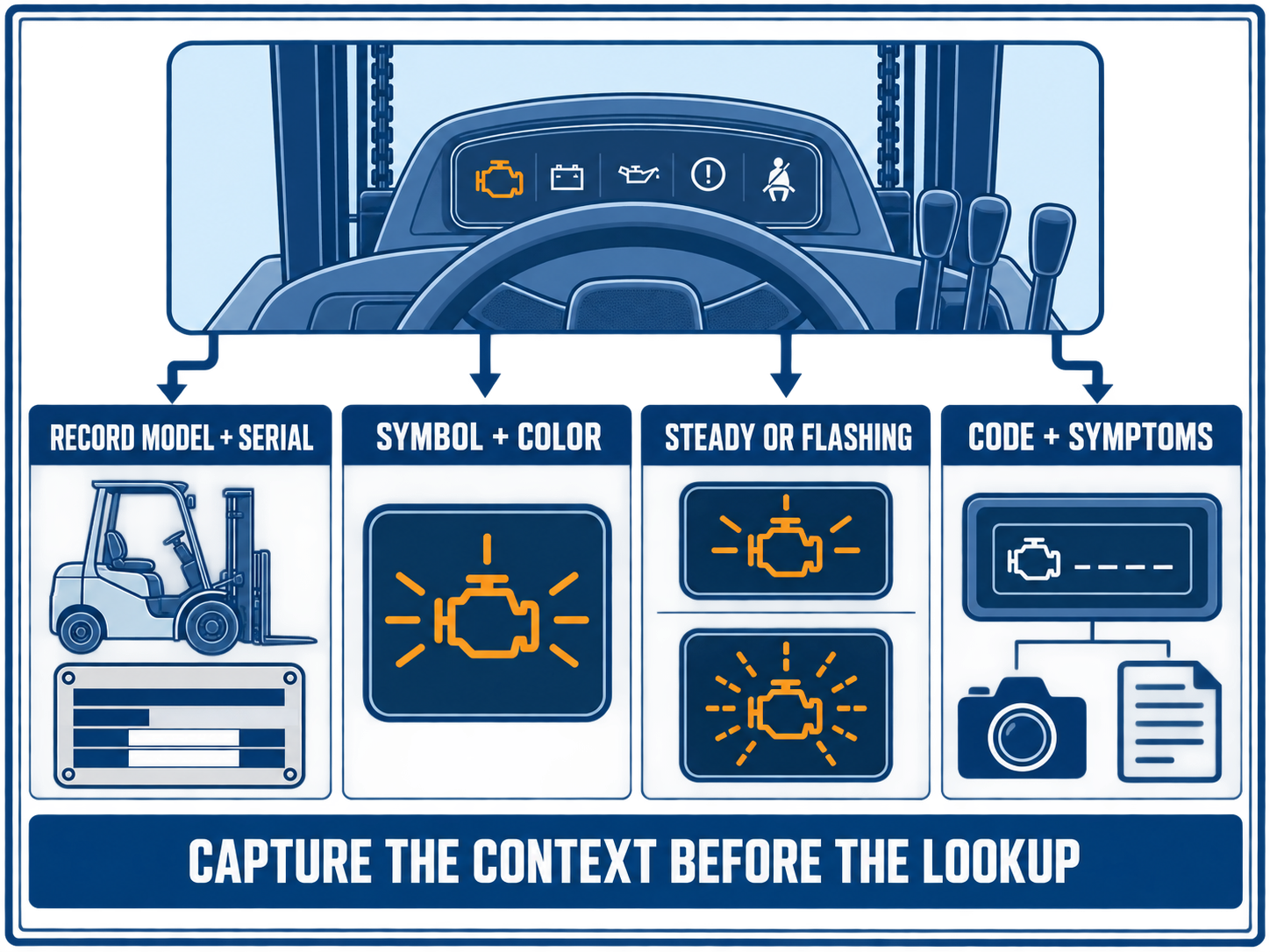
The same dashboard shape can lead to different checks on different Toyota forklift configurations. Before searching for a Toyota forklift warning light meaning, turn the event into a short record. That keeps a service discussion tied to the actual truck instead of to a stock image or a copied symbol list.
Record the model and serial number
Write down the complete model designation and serial number from the equipment data plate. A brand name by itself is not enough to select the correct manual or confirm a replacement component. Toyota’s official manual-access route is designed to connect equipment documentation with the applicable machine.
Record the symbol, color, and flash state
Take a clear photo before cycling the key or clearing the display. Note:
- The symbol shape, including any letters or numbers.
- The color shown by the display.
- Whether the light is steady, intermittent, or flashing.
- Whether a buzzer or other audible alert is present.
- Whether other lights appeared at the same time.
Do not redraw an unfamiliar icon from memory. A small mark, a nearby letter, or the difference between steady and flashing can change the lookup path.
Record the code and operating symptoms
If the display shows a code or message, photograph it and transcribe it exactly. Also record what the truck was doing when the signal appeared. Useful context includes starting, lifting, traveling, braking, charging, turning, or sitting at idle. Note any loss of power, unusual noise, heat, smell, leak, jerky movement, or change in the mast or attachment. For a charging-related event, the Toyota forklift battery fitment guide gives the parts conversation a separate identity check.
The record does not diagnose the failed part. It gives the manual lookup and service review a usable starting point. Keep the information together with the truck’s model and serial details before asking for a sensor, switch, wiring, controller, hydraulic component, or other replacement. If the evidence points toward an electrical issue, compare it with the forklift electrical system guide before naming a component.
How to decide whether the forklift can keep working
Color is useful for triage, but it is not a universal Toyota fault-code system. Use the table below as a behavior screen. The applicable model manual, the displayed code, and the truck’s symptoms still control the final action.
| Dashboard situation | What it tells you | First action | Order a part now? |
|---|---|---|---|
| Information light that matches normal operation | A function or status may be active | Record the symbol and confirm it in the manual | No |
| Amber or yellow light with no performance change | A check or maintenance review may be needed | Pause, document the state, and follow the model-specific check | No |
| Red, flashing, or buzzer warning | The truck may have detected a condition that needs prompt attention | Park safely and keep the truck out of service until reviewed | No |
| Warning plus brake, steering, lift, stability, heat, leak, or power change | The visible signal is paired with an operating risk | Stop use and request qualified service | No |
| Unknown or persistent light after a basic permitted check | The cause remains unresolved | Preserve the code and arrange model-specific diagnosis | No |
The last column is deliberate. A dashboard symbol is evidence about a system state, not proof of one failed component. Ordering a switch, sensor, wiring, or controller before confirming the code and fitment can create a second delay when the first part was not the cause. The OEM versus aftermarket forklift parts guide explains why fitment evidence still matters after the warning is understood.
Use three questions before anyone returns the truck to work: Is the warning still present? Did the truck change how it brakes, steers, lifts, travels, or controls temperature? Can the displayed condition be explained by the correct manual? A "no" answer to the last question means the case is still open. A "yes" answer to the first two means the truck needs a qualified review before normal work resumes.
Caution: If the truck is defective or unsafe, remove it from service until it is restored to safe operating condition. The warning-light lookup should support that decision, not be used to justify continued operation while a serious symptom remains.
For a light that clears and leaves no symptom, keep the record anyway. Intermittent events are easier to investigate when the technician can see the original symbol, the operating condition, and the time it appeared.
The safe sequence is simple: classify the event, protect the operator and nearby workers, capture the evidence, then decide whether the next call is routine forklift maintenance, qualified service, or parts fitment review.
OSHA 29 CFR 1910.178(p)(1) supports the stop-use boundary for a powered industrial truck found defective or unsafe. The five rows above are a screening aid, not a Toyota code chart: persistent warnings, audible alerts, performance changes, and unresolved signals should move the case to qualified review before parts sourcing.
Talk to the factory
Once the Toyota model, serial number, warning code, and symptoms are recorded, request an OEM-compatible forklift parts quote from Kingstream. Kingstream is a single-source forklift parts supplier covering 14 major brands and offers fast quotation for the next fitment review.
Check the warning in a safe, model-specific order
Once the truck is parked safely, use a short verification sequence. The aim is not to perform a repair from a blog post. The aim is to connect the visible warning with the correct Toyota documentation and preserve enough information for a qualified diagnosis.
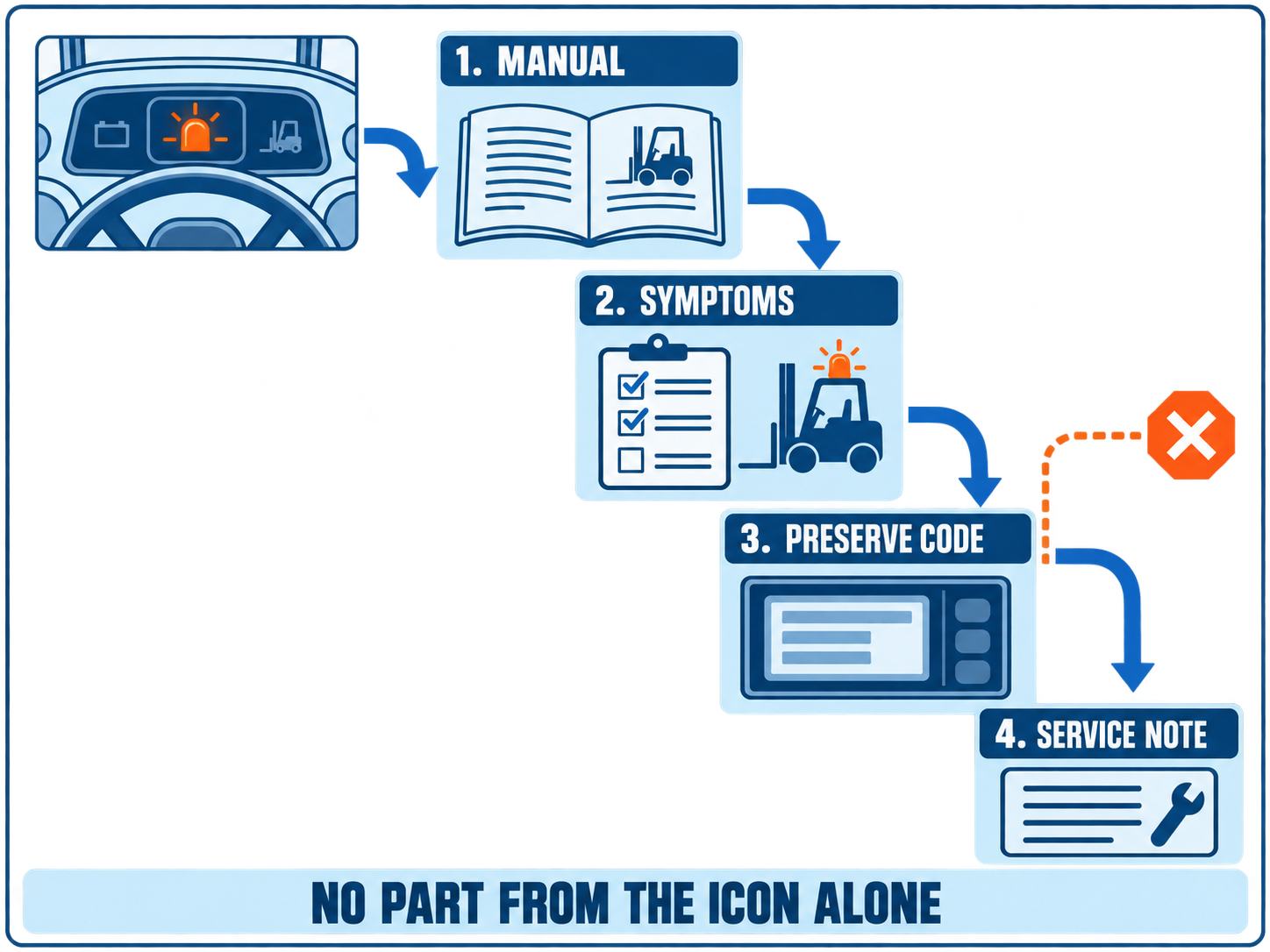
Start with the manual, not a generic chart
Use the model and serial number to locate the applicable operator or service information through Toyota’s official resource route. Compare the actual icon, color, display message, and any code with that document. If the symbol is absent from a generic chart, that does not mean it is harmless. If a generic chart gives a confident meaning, that still does not make it correct for the truck in front of you.
Compare the light with the truck’s actual symptoms
Make a simple separation between what is visible and what is happening:
- Visible signal: symbol, color, steady or flashing state, buzzer, and code.
- Operating symptom: loss of power, abnormal noise, heat, leak, braking change, steering issue, lift behavior, or no noticeable change.
- Recent event: charging, maintenance, part replacement, attachment change, impact, water exposure, or a long idle period.
Start with 2 identifiers, the model and serial number, before comparing the display with documentation.
The separation helps a technician test the right system. It also stops a reader from treating a symbol as a confirmed part identity.
If the warning appeared during charging, note the charger and battery context. The forklift battery charger guide can help separate charger, connector, and battery questions during that handoff. If it appeared while lifting, note the load and attachment state without repeating the test if the truck is unsafe. If it appeared after a repair, record the work date and the component touched. These details do not prove a cause, but they help the service person decide which information to verify first.
Preserve the code before clearing or cycling the truck
Photograph the display and save the original wording. Do not erase a code simply to make the light disappear. If the manual permits a basic check, record what was checked and what changed. Do not bypass a safety switch, jumper a circuit, disconnect a warning system, or keep operating to see whether a serious warning returns.
If the warning remains, or the truck behaves differently, move the question from "Which part matches the icon?" to "What diagnosis and fitment evidence are required?" The service request should include the model, serial, display photo, code, symptoms, and any recent work.
Do not use the absence of a code as proof that no fault exists. Some events are intermittent, some displays show a message rather than a number, and some problems are visible through operation before the dashboard provides a useful detail. Preserve what the operator saw and describe what the truck did.
Note: Toyota’s manual-access guidance makes 2 identifiers, the model and serial number, the cleanest starting point for a model-specific lookup. A dashboard article can explain the decision path, but it cannot replace the manual for symbols, code definitions, or repair instructions.
Toyota’s manual-access guidance makes 2 identifiers, the model and serial number, the first inputs for a model-specific lookup. The sequence above then adds the visible code, operating symptom, and recent event. That 5-part record supports service triage without turning a dashboard icon into a guaranteed diagnosis.
Why a warning light is not a parts diagnosis
A dashboard warning tells you that the truck wants attention. It does not normally tell you which catalog item to buy. One system warning may involve a sensor, wiring, connector, controller input, fluid condition, mechanical issue, or an event that has already cleared. The icon narrows the conversation, but it does not finish it.
That distinction matters most when a buyer is working from a screenshot. A screenshot can preserve the display, but it cannot show whether a connector is damaged, a fluid is low, a switch is functioning, or a controller has stored a different code. The picture is evidence for the next check, not a substitute for the check.
One symbol can point to more than one check
Treat these as separate facts:
- What the dashboard shows: the signal and its state.
- What the manual says: the possible system meaning for that model.
- What the technician finds: the tested cause.
- What the supplier confirms: the replacement part and fitment.
Blending those four steps is how a warning-light search turns into a wrong-part order. A common symbol from another Toyota series can look close enough to create false confidence, especially when a page uses one illustration for several truck types.
What a supplier needs before confirming a replacement
Send the model and serial number, a display photo, the exact code or message, the steady or flashing state, the operating symptoms, and any recent service detail. If a component has already been tested or removed, include its label and connector information. The supplier can then separate a part-number lookup from a diagnosis that still belongs with qualified service.
An evidence-first handoff is more useful than a request that says only, "I need the part for the red light." It also keeps the Toyota forklift parts conversation focused on verified fitment rather than on a guessed component.
When to stop and request model-specific service
Stop using the truck and request qualified service when a warning is paired with an unsafe operating change, remains active after the permitted basic check, or returns during the same task. Examples include abnormal forklift braking, steering, unstable lifting, an unexplained leak, overheating, smoke or burning smell, unusual noise, loss of control, or a warning that is red, flashing, or accompanied by a buzzer. For a temperature-related event, the forklift radiator and cooling-system guide is a useful follow-up once the truck is safe to inspect. These are stop-use signals for a safety decision, not invitations to test a replacement part.
Stop-use conditions
- Park in a safe area away from pedestrian traffic when possible.
- Lower the load and place controls in the safe position when the manual and site procedure permit it.
- Secure the truck against unintended movement.
- Record the display before switching the truck off if doing so is safe.
- Tell the next operator that the truck needs review.
OSHA’s powered-industrial-truck rule requires a truck found defective or unsafe to be taken out of service until it has been restored to safe operating condition. Follow the site’s lockout, notification, and qualified-person procedures for the actual inspection.
What to send with the service or parts request
Prepare a compact message containing:
- Toyota model and serial number.
- Symbol photo and exact display wording.
- Color and steady or flashing state.
- Fault code, buzzer, and when the warning appeared.
- Operating symptoms and the task underway.
- Recent maintenance, charging, repair, impact, or attachment changes.
The request has six fields: truck identity plus event context.
If a part is requested, describe it as a fitment review rather than a confirmed diagnosis unless the failed component has already been identified by qualified testing. The forklift parts sourcing guide shows the same evidence-first approach for a broader supplier request. That wording gives the supplier room to check the correct Toyota documentation and prevents the quote from being built around an unsupported assumption.
If the truck has already been inspected, separate tested findings from operator observations. For example, write that a code was present, a connector was inspected, or a component was tested, but do not turn an unverified suspicion into a confirmed failure. That makes the request easier to review and keeps the replacement decision tied to evidence.
Note: OSHA’s powered industrial truck rule supports the stop-use boundary when a truck is defective or unsafe. A six-field service note covering identity, symbol, code, state, symptoms, and recent work then gives a parts review the evidence it needs without turning an assumption into a diagnosis.
OSHA 29 CFR 1910.178(p)(1) supports removing a defective or unsafe truck from service until safe. The six fields above preserve machine identity and event context. Together they let a service team separate a safety decision, a diagnostic finding, and a replacement-part fitment review.
Toyota forklift dashboard symbols and fault codes: FAQ
What do the different symbols on a Toyota forklift dashboard mean?
They indicate a function, condition, or system that needs attention, but the exact meaning depends on the forklift model and configuration. Use the model and serial number to locate the correct Toyota documentation, then compare the actual icon and code. Do not treat a generic online image as a universal Toyota reference.
What do the different warning lights on a forklift mean?
Start with the signal state and the operating symptom. A steady information signal with no change in operation is a different first-screen case from a red or flashing warning paired with a buzzer, heat, leak, braking change, or loss of control. When the truck is unsafe or defective, stop use and request review.
What are the common fault codes for Toyota forklifts?
There is no single code list that can be safely applied to every Toyota forklift. Record the exact code, model, serial number, power type, display state, and symptoms. Then use the applicable Toyota manual or qualified diagnostic process. A code by itself is not a permission to replace a particular part.
Should I keep operating if the warning light turns off?
Do not use the light turning off as proof that the issue is solved. Save the original photo and context, note whether the truck behaved normally, and follow the applicable manual or site procedure. If the warning returns or any operating symptom remains, keep the truck out of service until it is reviewed.
Can I order a Toyota forklift part from a warning symbol alone?
No. A supplier needs the truck identity and warning evidence, while the failed component and final fitment may require qualified testing. Send the model, serial, photo, code, flash state, symptoms, and recent service history before asking for a sensor, switch, wiring, controller, or other part.
The same rule applies when a listing or search result appears to match the symbol. Confirm the truck information first, then let the manual, service findings, and supplier fitment review determine whether the part is suitable. That keeps a dashboard lookup separate from a catalog lookup.
Conclusion: prepare the evidence before ordering a part
When a Toyota forklift warning light appears, make the first decision about safe operation, not about the replacement part. Capture the model and serial number, symbol, color, steady or flashing state, code, buzzer, symptoms, and recent work. Check the correct Toyota documentation, and stop the truck when the warning is persistent, paired with an unsafe change, or not understood.
That evidence gives a technician or parts supplier a clear starting point. It also protects the buyer from turning a dashboard symbol into an unsupported fitment claim. A careful warning-light record can shorten the next service conversation without pretending that every Toyota forklift uses the same dashboard language.
If the cause is not confirmed, say so plainly in the request. "Warning light present, diagnosis pending" is more useful than a guessed sensor name because it tells the next person what is known and what still needs checking. The goal is a safe return to work with the correct part, not a fast order built on incomplete evidence.
References
- Toyota Material Handling. (n.d.). Where can I find manuals for my equipment? Retrieved September 17, 2026, from https://www.toyotaforklift.com/help/mytoyota/articles/23914288808347-where-can-i-find-manuals-for-my-equipment
- Occupational Safety and Health Administration. (n.d.). Powered industrial trucks. Retrieved September 17, 2026, from https://www.osha.gov/laws-regs/regulations/standardnumber/1910/1910.178
- Toyota Material Handling. (n.d.). The function and use of forklift lights. Retrieved September 17, 2026, from https://www.toyotaforklift.com/resource-library/blog/parts-and-service/the-function-and-use-of-forklift-lights
Last reviewed and updated: September 2026. Author: Kingstream team. For tailored guidance, contact our team.