
TL;DR
A forklift seat is not confirmed as a fit by the word universal or by the machine brand alone. Measure the old seat’s mounting pattern, base and surrounding clearance, then photograph the belt and operator-presence switch wiring. Choose a catalog example only within the fields the listing actually verifies; send the remaining details to the supplier before ordering.
Key Takeaways
- Universal describes a mounting approach, not guaranteed fitment.
- Measure hole spacing, rails, base, seat size, and surrounding clearance before ordering.
- Treat seat belts, operator-presence switches, connectors, and wiring as fitment fields.
- Choose static or suspension seating by space, use conditions, and verified product fields.
- Delay the order when model fitment, dimensions, or safety connections remain unknown.
Table of Contents
- Key Takeaways
- Why replacement forklift seat fit matters
- How to choose forklift seats: the fitment framework
- Use-case path 1: when a static or universal seat makes sense
- Use-case path 2: when suspension or model-specific seating is worth it
- Forklift seat fitment comparison table: check before you order
- How to verify a replacement forklift seat before buying
- Fields to verify, and forklift-seat claims to ignore
- When to delay your forklift seat order
- Conclusion
- References
Why replacement forklift seat fit matters
A forklift seat replacement has to work as part of the truck, not merely look similar to the seat you are removing. The mounting pattern, seat base, surrounding clearance, operator position, belt, and operator-presence connection all affect whether the replacement can be installed and returned to service safely.
That is why "universal forklift seat" should be treated as a starting description, not a fitment verdict. A universal design may cover several mounting patterns or machine families, while a direct-fit listing may identify a narrower model range. In both cases, the buyer still needs to compare the actual seat base and the machine-side safety details.
The practical question is not "Does this seat fit forklifts?" It is "Which evidence shows that this seat fits my forklift, leaves the controls clear, and preserves the intended restraint or operator-presence function?" That wording changes how you shop. You collect measurements before choosing a listing, then ask the supplier to confirm anything the product page does not state. The broader forklift parts sourcing guide uses the same evidence-first handoff.
For a fleet, the same process also makes repeat purchasing easier. Store a photo of the old seat underside, the hole spacing, the seat width and height, and the connector arrangement with the truck record. A later buyer can compare a new listing against that record instead of relying on a remembered brand name. The forklift preventive maintenance checklist offers a related way to keep recurring truck checks attached to the same record.
Fitment rule: A replacement forklift seat is not confirmed by a brand label or the word universal. Confirm the mounting pattern, physical clearance, and safety-system connection together, then resolve any missing SKU or truck-specific detail with the supplier.
Forklift seat replacement fit depends on 3 checks made together: the seat must attach to the measured mounting structure, remain clear of controls and surrounding panels, and preserve the intended belt or operator-presence connection. A brand label or "universal" description starts the search, but the buyer’s measurements and supplier confirmation decide whether the candidate is order-ready.
How to choose forklift seats: the fitment framework
Use the following order when screening a forklift seat replacement. It starts with facts that identify the machine, moves through the mechanical interface, and ends with the safety and operating requirements that can invalidate an otherwise attractive listing.
1. Identify the truck and the current seat
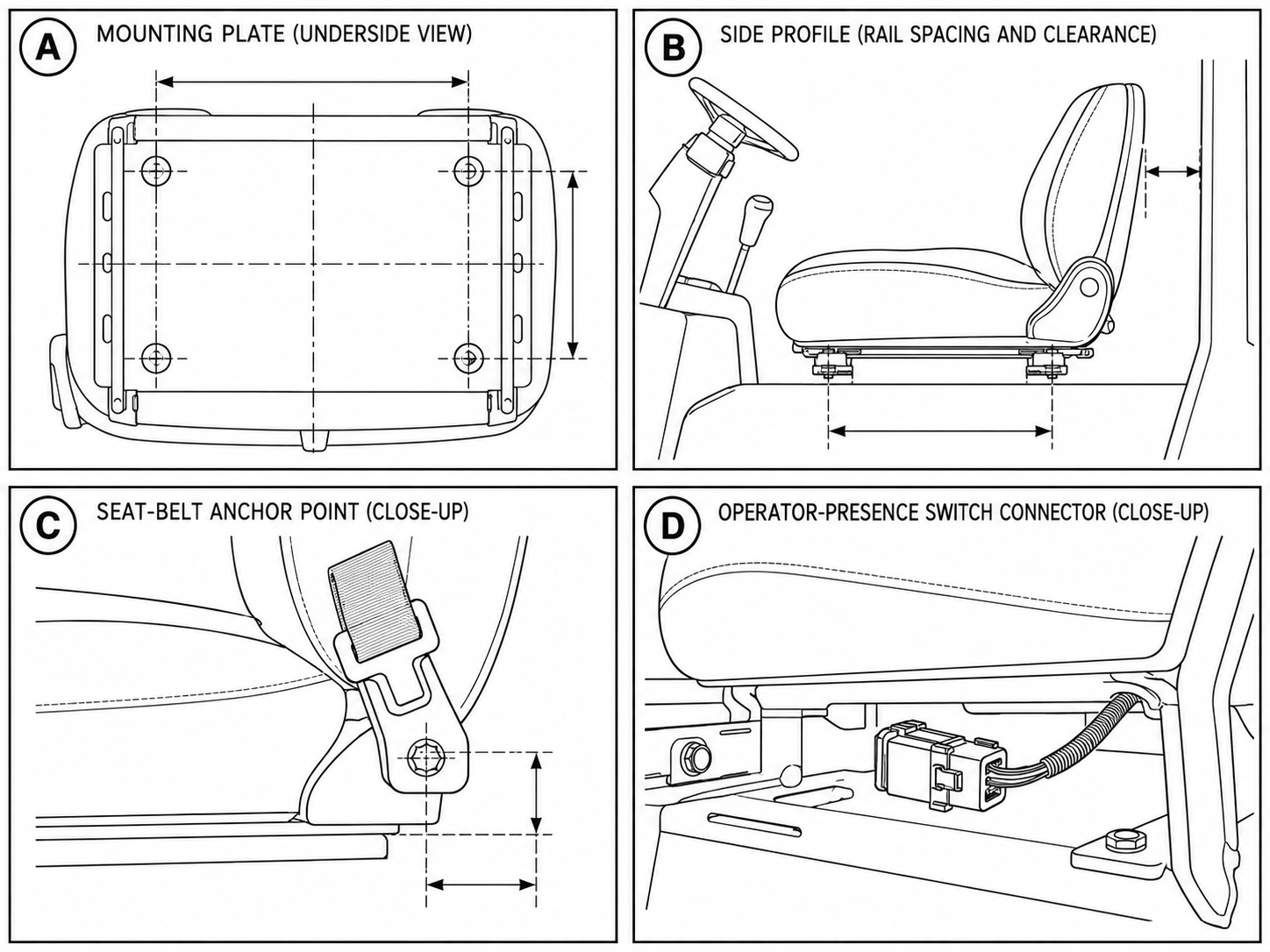
Record the forklift brand, model, serial number or year, fuel or drive type, and job environment. Photograph the current seat from the top, side, underside, and operator area before removing it. Include the seat base, brackets, rails, belt anchor, switch, connector, and nearby levers or panels. Machine identity narrows the search, but it does not replace the physical check.
If the old seat has a label, capture it without assuming that the label is the only fitment source. A model name can point to the correct parts family, while an earlier repair or an adapter plate may mean that the seat currently installed is not the original configuration.
2. Measure the mounting pattern and base
Measure hole spacing from the mounting surface. Record the left-to-right spacing and the front-to-back spacing separately. Then note the number and shape of holes, the rail spacing, the base dimensions, the bracket orientation, and whether the replacement will bolt to the existing rails or directly to the forklift bracket. A matching width with a different front-to-back pattern is not a match.
Take a picture with the tape measure or calipers visible when possible. Mark which measurement is center-to-center and which is an outside edge measurement. This prevents a supplier from comparing unlike dimensions. Product pages may list a seat footprint or one mounting pattern, but the listing value remains specific to that seat and must not be turned into a universal standard.
3. Check clearance and operator position
Measure the space available around the installed seat. Include seat width, cushion depth, backrest height, total height, armrest clearance, steering-wheel distance, control-lever movement, fender or side-panel clearance, and the full forward and rearward travel of any slide rail. A suspension seat can add height or travel that changes the operator position even when its base appears compatible.
Ask whether the seat can move through its adjustment range without touching a control or panel. Also check access to the battery compartment or service cover if the seat is designed to fold or slide. Clearance is a machine-side measurement, so a supplier cannot confirm it from a generic product title alone.
4. Confirm the belt, switch, and connector
Inspect the existing seat belt, belt anchor, operator-presence switch, wiring, plug, and connector location. Photograph both the seat side and the machine side. Note whether the truck expects a normally open or normally closed switch only when the machine documentation or supplier confirms it. Do not bypass a switch or join wires to make a replacement appear compatible. If the connector differs, stop and request the correct wiring or adapter information.
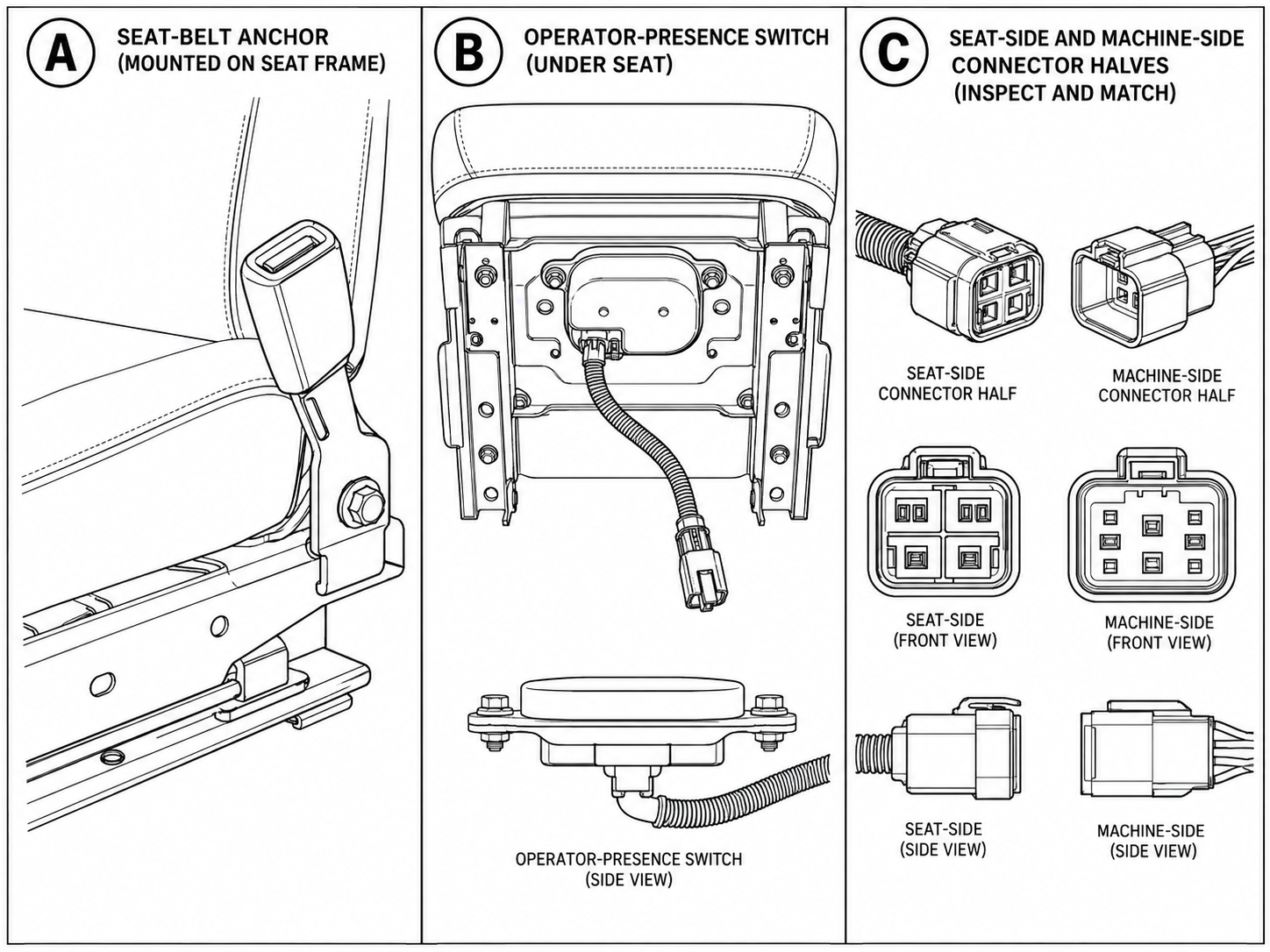
The seat belt and operator-presence system are separate questions. A seat may include a belt but not the connector required by the truck. Another listing may name an occupancy sensor without showing how it interfaces with the machine. Treat the belt, sensor, connector, and wiring as individual fitment fields.
5. Match the seat type to the application
Choose static seating when the existing installation is simple, height is restricted, and the buyer’s main need is a like-for-like replacement. Consider mechanical or air suspension when vibration, shift length, operator adjustment, and available height justify the added mechanism. The choice still depends on the selected seat’s verified dimensions and adjustment range, not on the word "suspension" alone.
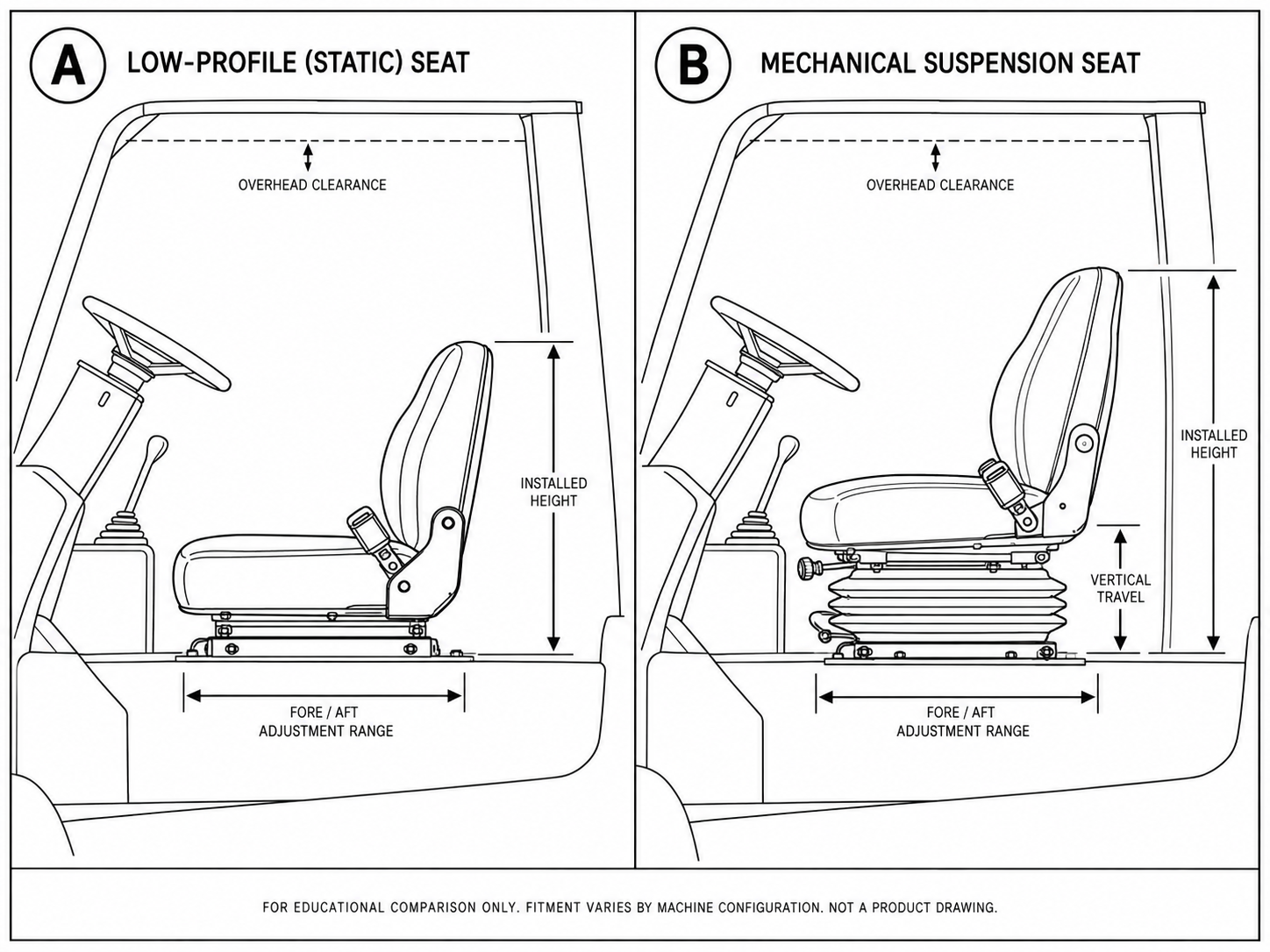
For rough outdoor work, check suspension height, travel, maintenance access, and machine clearance together. For a smooth indoor application, a static or low-profile option may avoid unnecessary complexity. These are screening paths, not universal prescriptions.
The framework produces a shortlist, not an automatic order. A seat moves from shortlist to purchase only when the listing fields, buyer measurements, and supplier confirmation agree.
The same make-model-serial discipline appears in the forklift drive axle fitment guide, even though the component interface is different.
Decision check: Choose a candidate only after machine identity, mounting pattern, seat clearance, safety connections, and seat type have been recorded. Any missing field becomes a supplier question, not an assumption.
Use a 5-part screening sequence for forklift seats: identify the truck and current seat, measure the mounting pattern, check clearance, confirm belt and connector details, then match static or suspension type to the application. The sequence turns a generic listing into a documented candidate and exposes missing fields before a purchase is placed.
Use-case path 1: when a static or universal seat makes sense
Start with a static or universal replacement when the existing truck has a straightforward seat base, limited headroom, and no need for a more complex suspension assembly. This path can reduce the number of variables, but it is valid only when the old-seat measurements and safety connections line up with the candidate. For another component-fitment example, see the forklift side shifter fitment guide.
Choose this path when height and simplicity matter
A static seat is a reasonable first screen for a standard indoor truck, a basic like-for-like replacement, or an application where adding suspension height could interfere with the overhead guard, steering position, or control reach. A universal seat can make sense when its rail or bracket arrangement covers the measured base. It is not a reason to skip the measurement.
One current Kingstream catalog example is the Standard Vacuum-Formed Seat 230x285mm with Safety Belt, SKU SEAT-VF-230-285. The listing states a 230 mm by 285 mm mounting dimension, an integrated retractable safety belt, and a fixed, non-sliding position. Those are useful comparison fields for a buyer who already measured the same interface. (Kingstream Parts, n.d.)
The catalog page does not, by itself, confirm the buyer’s truck model, serial range, machine-side connector, surrounding clearance, warranty, or lead time. Treat those as open questions before ordering, even if the product title resembles the current seat.
What must still be verified
For a universal option, compare the rail width, hole spacing, base shape, seat height, belt anchor, and operator-presence connector. The Kingstream Universal Forklift Seat with Adjustable Slide Rails and Safety Belt is a useful secondary example because the catalog name confirms adjustable slide rails and an integrated safety belt, while the exact mounting pattern and machine-specific fitment still require confirmation. (Kingstream Parts, n.d.)
When a model-labeled seat is preferable
Use a model-labeled or direct-fit path when the truck has an unusual base, a tight operator compartment, a fixed safety connector, or an existing seat that includes a model-specific bracket. Ask for the technical drawing or a fitment confirmation tied to the truck’s model and serial details. A universal claim is weaker than a measured match with a documented machine-side check.
Note: The catalog examples above show what a listing can verify. They are not proof that either seat fits every Toyota, Yale, Heli, or other forklift. The buyer’s measurements and the supplier’s fitment confirmation control the order.
Ready when you are
Your measurements can answer most of the forklift-seat fitment question, but model, serial, connector, and clearance details may still need a supplier review. The sourcing service covers 14 major brands and OEM-compatible forklift parts backed by fast quotation. Send your seat photos and fitment details for a quote.
Use-case path 2: when suspension or model-specific seating is worth it
Move to a suspension or model-specific seat when the buyer has a clear reason that a static seat cannot address: longer shifts, rough travel, a need for operator adjustment, or a machine-specific bracket and safety arrangement. The extra feature is useful only when its added height, travel, and wiring can be checked against the truck.
Choose suspension by space and work conditions
Check the installed height before choosing mechanical or air suspension. Measure the distance from the mounting surface to the top of the seat, then check the full travel range, the steering-wheel relationship, the control-lever reach, and clearance to the overhead guard or side panels. If multiple operators share the truck, ask for the supported adjustment range and record the supplier’s answer. Do not infer a weight range from the word "shock-absorbing."
The Forklift Seat 230x280mm Shock-Absorbing With Belt Sensor is a bounded Kingstream example. SKU SEAT-230-280-CR is listed with a 230 mm by 280 mm installation size, a shock-absorbing design, an integrated seat belt and occupancy sensor, and 150 mm of fore/aft slide. The catalog does not confirm a particular truck model, machine-side connector, installed height, operator weight range, warranty, or lead time. (Kingstream Parts, n.d.)
Those missing fields matter more than the feature count. A seat with a sensor still needs a compatible machine-side circuit. A seat with slide travel still needs clearance at both ends. A suspension assembly still needs enough space to operate without changing the operator’s control position.
Choose model-specific coverage by verified evidence
A model-labeled seat is preferable when the original base, belt anchor, or switch harness is tied to a particular truck family. Ask the supplier to identify the model and serial range covered, then compare that answer with the truck record and the old-seat photos. Brand words such as Toyota or Yale can help start the search, but they are not sufficient fitment evidence. The same evidence-first logic is used in the forklift steering axle assembly fitment guide.
Do not borrow another seat’s dimensions
The 230×280 mm example and the 230×285 mm static example are different catalog values. Similar-looking numbers should not be rounded together or treated as interchangeable. Use the exact listing value for the candidate, then compare it with a center-to-center measurement from the truck. (Kingstream Parts, n.d.)
Caution: A suspension upgrade changes more than comfort. Verify installed height, travel, clearance, belt anchoring, switch wiring, and operator adjustment before replacing a static seat.
Forklift seat fitment comparison table: check before you order
Use this table as a screening sheet. "Verified" means the buyer has measured or photographed the field and the supplier has confirmed that it matches. A product page that leaves a field blank is not evidence that the field does not matter.
| Fitment field | Buyer should record | What a listing may verify | Order status if missing |
|---|---|---|---|
| Machine identity | Brand, model, serial number or year, and current seat configuration | A named model family or application range | Request model and serial confirmation |
| Mounting pattern | Hole spacing, hole count, rail spacing, base shape, and bracket orientation | Exact mounting dimensions or a technical drawing | Do not assume direct fit |
| Seat clearance | Width, depth, height, slide travel, armrest and control clearance | Overall dimensions, rail travel, or seat height | Compare against the truck before ordering |
| Safety system | Belt anchor, belt type, operator-presence switch, plug, and machine-side connector | Included belt, switch, sensor, or connector details | Request wiring and machine-side confirmation |
| Seat type | Static, mechanical suspension, or air suspension, plus available height | Suspension type and adjustment fields | Check height, travel, and operator range |
| Catalog evidence | SKU, current listing fields, stock status, and quote questions | Product title, stated dimensions, and included features | Separate known facts from supplier questions |
The table keeps two different evidence owners visible. The buyer owns the machine identity, photographs, measurements, clearance, and existing connector details. The supplier owns the candidate’s technical drawing, exact fitment confirmation, machine-side wiring advice, stock, lead time, and final quotation. If the purchasing decision also involves product source, the OEM vs aftermarket forklift parts guide provides a separate comparison framework.
The Kingstream category currently contains 13 published Forklift Seat products, so the category can support several replacement paths without pretending that every listing fits every truck. (Kingstream Parts, n.d.) For example, SEAT-VF-230-285 lists a 230 mm by 285 mm mounting dimension and an integrated belt, while SEAT-230-280-CR lists a 230 mm by 280 mm installation size and an occupancy sensor. These values are product-specific. They should be compared with the truck, not combined into a "standard" size. (Kingstream Parts, n.d.)
The universal slide-rail example should be handled differently. Its catalog name identifies adjustable rails and a safety belt, but it does not provide a confirmed hole pattern in the fields used for this guide. That makes it a candidate for a fitment review, not a confirmed direct replacement. (Kingstream Parts, n.d.)
Verification rule: A complete replacement-seat comparison has three outcomes for every field: verified from the truck, verified from the candidate listing, or still open for supplier confirmation. Only the first two together support an order.
Kingstream’s Forklift Seat category contained 13 published products in the catalog snapshot used for this guide. That range supports multiple replacement paths, but the listed 230×285 mm and 230×280 mm dimensions remain SKU-specific. Compare each candidate with the truck’s measured interface, safety connection, and clearance instead of treating either value as a universal standard.
How to verify a replacement forklift seat before buying
Use a short evidence handoff instead of sending only "I need a Toyota seat" or "I need a universal forklift seat." The following sequence gives a supplier enough context to compare the candidate without guessing which version of the truck you have.
-
Record the truck. Write down the brand, model, serial number or year, fuel or drive type, and the environment where it operates. Note whether the current seat is static, sliding, or suspended.
-
Photograph the old seat. Take top, side, underside, mounting-base, belt-anchor, connector, and operator-area photographs. Keep one image with the surrounding controls visible so height and clearance can be discussed.
-
Measure the interface. Record hole spacing in both directions, hole count, rail spacing, base shape, seat width, cushion depth, backrest height, and current installed height. State the measurement method, such as center-to-center, and include units.
-
Trace the safety connection. Identify the belt anchor, operator-presence or occupancy switch, connector, wire count if documented, and where the connector reaches the machine. If the replacement listing names a sensor but not the connector, mark that field open.
-
Ask for the missing drawing. Request the candidate seat’s mounting drawing, overall dimensions, slide or suspension travel, installed height, connector details, covered model and serial range, stock, lead time, and warranty. Ask the supplier to reply against your photographs and measurements.
-
Check the installation before service. After fitting, confirm that all fasteners are secure, the seat does not contact controls through its adjustment range, the belt latches and retracts as intended, and the operator-presence system behaves according to the truck documentation. Do not return the truck to operation if a safety function is unclear.
This process also works for a Toyota forklift seat replacement or a Yale forklift seat search. The brand-specific term changes the search starting point, while the evidence required to approve the replacement stays the same.
Supplier handoff: Send the truck identity, old-seat photos, two-direction mounting measurements, clearance limits, belt and connector details, and the candidate SKU. Ask the supplier to list confirmed fields and unresolved fields separately.
A replacement forklift seat order should be based on 6 evidence steps: record the truck, photograph the old seat, measure the interface, trace the safety connection, request missing drawings, and check the installation before service. This handoff gives a supplier both machine-side facts and candidate-side questions, reducing the chance that a brand-only search becomes an unverified order.
Fields to verify, and forklift-seat claims to ignore
The useful parts of a forklift seat listing are the fields that let you compare the product with the truck. Look first for:
- Exact mounting information. Hole spacing, base shape, rails, brackets, and a technical drawing are more useful than a broad fit claim.
- Complete dimensions. Width, depth, height, and slide or suspension travel show whether the seat can occupy the available space.
- Safety details. Belt type, anchor location, operator-presence or occupancy switch, connector, and wiring information should be stated separately.
- Application boundaries. A named model or series is useful only when the supplier can confirm the model and serial range.
- Current purchasing fields. SKU, stock status, lead time, warranty, and quote requirements should be dated or confirmed at order time.
Be cautious with claims such as "fits all forklifts," "OEM replacement," "ergonomic," "heavy duty," or "plug and play." These phrases may describe the seller’s positioning, but they do not prove the hole pattern, clearance, or machine-side safety connection. "OEM" can also describe a supply relationship or a replacement style without proving that a particular truck configuration is covered.
Do not reject a listing merely because one field is missing, but do not turn a missing field into a positive assumption. Save the listing as a candidate, send the missing question to the supplier, and keep the order on hold until the answer matches the truck record. For a nearby Body Parts comparison, the forklift tire buying guide also separates category labels from verified fitment fields.
Buyer filter: Features help you compare candidates. Mounting, clearance, and safety evidence decide whether a candidate is ready to order.
When to delay your forklift seat order
Pause the order when the candidate’s mounting pattern is not stated and the supplier has not reviewed your measurements. A seat that looks close can still require an adapter, leave a fastener unsupported, or sit in the wrong position.
Also pause when the belt anchor, operator-presence switch, occupancy sensor, connector, or machine-side wiring is unclear. Do not bypass a safety function to make a new seat work. Request the correct drawing, connector information, or a supplier fitment response tied to the truck model and serial details.
Delay the purchase when the replacement is taller or has more travel than the old seat and no one has checked the overhead guard, steering wheel, levers, fenders, and service access. Delay when the selected suspension seat has no confirmed adjustment range for the operators who will use it.
Once the open fields are answered, update the truck record and proceed with the exact SKU, quantity, delivery, warranty, and quotation terms confirmed by the supplier. The same measurement discipline carries into the PU wheel forklift fitment guide, the preceding child-category article in this sequence.
Stop condition: If a missing field can affect attachment, operator control, or a safety function, the next action is fitment confirmation, not checkout. (Occupational Safety and Health Administration, n.d.)
Conclusion
The safest way to choose forklift seats is to treat replacement as a fitment check, not a brand-only search. Record the truck identity, measure the mounting interface and clearance, photograph the belt and connector details, and compare those facts with the exact candidate listing.
If the mounting pattern, physical clearance, and safety-system connection are confirmed, send the same evidence with the SKU when requesting a quote. If any missing field could affect attachment, operator control, or a safety function, keep the order on hold until the supplier confirms it against the truck record.
References
- Kingstream Parts. (n.d.). Forklift seat. Kingstream Parts. https://kingstreamparts.com/product-category/forklift-body-parts/seat/
- Kingstream Parts. (n.d.). Standard vacuum-formed seat 230x285mm with safety belt. Kingstream Parts. https://kingstreamparts.com/product/vacuum-formed-seat-230x285mm/
- Kingstream Parts. (n.d.). Universal forklift seat with adjustable slide rails and safety belt. Kingstream Parts. https://kingstreamparts.com/product/forklift-parts-alarm-buzzer-seat-mod/
- Kingstream Parts. (n.d.). Forklift seat 230x280mm shock-absorbing with belt sensor. Kingstream Parts. https://kingstreamparts.com/product/forklift-parts-shock-corrosion-seat-230-280/
- Occupational Safety and Health Administration. (n.d.). Powered industrial trucks (29 C.F.R. § 1910.178). U.S. Department of Labor. https://www.osha.gov/laws-regs/regulations/standardnumber/1910/1910.178
Last reviewed and updated: September 2026. Author: Kingstream team. For tailored guidance, contact our team.