
TL;DR
A Toyota forklift battery should be treated as a fitment-and-charging-system decision: identify the truck from its data plate, record the installed battery and compartment details, then have the supplier confirm the replacement.
Key Takeaways
- Voltage is one checkpoint, not a complete Toyota forklift battery fitment answer.
- The truck data plate and installed battery label start the replacement review.
- Physical fit, connector details, chemistry, and charger context must be checked together.
- Buyer evidence and supplier confirmation are separate steps in a safe quote request.
- Delay the order when a required field is missing or the charging system is unclear.
Why a Toyota forklift battery needs a fitment check
A Toyota forklift battery request can look simple because the truck brand is familiar. The replacement decision is still a fitment review. The truck identity, installed battery, compartment, connector, and charging arrangement all need to point to the same replacement path. A brand name or a voltage label alone does not establish that match.
Brand recognition is only the starting point
Start with the data plate on the truck. Record the model number and serial number exactly as shown, then photograph the installed battery label before removing anything. Toyota’s parts guidance identifies the model and serial information on the data plate as useful for identifying replacement parts. That is an identification step, not a universal battery-size answer.
For a broader model-family reference before the battery review, use the Toyota forklift models guide.
Treat the battery and charger as one system
The battery is also tied to physical space, connection details, chemistry, and charging method. Toyota’s charging guidance describes conventional, fast, and opportunity charging as choices shaped by operation, shift schedule, and available charging time. That makes the charger part of the fitment conversation, especially when the request involves a change in battery chemistry.
Warning: Do not approve a Toyota forklift battery order from a generic listing that shows only brand and voltage. Ask for the missing truck and system checks first.
Toyota forklift battery fitment checklist: collect these inputs first
Toyota Material Handling’s parts guidance points to 2 truck identifiers, the model and serial number on the data plate, as the starting evidence for replacement-parts identification. For a Toyota forklift battery request, add the installed battery label, compartment, connector, and charger context so a supplier can review the replacement as a system rather than as a generic voltage match.
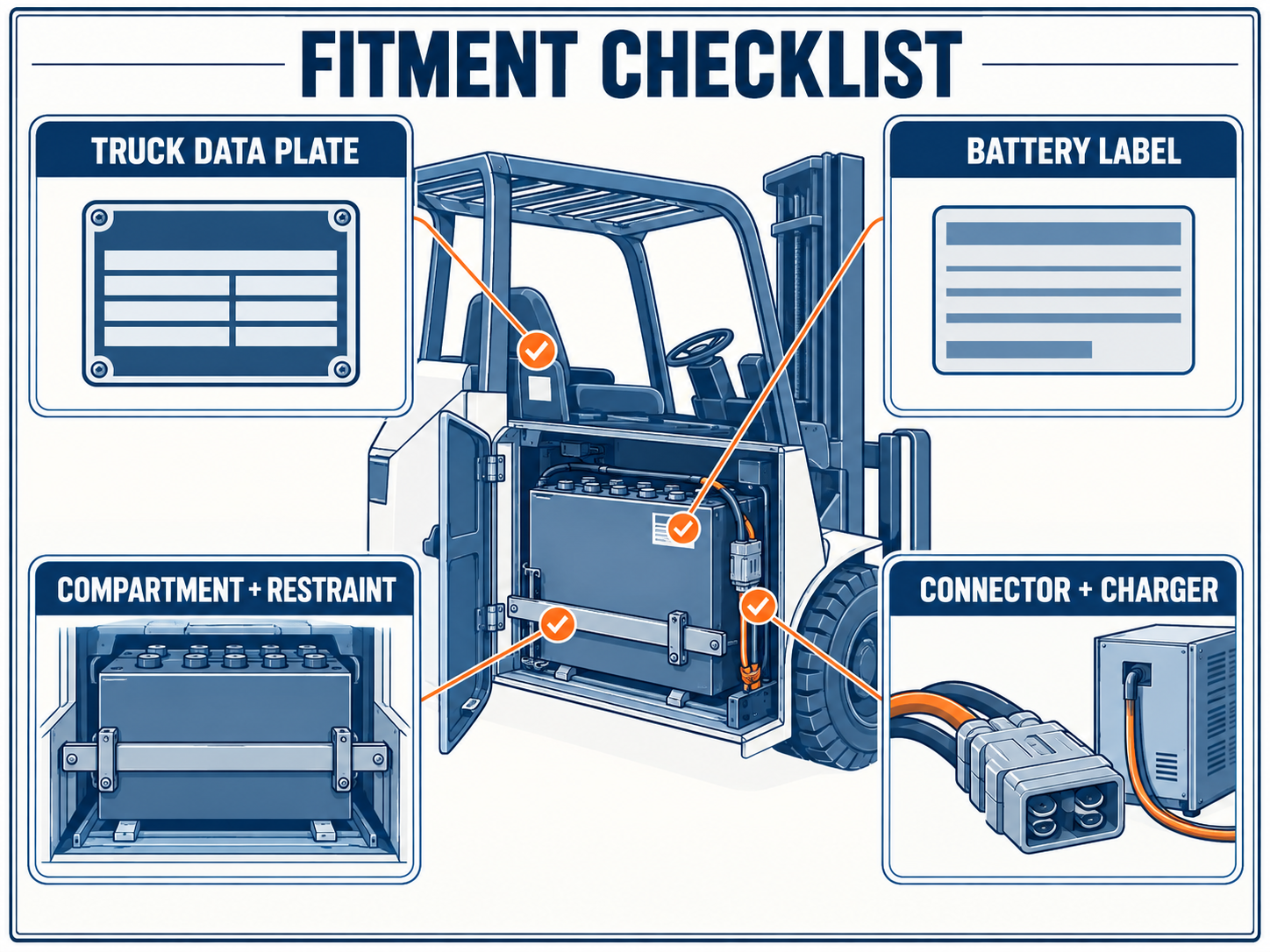
The fastest way to make a Toyota forklift battery request reviewable is to collect evidence in the same order a supplier will need it. Begin with the truck data plate, then document the battery and compartment, and finish with the connector, charger, and operating context. Toyota’s parts guidance connects model and serial information from the data plate with replacement-parts identification.
Truck identity from the data plate
Record the complete model number and serial number. Do not shorten a model family name or rely on a memory-based description. These details anchor the fitment review to the actual truck rather than to a broad Toyota equipment category.
If you already have a Toyota model record, the Toyota 8FGU30 fitment guide shows the same model-and-serial evidence pattern in a model-specific example.
Installed battery and compartment evidence
Photograph the battery label so the voltage, capacity, chemistry, and any visible identification details can be read. Record the installed battery’s dimensions and weight information when available. Also photograph the compartment, restraint, and access arrangement. Toyota’s lithium-ion information shows that battery and charger compatibility should be considered together.
Connector, charger, and operating context
Record the connector style, charger identification, charging routine, shift pattern, and the time available for charging. The goal is not to decide the replacement from a checklist alone. The goal is to give the supplier enough evidence to confirm the electrical and physical match.
Use the forklift battery charger matching guide when the charger label or connector information needs a separate review.
| Field to collect | What the buyer records | Why it matters for review |
|---|---|---|
| Truck identity | Model and serial from the data plate | Ties the request to the actual truck |
| Battery identity | Label photos and readable capacity details | Separates the installed battery from a generic listing |
| Physical fit | Compartment, restraint, dimensions, and weight evidence | Allows a supplier to check the available space and handling requirements |
| System context | Connector, charger, chemistry, and operating pattern | Prevents a battery-only answer from overlooking charging compatibility |
Note: If a field cannot be read, label it as unknown in the request. An explicit unknown is more useful than a guessed value.
Use case path: replacing a conventional Toyota forklift battery
Toyota’s charging guidance describes 3 operating methods, conventional, fast, and opportunity charging, and connects the choice with the operation, shift schedule, and available charging time. A conventional battery replacement request should therefore include the existing charger routine, not just a battery label, so the supplier can assess the intended like-for-like use.
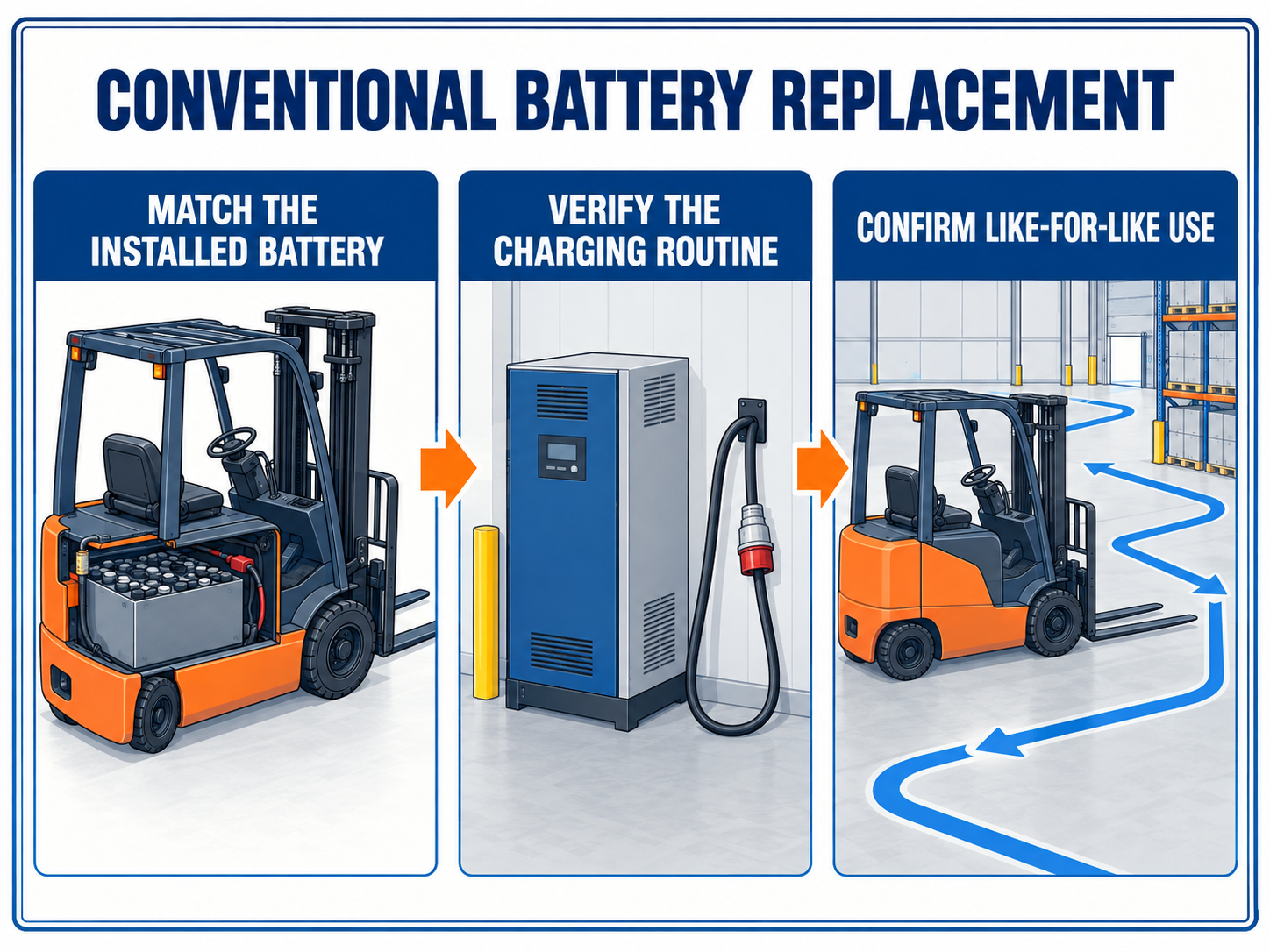
For a routine replacement, the buyer usually wants the truck to return to its existing work pattern. That makes the installed battery the starting evidence. Photograph its label, record the visible electrical and identification information, and preserve the physical details that a supplier will need to compare with the replacement request.
The Toyota 8FGU25 fitment guide is a useful follow-on when the general battery request becomes a model-and-serial fitment question.
Document the battery already in the truck
Send a clear photo of the label, a photo of the connector, and photos showing how the battery sits in the compartment. Include the truck data plate in the same request. If the label is worn, say so and provide every readable fragment rather than completing the missing text from memory.
Confirm the existing charging routine
Record the charger identification and how the truck is normally charged. Note whether charging happens during a planned downtime window or between operating periods. Toyota’s charging guidance says the appropriate method depends on the operation, shift schedule, and time available for charging. The supplier can then assess whether the replacement request is intended as a like-for-like review.
If the battery request is part of a wider electrical diagnosis, the forklift electrical system guide provides a related component-level reference.
Tip: "Replace the installed battery" is a useful starting description, but it is not a fitment confirmation. Ask the supplier to confirm the final match against the truck and charging evidence.
Here is what we would check first
When your battery request includes the truck data plate, installed battery label, compartment evidence, connector, and charger context, a supplier can review the fitment as one request. Ask Kingstream about forklift parts sourcing for OEM-compatible forklift parts backed by fast quotation.
Use case path: assessing a lithium-ion change
A lithium-ion review should account for 3 charging methods described in Toyota’s charging guidance, conventional, fast, and opportunity charging, alongside the truck, battery, and charger evidence. Those methods are not a universal conversion rule. They are a reminder to explain the operating pattern and available charging time before a supplier confirms the proposed chemistry change.
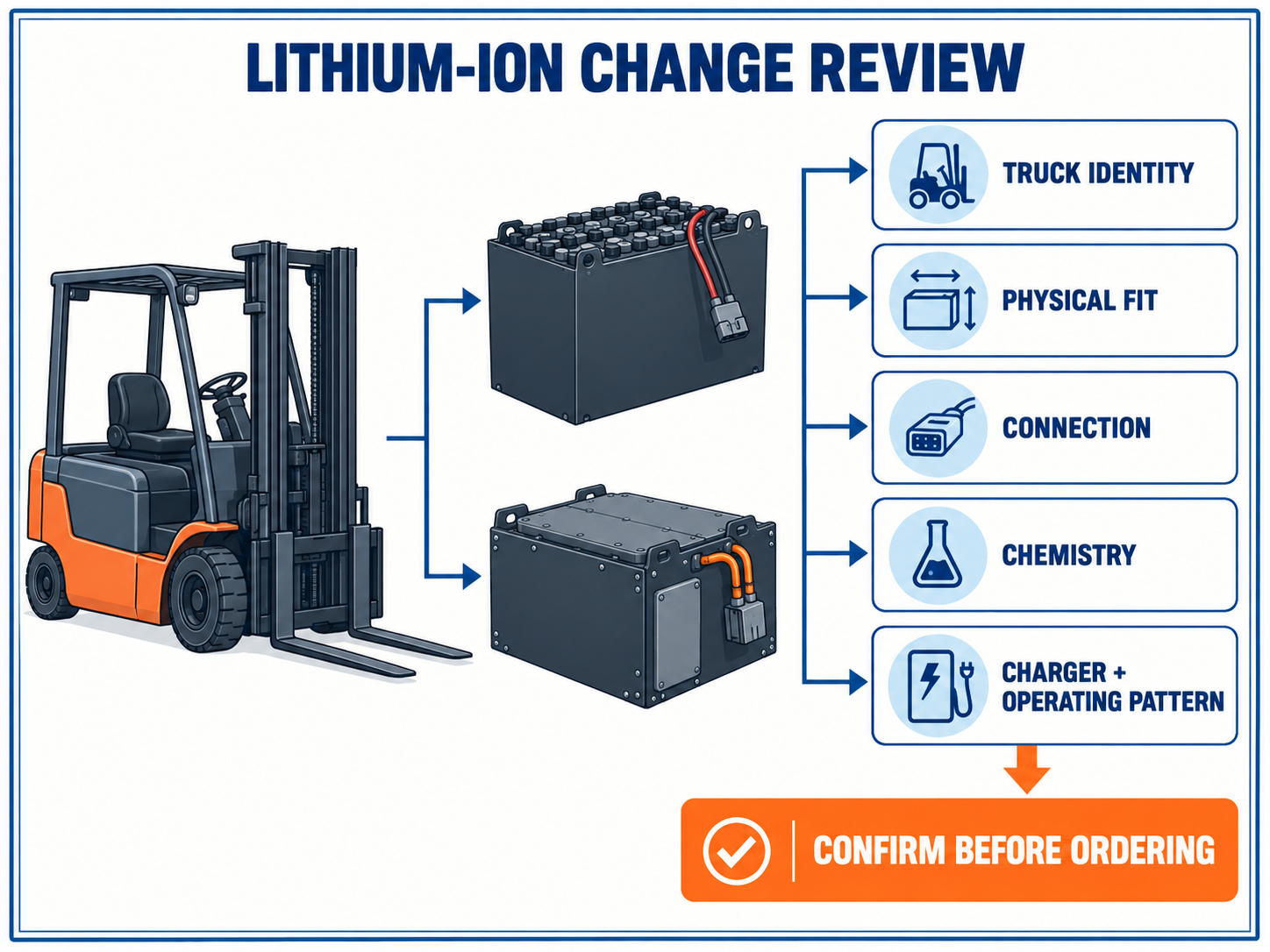
A lithium-ion request is a system change, not simply a different battery label. The review still begins with the Toyota truck model and serial information, then adds the battery compartment, connection, charger, and operating pattern. Toyota presents lithium-ion batteries together with compatible charging information on its energy-solutions materials.
Separate chemistry choice from fitment proof
Ask why the change is being considered. The buyer may be responding to charging time, operating rhythm, maintenance preferences, or a broader fleet energy plan. That reason helps the supplier evaluate the request, but it does not prove that the existing truck, compartment, connector, and controls are ready for a chemistry change.
For another Toyota fitment example with the same evidence-first approach, see the Toyota 8FGCU25 fitment checks.
Check the charging method and operating pattern
Provide the charger identification and describe when the truck is available for charging. Toyota’s charging-method guidance distinguishes conventional, fast, and opportunity charging by the demands of the operation and the time available to charge. Use that context to request a compatibility review, not to assume that one charging method suits every Toyota electric forklift.
Warning: Do not describe a lithium-ion battery as a direct replacement until the supplier has confirmed truck identity, physical fit, connection, chemistry, and charger compatibility.
Buyer inputs versus supplier confirmation
Toyota Material Handling’s parts guidance identifies 2 truck fields, model and serial number from the data plate, as a starting point for replacement-parts identification. The buyer supplies those fields and the surrounding battery evidence. The supplier then confirms the final match against the truck, physical fit, connection, chemistry, and charger context.
The buyer can collect strong evidence without making the final fitment decision. A supplier should use that evidence to confirm the replacement against the specific truck and charging system. Keeping these responsibilities separate makes the request more credible and avoids turning a readable label into an unsupported compatibility promise.
What the buyer can photograph or record
Provide the truck data plate, installed battery label, compartment, restraint, connector, charger, and operating context. Add the battery dimensions and weight information if it is available from the label, documentation, or an existing record. Toyota’s parts guidance supports using truck identification details to start replacement-parts identification.
The forklift parts sourcing guide explains how to organize identification evidence when a request includes more than one component.
What the supplier must match and confirm
The supplier should confirm that the proposed battery matches the truck identity, required electrical values, physical constraints, connector arrangement, chemistry, and charger context. A supplier may need clearer photos or serial evidence before giving a firm answer. That extra check is particularly important when the request changes chemistry or charging practice.
| Review item | Buyer provides | Supplier confirms |
|---|---|---|
| Truck identity | Exact model and serial photos | The request is tied to the correct Toyota truck |
| Existing battery | Label, connector, and installation photos | The proposed electrical and connection details are appropriate |
| Physical fit | Compartment, restraint, dimensions, and weight evidence | The battery can be accommodated and handled correctly |
| Charging context | Charger identification and operating pattern | The battery and charging method are compatible for the request |
Important: A supplier confirmation should state what evidence was matched and what remains quote-stage or installation-stage verification.
How to prepare a quote-ready Toyota forklift battery request
Put the evidence in one message so the supplier can review the request without reconstructing the truck from scattered replies. State that you need a Toyota forklift battery fitment review, then attach the truck and battery information in a consistent order.
Attach the evidence in one message
Send the evidence in the following sequence:
- Truck identity. Attach readable model and serial photos from the data plate.
- Battery identity. Attach the installed battery label and connector photos.
- Physical evidence. Attach compartment, restraint, dimensions, and weight information when available.
- Charging context. Identify the charger and describe the normal charging routine and operating pattern.
- Open questions. Mark anything unreadable or unknown instead of filling it in from memory.
Ask for confirmation instead of a guess
Ask the supplier to confirm the replacement against the truck identity, battery requirements, physical fit, connection, chemistry, and charger. Toyota’s parts and energy-solutions materials support treating truck identification and charging compatibility as separate parts of the review. That wording tells the supplier exactly what kind of answer you need.
For the wider maintenance record around the truck, see the forklift preventive maintenance checklist.
What to ignore in a Toyota forklift battery listing
Search results and listings often compress a fitment decision into a short compatibility label. Treat those labels as leads, not proof. The useful question is whether the listing gives you enough information to connect the battery to the exact Toyota truck, compartment, connector, and charging arrangement.
Marketing labels that do not prove fitment
Do not treat "universal," "direct fit," or "Toyota compatible" as a substitute for model and serial evidence. Do not infer physical fit from voltage alone. Do not assume that a chemistry description includes charger compatibility. Toyota’s own charging guidance frames the charging method around the operating context, which is why a battery label cannot answer the full system question.
Generic size claims without truck evidence
A size claim may describe the battery, but it does not by itself describe the truck compartment, restraint, access method, connector, or charger. If a listing omits the fields you need, ask the supplier to review your photos and identification details before relying on its wording.
When the purchasing question also involves source type, compare the evidence standards in the OEM versus aftermarket forklift parts guide.
Warning: A concise listing is not necessarily a bad listing. It becomes a problem when its short claim is treated as the final fitment decision.
When to delay a Toyota forklift battery order
Pause the request when the truck identity is incomplete, the installed battery label cannot be read, the compartment evidence is missing, or the connector and charger are unclear. A supplier cannot responsibly confirm a replacement from a broad Toyota description alone.
Missing identity or label evidence
If the model or serial information is uncertain, collect a clearer data-plate photo. If the battery label is damaged, send every readable detail and ask what additional evidence is needed. Do not turn an unknown field into a guessed capacity or size.
Unclear charger or chemistry change
Delay a chemistry change when the charger, charging routine, or operating pattern is not known. Toyota’s charging guidance treats the method as part of the operating decision. Resolve that question before treating the request as ready for ordering.
If the battery concern sits inside a larger maintenance request, the forklift filters guide is a related reference for organizing component information.
Caution: A short delay to verify a missing fitment field is usually less costly than discovering the mismatch after delivery or installation.
FAQ: Toyota forklift battery replacement and fitment
What battery does a Toyota forklift use?
Toyota electric forklifts can use different battery and charging arrangements. The safe answer for a replacement request depends on the specific truck, installed battery, physical compartment, connector, and charger context. Provide the data plate and battery evidence before asking a supplier to confirm a match.
What type of battery does Toyota recommend?
Toyota presents both conventional and lithium-ion energy solutions, but a general recommendation is not the same as a truck-level fitment decision. The right review depends on the operating pattern, charging method, truck identity, physical fit, and the buyer’s intended use. Treat chemistry as a decision to confirm with the supplier.
What size battery does a forklift take?
There is no safe universal Toyota forklift battery size answer for every truck. The required battery depends on the truck identity and the installed battery and compartment evidence. Send the model, serial, label, dimensions, weight, connector, and charger information so the supplier can confirm the applicable replacement.
Conclusion
For a Toyota forklift battery replacement, start with the exact truck model and serial number, then document the installed battery, compartment, restraint, connector, and charger. A conventional replacement still needs the existing charging routine, while a lithium-ion change requires a separate review of chemistry, physical fit, connection, and charging method. If any required evidence is missing, pause the order and ask the supplier to confirm the match before delivery or installation.
References
- Toyota Material Handling. (n.d.). Genuine Toyota forklift parts & accessories. Retrieved September 16, 2026, from https://www.toyotaforklift.com/parts-and-service/toyota-genuine-parts
- Toyota Material Handling. (n.d.). Assessing forklift charging methods. Retrieved September 16, 2026, from https://www.toyotaforklift.com/resource-library/blog/energy-solutions/assessing-forklift-charging-methods
- Toyota Material Handling. (n.d.). Lithium-ion batteries. Retrieved September 16, 2026, from https://www.toyotaforklift.com/solutions/energy-solutions/lithium-ion-batteries
- Toyota Material Handling. (n.d.). Forklift battery maintenance and handling best practices. Retrieved September 16, 2026, from https://www.toyotaforklift.com/resource-library/blog/energy-solutions/forklift-battery-maintenance-handling-best-practices
Last reviewed and updated: September 2026. Author: Kingstream team. For tailored guidance, contact our team.