
TL;DR
For Toyota 8FGU30 parts fitment, collect the model number, complete serial number, data-plate details, mast and attachment configuration, and the old-part number or clear photos before requesting a match.
Key Takeaways
- The model number identifies the truck family, not a universal replacement part.
- The complete serial number narrows the unit-level fitment review.
- Mast, carriage, attachment, fuel, tire, and option details can change the required evidence.
- A clear old-part number or component photo helps when the manual reference is incomplete.
Table of Contents
- Key Takeaways
- Toyota 8FGU30 fitment: what to gather first
- Decode 8FGU30 without treating the model as a part number
- Record the complete serial number and data-plate details
- Capture configuration details that can change fitment
- Use the parts manual as a cross-check, not final proof
- Send a fitment-ready Toyota 8FGU30 parts request
- Common assumptions that cause wrong forklift parts
- Conclusion
- References
Toyota 8FGU30 fitment: what to gather first
If you are searching for Toyota 8FGU30 parts, prepare the identifier packet before comparing a listing. The model starts the filter; the serial, configuration, and old-part evidence support the fitment review. (Toyota Material Handling, n.d.)
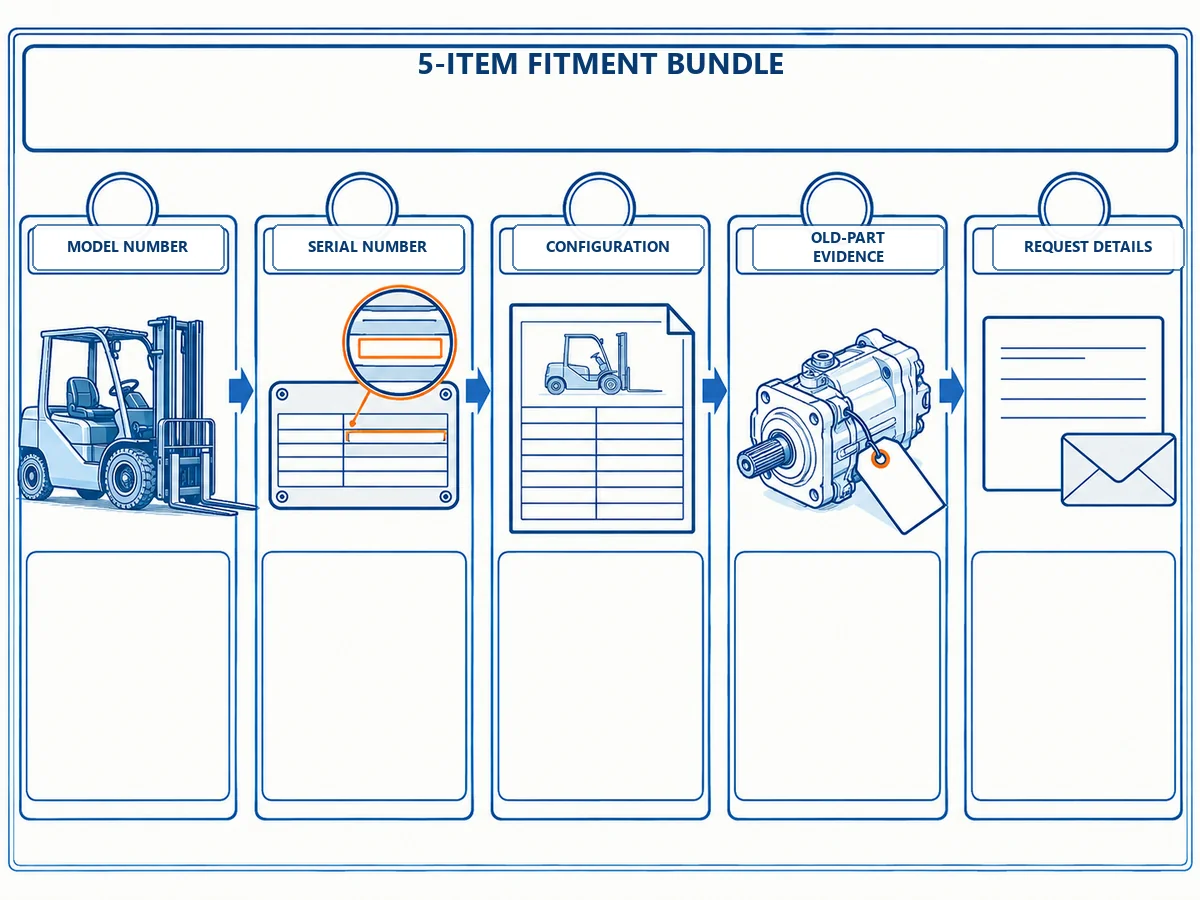
Use this five-item bundle:
- Model number: Copy
8FGU30exactly as shown on the data plate. - Serial number: Record the complete number, including every prefix, suffix, and separator.
- Configuration: Note fuel or drive type, tire style, mast, carriage, attachment, and visible options.
- Old-part evidence: Add the part number, label, connector, mounting face, or clear photos.
- Request details: State the system, quantity, symptom or service reason, and required delivery timing.
| Identifier | What it helps with | What it cannot prove alone |
|---|---|---|
| Model number | Narrows the Toyota truck family | The exact replacement part |
| Serial number | Narrows the truck-level lookup | That an unverified listing fits |
| Configuration | Selects the relevant catalog branch | A universal specification for every unit |
| Old-part evidence | Cross-checks the component being replaced | A substitute part without supplier review |
Toyota’s parts guidance treats the model and serial number as the key pair for replacement-part lookup. In practice, the model narrows the search, while the serial number and configuration let the parts team review fitment for that unit. A public specification sheet is reference information, not a universal compatibility table. (Toyota Material Handling, n.d.)
Toyota Material Handling’s parts guidance makes the model and serial number combination the starting evidence for finding parts that fit a particular piece of equipment. For Toyota 8FGU30, use the five-item bundle: model, serial, configuration, old-part evidence, and request details before asking for a match. (Toyota Material Handling, n.d.)
For a nearby Toyota model comparison, see the Toyota 8FGU25 fitment guide and the Toyota 8FGCU25 parts fitment check. Keep each truck’s serial and configuration separate.
Decode 8FGU30 without treating the model as a part number
The string 8FGU30 is a Toyota forklift model designation. It tells a parts buyer which truck family to start with, and it aligns the search with Toyota 8FGU30 specifications, manuals, and parts references. It is not the same thing as a component part number, and it does not identify every option installed on a particular truck. (Toyota Material Handling, 2023)
What the model label helps you identify
Use the complete model code when searching for a Toyota forklift 8FGU30 manual or parts manual. Toyota’s manufacturer material places 8FGU30 within its Core IC pneumatic model family and lists both 40-8FGU30 and 50-8FGU30 designations in the relevant specification sheet. That is useful for finding the right family of reference material, but it is still a model-level signal.
The practical first check is simple:
- Does the data plate actually show
8FGU30? - Is the code complete, rather than only a capacity label such as Toyota 30?
- Does the manual or diagram name the same model family?
What it cannot confirm
Do not infer a final part number from the 30 suffix. Do not assume that a model-specific page covers every mast, carriage, attachment, fuel arrangement, tire choice, or production configuration. A specification page can help you recognize the machine, while a fitment decision needs the model, serial number, component evidence, and supplier confirmation together.
Toyota’s model-level and serial-level identifiers serve different jobs. The model gets the request into the right reference family. The serial number and configuration help separate the exact truck record and catalog branch. (Toyota Material Handling, 2023)
Toyota Material Handling’s 2023 Core IC Pneumatic specification sheet lists 40-8FGU30 and 50-8FGU30 within the model-number tables. Those labels help identify the reference family, but they do not function as replacement-part numbers. Confirm the complete model and serial before using a manual or catalog result. (Toyota Material Handling, 2023)
Record the complete serial number and data-plate details
For a Toyota 8FGU30 parts request, treat the serial number as a required buyer input, not an optional note. Start with the data plate. If the plate is damaged, dirty, or missing, look for the stamped identifier on the truck frame and photograph the surrounding area so another person can check the transcription. Do not fill an unclear character by guessing. (Toyota Material Handling, n.d.)
Where to look
Record the model and serial together from the same truck. Capture a straight, readable photo of the plate, then make a typed copy in the request. Keep the original photo even after transcribing it. It can resolve a confusion between similar characters or show a field that was left out of the typed message.
How to transcribe it for a parts request
Use this short routine:
- Copy the model exactly, including letters and numbers.
- Copy the complete serial string exactly as shown.
- Preserve dashes, spaces, prefixes, and suffixes instead of normalizing them away.
- Mark one character as unreadable if the plate cannot be resolved.
- Attach the plate photo and state whether the number was read from the plate or frame.
Toyota’s parts and service guidance explains that the model and serial number combination is used to help identify parts that fit the equipment. That makes the serial a fitment field, not a decorative specification. If it is missing or partial, the right next step is to request a lookup or obtain a clearer identifier, not to select a part from a generic Toyota 30 result. (Toyota Material Handling, n.d.)
Toyota Material Handling says the model and serial number combination helps identify parts that fit the particular equipment, and its parts page directs buyers to information on the data plate. For an 8FGU30 request, preserve every character and send the plate image when a typed number could be misread. (Toyota Material Handling, n.d.)
Fitment warning: A serial number copied from a quote, listing, or another truck is not evidence for your 8FGU30. Use the number physically tied to the unit being repaired.
Get started here
If you need a single source for forklift parts after preparing your fitment request, Kingstream’s forklift parts sourcing service covers 14 major brands and offers OEM-compatible parts backed by fast quotation. Learn about forklift parts sourcing.
Capture configuration details that can change fitment
Once the model and serial are recorded, add the details that describe the truck as it is actually configured. These fields are buyer inputs. They help the supplier choose the correct catalog path, but they should not be converted into universal specifications for every Toyota 8FGU30. (Toyota Material Handling, 2023)
Mast, carriage, and attachment
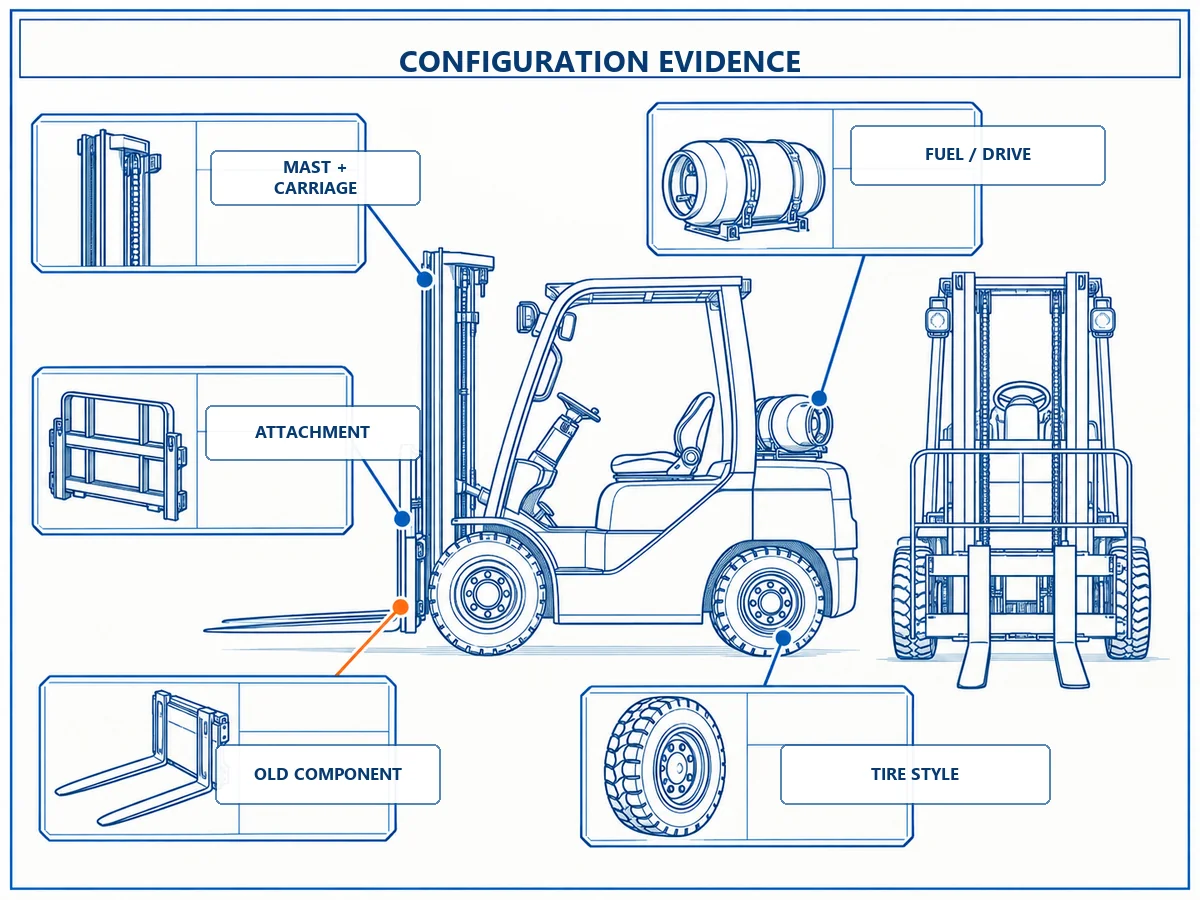
Photograph the mast and carriage from the front and side. Note the mast arrangement, visible lift height information, carriage style, side-shift or other attachment, and any unusual brackets. For a component connected to the lift system, include the mounting face, hose or connector location, and the part in place before removal when it is safe to do so.
Fuel, tire, and option clues
Record the fuel or drive arrangement shown on the truck and note the tire style. Add visible options that could affect the part, such as a different attachment, lighting package, enclosure, or control arrangement. The purpose is not to build a complete machine specification. The purpose is to explain which version the requested component came from.
Old-part evidence
Send the removed component’s readable label, stamped number, connector, hose end, fastener pattern, mounting face, and photos from more than one angle. If a measurement is important, label where it was taken and state that it was measured from the actual part. If there is no readable number, leave it unknown and ask for a visual or diagram cross-check.
This evidence matters most for mast, hydraulic, brake, steering, electrical, and attachment-related requests, where a similar-looking component may follow a different option or serial break. (Toyota Material Handling, 2023)
For component-specific checks, the forklift side-shifter fitment guide, hydraulic pump guide, fuel-system guide, and forklift filters guide show which extra details commonly belong in a request.
Use the parts manual as a cross-check, not final proof
A Toyota 8FGU30 parts manual or diagram is valuable because it can organize the machine by system, illustration, reference number, and component group. Use it to narrow the search and explain what you are trying to replace. Do not treat a page found through a manual search as final fitment proof when the serial range, configuration, or revision is still unknown. (Toyota Material Handling, n.d.)
Match the system and illustration
First, confirm that the diagram names the same model family and the correct system. Then compare the illustrated component with the removed part. Check connector shape, hose routing, mounting points, fasteners, and any label or stamped number. A visual match is supporting evidence, not the whole decision.
Check revisions and supersessions
When a manual or listing shows a reference number, ask whether it is a current part number, an older reference, or a superseded number. Ask the supplier to verify the replacement number against the complete model and serial. If the diagram covers more than one configuration, ask which branch applies to your truck.
Know when to stop
Pause when the model is only a broad capacity label, the serial is missing, the manual names a nearby model, or the proposed part lacks a serial range or revision note. Toyota’s own parts guidance directs buyers to use model and serial information for fitment and to contact a dealer when further assistance is needed. (Toyota Material Handling, n.d.)
Toyota Material Handling’s parts workflow accepts model and serial data as the lookup pair. For a Toyota 8FGU30 parts manual, treat one diagram or reference number as a starting clue, then check the system, configuration, serial range, and revision before ordering. A page match alone is not fitment approval. (Toyota Material Handling, n.d.)
The safe question is not “Does this part look similar?” It is “Which evidence confirms this component for this model, serial, and configuration?”
Send a fitment-ready Toyota 8FGU30 parts request
Turn the evidence into one compact message. A clear request reduces the back-and-forth that occurs when a buyer sends only “Toyota 8FGU30 part” and expects the supplier to infer the rest. (Toyota Material Handling, n.d.)
Copy-and-send request fields
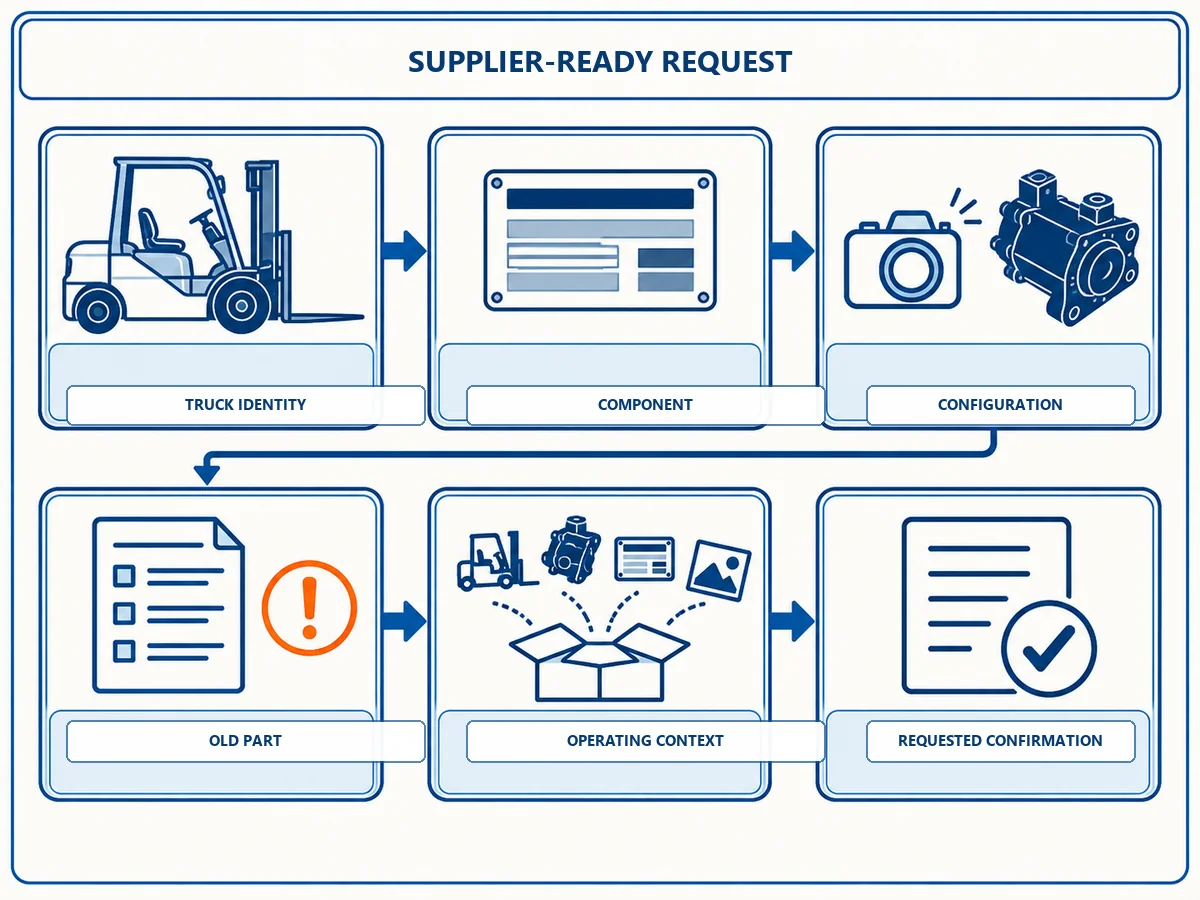
- Truck: Toyota 8FGU30, complete serial number, and a clear data-plate photo.
- Component: System name, component name, quantity, and whether it is in place or removed.
- Configuration: Fuel or drive type, tire style, mast, carriage, attachment, and visible options that may matter.
- Old part: Readable number, label, connector, hose end, mounting face, dimensions, and clear photos.
- Operating context: What failed, what is being serviced, and whether the truck is down.
- Requested confirmation: Proposed part number, serial range, revision or supersession, remaining unknowns, availability, price, and lead time.
What the supplier should confirm
Ask the supplier to state which details were used for the match. The answer should distinguish the model and serial evidence supplied by the buyer from the replacement part and revision confirmed by the supplier. If a required field is still unknown, the response should say so and request the missing photo, measurement, or identifier.
When not to place the order yet
Wait when the serial number is partial, the model code conflicts across photos, the attachment is unclear, or the proposed part is supported only by a nearby model or generic “fits Toyota” wording. Toyota’s parts service workflow supports model and serial based assistance, but it does not turn an incomplete buyer record into automatic compatibility approval. (Toyota Material Handling, n.d.)
A fitment-ready Toyota 8FGU30 request should contain six groups of information: truck identity, component, configuration, old part, operating context, and requested confirmation. Toyota Material Handling’s parts guidance supports using model and serial together, while the supplier still must confirm the replacement number and any supersession. (Toyota Material Handling, n.d.)
The same evidence-first approach applies to forklift brake parts, electrical parts, hydraulic cylinders, and alternators. For broader procurement planning, use the forklift parts sourcing guide.
Common assumptions that cause wrong forklift parts
Use the checklist to avoid these shortcuts:
- “The model is enough.” The model starts the lookup, while the serial and configuration narrow the truck-level fitment.
- “The 30 suffix is the part number.” It is part of the model designation, not proof of a component identity.
- “The public spec sheet is the truck record.” A reference configuration does not replace the actual data plate and options.
- “The first diagram result is current.” Check the serial range, revision, and supersession status.
- “A similar photo means a match.” Compare the old part, connectors, mounting points, and supplier confirmation.
If one of these fields is missing, label the gap in the request. A visible unknown is easier to resolve than an incorrect assumption that has already become a purchase order.
Conclusion
For a Toyota 8FGU30 parts request, use this sequence: identify the model, record the complete serial, capture the truck configuration and old-part evidence, then ask the supplier to confirm the part number and revision. If one field is unknown, mark it before ordering. That turns a generic model search into a fitment-ready request. (Toyota Material Handling, n.d.)
References
- Toyota Material Handling. (n.d.). Finding your model and serial number. Toyota Forklifts. https://www.toyotaforklift.com/help/mytoyota-store/articles/22978549001627-finding-your-model-and-serial-number
- Toyota Material Handling. (2023). Core IC pneumatic: Specifications [PDF]. Toyota Material Handling. https://www.toyotaforklift.com/content/dam/tmh/marketing/en/pdf/product-spec-brochures/2023_Core IC Pneumatic_Spec Sheet_Digital.pdf
- Toyota Material Handling. (n.d.). Parts and service. Toyota Forklifts. https://www.toyotaforklift.com/parts-and-service
Last reviewed and updated: September 2026. Author: Kingstream team. For tailored guidance, contact our team.