
TL;DR
A forklift runs four filters – engine air, engine oil, diesel fuel (usually with a water separator) and hydraulic return – and none is interchangeable with another. Match each part to its service point first, then verify the spec: air elements are dry paper rated under ISO 5011, hydraulic elements carry an ISO 16889 beta ratio and an ISO 4406 cleanliness target, and every family has a specific thread or port size (for example M20x1.5, M16x1.5 or 3/4-16 UNF). Buy by specification and OEM cross reference, not by part shape alone.
Abstract
A single forklift carries four separate filtration systems – engine air, engine oil, diesel fuel and hydraulic return – and each is a different product with its own test standard, efficiency or micron rating, thread or port size and OEM cross reference. The guide below gives a spec-first framework for telling the four filter families apart and ordering the correct in-stock forklift filter by specification rather than by a look-alike part number.
Key Takeaways
- A forklift uses four filter families – engine air, oil, fuel and hydraulic – that are not interchangeable
- Choose each filter by spec: media efficiency, ISO test standard, thread size and OEM cross reference
- Air elements are dry paper rated under ISO 5011; hydraulic elements are beta-ratio rated under ISO 16889
- A hydraulic filter is not an engine oil filter: different media, different standard, different thread
- Diesel fuel filters usually pair with a water separator and use fine 3-5 micron media to protect injectors
- Confirm the change interval in your OEM manual; forklift service runs on an engine-hours schedule
Table of Contents
- Abstract
- Key Takeaways
- Why a Forklift Runs Four Filters: Air, Oil, Fuel and Hydraulic
- How to Choose a Forklift Filter by Spec (Not by Part Number)
- Filter Specs, Decoded: Micron, ISO 5011, ISO 16889 and ISO 4406
- Forklift Air Filters: Dry-Paper Elements, ISO 5011 Rating and Fit
- Forklift Oil Filters: Thread Size, Bypass Valve and Burst Rating
- Forklift Fuel Filters and Water Separators: Micron Rating and Flow
- Forklift Hydraulic Filters: Beta Ratio, ISO 4406 Cleanliness and Return-Line Design
- Forklift Filter Specs Compared: Air vs Oil vs Fuel vs Hydraulic
- When to Replace Forklift Filters: Clog Signs and Service Intervals
- Frequently Asked Questions
- Conclusion
- References
Why a Forklift Runs Four Filters: Air, Oil, Fuel and Hydraulic
A lift truck that burns diesel or LPG carries four separate filter families at the same time: engine intake air, engine lube oil, diesel fuel (with a water separator on most trucks), and hydraulic return oil. Each family is a different product with its own media, test standard, thread and cross reference, and none is interchangeable with another. Ordering by part shape or by family name is the fastest route to the wrong filter, because the spec that proves fit on one family says nothing about the others.
Four service points, four different contamination jobs
Each filter guards a different precision surface on the machine. The air element keeps abrasive dust out of the intake before the engine can pull it into the cylinders. The oil filter scrubs wear particles and combustion soot from the lube circuit before that oil returns to the bearings. The fuel filter, plus its water separator, protects the injection pump from hard particles and free water. The hydraulic return filter catches pump, motor and cylinder wear debris before the oil is recirculated through the valves and actuators. The same four-way logic holds whether the truck is new or ten years old, which is why parts lists group them as separate families rather than one generic filter.
Which filters apply to IC (diesel or LPG) versus electric forklifts
Internal-combustion units, diesel or LPG, run all four families. A battery-electric forklift has no engine at all, so there is no intake-air element, no lube-oil filter and no fuel path; the hydraulic return filter still applies because an electric truck uses a hydraulic pump for steering, mast lift and tilt. Identify the drive type first, and the list of families you need to order collapses from four to one.
A single internal-combustion forklift can be carrying all 4 filters when a service interval comes due, while a battery-electric unit of similar capacity typically needs only the hydraulic return element, so 3 of the 4 engine-side service points simply do not exist on it. The rest of the guide applies the same spec-first method to whichever of the 4 your truck uses.
How to Choose a Forklift Filter by Spec (Not by Part Number)
Choosing a forklift filter by specification rather than by a part number means checking the family, the media and its rating, the thread or port, and the OEM cross reference in that order. That order is what catches look-alike parts before they cause a return or downtime.
The quick table below is the decision snapshot for the four families. Each column is explained step by step after it, and the concrete numbers for every family appear in the sections that follow.
| Filter family | What it filters | Key spec standard | Element style | First clue it is due |
|---|---|---|---|---|
| Air | Engine intake air | ISO 5011 (ISO, 2020) | Dry paper with polyurethane seals | Restriction gauge, lost power |
| Oil | Engine lube oil | OEM lube spec | Spin-on canister | Low oil pressure at hot idle |
| Fuel | Diesel fuel, then water | Fine-media fuel grade | Spin-on or element with separator | Hard start, water in bowl |
| Hydraulic | Return oil to the tank | ISO 16889, ISO 4406 (ISO, 2022) (ISO, 2021) | Return-line element | Differential-pressure gauge in change band |
Step 1: Confirm the filter family and service point
Start with the circuit the filter serves, not the shape. On an internal-combustion truck the candidates are engine air, engine oil, diesel fuel with water separation, and hydraulic return. A similar-looking spin-on can serve the oil, fuel or hydraulic circuit, so the housing and the line it sits on name the family before any number does.
Step 2: Match media class and efficiency rating
Each family is rated by a different rule. Engine air elements are tested as dry paper under ISO 5011 (ISO, 2020); hydraulic elements are efficiency-rated by an ISO 16889 multipass beta test (ISO, 2022); hydraulic oil cleanliness is coded under ISO 4406 (ISO, 2021). Compare the replacement’s media and rating against the OEM part, not against a look-alike label.
Step 3: Verify thread or port size and element style
Filters arrive as a spin-on canister or as an element that seats in a housing. The thread, gasket and style must match the head exactly, because a spin-on and an element are not interchangeable. Note whether a bypass or anti-drainback valve belongs to the design; the family sections give the exact sizes for each.
Step 4: Check the OEM number and cross reference
The OEM part number is the shortest route to the correct filter. A cross reference maps that number to aftermarket equivalents, so match the OEM number, the physical spec and the supplier reference together. If only the shape matches and the numbers do not, keep looking.
Step 5: Note the service schedule that applies
Filters are replaced on an engine-hours schedule from the OEM manual, and each family sits on a different point in that schedule. Record which service point the part belongs to so the replacement ships with the right lube and labor, and confirm the interval in the manual rather than assuming a round number.
Because the ratings live on different standards, the ISO designation on the box tells you which test a number came from: ISO 5011 for engine air-cleaner performance, ISO 16889 for the hydraulic multipass beta test, and ISO 4406 for coding contamination in hydraulic oil (ISO, 2020) (ISO, 2022) (ISO, 2021). Confirming family, media rating, thread and OEM reference in that order is what separates a matched order from a return.
Choose a forklift filter by specification, not by part number alone: confirm the family and service point, match the media and efficiency rating, verify thread or port size and element style, then check the OEM cross reference. Engine air elements are dry paper tested under ISO 5011 (ISO, 2020); hydraulic elements carry an ISO 16889 (ISO, 2022) beta rating.
Filter Specs, Decoded: Micron, ISO 5011, ISO 16889 and ISO 4406
Four terms carry most of the meaning on a forklift filter label: nominal micron rating, beta ratio, and the ISO designations 5011, 16889 and 4406. Once those are clear, the marketing on the box becomes background noise.
Nominal micron rating versus tested efficiency
A nominal micron rating is a design target: the particle size the media is built to stop. Tested efficiency is the measured result under a defined procedure, such as the ISO 5011 removal figure for an air element (ISO, 2020).
What a beta ratio really means (ISO 16889)
The ISO 16889 multipass test counts particles upstream and downstream of the element at one chosen size to produce a beta ratio (ISO, 2022). Efficiency equals (beta – 1) divided by beta (Ringholm, 2004), so a beta of 200 means the element holds about 99.5% of particles at that size.
What an ISO 4406 cleanliness code tells you
ISO 4406 codes hydraulic fluid cleanliness as three numbers, one per particle-size range (ISO, 2021). Lower numbers mean cleaner oil, and the code targets the whole hydraulic system rather than a single filter rating.
Marketing phrases you can ignore
Treat "universal fit", a micron figure with no test standard, and a logo without an OEM cross reference as noise.
Glossary
- Nominal micron rating. The particle size a filter is designed to stop, not a tested removal result.
- Beta ratio. Upstream particles divided by downstream particles in the ISO 16889 test; efficiency equals (beta – 1) / beta (Ringholm, 2004).
- ISO 5011. Performance test for engine inlet air cleaners; current edition ISO 5011:2020 (ISO, 2020).
- ISO 16889. Multipass method that rates hydraulic element filtration; current edition ISO 16889:2022 (ISO, 2022).
- ISO 4406. Contamination-level code for hydraulic fluid by particle counts; current edition ISO 4406:2021 (ISO, 2021).
- Bypass valve. Opens to route oil around a plugged element and prevent a pressure spike.
- Anti-drainback valve. Keeps oil in the housing between runs for a clean start.
Forklift Air Filters: Dry-Paper Elements, ISO 5011 Rating and Fit
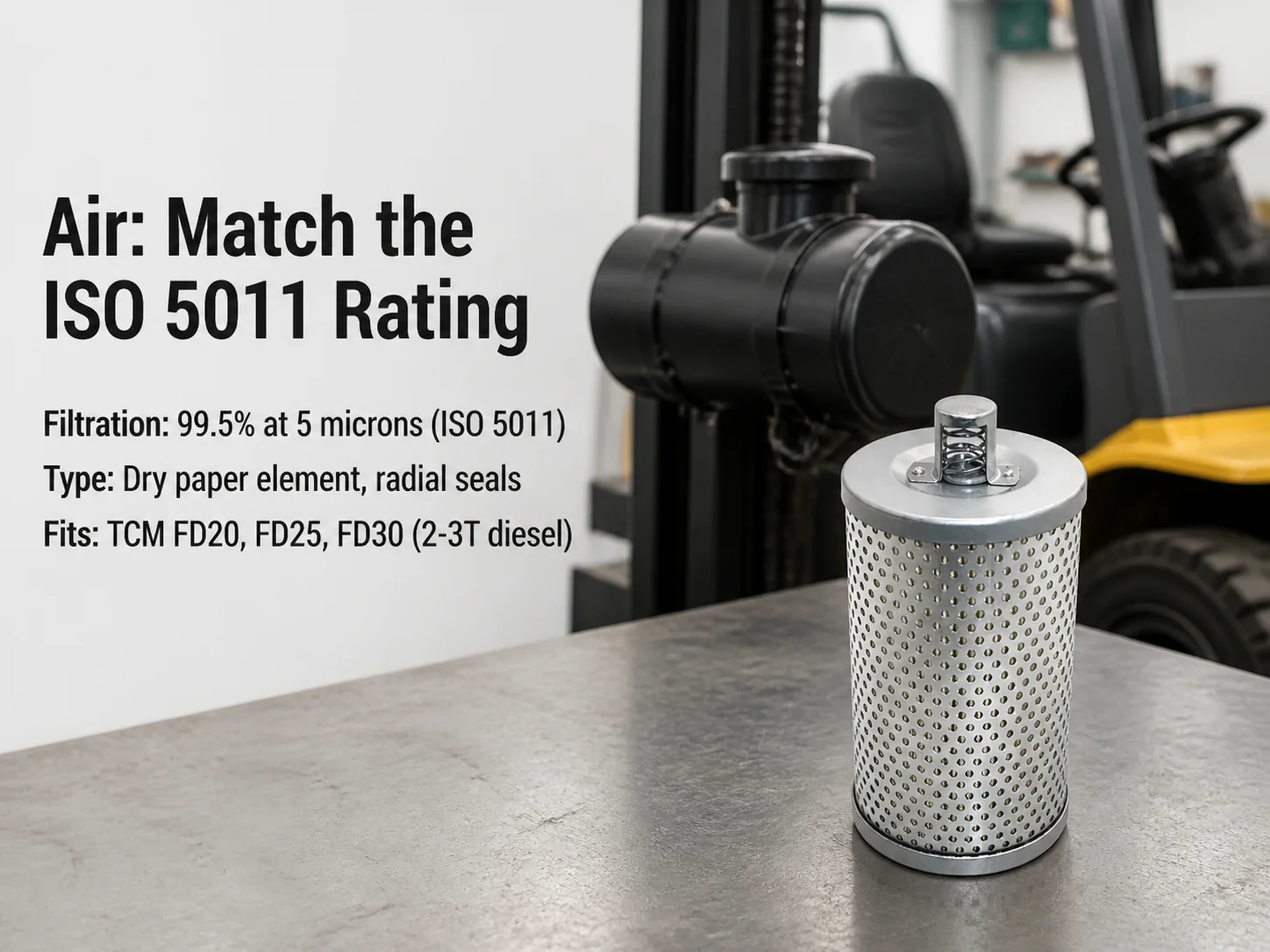
The air filter on a diesel or LPG forklift guards the engine intake, and its spec is short: a dry-paper element with radial polyurethane seals, a vendor-rated efficiency figure under ISO 5011, and a housing size the catalog lists by outside diameter and height. Match those against the OEM part and the element fits without guesswork.
Media and construction: dry paper, radial polyurethane seals
Air elements here are dry-paper types, not oil-bath designs; an oil-bath unit will not seat the same way in a dry-paper housing. The polyurethane seal is radial, so the outside diameter of the element decides the fit (Kingstream Parts, n.d.). A seal that does not seat squarely lets unfiltered air bypass the pleats and reach the engine.
What ‘99.5% at 5 microns’ really means (vendor-rated under ISO 5011)
ISO 5011:2020 is the test method for engine intake air cleaners (ISO, 2020). Important caveat: a figure like 99.5% at 5 microns under that standard is vendor-declared: the maker rates the element under the test, not as a certified laboratory result (Kingstream Parts, n.d.). The 214A7-52081 for TCM 2-3 ton trucks carries that figure, and the K1025 for Heli or Liugong A30-A35 models is rated at 99.5% or better at 5 microns over about -40°C to +120°C (Kingstream Parts, n.d.). Keep the standard attached to the number, because "99.5%" alone does not say which test produced it.
Reading the OEM cross reference for your engine family
OEM cross references resolve most of the guesswork. The 214A7-52081 serves the intake housing on TCM 2-3 ton machines; the K1025 serves Heli and Liugong A30-A35 machines, where the element measures 100 mm outside diameter, 60 mm inside and 250 mm tall (Kingstream Parts, n.d.). Confirm the housing seal style and the element height against the old part before ordering. Compare the full range of forklift air filters in stock against your OEM number.
Two maintenance habits shorten element life: cleaning a dry-paper element with compressed air punches holes through the pleats that are hard to see, and over-tightening the housing cover takes a permanent set in the polyurethane end seal. Both faults let unfiltered air reach the intake.
Forklift air filter elements are dry-paper units with radial polyurethane seals, not oil-bath designs. The 214A7-52081 for TCM 2-3 ton trucks and the K1025 for Heli and Liugong A30-A35 trucks are rated at 99.5% or better at 5 microns under ISO 5011 (Kingstream Parts, n.d.). Match the outside diameter and height to the housing before ordering.
Let us take a look
Keep the spec-first habit from this guide when you order: the OEM part number plus the family, thread and governing standard is enough for a clean match. Send those to Kingstream Parts and the sourcing team checks the cross reference against your make and model before quoting. Request a filter quote
By the Numbers
- 99.5% filtration efficiency at 5 microns, ISO 5011 vendor-rated (Kingstream Parts, n.d.)
- 100 × 250 mm element OD and height on the K1025 (Kingstream Parts, n.d.)
- -40 to +120°C rated working range, K1025 air element (Kingstream Parts, n.d.)
Forklift Oil Filters: Thread Size, Bypass Valve and Burst Rating
The engine oil filter is a spin-on canister, and its fit is set by the thread, the bypass valve behavior and the burst rating, in that order (Kingstream Parts, n.d.). Confirm those three against the OEM number before ordering, because an off-spec thread or bypass spring turns a routine change into a lubrication failure.
Spin-on engine oil filters: thread, gasket and canister
A spin-on oil filter threads onto a base and seals through a flat gasket. The JX85100C is the metric example, an M20x1.5 thread built for oil pumps moving 16-20 L/min, with roughly 96% efficiency at 30 microns (Kingstream Parts, n.d.). The GX630-OIL is the UNF example, a 3/4-16 UNF thread with a 350 PSI burst rating and about 95% efficiency at 20 microns.
Bypass valve and burst rating: why they are safety-relevant
The bypass valve keeps oil moving when the element is cold or clogged, and the burst rating is how much pressure the canister can hold before it fails. The JX85100C bypass opens at 1.0 bar so a blocked element does not starve the engine (Kingstream Parts, n.d.); the GX630-OIL 350 PSI burst gives headroom above normal lube pressure. The wrong bypass spring opens too early or too late, and an off-spec thread can strip the base or seat the gasket crooked.
Warning: Do not substitute an engine oil filter that only looks close. An M20x1.5 part will not seal on a 3/4-16 UNF base, and a bypass spring rated for the wrong pressure bypasses unfiltered oil into the bearings or holds the element shut until the canister bursts.
Matching the OEM lube filter cross reference
The OEM number is the anchor. The JX85100C and the GX630-OIL each carry a cross reference back to the original lube filter part for the engine they serve, so match the OEM number, the thread and the gasket together rather than by brand alone (Kingstream Parts, n.d.). An engine oil filter is a separate product class from the hydraulic return element, and the two are not interchangeable. For a current stock list with cross references, browse the forklift oil filter range.
Match an engine oil filter to the base thread and valve spec. The JX85100C uses an M20x1.5 thread with a bypass valve opening at 1.0 bar and about 96% efficiency at 30 microns, for oil pumps moving 16-20 L/min (Kingstream Parts, n.d.). The GX630-OIL uses a 3/4-16 UNF thread with a 350 PSI burst rating.
Forklift Fuel Filters and Water Separators: Micron Rating and Flow
A diesel fuel filter on a forklift does two jobs: it removes particles fine enough to score the injection pump, and it separates free water before the fuel reaches the injectors. The specs that carry that duty are the micron rating, the thread and the flow at an acceptable pressure drop (Kingstream Parts, n.d.).
Why diesel fuel filtration is finer than automotive-grade
Injection pumps hold internal clearances in the 2-5 micron range, so particles that size can score the plunger, barrel and injector surfaces. The CX0708-490 for Xinchai 490, 490B and 498B engines removes particles down to 3-5 microns and flows 25-30 L/min with less than 0.06 MPa pressure drop (Kingstream Parts, n.d.). The 13020488 is a 5-7 micron depth-filtration cellulose element with an integrated water separator bowl and a 500 PSI burst rating.
Fuel/water separator: the second job of a fuel filter
Water settles below the fuel line in the separator bowl, where it is drained on schedule instead of being pumped into the injection system. Counter to what the ‘water separator’ name can imply, the bowl does not wring dissolved moisture out of the fuel; it collects the free water that has already settled out, which is exactly why it carries a drain. The 13020488 combines that separator duty with fine cellulose media in one spin-on unit. When the bowl shows water, the filter has already done its job; drain the bowl and give the element a close look.
Thread, flow rate and pressure-drop specs to check
Fit and flow are both part of the spec. The CX0708-490 carries an M16x1.5 thread, measures 78.5 mm across by 105 mm high, flows 25-30 L/min and holds pressure drop under 0.06 MPa when clean (Kingstream Parts, n.d.). For the Cummins 4BT3.3, 4BT, 6BT and QSB family, the FS19594 head uses a 3/4-16 UNF thread at 76 mm outside diameter. Prime a new filter by filling through the outer ring of inlet holes, never the center thread, so the media wets evenly.
A 3-5 micron fuel filter such as the CX0708-490 is sized for the Xinchai 490 family at 25-30 L/min, while the 13020488 handles 5-7 micron depth filtration with its separator bowl at 500 PSI burst (Kingstream Parts, n.d.). Match the micron rating to the 2-5 micron pump clearances and the thread to the head. For stock options, browse the forklift fuel filter category.
Diesel injection pumps on a forklift hold internal clearances of 2-5 microns, so fuel filtration must stop particles in that range. The CX0708-490 for Xinchai 490, 490B and 498B engines removes 3-5 micron particles and flows 25-30 L/min with less than 0.06 MPa pressure drop, on an M16x1.5 thread (Kingstream Parts, n.d.).
Forklift Hydraulic Filters: Beta Ratio, ISO 4406 Cleanliness and Return-Line Design
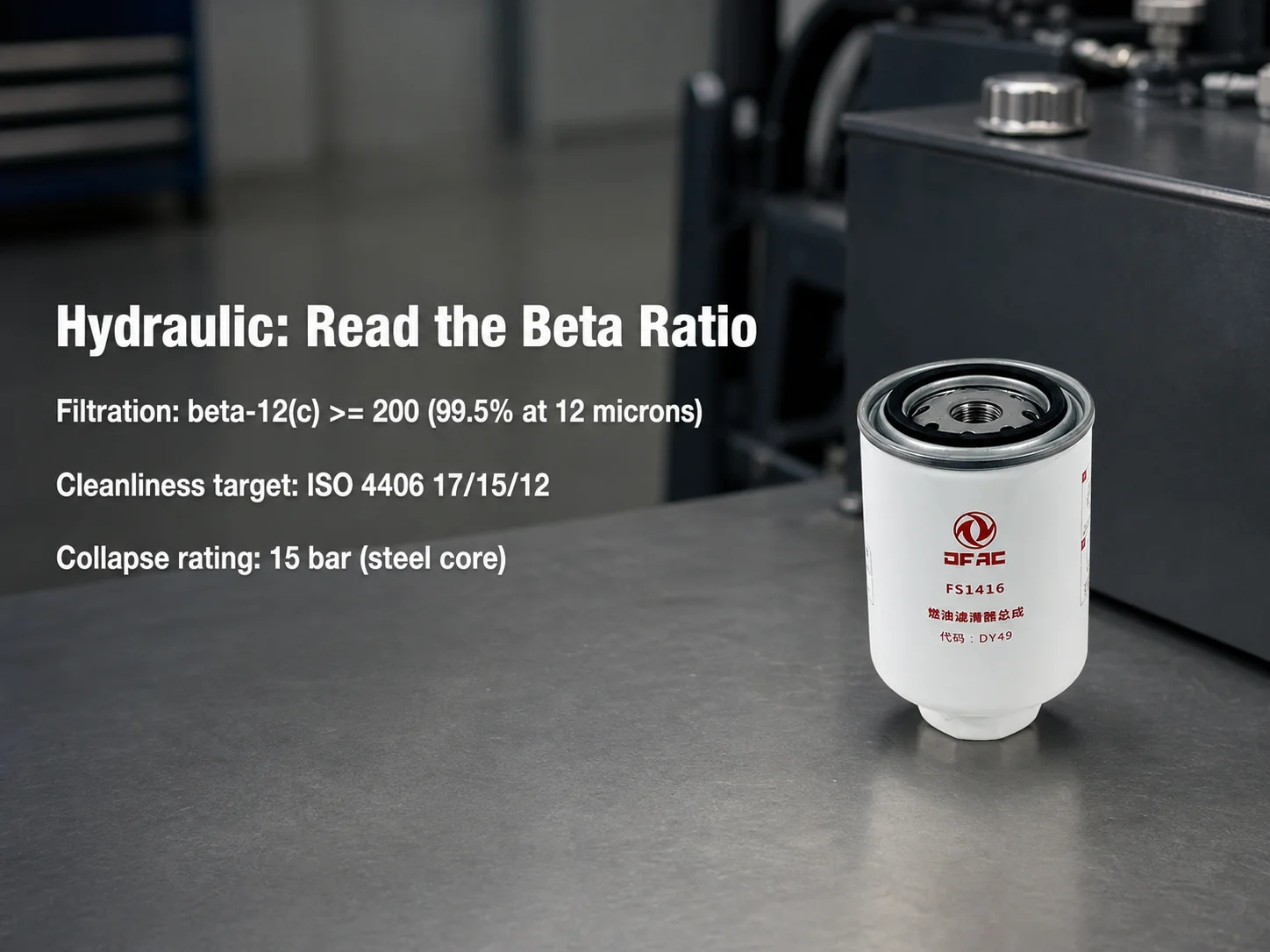
A hydraulic return-line filter is rated by its ISO 16889 beta ratio and the ISO 4406 cleanliness target it supports, not by a micron number alone (Day, 2001). Read both and you can tell a genuine hydraulic element from an engine oil filter at a glance.
Return-line hydraulic elements: where they sit in the circuit
A return-line element sits on the low-pressure line that carries oil back to the reservoir, catching the wear debris the pump, valves and cylinders shed before that oil is reused (Kingstream Parts, n.d.). The FS1416 is a synthetic glass-fiber element with a beta-12(c) ratio of 200 or better, meaning 99.5% efficiency at 12 microns, supporting an ISO 4406 code of 17/15/12 (Kingstream Parts, n.d.). The FTCE1A10Q is a multi-layer synthetic microfiber return-line element, ISO 16889 compliant, with a beta-10(c) ratio of 200 or better and a 10 bar collapse rating.
ISO 16889 beta ratio and ISO 4406 cleanliness codes
Beta ratio measures efficiency: efficiency equals (beta – 1) divided by beta, so a beta of 200 at a given size means the element holds about 99.5% of particles at that size (Kingstream Parts, n.d.). ISO 4406 then codes how clean the oil must be. The FS1416 supports a 17/15/12 target, while the 25967-82001, a resin-impregnated cellulose element rated at a nominal 10 microns, supports an 18/16/13 target. The beta ratio tells you what the element removes at the rated size; the ISO 4406 code tells you the contamination level the system is designed to hold (Day, 2001).
How to tell a hydraulic filter from an engine oil filter
Because a hydraulic return filter and an engine oil filter can look alike on the shelf, the two are often confused when an order is matched by shape alone. A hydraulic filter is not an engine oil filter. The media differ (synthetic glass or microfiber versus cellulose), the test standard differs (ISO 16889 multipass versus lube-oil duty), and the fitting can differ, so the two are not interchangeable. A hydraulic element like the 0815, rated at 10 microns with a 2.5 bar bypass, belongs in the return line, not on the engine oil base. Fitting the wrong spring invites premature bypass or element collapse, so confirm the bypass and the mounting before install. For stock options, browse the forklift hydraulic filter range.
A hydraulic return-line filter protects the reservoir-side circuit, and its rating is an ISO 16889 beta ratio plus an ISO 4406 cleanliness code. The FS1416 synthetic glass-fiber element carries a beta-12(c) ratio of 200 or better, equal to 99.5% efficiency at 12 microns, supporting an ISO 4406 code of 17/15/12 (Kingstream Parts, n.d.).
Forklift Filter Specs Compared: Air vs Oil vs Fuel vs Hydraulic
The side-by-side table below restates the exact figures from the family sections, so the values in each cell match the sections above verbatim. No new numbers appear here; the table exists to make the four families easy to compare on one screen. To build it, we compared each in-stock family against its OEM cross reference rather than trusting the label alone.
Side-by-side spec table across the four families
| Spec parameter | Air (example part) | Oil (example part) | Fuel (example part) | Hydraulic (example part) |
|---|---|---|---|---|
| Element style / media | Dry paper with polyurethane radial seals | Spin-on canister | Spin-on or element, depth cellulose | Return-line element, synthetic glass or microfiber |
| Efficiency / micron rating | 99.5% at 5 microns, vendor-rated under ISO 5011 | ~96% at 30 microns; ~95% at 20 microns | 3-5 microns and 5-7 microns media | beta-12(c) ≥ 200 (99.5% at 12 microns); beta-10(c) ≥ 200 |
| Governing standard | ISO 5011 | OEM lube spec | OEM fuel spec | ISO 16889 and ISO 4406 |
| Example thread / fitting | Radial polyurethane seal, no thread | M20x1.5 and 3/4-16 UNF | M16x1.5 and 3/4-16 UNF | Return-line and spin-on mounts |
| Example OEM part | 214A7-52081 / K1025 | JX85100C / GX630-OIL | CX0708-490 / 13020488 / FS19594 | FS1416 / FTCE1A10Q / 25967-82001 |
The pattern across the table is the point: engine air is tested under ISO 5011, hydraulic elements under ISO 16889 with an ISO 4406 code, while oil and fuel filters are matched to the OEM spec. Comparing the thread column shows why substitution fails: an M20x1.5 oil filter, an M16x1.5 fuel filter and a threadless air element cannot share one mount.
Reading an OEM cross reference in the catalog
An OEM cross reference maps the original part number to the aftermarket equivalents that share its spec, so the reading order matters: confirm the family first, then the standard, then the thread or seal style. Because the table above keeps the numbers verbatim, a catalog listing that matches the OEM number should also match one full row of the table before it is trusted.
When to request a quote with a part number
The fastest way to order is to lead with the OEM number and the family, then confirm the fitting. Requesting a quote by OEM number alone risks an automatic cross that ignores whether the part is a spin-on or an element. Add the thread or seal style and the governing standard from the table, and the quote comes back for the right family on the first pass. State the forklift model and engine family on the request so the cross reference can be checked against your machine.
When to Replace Forklift Filters: Clog Signs and Service Intervals
Filters are replaced on clog signals and on the engine-hours schedule, and the two must be read together. The family sections give the specs, and the triggers follow below.
Clog and bypass warning signs by filter family
- Air: restriction gauge in the change band or lost power under load.
- Oil: low oil pressure at hot idle or early bypass; the hours schedule is the usual trigger.
- Fuel: hard starting or water in the bowl; drain it and inspect the element.
- Hydraulic: differential-pressure gauge in the change zone or growling at cold start; never run until the bypass opens.
Interval guidance: engine-hours schedule, confirm in the OEM manual
Forklift service runs on engine hours, not miles, and the interval is set by the OEM manual for the specific machine and duty. No universal hour count applies across makes, so confirm each service point in that manual.
Warning: A generic replacement interval from the internet is not a substitute for the OEM manual. Confirm each service point against the hours schedule for your model and duty before ordering.
Inspect and replace without introducing contamination
Clean the housing and its sealing area before opening a filter, and inspect the seal surface on the removed part for fit clues. Drain the fuel/water separator bowl and prime a new fuel element correctly on refit.
Replace a hydraulic element when its differential-pressure gauge enters the change zone, which on a 2.5 bar bypass element such as the 0815 sits well before the valve opens. Confirm the air, oil, fuel and hydraulic service points against the OEM engine-hours schedule for your truck, because no universal hour count applies across makes.
Frequently Asked Questions
Short answers to the questions buyers search most. Every figure below is already sourced above, so the FAQ adds no new numbers.
Q: Are hydraulic filters the same as oil filters?
No. A hydraulic filter is a return-line element rated by an ISO 16889 beta ratio and an ISO 4406 code, while an engine oil filter is a spin-on canister chosen by thread and bypass valve. The media, standard and fitting differ, so each stays in its own circuit.
Q: What types of filters are used in hydraulic systems?
Forklift hydraulic systems filter the return line back to the reservoir, where the element catches pump, valve and cylinder wear before the oil is reused. Ratings appear as an ISO 16889 beta ratio, such as beta-12(c) of 200 or better, paired with the ISO 4406 code the system must hold.
Q: How do I know if my air intake filter is bad?
Watch the restriction gauge climb into the change band as the element loads with dust, and note lost power under load; a dust-loaded element or worn housing seal are the other signs. Replace it rather than cleaning it, since blowing a dry-paper element with compressed air punches holes in the media.
Q: Where are the hydraulic oil filters?
On a forklift the hydraulic filter sits on the return line back to the reservoir, not on the engine block. It is not the engine oil filter even when the canister looks similar; its differential-pressure indicator shows when it is due.
Q: Can one forklift filter type be substituted for another?
No. The air, oil, fuel and hydraulic families are separate products with different media, test standards and fittings. Crossing them risks unfiltered flow or a part that will not seat, so order by family and OEM cross reference rather than by shape.
Q: How often should forklift filters be replaced?
On the engine-hours schedule in the OEM manual for the specific truck, since duty and dust change how fast each filter loads. There is no single interval for all four families, so confirm each service point against the manual rather than assuming a round number.
Conclusion
(See verdict in main body sections.)
References
- International Organization for Standardization. (2020). Inlet air cleaning equipment for internal combustion engines and compressors: Performance testing (ISO 5011:2020). ISO. https://www.iso.org/standard/72490.html
- International Organization for Standardization. (2022). Hydraulic fluid power, filters: Multi-pass method for evaluating filtration performance of a filter element (ISO 16889:2022). ISO. https://www.iso.org/standard/77245.html
- International Organization for Standardization. (2021). Hydraulic fluid power, fluids: Method for coding level of contamination by solid particles (ISO 4406:2021). ISO. https://www.iso.org/standard/79716.html
- Ringholm, E. (2004). Understanding filter beta ratios. Machinery Lubrication. Noria Corporation. https://www.machinerylubrication.com/Read/564/filter-beta-ratios
- Day, M. (2001). Clarifying the new ISO contamination filtration standards. Machinery Lubrication. Noria Corporation. https://www.machinerylubrication.com/Read/217/iso-contamination
- Kingstream Parts. (n.d.). 214A7-52081 air filter for TCM 2-3 ton forklift [Product listing]. https://kingstreamparts.com/product/tcm-air-filter-214a7-52081/
- Kingstream Parts. (n.d.). K1025 air filter for Heli and Liugong A30-A35 forklifts [Product listing]. https://kingstreamparts.com/product/forklift-parts-filter-heli-k1025/
- Kingstream Parts. (n.d.). JX85100C oil filter for Xinchai 490B engines [Product listing]. https://kingstreamparts.com/product/forklift-oil-filter-jx85100c/
- Kingstream Parts. (n.d.). CX0708-490 fuel filter for Xinchai 490 engines [Product listing]. https://kingstreamparts.com/product/forklift-parts-filter-cx0708-490/
- Kingstream Parts. (n.d.). FS1416 hydraulic return-line filter [Product listing]. https://kingstreamparts.com/product/fs1416-hydraulic-filter-dx200m/
Last reviewed and updated: September 2026. Author: Kingstream team. For tailored guidance, contact our team.