
TL;DR
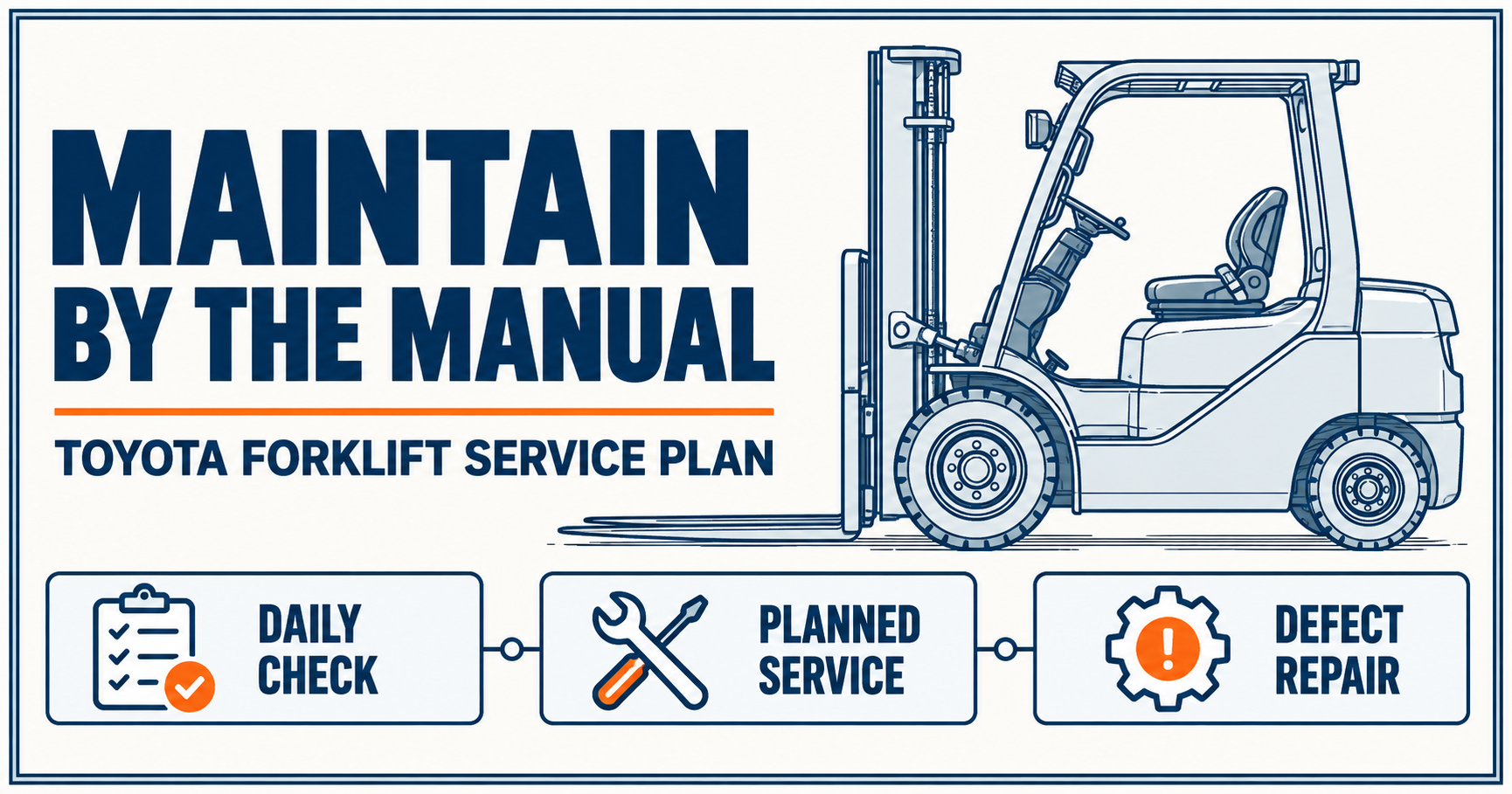
There is no safe Toyota forklift maintenance schedule that fits every model. Record the exact model and serial number, use the applicable Toyota manual, perform the required pre-shift inspection, track the hour meter, and remove the truck from service if a safety defect is found.
Abstract
A Toyota-specific maintenance planning guide that separates pre-shift inspection, planned service, and defect repair, then routes the reader to the exact model manual and fitment data.
Key Takeaways
- Use the exact Toyota model, serial number, and applicable manual before copying a service interval.
- Keep pre-shift inspection, planned service, and defect repair as separate layers.
- OSHA requires unsafe trucks to be removed from service and defects reported and corrected.
- The hour meter, power source, attachment, and operating environment affect service planning.
- Parts requests need model/serial and fitment review, not just a generic Toyota label.
Table of Contents
- Abstract
- Key Takeaways
- What is a Toyota forklift maintenance schedule?
- Start with the exact Toyota forklift and manual
- Daily or pre-shift Toyota forklift inspection checklist
- Planned service: use the hour meter and the manual
- Separate inspection, planned maintenance, and repair
- What to record before requesting Toyota forklift parts
- FAQ: Toyota forklift maintenance schedule questions
- Conclusion: build the schedule from the exact truck
- References
What is a Toyota forklift maintenance schedule?
A Toyota forklift maintenance schedule is a model-specific plan that combines 3 separate jobs:
- Pre-shift inspection: confirm that the truck is safe to operate before use.
- Planned maintenance: complete the checks, lubrication, adjustments, and replacements specified for that truck and its service condition.
- Defect repair: stop, report, and correct a safety problem instead of treating it as a routine service task.
There is no safe Toyota forklift maintenance schedule that can be copied unchanged across every model, power source, attachment, and operating environment. Start with the truck’s exact model and serial information, then use the applicable Toyota operating or maintenance manual as the controlling source for intervals and specifications.
Toyota’s inspection guidance supports a daily or pre-operation checklist, while OSHA sets the minimum safety boundary: a powered industrial truck must be examined before being placed in service, and an unsafe truck must not remain in operation.
Toyota’s model-specific approach has 3 layers: a pre-shift inspection to decide whether the truck is safe now, planned maintenance based on the hour meter and applicable manual, and defect repair when a safety problem is found. Toyota’s inspection guidance and OSHA’s daily examination rule support this separation; no universal Toyota interval is asserted here.
The schedule should answer three different questions
- Can this truck be used now? Complete the pre-shift inspection and operational check.
- What service is due? Use the hour meter, calendar/use pattern, power source, attachments, environment, and exact manual.
- What happens when something is wrong? Remove the truck from service when the problem affects safety, report it, and send it through an authorized repair process.
Keeping these questions separate makes the schedule useful. A daily checklist does not replace a planned service schedule, and a planned service entry does not authorize continued operation with a dangerous defect.
Start with the exact Toyota forklift and manual
Before copying an interval into a calendar or requesting a maintenance part, create an identity record for the truck. Toyota explains that the model and serial number on the data plate are important for technical assistance and replacement-part lookup.
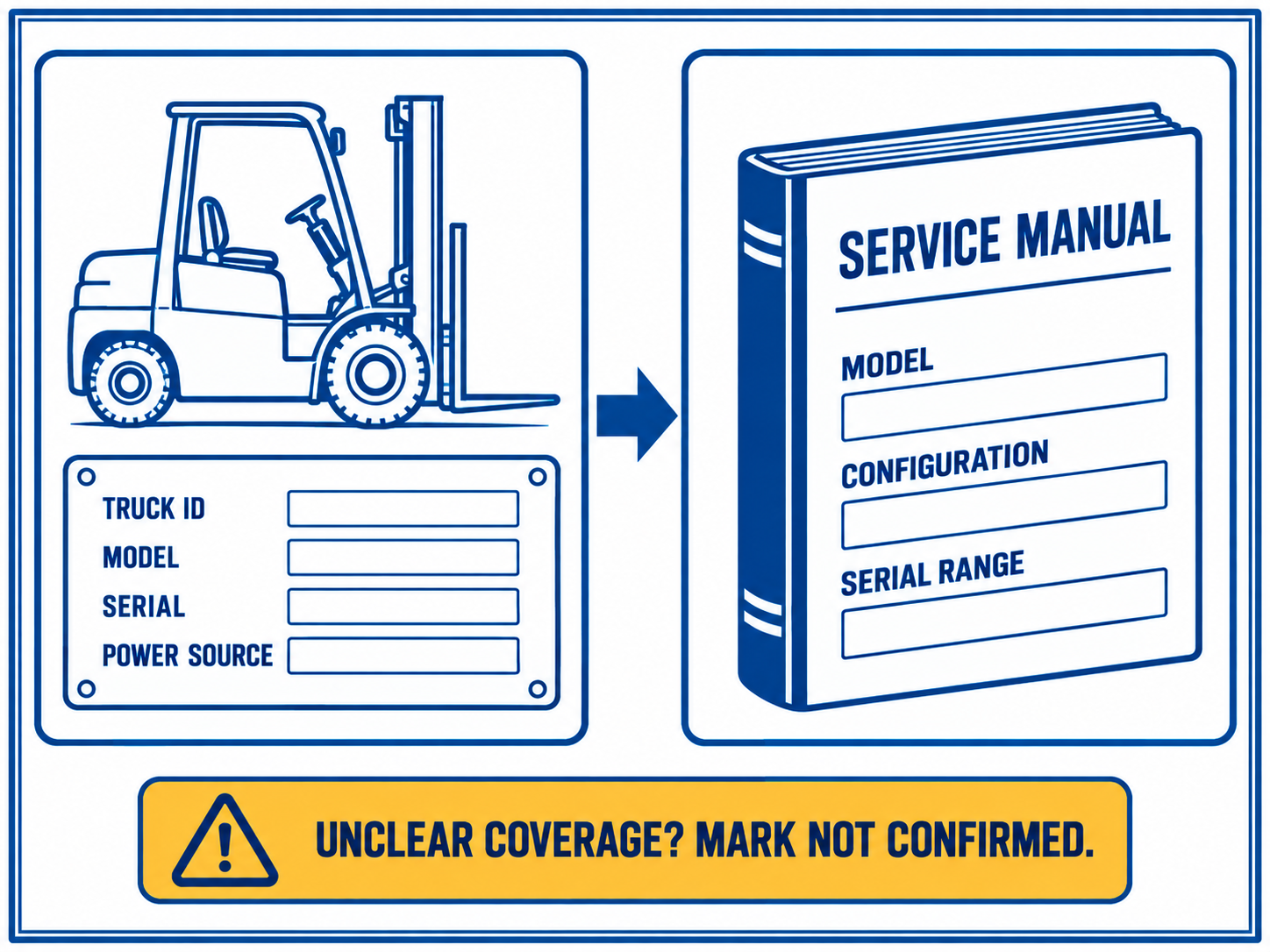
Record these 5 fields as they appear on the equipment or its existing service record:
| Field | Why it matters | Who confirms it |
|---|---|---|
| Toyota model number | Separates model families and configurations | Buyer or technician |
| Serial number | Helps narrow the applicable truck and fitment range | Buyer or technician |
| Power source | Changes the inspection and service items for IC and electric trucks | Buyer or technician |
| Hour-meter reading | Connects the truck’s use to the applicable service plan | Operator or technician |
| Attachments and environment | Heavy attachments, dust, heat, cold, and intensive use may change service needs | Fleet or maintenance team |
Use the complete model designation. Do not shorten a model number to a familiar family name if the manual or data plate includes additional letters, numbers, or configuration information. The goal is not to create a universal Toyota chart; it is to select the source that actually covers the truck.
Toyota’s data-plate guidance makes model and serial details central to technical assistance and replacement-part lookup. Record 5 fields before selecting a schedule: model number, serial number, power source, hour meter, and operating environment or attachments. Those fields identify the truck; the applicable manual still controls intervals, fluids, and replacement instructions.
Check the manual’s applicability notes
Once the identity record is complete, match it to the Toyota operating or maintenance manual for that truck. Check the model name, configuration, power source, revision, and any serial-range or applicability notes shown in the document.
If a manual is labeled for a nearby model but does not clearly cover the truck in front of you, mark the schedule as not confirmed. Do not fill the gap with an interval copied from a different Toyota series. The same rule applies before choosing a filter, belt, brake component, tire, hydraulic part, battery item, or other replacement component.
The manual is the source for the exact interval, fluid, capacity, adjustment, and replacement information. This article gives you the workflow for finding and using that source; it does not replace it.
Where we can help
Sourcing forklift parts in bulk? Contact Kingstream’s sourcing team with your part numbers and we will respond with availability and pricing.
Daily or pre-shift Toyota forklift inspection checklist
The daily inspection is the safety floor of a Toyota forklift maintenance schedule. Toyota’s pre-operation guidance describes a visual inspection followed by an operational check, and OSHA requires powered industrial trucks to be examined before being placed in service at least daily. Trucks used around the clock must be examined after each shift.
Use the truck’s own checklist where one is provided. A practical forklift inspection checklist can help organize the walkaround into these groups:
NIOSH Publication 2022-100 provides a detailed daily-inspection procedure for powered industrial trucks, including sit-down rider forklifts, consistent with OSHA 29 CFR 1910.178(q)(7). It addresses pre-use inspection; the Toyota manual still controls the model-specific planned-service interval.
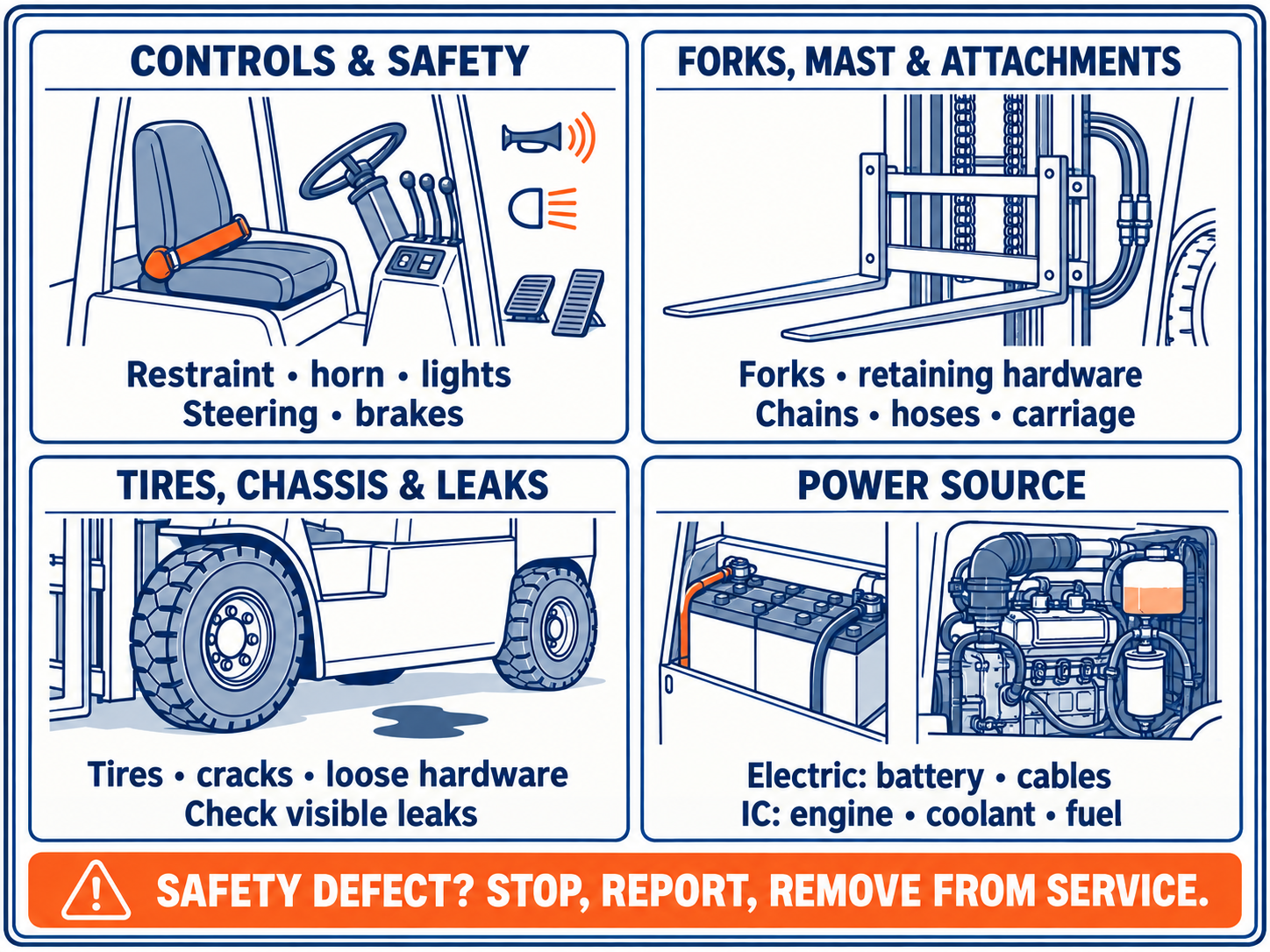
1. Safety devices and controls
- Seat belt or restraint system
- Horn, lights, alarms, and other fitted safety devices
- Warning labels, capacity plate, and operator documentation
- Steering, service brake, parking brake, and travel controls
2. Forks, mast, carriage, and attachments
- Forks, heels, retaining hardware, and visible damage
- Mast, chains, rollers, hoses, and cylinders for visible defects or leaks
- Load backrest and attachment mounting points
- Attachment operation, if the truck is fitted with one
Do not use hands to inspect a moving chain or attempt to test a suspected defect by placing yourself in a dangerous position. Keep the check within the operator’s training and the manufacturer’s instructions.
3. Tires, chassis, and leaks
- Tire condition and visible damage
- Loose hardware, cracks, and unusual noise
- Fuel, coolant, engine oil, hydraulic-fluid, or battery-related leaks as applicable
- Cleanliness around the engine, radiator, battery, and operator area
4. Power-source items
For an electric Toyota forklift, check the battery, restraints, cables, connectors, and charging-related items that the manual and site checklist identify. For an internal-combustion truck, check the applicable engine, coolant, fuel, air-intake, and hood or latch items.
Do not turn this checklist into a model-specific repair instruction. The purpose is to identify a condition that needs attention and route it correctly.
Stop condition: do not operate an unsafe truck
OSHA states that a powered industrial truck must not be placed in service if the examination finds a condition that adversely affects safety. Defects must be reported and corrected, and repairs must be handled by authorized personnel.
If a brake, steering control, fork, mast, restraint, tire, hydraulic system, alarm, or other safety-related item is defective, record the finding, notify the responsible supervisor, and remove the truck from service according to your site’s process. Do not keep operating it simply because the planned service date has not arrived.
Toyota’s pre-operation checklist and OSHA’s powered-industrial-truck rule establish a daily safety floor. A practical walkaround can cover 4 groups: controls and safety devices, forks and mast, tires and leaks, and power-source items. If any condition affects safe operation, report it, remove the truck from service, and route repairs to authorized personnel.
Planned service: use the hour meter and the manual
Planned maintenance answers a different question from the daily inspection: what service is due for this truck under its actual use? The answer should be built from the hour meter, calendar, power source, operating conditions, attachments, and the exact Toyota manual.
| Planning input | What to verify | Status without the exact manual |
|---|---|---|
| Hour meter | Current operating hours and the next service entry | Not confirmed |
| Calendar and use pattern | Whether the truck reaches a service point by time or operating hours first | Not confirmed |
| Power source | IC or electric-specific service items | Model-dependent |
| Attachments and load pattern | Whether attachment use or severe duty changes inspection needs | Confirm with manual or qualified service team |
| Environment | Dust, heat, cold, moisture, or other severe conditions | Confirm with manual or service plan |
| Service list | Lubrication, filters, fluids, brakes, mast, tires, battery/engine, and other listed items | Manual-specific |
Toyota Material Handling Solutions’ 2021 sample maintenance schedule illustrates the kinds of work a fleet may organize by hour and service stage. The same page also says the list is general and that the manufacturer’s guidance for the specific forklift should be followed.
That distinction matters. Do not copy a public 250-, 500-, 1,000-, or 2,000-hour example into every Toyota truck as if it were a universal Toyota requirement. Treat a sample schedule as a planning model only; use the exact manual for the actual interval, service list, fluid, filter, adjustment, and replacement instruction.
The 2021 Toyota Material Handling Solutions page presents 250-, 500-, 1,000-, and 2,000-hour examples, but labels the list general and directs readers to manufacturer guidance for the specific forklift. Those numbers are planning context, not a universal Toyota interval. Use the exact manual, hour meter, power source, and operating conditions.
Build a usable service record
For each scheduled event, record:
- Date and hour-meter reading
- Model and serial number
- Service level or manual section used
- Items checked, adjusted, lubricated, replaced, or deferred
- Defects found and the action taken
- Part numbers used, if verified
- Technician or responsible person
- Next due point according to the applicable schedule
If a value is not available in the matching manual, write not confirmed. A blank that remains visible is safer than an invented interval that looks authoritative.
Separate inspection, planned maintenance, and repair
Use the finding – not the calendar alone – to choose the next path.
Path 1: no safety defect found
Complete the pre-shift check, record it, and return the truck to operation within your site’s procedures. Continue tracking the hour meter and the next manual-based service point.
Path 2: planned service is due
Schedule the work described by the applicable Toyota manual or approved maintenance plan. Confirm the truck identity, service level, and parts list before ordering. A planned filter, fluid, belt, tire, or lubrication task should not be expanded into unrelated repairs without evidence from the inspection.
Path 3: a warning or defect is found
Stop and follow the site’s removal-from-service and reporting process. A warning light, fault code, leak, brake issue, steering issue, lift problem, or starting problem may require a focused diagnostic workflow rather than a routine maintenance entry. The Toyota forklift warning-light guide covers indicator checks. Use the Toyota fault-code guide for a separate code-verification path. Battery-charging and hydraulic-oil questions have their own sections elsewhere in the Toyota series; this schedule guide does not repeat those procedures.
This split keeps the maintenance record honest. "Inspected" does not mean "repaired," and "service due" does not mean a particular part has already failed.
Stop condition: do not order from a generic label
If the record says only "Toyota forklift part," it is not ready for fitment review. Add the exact model, serial number, system or component, current part number if visible, and the observed or scheduled task. Let the supplier confirm the current part number and compatibility during fitment review rather than treating a family name as proof.
What to record before requesting Toyota forklift parts
A maintenance schedule becomes commercially useful when the service record can be understood by the person checking the part or quote. Before requesting Toyota forklift maintenance parts, provide the truck identity from the data plate, including model and serial number, plus the power source shown on the truck.
Add the hour-meter reading, operating environment, attachment, duty pattern, and the manual section or scheduled item that is due. Name the system or component, such as the mast, hydraulic system, brake, steering, engine, transmission, electrical system, tire, or battery.
Describe the observed condition accurately. A leak, warning, wear, noise, or failure is different from a scheduled replacement. Include any current part number, casting or label information, clear photos, quantity, and whether the request is for planned service, repair, or an advance quotation.
Buyer fields and supplier fields are different
The buyer owns the information about the truck and the task. The supplier should confirm the current part number, fitment range, availability, and any required interchange or configuration review. Keep these roles separate:
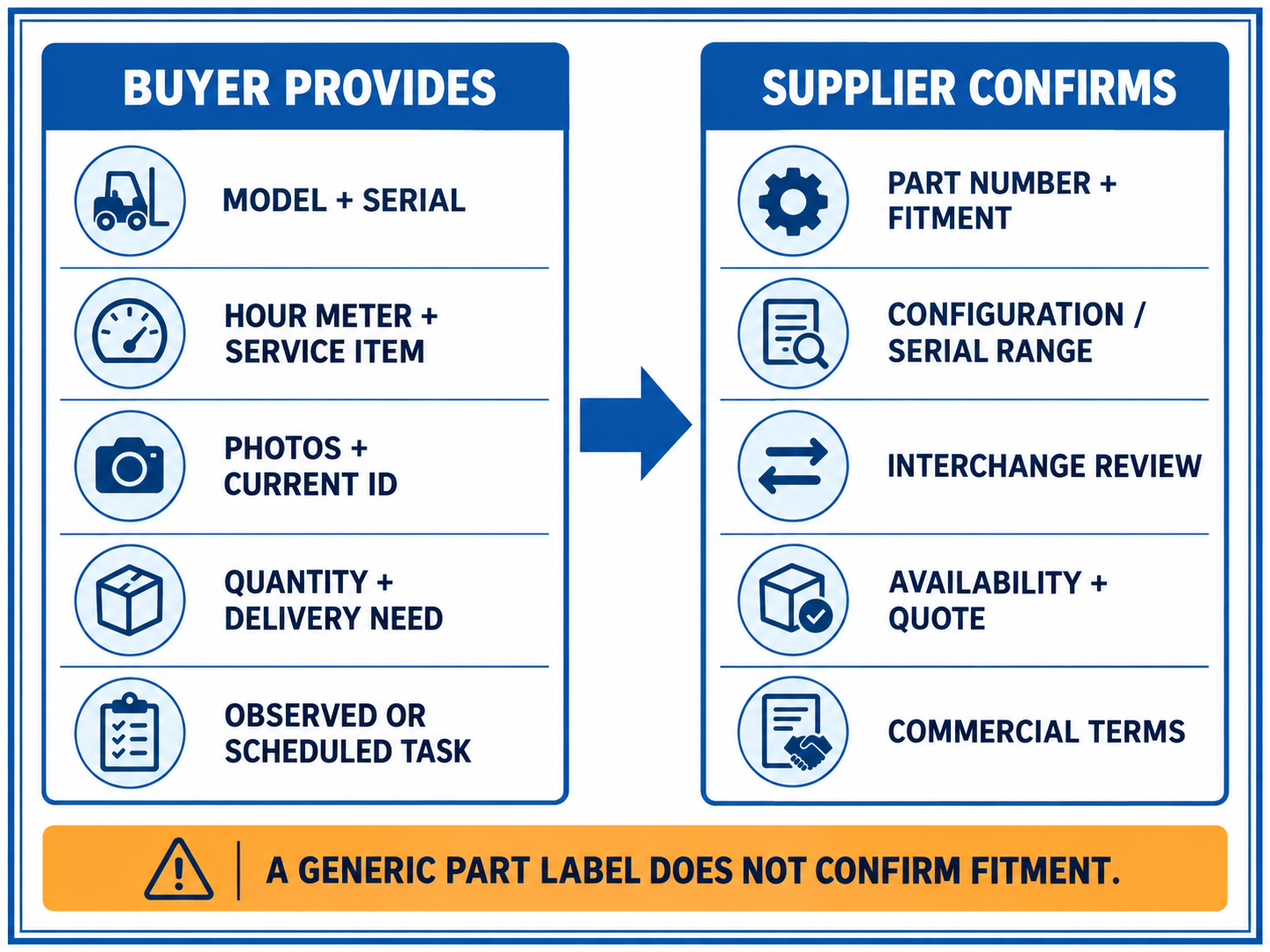
| Buyer provides | Supplier confirms during review |
|---|---|
| Model and serial number | Current part number and fitment |
| Hour meter and service item | Configuration or serial-range applicability |
| Photos and existing identifier | Interchange or replacement relationship |
| Quantity and delivery need | Quote, stock status, and commercial terms |
Kingstream can use this information to review a Toyota forklift parts request, but a generic Toyota label is not enough to guarantee a match. Submit the complete identity and application details before asking for a replacement part.
FAQ: Toyota forklift maintenance schedule questions
What is Toyota’s recommended service schedule?
Toyota’s exact schedule depends on the truck, power source, configuration, operating hours, and conditions. Use the applicable Toyota operating or maintenance manual for the interval and service list. Public sample schedules can show categories of work, but they should not replace the exact manual.
How often should a forklift get serviced?
Use the hour meter and the calendar/use pattern specified for the exact truck. Daily or pre-shift inspection is a separate safety requirement; it does not establish the complete planned-maintenance interval. Severe use, attachments, and environment may also change the service plan.
What should be checked during a forklift inspection?
Check the items required by the truck’s checklist, including safety devices and controls, forks and mast, attachments, tires, brakes and steering, visible leaks, fluids, and power-source items. Toyota and OSHA guidance support removing an unsafe truck from service and reporting the defect.
Can I use a generic checklist for every Toyota model?
Use a consistent inspection structure, but verify the actual checklist and service requirements for each model and configuration. A generic list can miss powertrain-specific or attachment-specific items, and it cannot supply model-specific fluid, interval, wear, or fitment values.
Conclusion: build the schedule from the exact truck
The most reliable Toyota forklift maintenance schedule starts with the truck, not a generic chart:
- Record the exact model, serial number, power source, hour meter, attachment, and operating environment, then match those details to the applicable Toyota manual.
- Keep pre-shift inspection, planned service, and defect repair as separate paths.
- Remove and report an unsafe truck instead of continuing to operate it.
- Use the verified identity and service record when requesting parts or service.
If the model/manual match or a safety condition is unresolved, stop at that decision point. If you are preparing a Toyota forklift parts request, send the model, serial number, application, current identifier, and service context so fitment can be reviewed before a part is quoted.
References
- Toyota Material Handling. (2018, March 28). Forklift inspections & pre-operation checklist. https://www.toyotaforklift.com/resource-library/blog/safety-support/forklift-inspections-pre-operation-checklist
- Occupational Safety and Health Administration. (n.d.). 1910.178 – Powered industrial trucks. https://www.osha.gov/laws-regs/regulations/standardnumber/1910/1910.178
- Occupational Safety and Health Administration. (n.d.). Powered industrial trucks: Pre-operation. https://www.osha.gov/etools/powered-industrial-trucks/operating-forklift/pre-operation
- Toyota Material Handling. (2026, April 16). What is a forklift data plate and how do I read it? https://www.toyotaforklift.com/resource-library/blog/toyota-products/what-is-a-forklift-data-plate-and-how-do-i-read-it
- Toyota Material Handling Solutions. (2021, October 7). How to set up a forklift maintenance schedule. https://www.toyotamhs.com/how-to-set-up-a-forklift-maintenance-schedule
- Hughes, S., Bobick, T., & Afanuh, S. (2021). Conducting a daily inspection of powered industrial trucks (forklift, narrow-aisle reach truck, walkie pallet lift, and tow tractor/tug) (DHHS [NIOSH] Publication No. 2022-100). National Institute for Occupational Safety and Health. https://www.cdc.gov/niosh/docs/wp-solutions/2022-100/
Last reviewed and updated: September 2026. Author: Kingstream team. For tailored guidance, contact our team.