
TL;DR
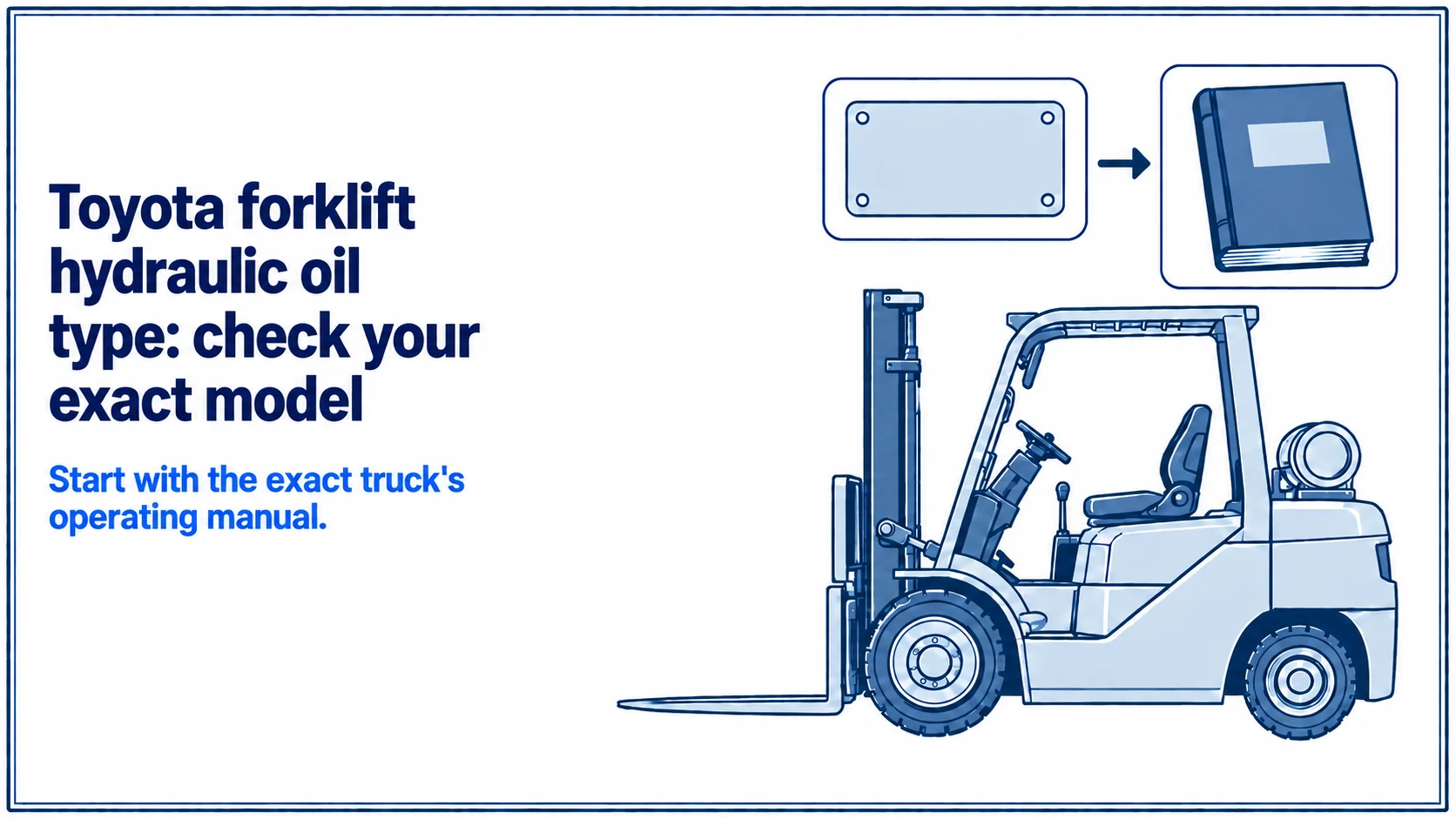
Toyota’s general guidance does not set one hydraulic-oil grade for every forklift. This article is a manual-lookup workflow, not a model-by-model grade chart: match the exact truck to its operating manual and follow its prescribed fill condition. If you cannot confirm that match, pause instead of relying on a generic AW grade.
Evidence boundary: no model-specific operating manual was available for this article, so an exact grade, capacity, fill condition, or service interval is not verified here.
What hydraulic oil type does a Toyota forklift use?
To identify a Toyota forklift hydraulic oil type, use 4 checks: match the truck to its manual, read the fluid specification, note capacity if stated, and follow the prescribed fill or level-check condition. Toyota’s general guide says grade depends on equipment and manufacturer and directs operators to that truck’s manual; it does not set one grade for all Toyota forklifts.
The safe answer is specific to the truck’s operating manual
Keep the manual match and fluid entry together. Treat a general chart, product label, or discussion page as a lead, not proof of fit; check it against the exact model and the manual’s applicability notes.
Use the following checklist before selecting fluid:
- Record the full model designation shown on the truck.
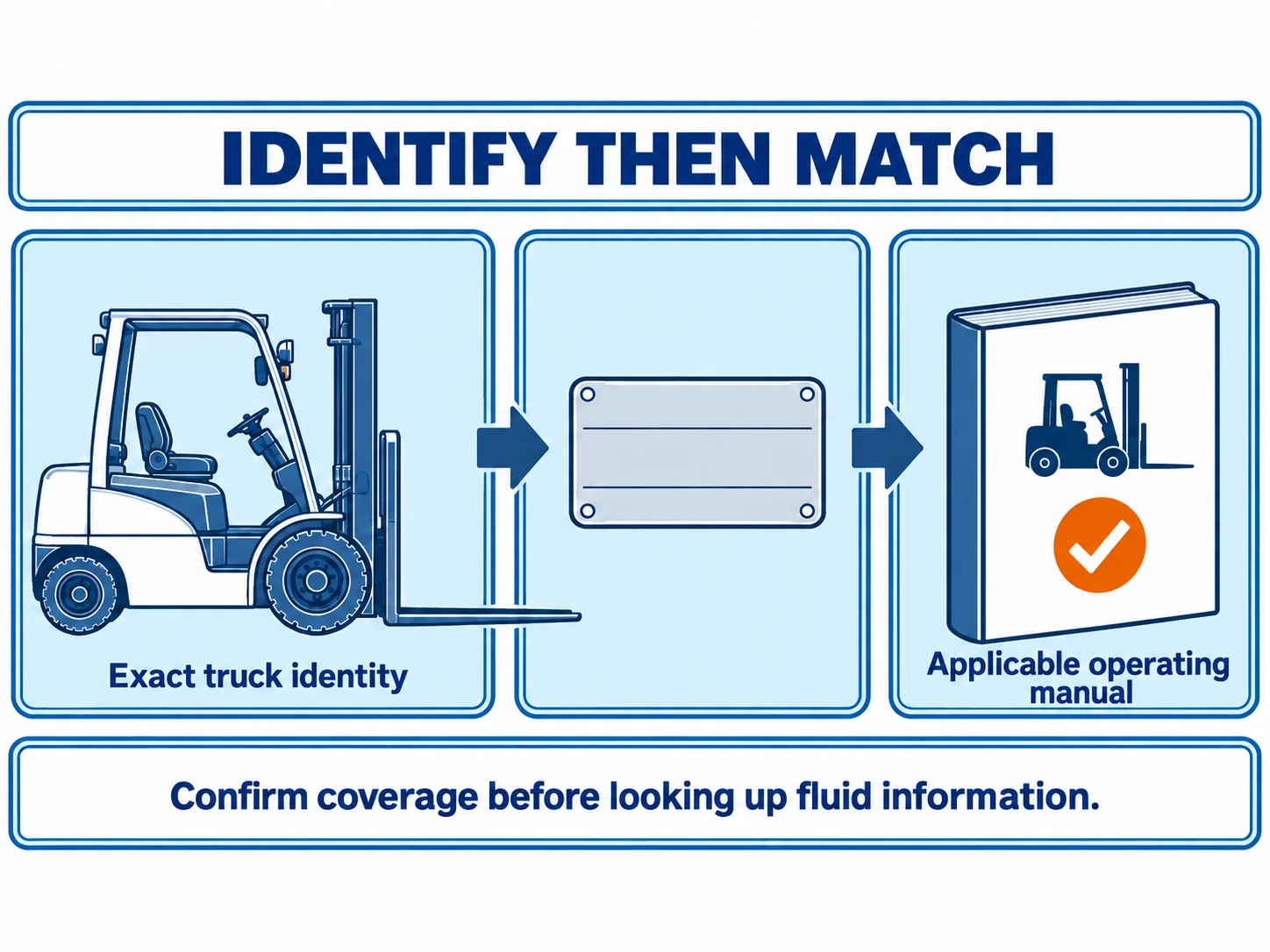
- Match it to the operating manual that covers that model and version.
- Find the hydraulic-fluid specification, including any application notes.
- Check the manual’s capacity and fill or level-check instructions separately.
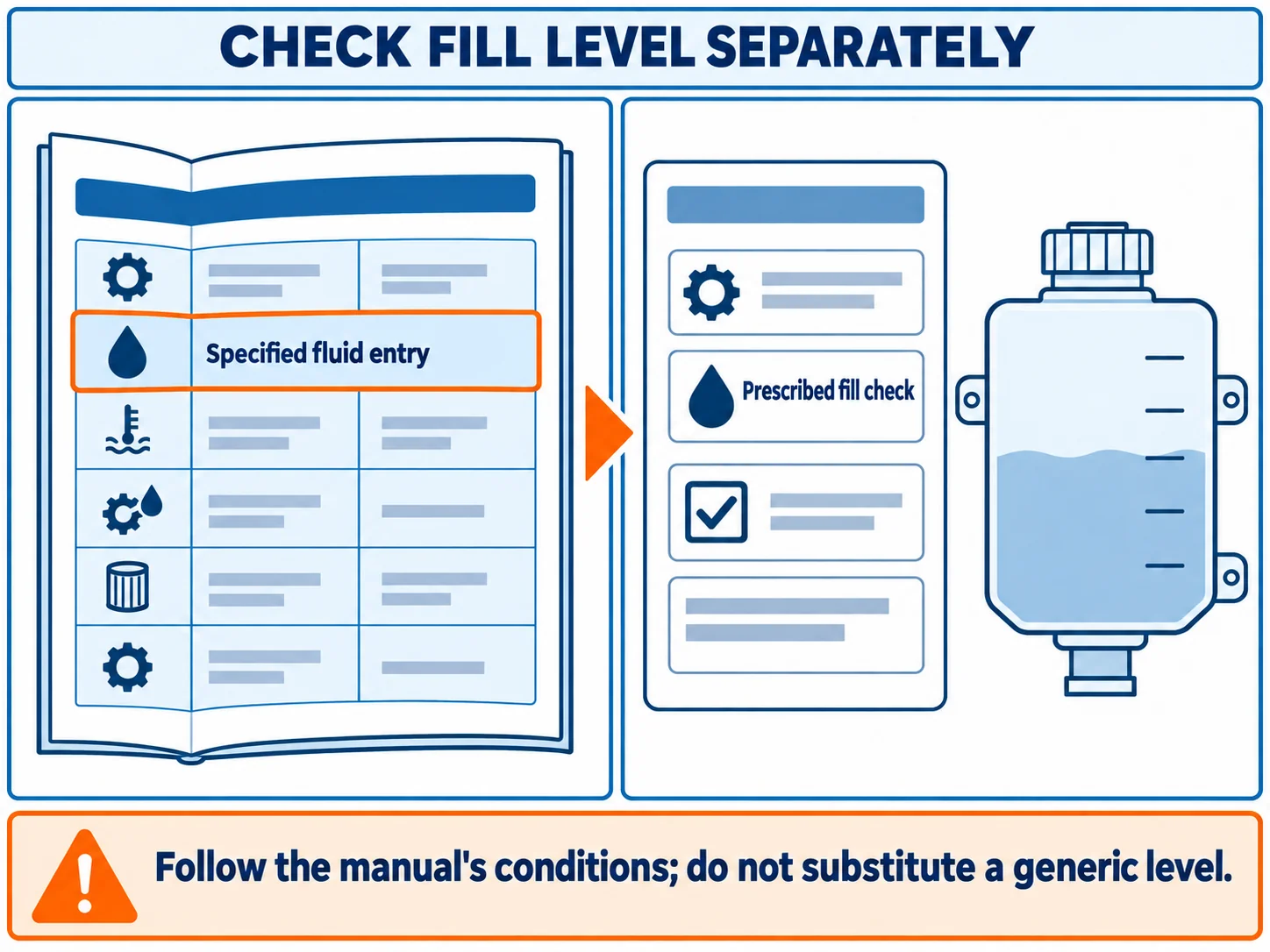
Do not treat the fluid name alone as the whole instruction. Toyota also says to follow the prescribed fill level; thermal expansion can lead to overflow and a safety hazard. The exact level and check condition remain model-specific.
Identify the exact Toyota forklift model
Start with the exact model designation. The Toyota forklift models guide explains why the series label is only a starting point. Toyota’s data-plate guidance is the primary source for reading that identification information. Copy every displayed character exactly as shown on the truck’s identification plate or service record, including any model suffix. Do not shorten a family name or replace it with a similar model label.
Record the exact model designation
A clear model record gives you a search key for the Toyota forklift parts lookup. Keep other visible identifiers with it, but do not assume a serial number is required for every fluid lookup.
Record:
- Full model designation exactly as displayed.
- Equipment or serial number, if available.
- Where the model information came from, such as the plate or a service record.
Use the model designation first when locating Toyota documentation. If its name differs between the truck and paperwork, or a suffix is unreadable, resolve that mismatch before choosing a manual. That identification narrows the equipment match; it does not select oil or a replacement part.
Match your truck to the correct Toyota operating manual
A manual’s title alone does not prove it covers the truck; check its model and configuration scope before using a fluid entry.
Check any manual applicability or serial-range notes
Compare the truck against the scope the manual actually states. Check:
Check the document for:
- The model family or designation it covers.
- Any stated configuration or production limits.
- A serial or equipment range, if the manual provides one.
An attachment or configuration change also belongs in the match record and should be checked separately from the base truck’s fluid entry.
If the manual title names a broad equipment family but does not clearly cover the exact model, pause. Ask Toyota-authorized technical support which operating manual applies. Share the model and other identification details if requested.
Ready when you are
For forklift replacement-part sourcing, see Kingstream’s forklift parts sourcing service.
Find the hydraulic-fluid specification in that manual
After the 4-step identification workflow, create a 4-field manual record: fluid specification, stated capacity, prescribed fill or level-check condition, and service interval if listed. Toyota’s general hydraulic-fluid guidance directs operators to the manual for that truck and does not state a universal grade.
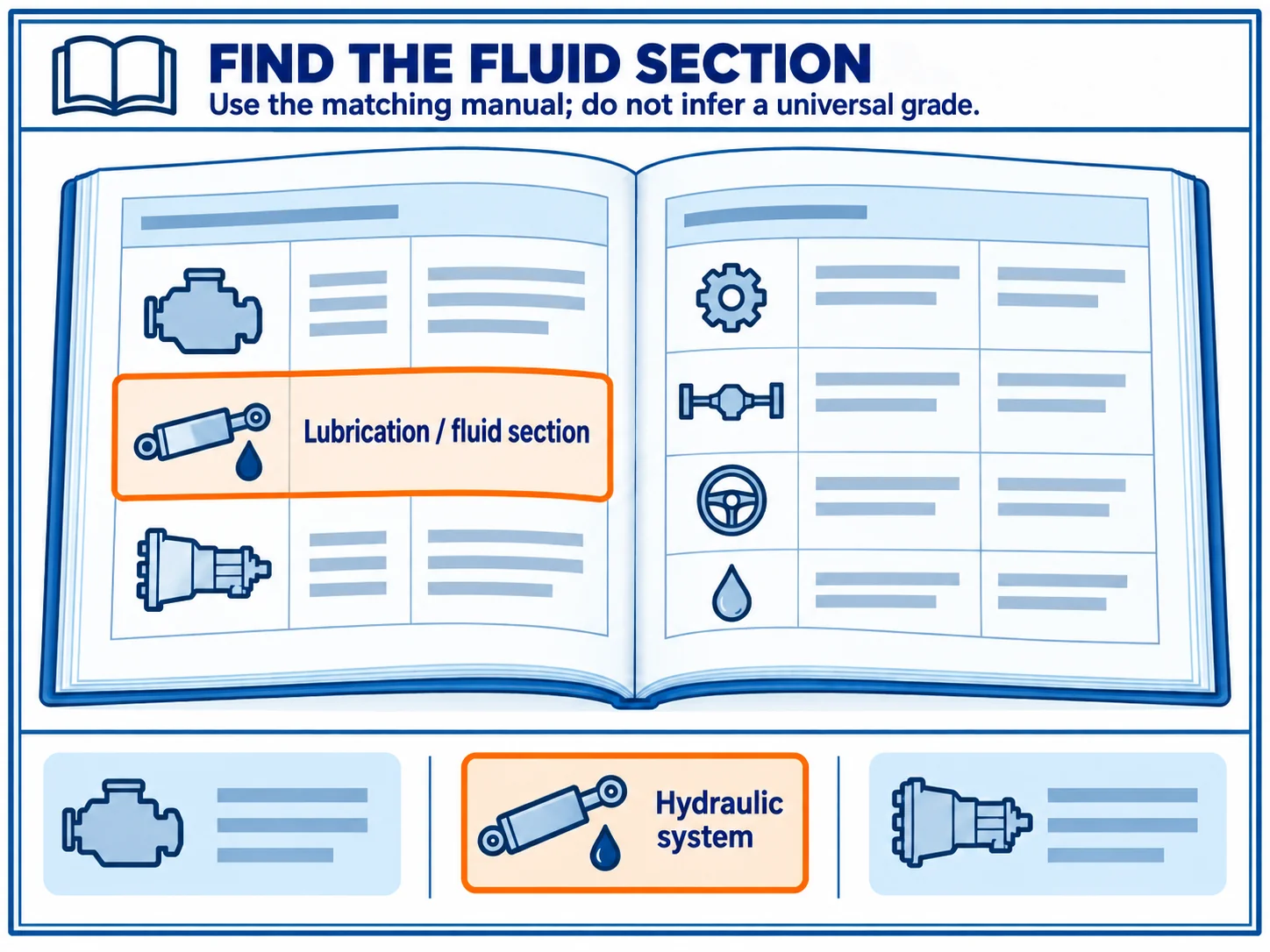
Look in the lubrication or fluid specification section
Use the manual’s index or search function. Try "hydraulic fluid," "hydraulic oil," "lubrication," "fluid capacity," or "hydraulic system." Manual headings vary; these terms are only search aids.
When you find a likely entry, read the surrounding notes rather than copying a grade from a search-result snippet. Record the exact wording and any stated application or operating-condition limits. If a table separates multiple systems or configurations, make sure the row you use names the hydraulic system and matches your truck.
Record the manual title, revision or publication date, and page or table number beside the fluid entry. Preserve the model/configuration note and the table-row heading, especially when the manual lists separate systems or versions. Copy capacity with its unit and service context, and retain the stated fill-check condition in the same record. That creates a traceable lookup another technician can check without treating a partial entry as a confirmed specification.
Keep hydraulic fluid separate from engine and transmission fluids
A manual can cover more than one service system. Do not copy an engine-oil or transmission-fluid entry into a hydraulic-fluid lookup. The forklift filters guide is a separate maintenance reference for filter types, not a substitute for the fluid specification. The scope here is the hydraulic circuit only; separate engine and transmission oil advice is outside it.
If the index search returns several fluid entries, compare each heading and its stated system. A result containing the word "oil" is not enough by itself. If a leak or actuator problem prompted the lookup, use the hydraulic cylinder replacement guide for the component question while keeping the fluid decision tied to the manual. Save the page or section reference with your notes so the fluid grade or type and capacity, along with the prescribed level-check instruction, can be checked against the same manual later.
Verify the grade, capacity, and fill level separately
Record fluid type, capacity, fill condition, and service interval separately; use the matching manual for each applicable value.
Use the manual’s exact grade and application notes
Copy the complete fluid description from the matching manual, including a stated viscosity grade or other specification. Do not replace it with a familiar grade because the number looks close. The research did not verify a Toyota-wide grade. This limitation is deliberate: it keeps an unresolved model lookup from becoming an unverified product recommendation. The field below remains unresolved until the exact manual is checked.
| Field | What to confirm in the matching manual | Current status |
|---|---|---|
| Fluid type or grade | Exact hydraulic-fluid entry and any application notes | No Toyota-wide grade verified |
| Capacity | Stated amount for the applicable model or configuration | Not established without the manual |
| Fill level and check condition | Required level and the condition under which it is checked | Follow the manual; Toyota warns that overfill can create a spill hazard |
| Change interval | Model-specific service schedule entry | No model-specific interval verified here |
For your notes, keep the fields separate rather than writing only "hydraulic oil." Copy the fluid wording exactly. For capacity, retain the unit and service context shown in the manual. For the fill check, note the stated level reference and condition, without turning it into an unverified service procedure. If you cannot locate a value or interval, mark it "not confirmed" instead of filling the blank from a general chart.
Treat every blank as unresolved until the matching manual supplies it. Do not make a partial record look like a confirmed specification.
Do not treat capacity as the same question as oil type
Capacity tells you how much fluid a stated service operation or system may require. Grade tells you which fluid specification applies. One cannot be used to infer the other, and a quantity from another model or configuration is not a substitute for the applicable manual.
Also preserve the fill-check condition. Toyota warns that thermal expansion can cause fluid to overflow and create a safety issue, so follow the manual’s level instruction instead of filling to an assumed amount. The exact procedure and reference point are not established here.
Why generic AW32, AW46, or AW68 advice may not fit
Treat viscosity comparisons as questions for the manual, not a model match
AW32, AW46, and AW68 are often offered as competing answers, but the research for this article did not verify any one of them as a Toyota-wide recommendation. The grade must come from the applicable manual, including its application notes.
A seller, forum post, or chart can suggest a question to verify, but without an identified Toyota manual and model range it does not establish fit. That does not make a grade universally wrong; its match to this truck remains unproven. If the concern began with pressure loss or another hydraulic symptom, the hydraulic pump symptoms and fitment guide addresses that component question separately. No climate-based exception or cross-model substitution is supported by the evidence used here.
If the manual is missing or does not match your truck
Keep the fluid entry unresolved until the manual is matched
Record the grade as unconfirmed while you identify the manual that covers the truck. A chart or another owner’s report does not resolve the missing model-to-manual match.
Obtain the manual that covers the exact model
Use Toyota’s Help Center article on finding equipment manuals as an official starting point. If the manual’s model coverage remains uncertain, ask Toyota-authorized technical support to identify the correct operating manual. Have the model designation ready; provide a serial or equipment number if requested.
Search results can also lead to a PDF hosted outside Toyota. Check its publication or revision information and stated model coverage; a matching series name is not enough. If those details are missing or unclear, confirm the document with Toyota-authorized support before relying on its fluid entry. When multiple revisions exist, use the stated serial or configuration notes rather than assuming the newest file covers every truck.
Resume the fluid lookup only when the manual scope and hydraulic-fluid entry are clear. If either remains uncertain, keep the grade unresolved rather than treating a generic chart as approval.
FAQ: Toyota forklift hydraulic-oil questions
Should I use 46 or 68 hydraulic oil?
The 46-versus-68 comparison cannot identify which applies to a specific Toyota truck. Check the exact model’s manual for its fluid entry and any application notes.
What grade hydraulic oil for forklift?
Read the hydraulic-fluid entry in the manual covering the forklift’s exact make, model, and configuration. Do not copy a grade from its engine or transmission section.
Should I use 32 or 46 hydraulic oil?
The research used here does not confirm either grade across Toyota models. Treat a chart as a lead and verify its grade against the matching Toyota manual.
Can I use 10w30 as hydraulic oil?
Use 10W-30 as hydraulic fluid only if the exact operating manual lists or permits it for that system; an engine-oil entry does not establish hydraulic compatibility.
Where can I find the right fluid specification for my Toyota forklift?
Open the operating manual that covers the exact model, then search its index for hydraulic fluid, hydraulic oil, lubrication, or capacity. Read the surrounding notes and follow its fill-level instruction. Ask Toyota-authorized support if the manual scope or entry is unclear.
Conclusion: verify before adding hydraulic fluid
For this lookup, use the operating manual that covers the exact truck. Toyota’s general hydraulic-fluid guidance does not assign one grade to all models.
Use the result of that manual check as the decision point:
- Manual confirmed: Record the listed fluid type, any stated capacity, and the prescribed fill-check condition.
- Manual missing or scope unclear: Obtain the correct document or ask Toyota support to confirm coverage.
- Fluid mixed or unknown: Leave the specification unresolved until the applicable manual confirms it.
Keep the manual title or revision with the service record. If a warning or fault code triggered the lookup, use the Toyota fault-code verification guide; after confirming the fluid, log the result in the forklift preventive maintenance checklist.
References
- Toyota Material Handling. (2018, May 2). Guide to changing hydraulic fluid for forklifts. https://www.toyotaforklift.com/resource-library/blog/parts-and-service/guide-to-changing-hydraulic-fluid-for-forklifts
- Toyota Material Handling. (2026, April 16). What is a forklift data plate and how do I read it? https://www.toyotaforklift.com/resource-library/blog/toyota-products/what-is-a-forklift-data-plate-and-how-do-i-read-it
- Toyota Material Handling. (n.d.). Where can I find manuals for my equipment? https://www.toyotaforklift.com/help/mytoyota/articles/23914288808347-where-can-i-find-manuals-for-my-equipment. Retrieved September 27, 2026.
Last reviewed and updated: September 2026. Author: Kingstream team. For tailored guidance, contact our team.