
TL;DR
Start with the transmission type, fluid path, and machine identification. A charge-pressure or drive complaint may involve the pump, valve, clutch, torque converter, fluid, or housing, so match the symptom and measured evidence to the exact model and part number before buying.
Abstract
This guide explains how a forklift hydraulic transmission transfers engine power through fluid pressure, how its main components fail, and how to verify a replacement part before ordering.
Key Takeaways
- Identify hydrostatic versus powershift operation before choosing a transmission part.
- Trace fluid from the charge pump through control valves, clutch packs, and torque converter.
- Use symptom, pressure-test evidence, model, serial range, and dimensions together for fitment.
- Separate fluid, filter, pump, clutch, valve, converter, and housing faults before replacing an assembly.
- Ask for clear machine, engine, transmission, and old-part details when catalog fitment is incomplete.
Table of Contents
- Abstract
- Key Takeaways
- What Is a Forklift Hydraulic Transmission?
- How a Forklift Hydraulic Transmission Moves Power
- Forklift Hydraulic Transmission Parts Explained
- Forklift Hydraulic Transmission Problems and What They Mean
- How to Test a Forklift Hydraulic Transmission Before Replacing Parts
- How to Choose Forklift Hydraulic Transmission Parts and Verify Fitment
- Forklift Hydraulic Transmission FAQ
- Conclusion
- References
What Is a Forklift Hydraulic Transmission?
A forklift hydraulic transmission is a travel-drive pressure circuit, not simply another name for the truck’s lift hydraulics. In a powershift unit, the charge pump supplies oil, valves direct pressure, and clutch packs select forward or reverse. A hydrostatic drive uses a hydraulic pump and motor as the propulsion pair. The buying decision starts with that layout and its pressure path. (Komatsu, 2022)
Hydraulic transmission versus lift hydraulics
The two systems may share a reservoir or related service procedures, but they do different jobs. Lift hydraulics create mast, tilt, and attachment movement. The hydraulic transmission controls travel, direction, and torque delivery. That difference matters when choosing forklift hydraulic transmission parts because a lift pump, lift valve, and transmission charge pump are not interchangeable simply because each is described as hydraulic.
Transmission oil also has a different job from engine oil. It must support pressure control, clutch friction behavior, lubrication, and heat transfer inside the drive unit. Always use the machine manual or transmission identification when confirming fluid type. A universal fluid label is not enough evidence for a replacement decision. (HELI, n.d.)
Hydrostatic and powershift layouts
Hydrostatic forklifts vary the flow and direction of hydraulic oil through a pump and motor. They generally do not use the same clutch-pack and torque-converter arrangement found in a conventional powershift transmission. A powershift forklift uses a gear train, torque converter or related input device, charge pump, control valves, and wet clutches to change direction and transmit torque. (Komatsu, 2022)
The practical buying distinction is simple: first identify how the truck moves, then identify which pressure path has failed. The next section follows that path from the engine input to the wheels and shows where charge pressure becomes the first useful checkpoint. For a broader comparison of layouts and repair decisions, see the forklift transmission guide.
Glossary
-
Charge pump – A transmission pump that draws oil through the supply side and delivers flow and pressure to control, lubrication, clutch, and, where applicable, torque-converter circuits. Its condition matters because low supply can resemble a failed clutch or valve during diagnosis.
-
Powershift transmission – A transmission that changes direction or ratio through hydraulically applied clutch packs and a gear train. The control valve routes oil to the selected clutch, so transmission identity and circuit evidence are needed before choosing a replacement pump, clutch, or valve.
-
Hydrostatic drive – A propulsion arrangement that uses controlled hydraulic pump flow and a hydraulic motor to transmit motion to the wheels. It is a different layout from a conventional powershift unit with gear reduction, hydraulically applied clutches, and often a torque converter.
-
Inching valve – A control valve that modulates clutch engagement during low-speed maneuvering. A fault can feel like clutch wear because the operator experiences hesitation or incomplete drive, which is why normal travel and inching behavior should be compared before ordering a clutch pack.
-
Torque converter – A fluid coupling that transfers engine torque into the transmission input while allowing controlled speed difference. Poor acceleration, noise, or heat can involve the converter, but the same symptoms can also result from low oil, pump loss, clutch slip, or another engine or transmission fault.
How a Forklift Hydraulic Transmission Moves Power
A forklift hydraulic transmission moves power through a sequence: engine input, fluid supply, pressure control, clutch or motor engagement, gear reduction, and axle output. The first useful diagnostic question is not simply whether the truck moves. It is which part of that sequence has lost flow, pressure, engagement, or mechanical connection. (HELI, n.d.)
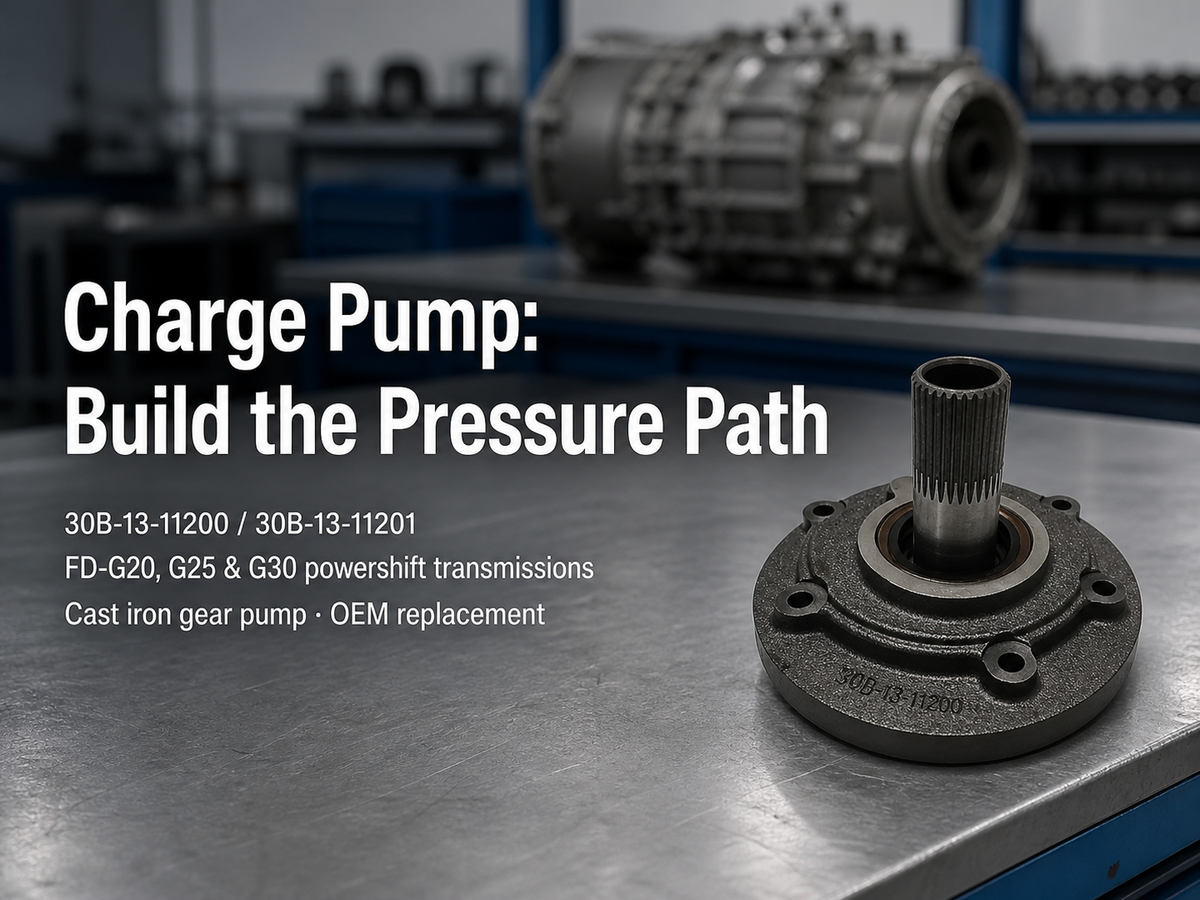
The pressure path from engine to wheels
In a powershift arrangement, the engine turns the input and the charge pump draws transmission oil through a filter or pickup. The pump sends oil into a control circuit. Valves then regulate and route that oil to the direction clutch, speed clutch, lubrication passages, and torque-converter feed. When a clutch piston receives enough pressure, its friction discs and steel plates lock the selected element to the gear train.
This explains why a charge-pump complaint can look like a clutch complaint. The clutch may be mechanically intact but unable to apply if the pump cannot supply the circuit. The reverse is also possible: pressure can be available at the valve, while a worn clutch pack slips under load. Testing the pressure path before ordering a complete transmission reduces that ambiguity. (HELI, n.d.)
Hydrostatic drive and powershift transmission compared
| Feature | Hydrostatic drive | Powershift transmission |
|---|---|---|
| Main propulsion element | Hydraulic pump and motor | Gear train with fluid-applied clutches |
| Direction control | Pump displacement or control linkage | Direction valve and clutch pack |
| Common service focus | Pump, motor, charge circuit, oil | Charge pump, valve, clutch, converter, gears |
| Typical buying evidence | Drive-unit model and control configuration | Transmission code, clutch or pump number, dimensions |
| Failure pattern | Weak or uneven drive from flow or control loss | Delayed engagement, slipping, pressure loss, or clutch wear |
The table is a buying aid, not a substitute for the OEM service procedure. Some forklift designs use specialized combinations, and model families can change configuration across production years. Confirm the unit before treating a symptom as proof of a specific layout.
Komatsu’s 2022 technical overview and the HELI CPCD50-M2 service manual illustrate why identification matters: a hydraulic drive links pump supply, control pressure, clutch engagement, and travel output in one system. Trace those relationships before naming a failed component, because the same no-drive symptom can begin upstream of the clutch. (Komatsu, 2022)
Why charge pressure matters
Charge pressure supports clutch application, lubrication, and converter feed in many powershift systems. Low pressure may result from a worn charge pump, restricted filter, suction leak, incorrect fluid level, relief-valve trouble, or internal leakage. High pressure can point toward control or relief problems. The useful sequence is to verify oil and filter condition, inspect the suction side, then test at the manufacturer-specified port and operating condition. (HELI, n.d.)
That sequence leads directly to the parts map: each component sits at a different point in the fluid path, so each requires different fitment evidence. The hydraulic parts glossary can help clarify the circuit terms used in a service report.
Forklift Hydraulic Transmission Parts Explained
The most useful way to shop for forklift hydraulic transmission parts is to connect each part to the pressure path and the symptom it can create. A charge pump supplies the circuit, valves control it, clutches convert pressure into selected drive, a converter transfers input torque, and the housing keeps the assembly aligned. (HELI, n.d.)
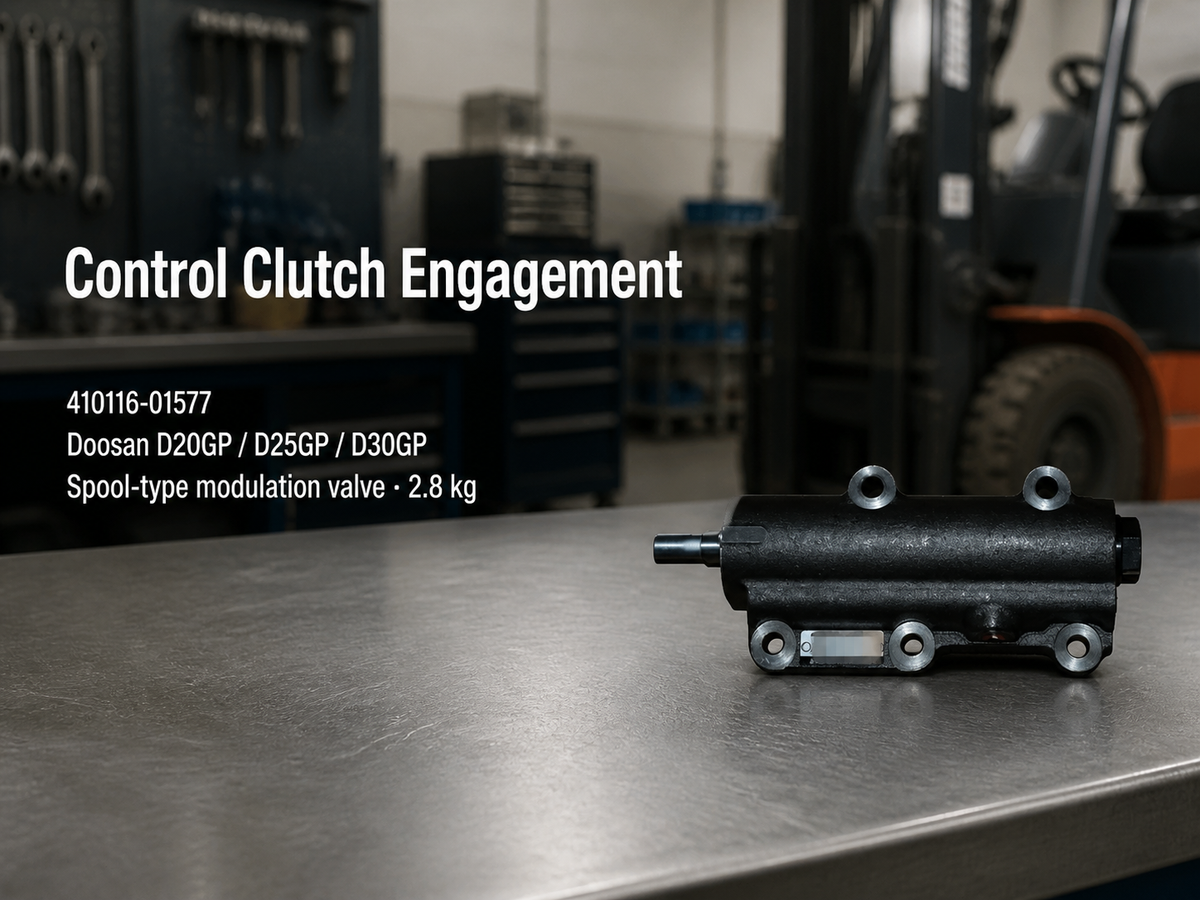
Charge pump and pressure circuit
The charge pump is often a gear-type assembly that supports clutch supply, lubrication, or torque-converter feed in a powershift circuit. A catalog description is only a starting point. The machine code, transmission identity, old-part number, configuration, and measured symptom still control fitment.
A pump that cannot maintain the required circuit flow may cause delayed engagement, no movement, or a drive that weakens as the oil warms. Those charge-pump symptoms overlap with restrictions, suction leaks, relief-valve faults, and worn clutches. Do not select a pump from forklift capacity alone.
Hydraulic clutch and inching valve
Hydraulic clutch assemblies use friction discs, steel plates, a piston, seals, and a drum or carrier. The clutch must apply with enough pressure to transmit torque without dragging when released. Worn friction material can create slipping and heat. A sealing problem can create the same complaint by allowing apply pressure to escape. See the clutch disc replacement guide when inspection points to friction-disc wear.
The inching valve controls gradual clutch engagement at low speed. A valve problem may feel like a clutch problem because the operator experiences hesitation or incomplete drive. Compare the symptom in normal travel and inching operation before ordering a clutch pack. (HELI, n.d.)
Control valve, torque converter, and housing
Control valves contain passages, spools, springs, and sometimes solenoid-operated sections. They determine where the available oil goes. A contaminated or sticking spool can produce one-direction failure, delayed engagement, or inconsistent response. The valve’s circuit count and mounting pattern matter as much as the forklift model.
The torque converter transfers engine input into the transmission through fluid coupling. Noise, poor acceleration, or heat can involve the converter, but those symptoms also overlap with low oil, pump loss, clutch slip, and engine problems. Housings are structural fitment parts. Bore alignment, mounting faces, shaft locations, and related gear geometry must be checked before treating a housing as a simple shell replacement. (HELI, n.d.)
| Part group | Primary job | Symptoms it can influence | Evidence to collect |
|---|---|---|---|
| Charge pump | Supplies transmission pressure and flow | No drive, delayed engagement, weak clutch apply | Part number, gear details, pressure test |
| Hydraulic clutch | Applies selected drive element | Slipping, heat, delayed forward or reverse | Clutch code, plate count, photos, measurements |
| Inching valve | Modulates low-speed engagement | Shudder, hesitation, poor inching control | Valve code, circuit layout, control type |
| Control valve | Routes and regulates oil | One direction missing, inconsistent shifting | Spool count, ports, casting and part number |
| Torque converter | Transfers engine torque to input | Poor acceleration, noise, heat | Converter number, engine, housing and input data |
| Housing | Aligns and supports transmission parts | Leaks, misalignment, gear or shaft damage | Mounting pattern, bore and casting details |
Get started here
For forklift parts sourcing, Kingstream Parts offers original, OEM, and aftermarket forklift parts with part-number matching and quotation support across 15+ major brands.
By the Numbers
- 6 core part groups organize the first fitment conversation: pump, clutch, inching valve, control valve, converter, and housing.
- 2-3T appears in a current catalog transmission fitment example, but capacity alone does not prove model compatibility. (Kingstream Parts, n.d.)
The next step is to use these component roles to separate overlapping transmission symptoms before choosing a replacement.
Kingstream’s category includes a 2-3T transmission fitment example, but that capacity range is only a catalog clue, not proof of compatibility. Match the machine, transmission code, component number, and dimensions before ordering. This is why a parts table should organize evidence to collect, not promise universal interchangeability. (Kingstream Parts, n.d.)
Forklift Hydraulic Transmission Problems and What They Mean
Hydraulic transmission problems become easier to separate when the symptom is tied to a pressure-path condition. No movement points first toward charge supply, control, or clutch engagement. Slipping under load points toward apply pressure, clutch capacity, or input torque. Heat, noise, and leaks widen the inspection to fluid condition, converter flow, seals, and housing. (HELI, n.d.)
No movement or delayed engagement
Check the simple pressure prerequisites before removing a transmission:
- Confirm the oil level and the fluid specified for the transmission.
- Inspect the filter, pickup, suction hose, and fittings for restriction or air entry.
- Confirm the linkage or electronic command reaches the direction valve.
- Test the charge circuit at the manufacturer-specified port and condition.
- Compare forward and reverse behavior to identify a shared supply fault or one clutch circuit fault.
If both directions are weak, the charge pump, filter, suction side, relief path, or common control supply deserves attention. If only one direction fails, focus on the relevant valve passage, solenoid, clutch pack, or seal circuit. This split prevents a complete transmission replacement from becoming the first guess. The transmission repair guide provides broader context for separating component faults from assembly problems. (HELI, n.d.)
Slipping, weak drive, or loss of pressure
Slipping that worsens after warm-up can indicate internal leakage or clutch friction loss, but fluid level, fluid condition, and pump performance must be checked first. A pressure reading that falls when the drive is loaded is more useful than a static reading alone. Follow the service manual’s test method because pressure ports and acceptable values vary by transmission family.
The charge pump and clutch are linked but not identical. Low supply pressure can prevent a good clutch from applying. Normal supply pressure with continued slip shifts suspicion toward clutch discs, piston seals, the control valve, converter, or mechanical gear damage. Record the measured condition instead of describing the unit only as a bad transmission.
Overheating, noise, leaks, and contaminated fluid
Overheating can follow clutch slip, low oil, wrong fluid, restricted flow, converter trouble, or inadequate cooling. Metallic debris points toward internal wear, while foaming suggests an oil-level, air-entry, or fluid compatibility problem. A leak at a housing seam does not prove the housing is damaged; the source may be a seal, shaft surface, gasket, or loose fitting.
Stop operation when the machine becomes unsafe or the transmission loses drive control. Contaminated oil should be handled according to the equipment and site procedure. Do not keep running a unit to see whether a slipping clutch improves. Heat can turn a component repair into a larger assembly repair. (Occupational Safety and Health Administration, n.d.)
| Symptom | Likely area | First check |
|---|---|---|
| No forward and reverse | Common supply or charge circuit | Level, filter, suction side, charge pressure |
| One direction missing | Direction valve or clutch circuit | Command, valve, circuit pressure |
| Slips under load | Clutch, pressure, converter, or input | Loaded test and oil condition |
| Delayed engagement | Restriction, leakage, valve, or clutch fill | Filter, pressure rise, linkage |
| Noise with weak drive | Pump, converter, gear, or bearing | Oil debris, sound location, pressure |
| External leak | Seal, gasket, fitting, or housing | Clean area and trace source |
This symptom-to-test-to-part order gives the replacement decision a defensible starting point. When the diagnosis is still broad, review the forklift hydraulic transmission parts catalog alongside the measured evidence.
OSHA’s 1910.178 powered industrial truck standard supports a controlled service approach, but it does not turn one symptom into a universal parts diagnosis. Isolate the operating condition, follow the manufacturer procedure, and stop when the truck is unsafe to test. (Occupational Safety and Health Administration, n.d.)
How to Test a Forklift Hydraulic Transmission Before Replacing Parts
Test a forklift hydraulic transmission in a fixed order: verify the complaint, check oil and external conditions, confirm controls, measure pressure using the correct service procedure, and then isolate the failed component. A symptom alone cannot distinguish a charge pump from a clutch, valve, converter, or mechanical fault. (HELI, n.d.)
Confirm the complaint and fluid condition
Record when the fault occurs: cold or hot, forward or reverse, unloaded or loaded, and during normal travel or inching. Check the fluid level, smell, appearance, filter condition, and visible leaks using the equipment maker’s procedure. Look for foam, water, metallic debris, or a burnt appearance, but do not diagnose from color alone. A preventive maintenance checklist can help standardize these routine observations.
Check pressure, controls, and engagement
- Verify the engine reaches the required operating condition without substituting an engine fault for a transmission fault.
- Confirm the direction lever, electrical command, linkage, and inching control move as intended.
- Inspect the filter, pickup, suction hose, and fittings before a pressure test.
- Connect the correct gauge at the specified test port.
- Compare readings with the manufacturer’s temperature, gear, and operating instructions.
- Repeat the test for the affected direction or clutch circuit when the design allows it.
Safety: Drive and pressure tests belong to a qualified technician using the manufacturer’s approved procedure. Apply the required isolation, blocking, support, gauge, and exclusion controls before testing. Keep clear of wheels and moving equipment, and stop if control, braking, or leakage makes the test unsafe. (Occupational Safety and Health Administration, n.d.)
Decide between component repair and assembly replacement
A component repair is more defensible when the fault is isolated, the housing and shafts are serviceable, and the replacement part can be matched by number and dimensions. An assembly replacement becomes more reasonable when multiple internal groups are damaged, contamination has spread through the circuit, or the housing and gear alignment are compromised.
The output of testing should be a short evidence pack: symptom conditions, fluid findings, pressure readings, part numbers, photos, and machine identification. That pack makes the next fitment step faster and reduces the temptation to buy from a generic forklift class. It also gives a parts supplier the information needed for a more reliable forklift parts sourcing process.
The HELI CPCD50-M2 service material and OSHA’s 1910.178 standard point to the same practical boundary: testing must follow the identified truck and its service procedure. A pressure reading has meaning only when the port, temperature, gear, and operating condition are correct, so record those details with the result. (HELI, n.d.; Occupational Safety and Health Administration, n.d.)
How to Choose Forklift Hydraulic Transmission Parts and Verify Fitment
Choose forklift hydraulic transmission parts by the transmission identity first, then confirm the component number, configuration, dimensions, and failure evidence. A forklift’s rated capacity or brand is only a starting filter. The same capacity class can contain different engines, transmission families, valve layouts, and production revisions. (Occupational Safety and Health Administration, n.d.)
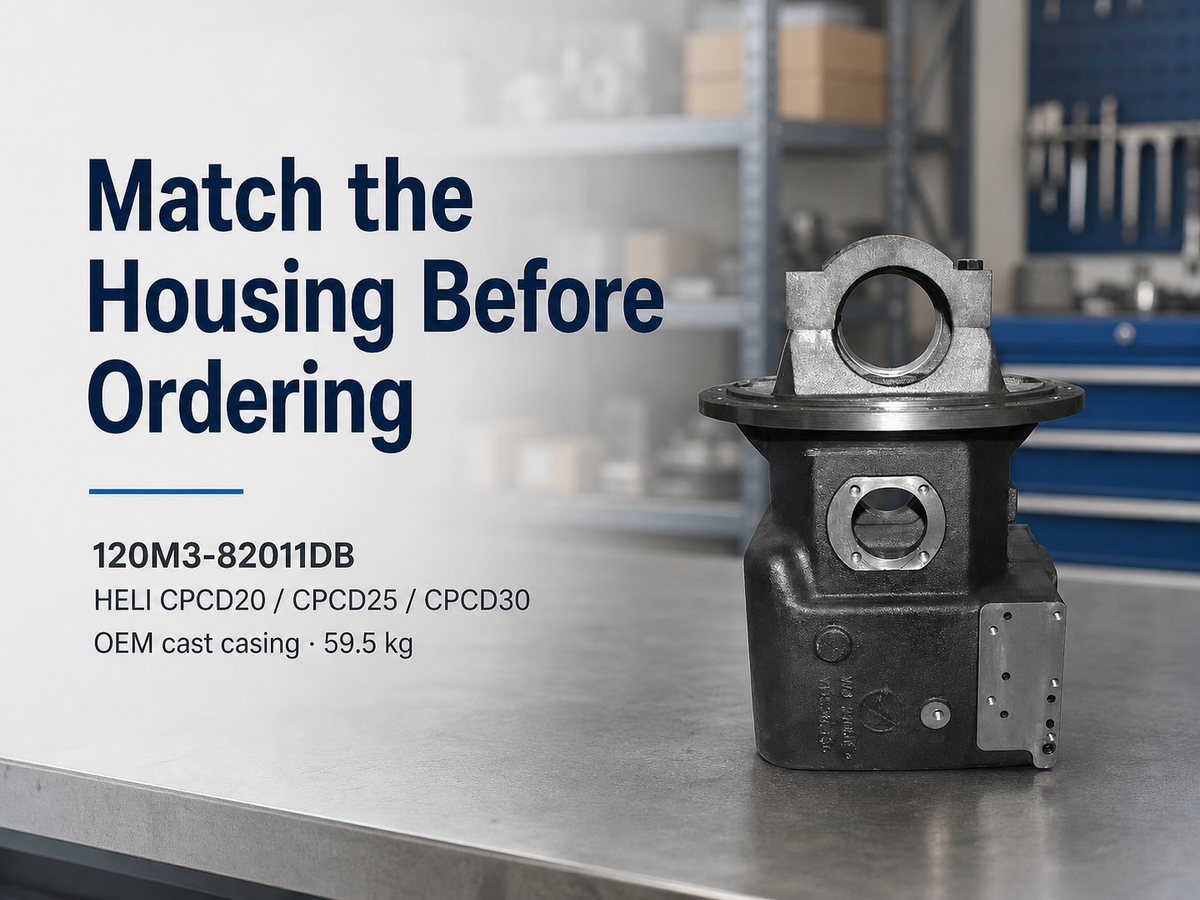
Record the machine and transmission identity
Collect the forklift make, model, serial range, engine model, transmission code, production year when available, and the number stamped or cast on the old part. Photograph the whole assembly, mounting face, ports, connectors, shafts, gears, and any identification plate. For a charge pump, record gear form and mounting pattern. For a clutch, record plate count, piston or drum details, and stack dimensions. The engine assembly fitment guide is useful when engine and transmission identity must be checked together.
Match part numbers, dimensions, and configuration
Use a catalog listing as a candidate, not as permission to ignore the old part. A product description still needs the machine’s exact series and transmission details. Clutch assemblies described for 2-3T trucks also require model and component confirmation. These checks are especially important when a listing covers several brands or a replacement is described as compatible across a range. Compare OEM and aftermarket parts only after the technical fitment evidence is complete.
Fitment rule: Match the transmission identity, not only the forklift capacity. A correct-looking component with the wrong pressure circuit, shaft, or mounting pattern can create a second failure. (Occupational Safety and Health Administration, n.d.)
What to send with a parts inquiry
- Machine make, model, serial number, and engine model.
- Transmission code and every number on the old component.
- Symptom, test result, fluid condition, and whether the fault is hot, cold, forward, or reverse.
- Clear photos of the part from several angles, including ports, gears, mounting faces, and labels.
- Critical measurements, plate count, circuit count, or connector details.
- Whether you need an individual component, an overhaul group, or a complete assembly.
This information lets a parts supplier compare the catalog candidate with the truck instead of guessing from a product title. It also clarifies whether a pump, clutch, valve, converter, housing, or complete transmission is the right commercial path.
Forklift Hydraulic Transmission FAQ
The short answer is that a forklift may use a hydrostatic drive or a powershift transmission, and the correct repair path depends on the fluid circuit, machine identity, and measured symptom. The questions below separate those systems and keep the buying decision tied to verified fitment rather than a generic capacity label.
What type of transmission does a forklift use?
A forklift may use a powershift transmission, a hydrostatic drive, or another manufacturer-specific arrangement. Powershift units use a gear train and hydraulically applied clutch packs. Hydrostatic units use a hydraulic pump and motor for propulsion. Confirm the transmission code and service information before ordering parts. (Komatsu, 2022)
How does the hydraulic system work on a forklift?
Lift hydraulics move the mast, tilt, and attachments. A hydraulic transmission or hydrostatic drive handles travel and direction. They may share service information or a reservoir, but their pumps, valves, pressure paths, and fluid requirements are not automatically interchangeable. (Komatsu, n.d.)
How does a hydraulic transmission work?
In a powershift design, a charge pump sends oil to control valves, clutch packs, lubrication passages, and often a torque converter. The selected clutch applies and connects the gear train for travel. A hydrostatic design uses controlled pump flow to drive a hydraulic motor instead. (Komatsu, 2022)
How much does it cost to repair a forklift transmission?
Short answer: there is no reliable single price without the model, failed component, labor requirement, contamination level, and parts availability. A charge-pump or valve repair can be a different job from a clutch rebuild, converter replacement, housing repair, or complete assembly replacement. Collect diagnosis and fitment evidence before comparing quotes.
What fluid does a forklift hydraulic transmission use?
Use the fluid grade and service interval specified for the exact transmission and forklift model. Do not assume lift-hydraulic oil, engine oil, automotive automatic-transmission fluid, or a generic forklift fluid is acceptable. Verify the manual, transmission label, or supplier fitment guidance, then check level and condition using the prescribed procedure. (HELI, n.d.)
The safest purchase is the one supported by a clear symptom, a documented test, and a complete machine and part-number match. (HELI, n.d.; Occupational Safety and Health Administration, n.d.)
Conclusion
Start with the hydraulic transmission’s actual pressure path: confirm the fluid and filter, check the charge supply and controls, then isolate the clutch, valve, converter, or mechanical group that matches the symptom. That order helps separate a component repair from a complete assembly replacement. Before ordering, send the forklift and transmission identity, old-part numbers, dimensions, photos, and test evidence so the replacement can be matched to the truck rather than guessed from capacity alone.
References
- Komatsu. (2022). Hydrostatic transmissions: 6 forklift and material handling benefits. https://www.komatsu.com/en-us/blog/2022/hydrostatic-transmissions-forklift-material-handling-benefits
- Komatsu. (n.d.). FH100-160-1 forklift family brochure. https://www.komatsu.com/content/dam/komatsu/sales-and-marketing-documents/brochures/forklifts/fh100-160/en-fh100-160-familybro-preliminary-v4.pdf
- HELI. (n.d.). CPCD50-M2 service manual. ManualsLib mirror. https://www.manualslib.com/manual/3940776/Heli-Cpcd50-M2.html
- Occupational Safety and Health Administration. (n.d.). 1910.178: Powered industrial trucks. https://www.osha.gov/laws-regs/regulations/standardnumber/1910/1910.178
- Kingstream Parts. (n.d.). Forklift hydraulic transmission. https://kingstreamparts.com/product-category/forklift-hydraulic-transmission/
Last reviewed and updated: August 2026. Author: Kingstream team. For tailored guidance, contact our team.